
Archives |
|
| Whew | 10 September 2013 |
Riding a roller coaster would be a more sedate way to spend this last week, but here we are, as expected, about to play in the next round of Eurobasket 2013. Sure, we did it on the back of a loss which is most unsatisfying, but in the end it was enough – just. Lithuania needed to win, or at least lose by less than 10 to Bosnia and Herzegovina in the final group match to make it to the next stage. This was an old fashioned duel, both teams knew the score and there were no external factors influencing the final placings; it was mano-a-mano. Kazlauskas started with another surprise, elevating Počius to starting status after he sat out the previous game. And the move was effective as Martynas blazed his customary path to the basket snaring a couple of early team-lifting buckets. But the BiH boys were not fazed at all, and within a few minutes were leading before Lithuania settled and brought the contest back to parity, at 18 each, by the sounding of the first term bell. What was obvious from the start was that this was a game of passion with both sides working hard, making some mistakes, but fighting all the way. A one point difference at half-time was all that was separating the teams, and while nerves were high on the sidelines, there was an air that we were in control of the situation and had enough in reserve to keep BiH at bay. It was in the third quarter that the blood pressure well and truly boiled as Teletovic started to make impossible shots and BiH ended the third quarter five points ahead. But if Teletovic’s shots were at first impossible, then the Vatican needs to confirm his later shots as miracles. There was one in particular when Teletovic moved the ball over the halfway line, looked at the ring, shuffled and skipped, and with a seven foot Lavrinovic in his face buried a three from closer to the middle than the three point line. And it was pure net. That served to ignite the relatively sparse number of Bosnia and Herzegovina fans into rapture as quickly as it quietened their Lithuanian counterparts. From a barrage of three pointers and a couple of fast breaks BiH were 16 up before we knew what hit us, and it was seven minutes into the final quarter. The unthinkable was actual as Lithuanian fans gasped in horror, not to mention the team itself. Kazlauskas vainly subbed players to guard Teletovic, but the devil was on his side as every prayer he sent to the heavens ended with the referees raising their arms in unison and yelling “three”. I don’t know if it was tactics that stopped him in the end or he just ran out of puff, but BiH finally started missing a few shots and Lithuania was able to answer a Bosnia and Herzegovina nine point run with a nine point run of our own that got us back to a deficit of only nine. Finally the gods decided not to play favourites all night and a bit of luck went our way. This time Kleiza went to the line with the deficit still at nine. As our poor free throw performance persisted, he missed both, but we grabbed the offensive rebound, back to Kleiza, and he calmly buried a three to get us to only six down. We ran out the game a comparatively comfortable six points adrift and shook hands with our Bosnia and Herzegovina opponents with eyes downcast as much to acknowledge their great effort as to breathe a collective sigh of relief, feeling it not quite right to celebrate too hard. Apparently Kazlauskas asked the boys if they were prepared to pack their bags and go home late in the final quarter, and that might have been the stimulant to get them going again. And again they dug deep and found enough to do what had to be done, and you have to give them full credit for that. But if we keep playing like this they’ll have to play the final in the cemetery, because that’s where all the fans will be. Of course I jest, and can only praise our boys for their stellar effort in maintaining their composure in a situation where the world and heavens were truly against them. The crowd was baying for their blood, the BiH boys were riding high and the fans were having trouble finding their customary voice, but still they managed to turn it around and march on. So it’s somewhat sad to see a lot of criticism in the Lithuanian press about their performance and the team in general. We’ve seen what an unpredictable tournament this is, and the only thing certain is that nothing is certain. Russia, Turkey and FYR Macedonia are going home with only three wins between the lot of them, and then Finland, Ukraine and Belgium moving to the next round. Sometimes we forget how much these guys give up just to play for the national team. They all have lucrative basketball contracts and playing outside of their club commitments puts not just their season in jeopardy, but potentially their whole careers. And they give up all their summer holidays, time with family, time away from the sport, time to recoup, all cast aside to represent their country and to make us proud. For the press to then turn around and criticise their efforts is as heartless as it is unfair. Let alone stupid. For what the team has given us over the years we can only heap praise upon them, and we need to double our support and help them through instead of tripling the pressure already upon them with petty criticism. As one of three million official coaches however, I do feel warranted in questioning some of the coaching. One day Počius on the bench all game, the next he’s a starter and playing almost 30 minutes. One day K. Lavrinovic hits 23, the next he doesn’t even get five minutes. Call me old school, but I reckon you need to earn your spot in the starting five, and if you lose it, it’s only because someone has come off the bench and made better of their opportunities. These are all young, successful and highly competitive players, and I’m not sure that a rotation system has ever been particularly successful. Sure, you can say that Kazlauskas is responding to match-ups with the opposition, but the key word here is responding. A good team goes in and dominates and leaves others behind. If your opening salvo is a defensive match-up, then you are on the back foot from the start and sending a message of fear rather than intimidation. But what do I know? I do know that next round we play France, Belgium and Ukraine, in that order. If I was in the betting business I’d say we have a pretty good draw after being set the toughest group first up. But, like I said, the only thing that is certain is that there is uncertainty ahead. The only way we can help now is by giving our full support to our team and wishing them well instead of increasing the pressure upon them. We’re still on the ride – let’s all hop on. |
|

| Big Brothers to the Rescue | 9 September 2013 |
Ksistof and Darjus Lavrinovic hit five of six three pointers between them, and ultimately that proved the difference between Lithuania and Montenegro and a nerve-wracking overtime win.
In the crucial penultimate game in the first round of Eurobasket 2013 the brothers sent a grim message to opposition benches saying we have a variety and depth that is the envy of many teams. Unfortunately though, we still don’t have a great team game to go with it, but a unity is starting to develop. While the brothers provided the spark to ignite the win, this joyous victory was very much a team effort. Kalnietis was below his usual points tally as both he and Seibutis each racked up 40 minutes of game time and continued their stellar on-court leadership roles. Kleiza is showing signs of returning to something near his best, but the ball just won’t drop for him at the moment. Still, there are signs that he’s on his way, and most heartening is that he seems to have regained the desire to do some dirty work inside the paint. Jonas Maciulis has been an improver too, showing off his bulldog pedigree with a snarl he scratched and scraped away in clocking up 36 and a half minutes on the parquetry despite being none from nine on the field. His defensive effort was substantial in giving the team some foundation in withstanding the Montenegrans who were playing their very last card in this tournament. Montenegro withstood the early Lavrinovic onslaught and after being about 10 points down early in the first quarter, had recovered to even the score by the first break. They went one step further in next quarter taking a two point lead to the long break as their talls continued to play well and their defence left Kazlauskas searching for a winning combination. Kuzminskas and Motiejunas were given a couple of minutes in the first half but relegated to the bench for the rest of the match, while Pocius didn’t see any action at all. Javtokas had a couple of minutes in the second half but his cameo was soon curtailed as coach Kazlauskas went back to his pre-game plan. To his credit Motiejunas then took charge of cheerleading duties on the bench and gave as much drive off the bench as one possible can. Valanciunas is starting to settle in as the prime centre. Having started the second half with a couple of massive dunks the whole hall was hoping it was a hallmark of some domination to come, but the Montenegran defence stood up and dried up his opportunities to get his hands on the ball. It seems the team is either overly intent on getting the ball into him, or otherwise they appear to completely ignore his picks and rolls. Last night there were a few passes that I reckon even I could have picked off from the sidelines, but again, this is a learning process and all seems to be moving in the right direction. Lithuania took a four point lead into the last quarter and then stretched it to eight before we suffered an unseasonal scoring drought. We were simply unable to hit the hoop for the most part of the quarter as Montenegro slowly clawed back, inch by inch. It took the shock of seeing the scores tied to prod Lithuania into action and a late flurry of points from both sides saw the siren sound with both teams tied on 63, including a three point prayer thrown up by Rice that was the catalyst in the teams ending regulation even. Overtime was tight at the start, but fittingly it was a Lavrinovic triple from the top, courtesy of Darjus this time, that gave us the extra momemtum to push past our gritty rivals. With a five point buffer, Valanciunas iced the win with a couple of free throws after a strong defensive rebound and it was off to the party for the rapturous fans who were brought back from the brink of a massive collective heart-attack. Full credit to Montenegro who outscored us in the paint 38 – 24 and out-rebounded us 44 – 31, but their Achilles' heel was turnovers which Lithuania capitalised on to the tune of 16 to 6. The lead changed 12 times and scores were tied another 11 in this gut-wrenching encounter, but we got to sing ‘Mes Laimejom’, and that’s what counts. It’s also a good sign that this team knows how to win. It has many options and is prepared to let various players take the initiative as conditions and form dictate. But most of all, they want to win. After all the drama of last night, and a decent night’s rest, the good news is that we do it all again tonight. Bosnia and Herzegovina are in an identical position and need to win to have any chance of moving forward, while Lithuania can still drop out if we lose and other results go against us. Talk to you tomorrow – if I can. |
|

| Ouch - Lithuania loses to Serbia in Eurobasket opener | 5 September 2013 |
Lithuania opened its campaign in Slovenia with a notch in the loss column after a more defensive and disciplined Serbia controlled a physical game. First of all Serbia out-hustled Lithuania. Knowing that Lithuania is short of quality point guards the Serbs kept constant pressure on the ball-carriers and never let them control the game as they had against weaker teams in the warm-ups. Kalnietis responded by top scoring with 17, but he and Seibutis were never able to set up a consistent offence that could hurt Serbia. And both were forced to play major minutes in a team dominated by big men that were not producing. Kazlauskas threw his players around, but a team never emerged from the mix as the Lithuanians continued to put their trust in long shots while Serbia showed the sensible way to play – varied offence built on good defence. Lithuania on the other hand had everyone playing for themselves, taking the early shot instead of working it around. Seems all players at some stage were taking it on themselves to hit the big shot, but when none fell, so did the team. We can throw a bit of pre-tournament controversy into the mix, a bit of over-confidence and hopefully this loss will serve as a kick start to a team that has so far lacked unity. Poor foul shooting continues to haunt the team, and 6 from 12 is simply not good enough. Foul trouble again for Valanciunas as he failed to make any impact on the game and was given a lesson courtesy of Krstic. But while I can easily criticise from the sidelines, everyone can have a bad day, and let’s hope that’s all there was to it. A quick rebound and a confidence boosting win is what any doctor would prescribe, but today we are up against Macedonia, who are also playing for their place and pride after unexpectedly going down to Montenegro. For now all we can do now is continue to support our team and trust that the coaching staff and players understand these problems better than us – and I’ve no doubt they do. See you there tonight – wouldn’t want to be anywhere else. |
|

| Olympic Qualifying Tournament either Lithuania or Venezuela | 9 December 2011 |
FIBA’s Central Board holds its second meeting of 2011 this weekend (10-11 December) in Madrid, Spain, with a number of key topics on the docket.
Topping the agenda will be the selection of the two countries to host next year’s Olympic Qualifying Tournaments (OQTs) for Men and Women. Mindaugas Balčiūnas, General Secretary of the Lithuanian Basketball Federation said Lithuania was in with a good chance. The first surprise was that Macedonia is no longer a contender, leaving Lithuania the only European option. It was intitially thought that Macedonia could put together a strong financial bid to host the OQT. Angola had also put its name up as host, but was seen as the least likely option. Venezuela's bid also has a strong financial advantage over Lithaunia, Balčiūnas said, but the political climate of the country might count against them. Lithuania is also in a similar time zone and season to the Olympics, which should be an added incentive to host the OQT on European soil. For the moment many remain hopeful, and verging on confident, that Lithuania will win the right to play host, but no-one is jumping to conclusions just yet. Hosting the event in Lithuania would also give the home team a much needed boost in grabbing one of the three Olympic qualifying positions that are up for grabs. A total of 24 teams - 12 men's and 12 women's - will compete in the two OQTs with a view to qualify for the 2012 London Olympics. The topic at last month’s meeting was how to improve the calendar of competitions as well as implement simpler and clearer formats and systems that respect players, clubs, federations and all other stakeholders of the game. The findings of the workshop are to be put to the Central Board who will debate where to go from there. |
|

| Lithuania makes important step in implementation of EU Third Package gas separation | 9 November 2011 |
The Government recently approved the implementation plan on separation of operation and control of natural gas companies non-compliant with the Law on Natural Gas whereby AB Lietuvos Dujos must complete the separation of its operational activities (transportation, distribution and supply) by 31 October 2014. |
|
| Amnesty International calls on Lithuania to reopen investigation into CIA prisons | 12 October 2011 |
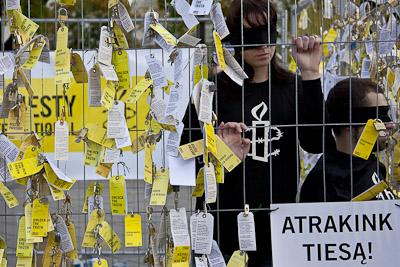
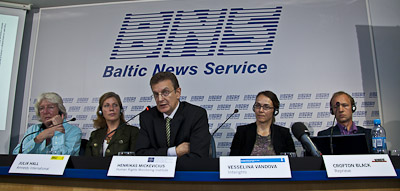
Lithuania must immediately reinstate the criminal investigation into its involvement in the US-led rendition and secret detention programmes Amnesty International demanded in a recent press conference held in Vilnius.
Unlock the Truth in Lithuania: Investigate Secret Prisons Now is a publication released by Amnesty International that documents developments since the authorities admitted that Lithuania hosted two secret CIA detention facilities between 2002 and 2006. It also provides information on Lithuanian involvement in rendition operations and suggests new critical lines of inquiry that must be pursued, including allegations that Abu Zubaydah, currently detained at Guantanamo Bay, had been held in a CIA black site in Lithuania. The organization is also calling for Lithuania to investigate links to Poland and Romania, where other secret CIA prisons are alleged to have been established. Citing the need to protect state secrets, the Lithuanian Prosecutor General closed the criminal investigation into secret CIA detention sites on Lithuanian territory in January 2011 without making any information regarding the investigation public.
“The Lithuanian authorities should not hide behind the blanket claim of ‘state secrecy’ to prevent allegations of disappearance and torture from being properly investigated. No one has been held accountable for helping the USA to construct these secret sites or for any violations that may have occurred in them,” said Julia Hall, Amnesty International’s expert on counterterrorism and human rights in Europe. “The Lithuanian authorities must reopen their investigation into these operations, including the activities of US officials, and hold accountable those responsible for complicity in all abuses that have taken place.” Lithuania was the first country in Europe to admit that it hosted two secret prisons and that officials collaborated with US intelligence agencies, following a parliamentary inquiry in December 2009. As part of the US-led programmes, from late 2001 until 2006, a number of individuals were illegally detained and transferred to secret facilities in third countries where many of them were beaten, deprived of sleep and food and otherwise ill-treated. Some so-called “high value” detainees were subjected to waterboarding (mock drowning). “Governments ignored their international obligations, state officials broke the law. As a result people suffered – suspects were snatched from the streets of towns and villages and were tortured with impunity, while their families were left clueless about their fate,” said Julia Hall. “While the Lithuanian government stands alone as having publicly acknowledged that it permitted the CIA to establish secret prisons on its territory, it remains solidly in the pack of European states that have failed miserably at investigating - and holding any state official accountable for - the human rights violations that are known to have occurred in such sites,” Julia Hall said. In face of the refusal so far by the Prosecutor General to re-open the investigation, non-governmental organizations are finding ways to seek additional information from a range of Lithuanian government agencies and other sources regarding state officials’ and agencies’ cooperation with the CIA between 2002 and 2006. Non-governmental organizations such as Amnesty International, the Vilnius-based Human Rights Monitoring Institute, and the London-based Reprieve and Interights have uncovered new data about rendition flights and related links between landings in Lithuania and other European countries. Amnesty International challenges the Lithuanian authorities to investigate, in particular:
“There is enough information in the public domain to make it imperative for the criminal investigation to be re-opened. The Lithuanian authorities hold the key to unlocking the whole truth about their country’s role in the rendition and secret detention programmes,” Julia Hall said. Lithuanian authorities all responded with the appropriate diplomatic answers, with the President and Prime Minister both stating that they welcome the reopening of inquiries, but both claimed the caveat of needing to see new concrete evidence first. The Prosecutor General’s Office was said to be surprised by the new information, but Deputy Prosecutor General Darius Raulusaitis said it was great news, and they were waiting to receive the additional information from the NGO organisations. All this despite the fact that Reprieve uncovered the information of additional flights with only a fraction of the resources available to a state organisation. One can't help but feel that authorities are trying to sit this one out, but at a time when Lithuania is trying to take the high ground on Soviet persecution, Russian monopolies and Ukraine integration into the EU it fails to administer the same level of transparency at home as it requires of others. Even Poland has recognised the claims of Abu Zubaydah and they have granted him official status as a victim in the ongoing criminal investigation. Since Lithuania ceased investigations Abu Zubaydah has taken the government of Lithuania to the EU Court of Human Rights, claiming the country is in breach of the European Convention of Human Rights. In essence, this ensures that this issue will not go away anytime soon. |
|
| Saulė – breakthrough in the transportation market | 6 October 2011 |
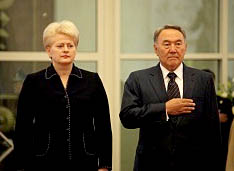
President Dalia Grybauskaitė, currently on her first official visit to Kazakhstan, agreed with Kazakh President Nursultan Nazarbayev to support at the highest level the construction of a shuttle container train - Saulė - from Klaipėda to Almaty, eventually extending the line to China, and to put her best efforts into launching the project this year.
|
|
| Case against Beliatski Submitted to Court | 5 October 2011 |
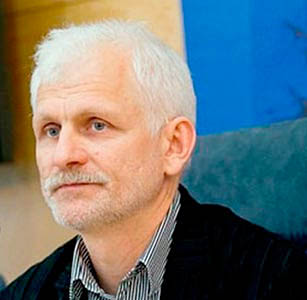
On Tuesday 4 October the criminal case against Ales Beliatski, head of the Human Rights Centre Viasna, was submitted to the court of Pershamaiski district of Minsk. According to a senior assistant prosecutor of Minsk, Sergei Balashov, the lawyer's restraint measure isn't changed - he remains in custody.
Ales Beliatski was detained in Minsk on 4 August. Lithuania and Poland had earlier provided information on his bank accounts to the Belarusian authorities. On 12 August the lawyer was formally charged under Part 2 Article 243 of the Criminal Code of Belarus (evasion of taxes and fees on a large scale). Ales Beliatski faces imprisonment of up to seven years with confiscation of property. Meanwhile, international human rights organizations, as well as the leadership of European countries and the United States demand the release of Ales Beliatski. There has also been formed an international committee on the nomination of Ales Beliatski for the Nobel Peace Prize in 2012. It comprises 29 people, including the head and founder of Moscow Helsinki Group, Lyudmila Alekseeva, Bundestag member, Marie-Louise Beck, former head of the OSCE mission in Minsk, Hans-Georg Wieck, BNR chairman Ivonka Survilla, as well as human rights activists from Norway, USA, Sweden and Amnesty International. |
|
| Record flag decorates Panevežys stadium | 24 August 2011 |
Lithuanian basketball fans were keen to give their national team a bit of an edge in the group games in Panevežys, so decided to surprise them with a 282 by 8.7 metre flag to cover the bicycle track of the Panevežys basketball stadium.
|
|


| Lithuania News Review - Henrikas Mickevičius | 17 August 2011 |
Text: Ray VysniauskasAs the first in a series of interviews with political and social commentators we talk to Henrikas Mickevičius about a number of issues concerning his work and views on current affairs in Lithuania.
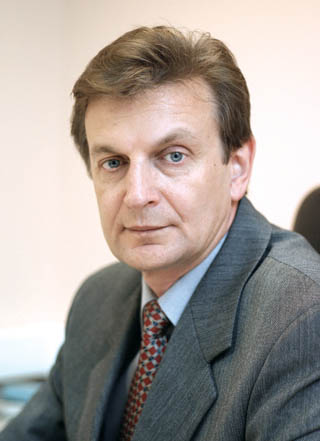
Henrikas Mickevičius (above) is the overworked Director of the under-funded Human Rights Monitoring Institute (Žmogaus teisių stebėjimo institutas) in Vilnius, Lithuania. Lithuania raised an international scandal a few weeks ago when Austria released a suspect from the 13 January 1991 TV tower murders in Vilnius. Then they go and supply Belarus with the banking details of Ales Belyatsky, a leading human rights activist in Belarus through which he was detained and faces up to seven years in jail. Is this a breakdown in Lithuanian foreign policy? These are two different issues. With Austria it is a more complicated situation. There is a strictly legal and then a political side to the episode and you need to separate them. From a legal point of view it is difficult to criticise Austria, but the one thing is that they only gave Lithuania a very short amount of time to supply additional information, some four hours. Usually it is up to 48 hours, but otherwise, in strictly legal terms, we don't have a case against Austria. In more political terms Austria as an EU member and Western country had to think about showing some solidarity. One cannot get away from the impression that what they did is to formally look at the warrant and do all they could not to fill it. More solidarity and dialogue would have been expected. With Belarus it is a shameful act by the Lithuanian authorities. It shows me that law enforcement here, as well as some officials in the executive branch of government, are apolitical. They have no idea of the political context of the law within which they are functioning. They purely see the text of the law and they don't take any regard of the political or social context that it operates in. A number of public officials are not aware that the law in Lithuania functions within a democratic system of values and that is how it should be interpreted. Many here apply it very formally and just read the words and nothing more. There is no law without a broader society and this context creates political and social conditions, and in order to apply the law properly you have to keep that in mind. This is a good example of where law is applied purely legalistically without evaluating whether the request from the Belarus government would comply with the Lithuanian idea of statehood. It is a shame and a mistake and they didn't need to supply that information. Ales Belyatsky is an outstanding human rights defender and we betrayed him and his whole cause. I don't know what we can do to wash away this shame.
President Grybauskaitė recently celebrated two years in office. Her ratings have dropped since the incredibly high approval she enjoyed when she was first elected, but she is still by far the most popular politician in the country. How do you rate her first two years? From my point of view in general they were two good years and overall we should evaluate her positively. She brought fresh air into many areas of government and was especially active in bringing new people to important key positions, especially in the law and regulatory and supervisory institutions like the competition commission. And they are, at least until now, performing pretty well. She also came up with a number of legal initiatives, especially against corruption, which are very good. President Grybauskaitė always emphasises the importance of the human dimension in national politics. Before her politics was largely seen from the perspective of national interest, but now more emphasis is placed on the people as individuals. Policies don't make sense unless they help the individual citizen, and she is the first high profile Lithuanian politician to fully understand that. Less clear is her stance on foreign policy. There has been criticism of her in that she does not show clear direction. The President tries to be friends with everyone, but with Belarus for example she has become probably too friendly. Then with the US, first we were on very good terms but now less so. But overall I would say she has had a good two years. In the future the President’s office needs to be more defined. It is still sometimes not clear where her presidential powers start and finish. Her standing on certain policies and her actions should be more defined and explained in greater detail. This is more of a personal issue with her. Sometimes she doesn’t explain her actions enough. She just says she is doing this or that but doesn’t explain why. The Government has had a tough time during an economic crisis. They have had to make unpopular decisions, but lately they seem to be stagnating. But then the opposition has done very little from their side. For me they seem to be just waiting for the economy to get better and thus avoid having to make any hard decisions. I would agree. I would criticize the opposition as much as government. The opposition is extremely weak. They occasionally criticize the government but they offer no alternatives, just stating that the current policies are too tough. They keep saying the government should promote business and make less cuts, but there is no suggestion of how. Overall I would evaluate the government positively, especially Prime Minister Kubilius. I could not imagine anyone else in this position during these tough times. He's open to ideas and innovation and attracted a good team of progressive and dynamic people, and I would say that the fact we came out of this crisis the way we did is essentially thanks to the Prime Minister. More critically I think some cuts went too far. I don't think it would change much if pensions were not cut as much and in the process we created more poverty. We had to look to cut more from those with high incomes because the gap between the wealthy and poor increased in this time and so he didn't look for savings in the right places. The poor suffered the most. Things are slowly improving but the government is totally fixed on finances, there is no human dimension on the government agenda. The PM and cabinet are focused totally on the economy. The thinking is that if we come out of the recession well and improve the economy we will all be better off and the social problems will solve themselves. This in not true. We need to show solidarity to the less fortunate and protect human rights because it is important for individuals to feel respected and safe and to have equal opportunity. This creates a context where people really contribute to society, much more than when they are not empowered, safe or not equal. Lack of rights also leads to increased migration. There was a survey conducted by Vytautas Magnus University. They surveyed Lithuanian immigrants in Norway, Spain, Ireland and the UK. Most said they stayed away because they feel more respected, free and safe than in Lithuania. These are basic human rights. It is not better economic conditions that keep them away but the government and society’s attitude to the individual. The PM is getting better in this respect and turning more towards broader social issues lately, but there is still a long way to go. You said that human rights have generally been declining since Lithuania joined the EU and a lot of the focus was lifted off us. Do we see any light at the end of the tunnel or has the economic downturn allowed economic concerns to overshadow personal rights? The situation will probably deteriorate more, but not in economic terms. Economists say the worst is over, but in more broader terms it is a worry that there has been a long-term lack of attention to the basics of Lithuanian statehood: democracy, the rule of law and protection of human rights. Now we are seeing the consequences. Now the standard of human rights is still declining and more recently you can see rising extremism in Lithuania in the form of exaggerated ethnic patriotism which if not checked could lead to fascism, that is where it usually starts. Lately we see objection on the grounds of race, religion, colour or sexual orientation. There is growing criticism of the EU, which is also partly justified because EU structures are very bureaucratic and slow. Political correctness dominates the culture of the bloc. But there is no alternative for Lithuania. We should concentrate on improving the mechanism of the EU and not rejecting the idea of a united Europe. Two odd bits of news about the army. First saying it has been infiltrated by skinheads and Nazis and then by gays. I would guess that our army is the same as any other in the world and has a cross-section of the community in general. Are there any specific problems with our armed forces in particular? It is obvious lately that some of the professional soldiers and volunteers represent a way of thinking that conflicts with the basic premise of modern Lithuanian statehood - democracy, human rights, pluralism and tolerance of otherness. The fact that a person is in the uniform of the Lithuanian military and entrusted with a weapon and had a swastika on his arm is a worry. Even if it is just a single person it shows that a person like that has a different idea of the Lithuanian state and how it should look. This is not respecting tolerance, pluralism and human rights. How can such a soldier defend a state he disagrees with? That is the most basic question. The swastika is a statement that I'm a Nazi and serving the Lithuanian state. And how do we know that such a person won't one day turn his weapon against a person who in his mind represents the wrong version of Lithuanian statehood? And some soldiers took part in the 11 March demonstration and some other public events which show they disagree with the fundamentals of current Lithuanian statehood and it raises questions of whether something is wrong with the so-called patriotic education in the military. They see themselves as super-patriots and within the army this is only understood in narrow, ethnic but not civic, terms. It is a dangerous situation. It was a first time this year that the PM took a stand against extremism and came out with a strong statement after the 11 March demonstration which had Nazi undertones. Lithuania has recently been shown to have the highest rates of telephone bugging by the government on its people. Is this something we should be concerned with? This was misunderstood by the media. This was not bugging as such, but requesting information about connections and not content; the fact that calls were made and not what they said. But indeed the numbers are unexpectedly high. We have been speaking for many years about the protection of privacy and it is not news to us. This control over electronic communications like phone and internet is pretty widespread and law enforcement relies on data from this as evidence which is not correct. The European Court of Human Rights says that you cannot rely on such evidence because they are not very reliable. This data can be forged and there are plenty of facts showing that they can be manipulated. The law enforcement agencies and courts should turn back and work more traditionally instead of just relying on who called or wrote to whom. This way you can end up punishing people for crimes they did not commit. There is one clear example when someone created an email address with the name of a prominent public prosecutor, sent emails to various people and tried to compromise him. This is a clear example of how unreliable it is to make certain conclusions on electronic communication. During the Paksas scandal we invited an IT expert to send an sms message from one person to another in the same room. He intercepted that sms, changed it and then sent it on. It is easy for experts to manipulate this information. This is one more example of where law enforcement has to rethink its way of collecting evidence in criminal cases. As most of the world shies away from Nuclear Power Lithuania signs a new deal to build a new one. Turns out this might be a bonus as Lithuania's plant is due to come online in 2022 and Germany plans to scrap all their reactors by 2020. This is far from my area of expertise, but there are a few broader issues. We are living without a power station now and we must ask ourselves if we really need this new nuclear station. It raises the question of whether it's a political rather than a economic project to emphasise our independence. Perhaps it would be better to seek alternative sources, perhaps wind, solar or hydro, and still buy from Russia using a combination of energy resources. Some experts say that having nuclear plant would not make us independent anyway as we would still be dependent on Russian nuclear fuels. |
|

| Zuokas crushes bicycle path bandits | 2 August 2011 |
Arturas Zuokas, Mayor of Vilnius, has never been camera-shy, and his latest exploits include his love of alternative transport as well.
|
|

| Basketball moves to centre stage | 21 July 2011 |
After the euphoria of the Lithuanian Under 19 team winning the FIBA World Championships in Latvia, sanity and reality has returned to basketball circles in Lithuania.
First our newest world champions were given massive civic receptions in Vilnius and Kaunas, paraded before the Seimas and had a meet and greet with the President. The team was awarded LTL150,000 from the government and a sword from the folks of Kaunas before returning to their normal lives. Dovydas Redikas made his way to Spain where the Lithuanian Under 20 team was competing in the European Championships, but unfortunately the momentum and success didn't make the trip down to the Iberian peninsula. Lithuania won their first game, but then lost four in a row and were relegated to the playoffs for 13 - 16 position. The other problem of playing for the minor placings is that the last two teams are relegated to B Division, and if Lithuania do not make the main draw, it would mean our victorious Under 19s will not be eligible to compete in the Under 20 European Championship main draw next year. But back to Eurobasket 2011 The new Kaunas stadium is yet to open or host a game, but after even more inspections by FIBA it has been announced that the grand opening will be on 18 August with a game against Spain, while a smaller crowd will witness a Kaunas Council team take on the builders on Friday 22 July. The other stadium under some doubt was Klaipėda, but the latest is that after inspection all parties are satisfied with the progress and confident that it will be finished in plenty of time. Otherwise all arrangements for Eurobasket2011 seem to be going ahead and everything is expected to be completed on schedule. National Team The Lithuanian National Basketball Team began training this week. The team met in Druskininkai, but without Jasikevičius, who finally decided to play, but on the condition he could join the team a week later as he had some private matters to attend to. Jasikevičius will join the team in Palanga for the second camp and is working out by himself in Greece until then. This was agreed to by the Kemzūra and the coaching staff, though Garastas said on TV that this would never happen in his day.
In all 20 players will be at the training camps, all hoping to make it to the final roster of 12. It was supposed to be 14, but FIBA recently announced that having two extra players in the squad would be a breach of international rules and 12 it is. This of course makes the final decision for Kęstutis Kemzūra all that much harder, but here is what he'll have to grapple with: The players hoping to defend Lithuania's basketball honour this year are: Mantas Kalnietis, Šarūnas Jasikevičius, Tomas Delininkaitis, Martynas Pocius, Rimantas Kaukėnas, Martynas Gecevičius, Renaldas Seibutis, Deividas Gailius, Simas Jasaitis, Artūras Jomantas, Mindaugas Kuzminskas, Mindaugas Lukauskis, Paulius Jankūnas, Darius Songaila, Donatas Motiejūnas, Kšištofas Lavrinovičius, Darjušas Lavrinovičius, Robertas Javtokas, Marijonas Petravičius and Jonas Valančiūnas. Frankly I'm not sure if Jasikevičius will make the cut. While in the World Championships last year our weakness was seen in the point guard and centre positions, this year we have an embarrassment of riches in both categories. With Kaukėnas and Jasikevičius returning for duty, I expect Kaukėnas to get the nod as he has had a more consistent season. Seibutis will probably also be cut as I expect Kalnietis to be rewarded for his efforts of last year and playing as the back-up point guard is the perfect role for him. Gecevičius is the third option at point at a pinch, but only when taken off shooting guard duties where his real value is. Martynas Pocius doesn't have Gecevičius three point shot, but adds drive and energy off the bench and should also be rewarded for last year's efforts as well. I don't expect Jomantas as a defensive specialist to make the cut. Small forward is full of choices. Tomas Delininkaitis, Simas Jasaitis, Mindaugas Kuzminskas and Mindaugas Lukauskis are almost interchangeable, all with fine shooting and rebounding skills, and even capable of doing duty at point. Delininkaitis usually fights for a position against Lukauskis, while I think Kuzminskas was brought into the team for a bit of experience and his years in national colours are still ahead of him. At power forward we have the return of Darius Songaila. After a year on the bench in the NBA he should be fresh, but camp will test out his match fitness. Paulius Jankūnas is a certainty to be picked and then there are Kšištofas and Darjušas Lavrinovičius. It's always a shame to split a set, but I only expect to see one brolis playing this year. Taking us to the centre is one of our most intriguing problems. Robertas Javtokas is a must after his heroic efforts last year when he kept the centre secure while playing on one leg. Although becoming a defensive player, it is a luxury we can afford with the firepower that will be surrounding him. Marijonas Petravičius has performed well in national colours but injuries have kept his form in check over the last few years, and this could count against him. Which brings us the juiciest choice of all: Jonas Valančiūnas or Donatas Motiejūnas. Both were taken in the NBA draft this year and had to prove themselves before the prying eyes of NBA's best talent scouts. Valančiūnas was taken fifth overall on potential, while Motiejūnas went 20 for a more mature and ready game. Motiejūnas can probably drop down to power forward which could improve his chances, but I expect Valančiūnas to get the nod if we have to choose between them. He has considerable national sentiment behind him as well, which I think will be important throughout the European Championships. But anything can happen, and one of the reasons for this team's solidarity is that Kemzūra uses an honest and straightforward approach, and if players perform in camp, then they will be considered on their merits. So with only 40 days to tip off the last pieces of the puzzle are falling into place and the long awaited European Championships on home soil is the talk of the town and country throughout Lithuania. If you want to get a peak at the team before Eurobasket2011, or just couldn't get a ticket for Panevežys, then you can see our boys going through their paces in their practice matches. In Lithuania they will play: 4 August, Klaipeda: Lithuania - Slovenia; 6 August, Klaipeda: Lithuania - Czech Rep; 18 August, Kaunas: Lithuania - Spain; 19 August, Panevezys: Lithuania - Russia; 20 August, Panevezys: Lithuania - Latvia; and 27 August, Vilnius: Lithuania - Georgia. Tickets are available for all games, and note especially the chance to see the opening of the Kaunas Stadium in the game against Spain on 18 August. Lithuania will also have three practice matches outside our borders: 10 August, Moscow: Russia - Lithuania; 13 August, Madrid: Spain - Lithuania; and 24 August, Liubliana: Slovenia - Lithuania. Like all of Lithuania we are just waiting for the boys to bring it on! |
|


| Lithuanian – Austrian relations at all time low | 18 July 2011 |
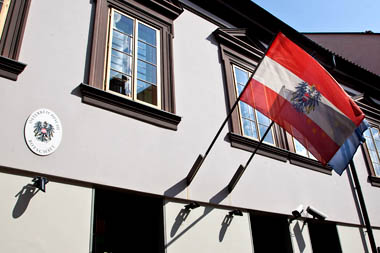
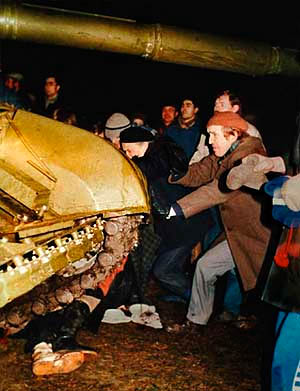
• Austrian Embassy in VilniusLithuanian – Austrian relations have hit an all time low after Austrian authorities released Mikhail Golovatov from their custody, despite a current European Arrest Warrant. Mikhail Golovatov was wanted in Lithuania for his part in the murders of 13 January 1991 when Soviet troops killed 15 people, including one of their own soldiers, and wounded about 1000 others as they stormed the TV tower in Vilnius.
• 13 January 1991Austria refused to extradite former leader of the ALFA paratroop regiment citing an unsatisfactory response from Lithuania about the allegations, and a vaguely worded warrant. Lithuania in return question the hast of the Austrian actions and reminded them that a European Arrest Warrant is valid and enforceable throughout the EU and brings into question Austria’s commitment to the European family of nations. While some parliamentarians called for the immediate cessation of diplomatic ties with Austria, a parliamentary committee adopted the less drastic measures of recalling their ambassador to Austria, sending a formal note asking for explanation from the government, and as an aside Lithuanian Vice-Minister of Foreign Affairs Asta Skaisgirytė Liauškienė also handed the Austrian Chargé d’Affaires in Vilnius Josef Sigmund a book which documents the events, testimonies and eye-witness reports from 13 January 1991. President Dalia Grybauskaitė was quick in condemning Austria’s actions: "Austria's haste in releasing the suspect in the January 13 case cannot be politically justified and compromises cooperation between the European states in law enforcement," she said. She instructed the Lithuanian Foreign Minister and Minister of Justice, currently attending EU ministerial councils in Brussels, to inform the General Affairs Council and the Justice Council about Austria's unprecedented move. The President also instructed the Ministry of Foreign Affairs to present the note to the Ambassador of Austria and to summon the Lithuanian ambassador in Vienna home for consultations. The official note expresses disappointment over Austria’s action. The note also emphasized that the European Arrest Warrant is issued by judicial authorities of the European Union and obliges another EU member state to arrest and extradite the suspect to the issuing state. “Lithuania assesses Austria’s actions with regard to the European Arrest Warrant that has been issued for Mikhail Golovatov as a particularly brutal violation of EU law. We are concerned that Austria’s practice of violating EU law and principles of cooperation between the EU member states can have a negative impact on international communication in criminal cases between the EU member states in the future,” the document reads. As of 18 July, Lithuania withdraws its Ambassador to Austria Giedrius Puodžiūnas for consultations in Vilnius. In the short run, Lithuania will be raising this issue in various possible frameworks at the EU institutions. “Lithuanian officials, the people of Lithuania and relatives of the victims of the January 13 events hope that Austria, just as other EU partners, is addressing sensitive and important issues precisely in accordance with international law. We are waiting for a convincing explanation from Austria on what grounds the decision was taken and why it was taken so hastily,” Audronius Ažubalis, Lithuanian Minister of Foreign Affairs commented on the decision to hand in the note. On 15 July, Lithuanian officials were informed that on 14 July in Austria, the Russian citizen Mikhail Golovatov was arrested on the European Arrest Warrant of 18 October 2010. Overnight of July 15-16 Lithuania received confirmation from Vienna that the suspect was released. Austria’s motives for the decision are not yet known to Lithuania. Many suspect that the quick release was due to pressure from Moscow and seems to indicate that Austria is more responsive to pressure from Russia than to their obligations as a member of the European Union. Emanuelis Zingeris, the Chairperson of the Parliamentary Committee on Foreign Affairs was not as forgiving in his assessment of the situation. “Having enough of our own information, we propose discussing the perspective of diplomatic relations with Austria, first of all, by reducing the level of diplomatic relations by recalling the Lithuanian ambassador for consultations, and later mulling the possibility of freezing diplomatic relations by recalling the Lithuanian ambassador, and even breaking off those diplomatic relations if all arguments are like those currently presented by the media,” Zingeris said at a press conference in Parliament on 18 July. “We hope this spit in the face of Europe, not only Lithuania, to the whole Europe, will be evaluated by member states of the European Union and NATO partners,” he added. Zingeris admitted that his own reaction was moderated by the consensus of the committee, but noted that further, and more drastic action would be an option in the future as further facts emerge. Mikhail Golovatov, a Russian business person now retired from the army faces a maximum of life imprisonment in Lithuania and is believed to have made a hasty return to Russian territory on his release in Austria. |
|
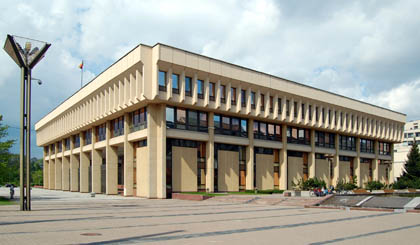
| Valančiūnas rapt to be a Raptor | 25 June 2011 |
As a basketball nation sat wide awake on the edge of their chairs in the small hours of Friday morning, their dreams came true when Jonas Valančiūnas was chosen fifth in the NBA draft and turned towards Toronto.
First of all it was a bit of a surprise that Cleveland didn’t take the talented big man with a lot of potential at pick four - as was widely expected. Seems the concern over the buyout of Valančiūnas’ existing contract and his tender 19 years of age probably swayed Cleveland towards the more game-ready Tristan Thompson who also has a massive wingspan and great athleticism. If Jonas had been chosen by Cleveland he would have been pulled into the team immediately and expected to play significant minutes straight away. A tough start to a long career is the worst possible tonic, as evidenced with Martynas Andriuškevičius, and with big men playing well into their mid-thirties there is no reason to hurry at this stage. Still, tell that to a young buck eager to prove himself. Jonas announced that he was delighted to be heading to Toronto. And of course the Kleiza connection will really give Lithuanian basketball a boost. But in reality Jonas probably isn’t half as happy about the move to Toronto as the Lithuanian basketball public. During the previous season Siemens has been a regular haunt for NBA talent scouts, and the most prominent among them has been Maurizio Gherardini, the Raptors Vice President and Assistant GM who must have his own key to the place. The good news is that Toronto are a Euro-centric franchise, despite claiming they are not, and as such are keen supporters of their players representing their country in international competition meaning there will be no club hindrance to Jonas donning the red, green and yellow. (We remember that Ilgauskas sometimes quoted club concerns as his reason for not playing for Lithuania, though this was not the whole story, and after all Lebron made national duty.) Toronto are also a forward-thinking club and are relaxed with the reality that Jonas needs another year in Europe, at least, to mature both physically and as a player before making his mark in the NBA. Having dealt with a number of European clubs and having good relations with Rytas, they also weren’t scared off by the contract buy-out issues. The extra year in Europe will be of great benefit to Jonas. First to give his body a chance to mature, give him more time in the weight room and give him a taste of NBA pressure as every time he steps onto the court I’m sure his opponents won’t let him forget his pin-up boy status. And with the strong possibility of an NBA lock-out next season, it means Jonas won’t be wasting a year of valuable experience running the same drills over and over again on the practice courts and instead improving his craft on the hardwood floors of Europe. But for me the most impressive thing about Jonas Valančiūnas is the man himself, and I say man rather than boy. After winning the LKL title last year we joked that he needed to learn how to swear in English properly to be better prepared for increased international competition. But the best thing is that he didn’t need the lessons. Not because he learnt to swear elsewhere, but because he chose to put his faith in hard work and commitment instead. Sure he had a good year, but not a great year. Frankly you’d expect more from a number five draft pick. But Jonas’ enduring feature this year was his commitment and desire. He had good games, and he had bad games too. He was benched when he wanted to be playing and he was found wanting a number of times. Instead of swearing he listened, and instead of blaming others he worked harder in practice and he always kept trying. There is always a buzz around the stadium when an NBA scout is in the house, but this year it happened so often that even the press didn’t even care much where the latest NBA scout was from. And Jonas didn’t play his best games when the scouts were watching, but they all saw the same thing that we’ve known for ages: Here is a talented young kid who is intent on making the most of his God-given gifts and has done so remaining a genuine and good natured person – probably his greatest achievement of all. Let’s all hope the basketball gods are good to Jonas Valančiūnas and one day UNESCO might also name him a significant Lithuanian treasure. |
|

| Seimas Passes Law on Compensation to Jewish Religious Communities | 21 June 2011 |
Acknowledging the significant contribution of the Lithuanian Jewish community to Lithuanian culture and social progress before the Second World War, occupation of Lithuania, and the Holocaust that marked the start of indiscriminate destruction of the Jewish nation, in an effort to restore historical justice and voluntarily compensate for the property of Jewish religious communities in Lithuania illegally seized during the occupations by the totalitarian regimes, the Seimas decided to adopt the Law on Good Will Compensation for the Property of Jewish Religious Communities (draft No. XIP-968 (4)). The Law was passed by 82 votes in favour, 7 against, and 16 abstentions.
The Law establishes the size, terms of payment, procedures, and purpose of the compensation for the property of Lithuanian Jewish religious communities. The decision was made to compensate for Jewish religious communal property illegally seized during the occupation of Lithuania by the totalitarian regimes. The size of compensation amounts to LTL 128 million and will be paid from the state budget to the compensation fund designated by the Government. As noted in the explanatory memorandum, the compensation size was set in view of the financial situation of the state, the search results from the Lithuanian Archives Department for documents evidencing the ownership of the currently existing property of Jewish communities, and the property valuation data from the Centre of Registers. Compensation will be paid starting from 1 January 2013 and completed on 1 March 2023. The payment will be executed in annual instalments depending on the financial resources of the state. The size of compensation instalments to be paid will be determined by the Seimas through the approval of each year’s state budget. Given the old age of the Jews who resided in Lithuania during the years of the Second World War and suffered from the occupational totalitarian regimes during this period, the law foresees the payment of a part of the compensation (i.e., LTL 3 million) in 2012. The law also allows for compensating for the Jewish religious communal property through the transfer of ownership of the state property, i.e. buildings or parts thereof, to the fund designated by the Government. Where state property will be transferred to the fund designated by the decision of the Government, the size of the monetary compensation will be reduced by an amount that equals the value of the transferred property calculated on the basis of the mass valuation data of the Centre of Registers. Legal safeguards were established in order to ensure targeted use of the monetary compensation under the current Law and its contribution to the Jewish religious community-building activities in Lithuania. The Law provides that compensation will be used only for religious, cultural, healthcare, sports, education, and research purposes of the Lithuanian Jews in Lithuania and support for the Jews who lived in Lithuania during the Second World War and suffered from the occupational totalitarian regimes during this period. The transferred property will also be used exclusively for religious, cultural, educational, and scientific purposes of the Jews of Lithuania. Under previous laws, only ownership of houses of worship, i.e. synagogues with a clear successor have been restored to the Jewish religious communities. Restitution of other Jewish communal property cannot be performed under the Law on the Procedure for the Restoration of the Rights of Religious Associations to the Existing Real Property, as, owing to historical circumstances, there are no remaining successors to this ownership: the Jewish communities that existed in a number of Lithuanian towns before the Holocaust and were actively engaged in Lithuanian economy and business were virtually destroyed and new ones were not established. |
|
| Nuclear News | 17 June 2011 |
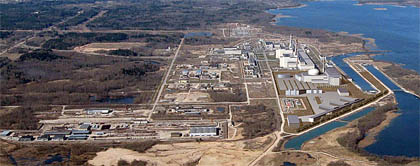
Hiroaki Nakanishi, President of Hitachi, met with Lithuanian Prime Minister Andrius Kubilius yesterday to discuss the future of Lithuania's Visaginas nuclear plant.
|
|
| Lithuanian tobacco consumption down in 2010 | 15 June 2011 |
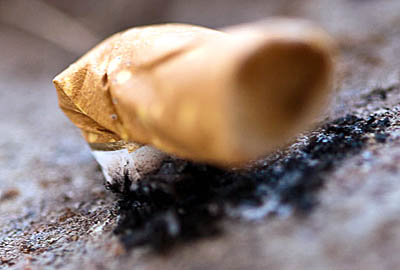
The good news is that there was less tobacco sold in Lithuania in 2010, according to Statistics Lithuania. Initial figures show that Lithuanians spent LT891.6 million on tobacco products, which is 12.5% less than in the previous year.
Last year, on average, every Lithuanian bought 37 packets of cigarettes, or for every Lithuanian 15 and over it was 43 packets of cigarettes per person. This is three to four packets fewer than in 2009. In 2010 production of tobacco products in Lithuania was down 3% and the importation of tobacco goods down 40%. The price of tobacco products rose 26.5% in 2010 compared to 2009. The largest rise of 32.% was for filtered cigarettes. The Health Information Centre announced that 1,800 people were admitted to hospital with smoking-related illnesses. In 2010 a total of 1577 people died of smoking related illnesses, which was 61 fewer than in the previous year. The majority of people dying from smoking related illnesses are men - 85%. |
|
| Lithuanian alcohol consumption in 2010 | 15 June 2011 |
Statistics Lithuania announced that, according to preliminary data, the 2010 per capita consumption of alcohol was 11.3 litres of pure (100%) alcohol per person, or 13.3 litres for every person over the age of 15. These figures are, respectively, 0.4 and .05% higher than in 2009.
In 2010 the equivalent of 9 million litres of pure alcohol were produced in Lithuania. Compared with 2009 production was down 14%, however these figures reflect the greater consumption of lower alcohol products rather than reduced consumption per se. There were 7 million litres of wine and vermouth produced in 2010 which is 34% more than in 2009. The production of fruit, berry and sparkling wines, cider and other fermented beverages came to 42 million litres or 16% higher than the previous year. Beer was the most produced alcoholic beverage by volume at 292 million litres and up 6%. Imports of alcoholic drinks were up significantly, the import of beer up 74% and wine up 52%. For overall sales in 2010 there was a total of 31 million litres of spirits sold, down 7% on 2009. A total of 64 million litres of wine and fermented beverages were sold in 2010 - up 3%. As usual beer sales were highest by volume with 293 million litres going over the counters, 27 million litres or 10% more than in 2009. The retail prices of alcoholic beverages in 2010 only increased 1.1% compared to 2009, but it was not an even rise. Whiskey went up 4.1%, meads or trauktines up 3.7%, vodka up 1.8%, liqueurs up 1% while beer was down by 1.8%. As far as alcohol-related medical issues go, the State Mental Health Centre announced that 798 people applied to medical institutions for alcoholic psychosis for the first time and 1,100 for chronic alcoholism. These numbers are down 37 and 152 respectively. In total there are 55,300 people in Lithuania being treated for chronic alcoholism, somewhat less than in 2009. The Hygiene Institute for Health Information Centre released figures showing that last year 962 people died of alcohol related health problems, 57 less than in 2009. The most common cause of death was alcoholic liver disease (46%), accidental poisoning by alcohol (32%) and alcoholic cardiomyopathy (13.5%). Compared with 2009, the number of deaths due to accidental alcohol poisoning fell 10%. In 2010 the male mortality rate due to alcohol consumption was nearly four times higher than for women. The State Labour Inspectorate indicated that in 2010 there were 38 alcohol related workplace accidents involving intoxicated persons, seven of whom died. There were 11 deaths in 2009. Another 9 intoxicated people were injured traveling to or from work (6 in 2009). The Police Department under the Ministry of Internal Affairs announced that 528 road accidents were the result of intoxicated people, or every seventh road accident. This is a rise of 23% where a total of 63 people were killed and 699 injured. The number of accidents caused by drunk drivers decreased 9%.
|
|
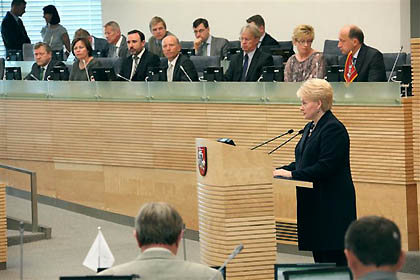
| State of the Nation Address by President Dalia Grybauskaitė | 7 June 2011 |
Dear Fellow People of Lithuania, Distinguished Participants of the Parliamentary Sitting,
• Photo courtesy Presidential Press Ofiice.I view the annual address, which is a moment of special importance to me, not only as a constitutional duty, but first and foremost as an opportunity for all us to take a moment, to pause in our daily routine of problems, conflicts and scandals, and to speak about the issues that can shape the environment for our today and our children's tomorrow. I have come to the conclusion that if deficiencies are pointed out and rectifications presented, members of the Seimas do not ignore them. It means that cooperation is possible and that it was fruitful, although not always easy and time efficient. Ladies and Gentlemen, I do not intend to only evaluate the situation, to regret the poor progress made or to condemn anonymous culprits. Whatever other areas, but with respect to legislation we cannot afford to wait for another year only to speak about it once again. Therefore, I will be consistent and determined in attaining the results we need - a new approach and a new quality of laws. If a law presented to me for signature is adverse to the interests of society, I will veto it. I will offer constructive solutions which would make our life better and brighter, and would not push people into poverty and despair or force them to go to foreign countries in search of hope. Each time I am presented with a piece of legislation which is custom-made for a particular interest group, which smells of corruption or of plain stupidity, I will personally request to investigate its origins. I will personally enquire in which chain of the legislation process the doubtful provisions were introduced. They say that people need to know their heroes. But they also need to know the wrongdoers, the know-nothings and especially the hypocrites. So we can clean up the civil service. So we can expel those who have come not to serve, but to trade in laws, permits, decisions, and the worst of all, in the trust and confidence that people have in their state. Yes, I am speaking about corruption once again. I spoke about it a year ago - about this dreadful, deep rooted and hardest to treat disability of ours. Let me remind you in a few words: I spoke about its scope and related impunity problems; I informed you that more than 700 pre-trial investigations into corruption were initiated. However, no one was convicted for bribes. The first figure stands the same: more than 700 pre-trial investigations into corruption have been started. This time, however, 18 persons were convicted of corruption: 6 for bribe-taking and 12 for bribery. Is this a victory? Of course, not. First, those who are now in prison are not the only and the last offenders engaged in such activity. I respect the presumption of innocence, but I will nevertheless venture to say that there are more bribe-takers outside the bars than behind them: This is also confirmed by special service investigations and people who have the relevant experience in this area. Second, our objective is to prevent wrongdoing, not to send to prison as many people as possible. I believe that over the year we have made substantial progress in this direction. I would like to thank the Seimas for responding to my last year's appeal, for supporting my efforts to start a consistent and systematic fight, for approving in principle all of my proposals aimed at creating an environment where it would be not only wrong, but also unprofitable to steal and cheat. The prolonged limitation periods that I proposed and the Seimas adopted will help plug the loopholes to escape deserved punishment. In addition, they offset the delaying legal tactics. I proposed to impose much heavier fines for economic offences, and amendments to this effect have already been passed. We convinced the Seimas to approve my proposed amendments to the Penal Code introducing responsibility for unlawful enrichment and the possibility of extended confiscation of such assets. These amendments have invalidated the shallow and myopic popular doctrine "Not a thief until caught red-handed". The inability to catch the thief does not make the thief righteous. We therefore granted the state the right to investigate into the origin of unexplainable wealth. The state now has the right to confiscate all of the unlawfully acquired assets, including those fraudulently held by other family members or accomplices. These decisions will not only revaluate the profitability-and-risk ratio of criminal business. They will also offer - and have already offered - new and effective law enforcement instruments. We will soon be able to demand factual results. We have thus sent a clear signal to those who even now are mocking society and the state, sometimes surreptitiously and sometimes quite openly and directly. We warned them: We are not only talking, we are acting this time! We will use all the powers of the state to protect national property and national dignity. And we will place special focus on the ability and efficiency of those who fight crime and corruption: on their competence, professional qualities and, first and foremost, their integrity. I have proposed to amend the Law on Civil Service, the Law on Prevention of Corruption and the Law on Operational Activities. We have made the safety net more stringent so that persons of poor competence and especially of doubtful reputation could not be recruited to those ministerial, municipal, law enforcement or state enterprise positions where proposals are developed and where decision are made. I am convinced that the law enforcement and special services also need a wind of change. I would like therefore to thank the Seimas for supporting my initiative to introduce terms in office for those institutional positions. I believe that it will shake up the system and encourage the professional aspirations of talented and qualified specialists. I am certain that it will help us overcome what until now has seemed impossible to be overcome: the dangerous syndrome of longtime posts which is only a step away from almightiness, impunity and clan-based justice. There is still work to do to make the civil service and the budget-funded sector more transparent, responsible and professional. At this point, I would like to go back once again to my last year's annual address: to that part where I spoke about the courts of law, about the stagnation, professional degradation and arrogance running in the system. About the immediate need to simplify judicial proceedings and to have society represented more widely in courts of law. I also spoke about the need to open the system to new faces, new approaches and new efforts. I know that in the context of recent public scandals this will possibly sound unexpected, but as I look back at the events and the work of this past year I can say: The ice has broken! The amended Law on Courts created preconditions for engaging society in the process of controlling the administrative activities of courts and judges. We now need to start applying this legal provision in real terms. So that public organizations make active use of controlling rights granted to them. Where necessary, I am ready to support their efforts to join the process of improving the performance of the judicial system. Some time ago, at my own initiative, I signed a decree approving a new judge selection procedure. I know that it has already accelerated the selection process, brought new people of good repute to the judicial team and reduced the workload of judges. Last week I also signed amendments to the Law on Courts similarly aimed at making the judicial system more flexible and at speeding up the judge transfer and selection procedures. It will allow to build a more rational network of judges and to distribute their workload more evenly. The general public will have the right not only to request more rapid but also better quality judicial procedures. The recent wave of judge behavior scandals is shameful. However, it should not drive us to despair. These are old blisters that have been long shielded from public view by the judicial clan. Now they have come out into the open. It means that we are cleaning up. It adds weight to our arguments, not those propagating a closed-door system. Bribes, power abuse and corruption are transactions that involve at least two parties. They can exist only as long as we - the society - tolerate them. The situation is going to change when social discontent reaches a critical point. I am determined and I will do my best to make it happen as quickly as possible. I pledge to consistently support and encourage all civic initiatives targeted at this purpose. The turning point "either - or" is here and now, not tomorrow. Ladies and Gentlemen, We live in a period of time when almost every life zone of the state and society is marked by critical points. It applies to the economy too. It has been some time that we heaved a sigh of relief that we managed to evade financial collapse. We curbed the crisis. We did it even better that some of the European old timers, members of the euro zone. That is good news. Economic growth has considerably exceeded the projected level, reaching an index of almost seven percent - an impressive accomplishment. I strongly hope that everybody in Lithuania will be able to feel it soon. But what is most important is not the record rates of growth, but its sources. It is now that solidarity acquires a special meaning. So let us not forget those who are in the most difficult circumstances. Let us give our attention to the price of foods that are especially important in a modest consumer basket. Let us find out why they are increasing. It is here that competition regulators have to come in and do their work. Let us have an honest discussion about the minimum wage. We have to be prudent, but not stubborn. We have to fulfill our promise to restore pensions to their previous level. The social system is waiting for real reforms, not paper concepts or guidelines. Let's support business, especially if it invests in the future, creates jobs and in this way helps the state to translate human expectations and economic development opportunities into reality. I know that we cannot afford to provide either financial support or substantial tax reliefs. But let us do what we can. Let's remember our plans and intentions: to eliminate senseless restrictions and bureaucratic constraints, to encourage and promote business. Regrettably, it has been a long time that we have heard about the work performed or at least the proposals initiated by the "bureaucracy sunset" and "business sunrise" architects. The economy is gaining momentum and it needs real support now, not in 2020 or 2030. I therefore urge all ministries, services and agencies to streamline their work, future plans, guidelines, and strategies towards this objective. Let us finally fix the heating sector and start building a liquefied natural gas terminal. We have no time for idle talk. Things cannot be delayed anymore! The public procurement process must finally become transparent, and this cannot be delayed either. The people and the state must know what is bought for their money, and why it is bought. I have therefore proposed legal amendments to implement an institutional reform of the Public Procurement Service, ensuring its actual independence and efficiency, and to put an arrangement for adequate publicity in place, which would not allow purchasing organizations to withhold information about the ongoing procurements. It will reduce the possibilities of abuse and set the conditions to initiate administrative proceedings against any persons who have violated public procurement rules and to impose adequate legal sanctions. I hope to have the support of the Seimas in this matter. As the economy recovers, optimism and faith should also emerge in other spheres: in culture, education and the non-governmental sector. I said when I submitted the Guidelines on Changes in Lithuanian Cultural Policy to the Seimas, and I would like to repeat it once again: the state has yet a lot to do to improve the cultural environment, to create conditions for the people to better understand culture as a unifying phenomenon and to become its creators. Everybody must have the possibility to read books, visit museums, theaters, concerts, and watch movies. Culture is not an item of luxury; culture is the guarantor of our unity which is vital for our democracy, togetherness and for Lithuania. I place a strong emphasis on the human element in education. The education system must not only offer knowledge, but it must also be sensitive to the needs and abilities of every individual. It must instill a feeling of self-confidence, togetherness and pride in the homeland. Each and every Lithuanian citizen must feel appreciated and capable of realizing own potential. We will be able to attain the goals we have set only when economic wellbeing, social justice and respect for the human person become an integral and essential part of the strategic objectives and tactical decisions of every government. This year we mark the twentieth anniversary of the reestablishment of diplomatic relations with many countries. For me, these are very significant anniversaries because I had the privilege of contributing personally to building the Lithuanian diplomatic service and to Lithuania's first diplomatic steps. I therefore appeal to politicians: I invite you to fight not for power, but for the state - and for the people who are building it through every-day work. So let us restore trust and confidence. Let us build a strong civil society that is resistant to corruption and intolerant to lies. A civil society that has real values and a strong spirit to protect them. |
|
| US President supports Lithuania’s position concerning anti-missile defense | 28 May 2011 |
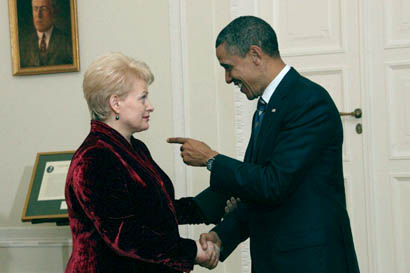
President Dalia Grybauskaitė attended the meeting of Central European heads of state with US President Barack Obama on Friday 27 May.
• Presidents Grybauskaitė and Obama meet in Warsaw.
|
|
| Zuokas heart scare | 25 May 2011 |
Artūras Zuokas was admitted to hospital on Tuesday evening variously reported as being for poisoning or heart attack. On being released from hospital Wednesday morning Zuokas announced through his facebook page: "Everything is OK, I have already been released from hospital and will be back at work later today. Thanks for your support, and thanks to the doctors for their fine work. "Everything is OK. The heart - good (according to doctors), everything else also fine. Somehow contracted food poisoning which caused a severe internal reaction," said the mayor of Vilnius. Zuokas is well known as the recently re-elected mayor of Vilnius who is often seen riding around town on his Segway. Zuokas recently took control of Vilnius municipality after forging a coalition of parties and garnering the vote of the Labor Party in securing his role as Mayor. Despite a bribery conviction back in 2008 Zuokas was able to lead his "Yes" party to power on his ability to get things done, which over-rode the negative connotations of the bribery conviction and suspicion in many other corruption cases. Artūras Zuokas was the youngest ever Mayor of Vilnius at age 32 back in 2000. He was later elected to Parliament as leader of the Liberal and Center Union Party and joined the ruling coalition headed by Andrius Kubilius. He withdrew his candidacy for the post of Health Minister after concerns of his bribery conviction arose. In June 2010 he left the Liberal and Center Union Party to form his new Yes Party, which was intended for people who are creators and are optimistic about Lithuania. Initially he claimed would his new Yes Party would not yet run in municipal elections. |
|
| Boris Yeltsin proposed for Grand Cross of the Order of the Cross of Vytis | 19 May 2011 |
The Lithuanian Government has approved the proposal of the Ministry of Foreign Affairs to confer the Grand Cross of the Order of the Cross of Vytis upon the first Russian President Boris Yeltsin, (posthumously). The decision has been taken in tribute to Boris Yeltsin for his exclusive merits in shaping and promoting Lithuania-Russian relations, as well as for his many years of support for Lithuania`s independence and its consolidation. Back in 1991, President Yeltsin signed the Treaty on Basic Principles of Interstate Relations between the RSFSR and the Republic of Lithuania. Later in 1992 he signed a joint bilateral communiqué on the withdrawal of the Soviet armed forces from Lithuania, as well as other relevant bilateral agreements. This year marks the 20th anniversary of the Treaty on Basic Principles of Interstate Relations between the RSFSR and the Republic of Lithuania and diplomatic relations with Russia. Prime Minister Andrius Kubilius will submit the resolution on Yeltsin`s award to President Dalia Grybauskaite. State awards in Lithuania are conferred by presidential decree. |
|
| Lithuanian mother murders baby, suspected of second murder | 16 May 2011 |
A gruesome tale has emerged about Ineta Dzinguviene, a 26 year old Lithuanian mother of three who has been found guilty of the murder of her newborn son in Scotland. The court heard that after leaving hospital just hours after delivering a healthy baby boy, the child was suffocated by having cling film held over his face. The baby, since known as Paulius, then had a Tesco bag placed over his head and the body put in a holdall bag and hidden behind some carpet in the common close of the flats where she lived. The police were alerted by her husband's sister-in-law who feared for the baby's welfare. Dzinguviene arrived in Aberdeenshire seven months pregnant, but was making no plans for the child's future. Her husband claims that he didn't know her wife was pregnant, and just thought she was fat. Now awaiting sentencing at the High Court in Livingston, it has emerged that Lithuanian police are also seeking to question Dzinguviene about a similar suspicious infanticide back in 2009. Back then the couple were living in Vilkaviskis and Dzinguviene gave birth to a baby daughter in nearby Marijampole. She was released from hospital three days after the birth with her baby dressed in hospital clothing because she had made no provisions for the child. The child was never seen again. Suspicion led back to Dzinguviene after a suitcase which was found in the flat they once occupied had been discarded by builders during renovations. A passing woman thought the suitcase still good and took it back to her house, only to discover the body of a baby stuffed in a supermarket bag and a smaller plastic bag tied over her head. Lithuanian police were in contact with their Scottish counterparts and it is expected that Dzinguviene will be extradited back to Lithuania to face further charges after sentencing. |
|
| Now the semi-official census figures | 16 May 2011 |
Lithuania's population is 3.053,800 according to the recently completed census. This is made up of 1,407,900 men and 1,645,900 women. This figure represents 94% of the officially registered 3,234, 900 citizens living in Lithuania. According to the preliminary figures 539,000 people lived in Vilnius, 321,200 in Kaunas, 161,300 in Klaipeda, 113,100 in Siauliai and 103,500 in Panevezys. Overall 1,415,000 households were counted, with approximately one percent of dwellings either not allowing census workers into their homes or being unable to contact them. This is preliminary census data and in June the work of scanning and coding the information will begin, as well as comparison to official figures and public records. The final population figure may differ from the preliminary census data. Detailed population and housing census data will be published by the Statistics Department in 2013 June. The Department of Statistics thanked all the people who participated and have contributed to the success of the census. For any citizens that did not take part in the census, you can still contact your local |
|
| Population and housing census is over - The Official Version | 12 May 2011 |
Statistics Lithuania encourages those who have not been registered to contact census divisions Statistics Lithuania informs that the nationwide population survey came to an end on 9 May. From now on enumerators will be visiting only those residents with whom they have already agreed the visit. Statistics Lithuania encourages those who have not participated in the Census yet to apply to the closest Census division or to Kaunas, Klaipėda, Panevėžys, Šiauliai or Vilnius regional statistical offices. Their addresses and phone numbers are available on the website of Statistics Lithuania, Population and Housing Census section. Until 5 May, in the course of the second stage of the Census, when residents were visited by enumerators or were attended Census divisions to fill in the Census questionnaire themselves, 1.7 million residents (793,000 men and 923,000 women) and about 900,000 dwellings were registered. About 80% of residents who had been planned to be enumerated at the second stage of the Census were enumerated; together with those who successfully participated in the e-Census – about 85% of the total population of Lithuania. (The total population has been estimated based on the Resident Register data as of 1 March 2011 to be 3.2352 million). The occupants of more than 4,000 dwellings refused to participate in the Census; moreover, enumerators were not let in to more than 15,000 dwellings at all (such dwellings were visited by enumerators three or more times). Provisional statistical information on the residents of Lithuania enumerated is planned to be published on May 16. The obligation to participate in the Census is established by law. The Census data is confidential and will be used exclusively for the production of summary statistical information. Data confidentiality is protected by the Law on Legal Protection of Personal Data and Law on Statistics of the Republic of Lithuania. Please feel free to address Census-related questions to a toll free number 8 800 01 418 (on working hours) and tel. (8 5) 236 4418 (until 9 p.m.); on other days – tel. (8 5) 236 4618 (on working hours). |
|
| Lithuanian Population - The Unofficial Version | 12 May 2011 |
Current official estimates of Lithuania's population put the figure at around 3.2 million, but early analysis of census figures indicate a more realistic figure to be below 3 million. We remind readers that the population in 1991 was 3.7 million. Lietuvos Rytas' journalist Edmund Jakilaitis spoke with two experts, Gitana Nausėda of SEB and Rimantas Rudzkis from DnB Nord Bank to better understand the current situation. Both agreed that it had long been suspected that Lithuania's current population is below 3 million, and more likely around the 2.9 million mark as over 700,000 are believed to have left the country since Lithuania joined the EU. While the main reason for the exodus of Lithuanian nationals was the weak economic environment and financial crisis, the point was also raised that other countries were undergoing similarly rough times, yet they were not haemorrhaging citizens. There is some speculation that the government's lack of support for small to medium business is partly at fault and perhaps also the inclination of Lithuanians to try to better their situation as soon as possible, instead of sitting around and waiting for the economic climate to improve. As always, emigration has both a positive and negative impact and it must be remembered that Lithuanians living abroad send around four billion litas back to Lithuania each year. The current situation however, with so many people leaving the country, is seen as a major disadvantage to Lithuania. Eurostat data suggests that Lithuania's population might fall to 2.5 million by 2050, but Rudzkis said that 2020 would be the more likely date. By that time the workforce would be depleted and the percentage of older population increased causing a crisis in revenue. Public sector reform should be a top priority. |
|
| Lithuania sentences ex-Soviet commando to life imprisonment | 11 May 2011 |
Konstantin Nikulin, a former member of an elite Soviet police squad, has been sentenced to life imprisonment for his role in the 1991 Medininkai massacre. The Vilnius District Court passed down the sentence to the now Latvian national for his part in the murder of seven Lithuanian border guards and police officers who were stationed at the Medininkai border crossing between Belarus and Lithuania on 31 July 1991. In 1991 a group of four Soviet commandos stormed the border station and all seven Lithuanian nationals were captured and ordered to lie on the ground and were executed with shots to the head. Incredibly an eighth officer survived, though is now wheelchair bound. Konstantin Nikulin, now known as Konstantin Mikhailov, has denied any involvement in the crime, though admits he was in Lithuania at the time. Konstantin is expected to appeal the sentence. Konstantin was arrested in Latvia in 2007 and extradited to Lithuania in 2008. Three other suspects in the case are known to be living in Russia, but Russian officials refuse to hand them over and this has added to tension between the two countries. |
|
| Evalina breaks Eurovision Losing Streak | 11 May 2011 |
After years of promise, failure and frustration, Evelina Sasenko has once again taken the hopes of Lithuania to the finals of Eurovision 2011.
• Evelina Sašenko draws her performance order on qualifying for the final.
|
|
| Eurovision First Semi-Final | 10 May 2011 |
The First Semi-Final of the 2011 Eurovision Song Contest will take place tonight, Tuesday 10 May in the Düsseldorf Arena, and will be telecast in Lithuania live from 10pm. Judith Rakers, Anke Engelke and Stefan Raab will host the live broadcast on LRT.
|
|

| OSCE’S Potential Role in Cyber Security Explored in Vienna | 9 May 2011 |
On 9 May in Vienna, Political Director of Lithuania’s Ministry of Foreign Affairs Eitvydas Bajarūnas is to deliver an opening speech at the cyber security conference that is organized by Lithuania’s Chairmanship of the Organization for Security and Co-operation in Europe (OSCE) and the OSCE Secretariat. The conference focuses on ways for the OSCE to address challenges, related to cyber security. The conference is intended to discuss regional and global initiatives, and the potential role of the OSCE in creating a more secure cyberspace. The event consists of two parts. The first part of the conference explores best practices of individual countries of the OSCE also taking into account the research and prosecution, joint private and public activities, as well as effective civil society engagement. The second day of the event focuses on potential response to cyber threats and on the establishment of the OSCE standards of conduct, which will contribute to the ensuring of cyber security and the reducing of risks. The Cyber Security Conference takes place in Vienna on 9-10 May. |
|
| MFA on the Killing of Osama Bin Laden | 2 May 2011 |
In Pakistan, the United States has conducted an operation that killed Osama bin Laden, the leader of the international terrorist network al-Qaeda, terrorist mastermind and the face of global terrorism who was responsible for the murder of thousands of civilians and for orchestrating one of the world’s bloodiest terrorist attacks on 11 September 2001. The U.S. operation is an important event. This is historic news for relatives of the victims of September 11 and for entire international community. |
|
| President congratulates the British Royal Family on the marriage of Prince William and Catherine Middleton | 2 May 2011 |
President Dalia Grybauskaitė extended congratulations to the British Royal Family on the marriage of Prince William and Catherine Middleton. "Lithuania has always felt a special closeness to your country. I would like therefore, on behalf of the Lithuanian people, to extend congratulations to Your Majesty and the British people on this exciting and exceptional celebration, and to wish happiness and every possible success to their Royal Highnesses Prince William and Catherine," the President wrote in her message of congratulations. |
|
| Doh - Duff beer | 21 April 2011 |
Comic book publisher Media Incognito has found itself in an odd bit of bother, being fined 10,000 litas for merely mentioning an imaginary beer in a comic book. Media Incognito are the Lithuanian publishers of The Simpsons comic book in Lithuania, "Simpsonai" as translated in Lithuanian, and has a monthly print run of 10,000 copies. So it seems the industry watchdog slapped the fine on the publishers because an actual Duff beer exists. But it exists in only in Argentina, Mexico, Spain, Portugal and Germany, where it is produced without the licensing consent of Simpsons' copyright holder Bongo Comics, or the consent of Matt Groening. In fact Matt Groening, the creator of the Simpsons, has always refused to trademark the name Duff Beer in case it encouraged any younger viewers of the program to drink. And there was a case in Australia where they successfully took an Australian brewer to task for using the name and all production was removed from sale and destroyed. So the powers that be have decided that by mentioning Duff beer in the comic book the publishers are guilty of advertising an alcoholic beverage. Although the dialogue is translated into Lithuanian, Bongo Comics are known for not allowing any changes to their illustrations, so all parties are looking for some resolution to the problem. For the moment Media Incognito have halted publication of Simpsonai. Seems the best resolution would be if the watchdog of Lithuanian advertising might stop reading comics in their work time. |
|
| Lithuania finishing seismic monitoring network | 18 April 2011 |
Although Lithuania is relatively safe from a seismic point of view, following the recent disastrous earthquakes in Japan, Lithuania cannot rule out the possibility of earthquakes in the future. No earthquakes have been recorded in the country so far, however, according to Jonas Satkūnas, Deputy Director of Lithuanian Geological Survey under the Ministry of Environment, about 40 earthquakes have occurred in the Baltic Sea region and neighbouring Belarus since 1616. Their intensity varied from 5-7 points on the Richter Scale. The earthquakes which occurred in September 2004 in neighbouring Kaliningrad showed that such earthquakes could also occur in Lithuania because they share a very similar subsoil structure. A continuously operating network of seismic stations is needed in order to accumulate sufficient data on the country's seismic condition, and its development will be completed this year. Seismic observations in Lithuania started in 1970 when a seismic station was built at the Institute of Physics in Vilnius. It was closed in 1999, with four seismic stations opened in the surrounds of Ignalina Nuclear Power Plant. The installation of seismic stations is now being completed in Paberžė (Kėdainiai district) and Žemaitija National Park. Permanent observation of seismic activity helps to identify tectonic structures and zones with increased seismic hazard as well as their seismic potential and activity. A seismic hazard map of the country's territory indicating the most dangerous zones from a seismic point of view will soon be compiled on the basis of the data. |
|
| Attempting to bring some sense to Lithuanian - Polish relations | 15 April 2011 |
Since the death of Polish President Lech Kaczyński a year ago, Lithuanian - Polish relations have reached an all-time low. In an effort to bring some sanity to the situation an open letter signed by Antanas Gailius; Dr. Irena Vaišvilaitė; Prof. Alvydas Jokubaitis; Dr. Paulius V. Subačius; Prof. Danutė Gailienė; Rev. Julius Sasnauskas OFM; and Prof. Rimvydas Petrauskas was published recently.This translation was taken from the facebook page of MP Mantas Adomėnas. There has been much discussion, argument and reply to this letter, but let's hope it's a start to getting neighbourly relations back on the right track. Open letter in commemoration of the first anniversary of the death of Lech Kaczyński, President of the Republic of Poland It is with burning concern and sorrow that we observe in Lithuania the daily destruction and disdain of the seeds of the European Christian civilisation: the virtues of wisdom and tolerance, humility and the love to one’s neighbour. Several years ago, it would have been hardly credible that unsound conspiracy theories, ill-founded or even deliberately misleading and mischievous statements that are abundant today with reference to the relations between Lithuanians and Poles could become the focus of state politics and a determining factor in the bilateral relations. We are alarmed by the growing radicalisation and polarisation of society, as well as by the manifestations of pseudo-patriotism, such as witnessed during the 11 March procession. The chauvinist version of history which considers the shared history of Lithuania and Poland as the ‘lost centuries’ distorts the vision of the past, rejects and smears the common spiritual, political, and cultural heritage of the two nations – from the Battle of Grunwald to the Constitution of the 3rd of May, from Our Lady at the Gate of Dawn to the joint struggle against the enemy of the two nations, both in 1863 and in 1989. We embarked on the 21st century having overcome, it seemed, the quarrels of the past and having preserved the brotherhood of the two Christian freedom-loving nations. Now we must put every effort in order to safeguard this peace and unity. Our common faith obliges us to seek peace. Therefore, more than ever should we recall the words of the Apostle who said that “there is neither Jew nor Greek” in the eyes of the Church and faith. Lithuanian citizens of Polish origin who consider themselves Poles constitute an integral part of Lithuanian society and the state. We lived, we live, and we will continue to live together with them. Radicalism will not help us find a common ground or jointly build our common state. On the contrary, it promotes distrust and hostility and prevents the possibility of peace. We invite everyone to surmount political discord, extinguish the fire of polarisation that is often fuelled by short-lived political ambitions, and seek agreement with the Lithuanian Poles as our fellow citizens who, like everyone else, want to live their lives and build their future, as well as that of their children, in peace and harmony on this soil. Our ability to live with Poles in concord demonstrates our maturity and Europeanism. Being the larger community we are obliged to offer our hand first and to start the process of reconciliation, which will not be easy and will require much effort. The approaching holiday of the Resurrection urges us to seek concord, for how will we be able to celebrate Easter without having reconciled with our neighbours? Vilnius, 10 April 2011 Antanas Gailius; Dr. Irena Vaišvilaitė; Prof. Alvydas Jokubaitis; Dr. Paulius V. Subačius; Prof. Danutė Gailienė; Rev. Julius Sasnauskas OFM; Prof. Rimvydas Petrauskas |
|
| Homeland Union / Conservative Party leadership battle | 14 April 2011 |
Prime Minister Kubilius has been blowing his own trumpet and announced that an extra billion litas has been pulled out of the black economy and the result of the war against smuggling. While most analysts are not so sure of the origin of the extra revenue and suggest the growth in the broader economy as the more likely reason. Despite the optimism and growing confidence in the economy, Lithuania has still not reached pre-crisis levels. Analysts further speculate that Kubilius is trying to raise his stocks on the eve of the party elections, where Degutiene will be challenging for party leadership. Degutiene is the most popular politician in Lithuania behind President Grybauskaite, but party politics is more about internal friendships, favours and allegiances. Even if Degutiene wins leadership of the Homeland Union / Conservative Party, both are expected to remain in their current positions, Kubilius as Prime Minister and Degutiiene as Speaker of the House. |
|
| European Council agrees to Lithuania’s proposals concerning nuclear safety | 14 April 2011 |
Concluding its meeting in Brussels, the European Council adopted conclusions concerning guidelines for the development of European nuclear energy in the light of the situation in Japan following the incidents in its nuclear power plants. President of Lithuania Dalia Grybauskaitė attending the meeting came up with concrete proposals to the Council, aimed at enhancing nuclear safety in the existing and planned power plants in the EU neighborhood. "The European Council agreed that maximum safety of nuclear energy must be ensured in Europe, and around Europe. All the objectives set by Lithuania for this meeting have been achieved, as the European Council agreed to Lithuania's suggestions that all nuclear power plants within and outside the European Union must be subject to safety tests. The Council also supported our requirement that such tests must be performed not only on existing but also on planned power plants. The European Union will pursue these requirements by involving all international organizations," the President said. The European Council instructed the European Commission to draft a concrete concept of how EU nuclear safety requirements would be applied to neighboring countries depending on the results of safety tests in their power plants and their compliance with international commitments. According to President Grybauskaitė, Lithuania is joining the Pact despite not being a eurozone country, as the country needs to continue responsible budget and fiscal policy. "The European Union must have measures to promote economic development, prevent further crises of this magnitude in Europe, and lay the foundations for long-term stable growth. The Pact will be beneficial to Lithuanian people and the domestic economic growth in the future, as it promotes employment, fosters business growth and, no less importantly, ties hands of those who may want to pass excessively populist decisions. I am glad this kind of Pact was adopted and that six non-eurozone countries, including Lithuania, joined the Pact. On the basis of this Pact, we will have to develop and present to the European Commission a concrete action plan outlining the steps to be followed by Lithuania to meet its commitments under the Pact," the President said. Apart from Lithuania and 17 eurozone countries, five other states - Denmark, Bulgaria, Latvia, Poland and Romania have already confirmed joining the Pact. |
|
| Dell Considering Operations Centre in Lithuania | 14 April 2011 |
Dell is the latest international company thinking of establishing data and customer support services in Lithuania. Lithuanian Transport Minister Eligijus Masiulis met with Dell's Manager of Eastern Europe, Russia and the CIS, Veitas Dengleris. Lithuania has a good track record in attracting foreign companies lately with Barclays and Western Union setting up Operations Centres recently. Talks with Dell are still at a preliminary stage and much will rest on the flexibility of the labour laws, labour supply and taxation. Dell announced on 7 April that they intend investing US$1 billion in opening 10 data centres and expand customer support to make it easier to sell hardware, software and services to large companies internationally. |
|
| Bertrand Cantat not welcome in Montreal | 8 April 2011 |
Bertrand Cantat is the centre of controversy once more. The French musician and actor was convicted in Lithuania for beating to death his girlfriend Marie Trintignant in a Vilnius hotel room in 2003. Convicted to eight years jail, Cantat was released on parole after serving just four years of his sentence in France. Now his infamy moves to Montreal where the Théâtre du Nouveau Monde invited Cantat to perform, but the barrage of negative opinion seems likely to curtail his appearance, if not Canadian immigration laws. The theatre itself was not answering calls and a recorded message from the theatre's marketing and communications director announced that they had retreated into a period of reflection after initially stating that Cantat had served his time and deserved a second chance. As the controversy continues the Théâtre du Nouveau Monde, the largest theatre company in Montreal, is due to make an announcement soon. It is further unlikely that he will appear in a series of plays by Sophocles as he would not qualify for a visa to travel to Canada. Canadian politicians have stated that Cantat is not welcome in their country and Josee Verner made an election issue out of his appearance by stating that if they win the next election her party would definitely not grant Cantat a visa. Canadian immigration does not allow entry for anyone convicted of a crime punishable in Canada by a maximum sentence of at least 10 years in prison, until five years after the completion of the full prison term. France has an appalling reputation in the detention of its nationals. They released Cantat on parole after just four years citing good behaviour. Readers may also remember that after sinking the Rainbow Warrior and killing photographer Fernando Pereira in New Zealand, two French agents were sentenced to 10 years jail, but were released and back in Paris after less than two years in French custody. One of them was found to be pregnant, and both were later further promoted by the French military. |
|
| Life Expectancy and Migration Report 2010 | 8 April 2011 |
Latest figures on the demographic challenges in the EU The European Union, with a population of half a billion, is facing important demographic changes. While the population is getting older, fertility has begun to increase again, life expectancy keeps growing and the EU continues to attract a large number of immigrants. These trends come from the third Demography Report published jointly by Eurostat, the statistical office of the European Union and the Directorate General Employment, Social Affairs and Inclusion of the European Commission. Fertility After falling sharply between 1980 and the early 2000s, the fertility rate in the EU27 started to increase again in 2003, when it stood at 1.47 children per woman, to reach a level of 1.60 in 2008. The fertility rate rose in all Member States, except Luxembourg, Malta and Portugal. The largest increases over this period were in Bulgaria (from 1.23 children per woman in 2003 to 1.57 in 2009), Slovenia (from 1.20 to 1.53), the Czech Republic (from 1.18 to 1.49) and Lithuania (from 1.26 to 1.55). In 2009, the Member States with the highest fertility rates were Ireland (2.07), France (2.00), the United Kingdom (1.96 in 2008) and Sweden (1.94), all approaching the replacement level of 2.1. The lowest rates were observed in Latvia (1.31), Hungary and Portugal (both 1.32) and Germany (1.36). Lithuania has a rate of 1.55. At age 65, life expectancy is highest for both women and men in France and Spain Over the last 50 years, life expectancy at birth in the EU27 has increased by around 10 years for both women and men, to reach 82.4 years for women and 76.4 years for men in 2008. The life expectancy at birth rose in all Member States, with the largest increases for both women and men recorded in Estonia and Slovenia. As for life expectancy at birth, life expectancy at age 65 has also increased in all Member States between 1993 and 2009, with the largest increases for both women and men in Ireland. In Lithuania life expectancy rose from 75 to 78.7 for women and from 63.1 to 67.5 for men. 32 million foreigners living in EU27 Member States in 2010 In recent years, immigration has been the main driver behind population growth in most Member States: between 2004 and 2008, 3 to 4 million immigrants have settled in the EU27 each year. In 2010, a breakdown of the population by citizenship showed that there were 32.4 million foreigners living in an EU27 Member State (6.5% of the total population), of those, 12.3 million were EU27 nationals living in another Member State and 20.1 million were citizens from a non-EU27 country. In 2010, the largest numbers of foreign citizens were recorded in Germany (7.1 million persons), Spain (5.7 million), the United Kingdom (4.4 million), Italy (4.2 million) and France (3.8 million). Almost 80% of the foreign citizens in the EU27 lived in these five Member States. In Lithuania the total number of foreign citizens was just 37,000 or 1.1% of the population, with 2,400 from other EU Member States (0.1%) and 34,600 citizens from non EU Member States (1.0%). Among the EU27 Member States, the highest percentage of foreign citizens in the population was observed in Luxembourg (43% of the total population), followed by Latvia4 (17%), Estonia4 and Cyprus (both 16%), Spain (12%) and Austria (11%). |
|

| LKL Rocked by Betting Scandal | 7 April 2011 |
News is emerging about a match fixing incident arising from a recent LKL league game.
The encounter of interest was a game between Kaunas Žalgiris and Palanga Naglis. It is alleged that the players from Naglis bet against themselves and took the odds on a greater than 30 points spread. Mindaugas Balčiūnas, General Secretary of the the Lithuanian Basketball League (LKL) said that for the moment the allegation of match fixing was still speculation, but if proved, the offenders will face the full wrath of the LKL. He also praised the administration of the Palanga Naglis basketball team for raising their concerns and dealing with the situation in such a professional manner. The administrators of Palanga Naglis notified bookmakers of suspicions that their players threw the match against Žalgiris after they played lacklustre defence in the final quarter when they were 28 points down, eventually losing to the LKL ladder leaders 103 - 66, and a margin greater than 30. Bookmakers said it was odd that only a few percentage of bets were for a win of less than 30 points, while the vast majority of the €8,000 of domestic bets were for a win of 30 or more. All payments on the outcome of the game have been suspended. The Naglis club has gathered video footage of the game and is conducting internal investigations. It is said they are talking to particular players about the incident. Balčiūnas was keen to point out that this was the first such incident in the LKL. |
|

| Agreement with Norway that sentenced prisoners will serve terms in their home country | 6 April 2011 |
On 5 April the Lithuanian Minister of Justice Remigijus Šimašius and Norwegian Minister of Justice Knut Storberget signed a bilateral agreement concerning the transfer of convicted criminals to serve their sentences in their home country. “Even closer co-operation between Norway and Lithuania in the justice sector is of priority for the government”, Norwegian minister of justice Knut Storberget commented. |
|
| Summer Season adds new destinations airlines to Vilnius Airport | 6 April 2011 |
Recently Vilnius International Airport (VIA) introduced a new timetable of regular flights for the summer season. Vilnius Airport starts the summer season by introducing new destinations and airlines which are to begin operating flights to/from Vilnius. It is estimated that these airlines should attract around half a million passengers to Vilnius. The greatest news this summer season is the arrival of two low cost airlines Wizz Air and Ryanair. As of 17 April Wizz Air will start to operate flights to London, Cork, Doncaster, Eindhoven, Milan, Rome, Barcelona and Stockholm, while Ryanair will start its activities on 2 May and will offer flights to Bremen, Dublin, Girona, London (Stansted), Milan and Rome. The old-timer of Vilnius Airport, Estonian Air, has expanded its destination base by offering flights not only to Tallinn, Amsterdam and Stockholm (Arlanda) but also to Berlin as of 1 May. “In the summer of 2011 it will become as easy to reach Lithuania by air as never before throughout its period of independence. As compared to all three Lithuanian airports, Vilnius Airport will offer the largest number of seats since 2008 – the best year before the recession. In July the number of seats on regular flights from Vilnius Airport will reach the level of 2008 and will make up around 200,000. A greater increase in supply was hindered by the shrinking market of charter flights in the last three years”, Director of VIA Commerce Department Simonas Bartkus said. According to Mr Bartkus, this summer none of the 15 airlines operating in Vilnius Airport will have a dominant position which will allow the Airport to distribute risk and competition among the airlines, and will be of great benefit to passengers. According to the number of passenger seats offered, this summer the leading position will be held by airBaltic which is to offer around 35,000 seats per month. Ryanair and Wizz Air slightly behind offering over 30,000 seats per month each. The number of seats offered by three trademarks of the Lufthansa Group – Lufthansa, Austrian Airlines and Brussels Airlines – will make up over 25,000. VIA is planning to service 1.8 million passengers this year. In the summer season 15 airlines will operate regular flights to 25 destinations to and from Vilnius Airport. |
|
| Norway provides money for projects in Lithuania | 6 April 2011 |
On 5 April the Lithuanian Minister of Finance Ingrida Šimonytė and Norwegian Minister of Justice Knut Storberget signed two memorandums of understanding on the allocation of the funds for the EEA and Norway Grants for Lithuania in the period leading up to 2014, amounting to €84 million. |
|
| Wages in October 2010 | 5 April 2011 |
Statistics Lithuania informs that in October 2010, compared to October 2009, the number of employees who had earned a minimum monthly wage (MMW) or received remuneration of LTL 800 and less (less individual enterprises) slightly decreased – by 0.2% – and accounted for 19.4% (168,500) of employees. More than half of employees (59.7%, or 100,600) receiving LTL800 and less worked part-time. The number of full-time employees earning the MMW, against the number of full-time employees of the respective sector, in the whole economy amounted to 9.3% (67,900), in the public sector – 5.7% (17,100), in the private sector – 11.7% (50,800). Compared to the corresponding period of the previous year, the number of such employees in the whole economy dropped by 0.4%, in the public sector – 0.3%, in the private sector – 0.5%. Against the total number of full-time employees, the number of full-time employees earning less than LTL1500 in the whole economy dropped by 0.7% and amounted to 43.4%, in the public sector – 31.8%, in the private sector – 51.2%. The share of persons earning more than LTL2500 slightly increased (by 1%) and accounted for 27% of full-time employees in the whole economy, 33.7% – in the public sector, 22.4% – in the private sector (grew by 1.8% and 0.5% respectively). Employees earning LTL5501 and more amounted to 3.2% of the whole economy. In October 2010, two thirds of full-time employees earned less than average earnings in the whole economy (LTL2106). Full-time employees earning MMW comprised as much as a quarter of employees in enterprises engaged in accommodation and food service activities, a fifth – in enterprises engaged in other service activities, a seventh – in the construction sector. The majority of employees of said enterprises earned less than LTL1500: in accommodation and food service activities enterprises – 79.5%, other service activities enterprises – 57.7%. The number of employees earning more than LTL2500 in enterprises engaged in information and communication activities grew by 6%, in enterprises engaged in real estate activities and education activities – by about 4%. The highest number of employees earning LTL5501 and more was recorded in financial and insurance enterprises – 16%, in enterprises engaged in information and communication activities – 13%, professional, scientific and technical activities – 8.4% of the total number of full-time employees in these activities. The greatest share of employees earning MMW, against the total number of such full-time employees, was recorded in wholesale and retail trade (14,300), education (11,800), and manufacturing (11,200), since the majority of employees in the whole economy work in the said activities. The number of full-time employees earning LTL10,001 and more in the whole economy amounted to 3,975 (of whom 3,507 were in the private sector). The highest number of such employees was recorded in enterprises engaged in wholesale and retail trade (794), manufacturing (658), financial and insurance activities (522). |
|
| Second stage of population census to start | 5 April 2011 |
Statistics Lithuania informs that the second stage of the Population and Housing Census 2011 – the population survey – starts April 5. As many as 1.39 million individuals and 403,000 dwellings have been registered electronically. For this reason, enumerators will now be visiting those dwellings whose occupants have not participated in the e-Census or, during the e-Census, have submitted not all the necessary data, e.g. have enumerated not all the occupants of the dwelling or have indicated incorrect relationships between them. In populated localities with an incomplete address, i.e. with no street name or number, enumerators will enquire as to whether the occupants of the dwelling have participated in the e-Census and whether they still have to be enumerated. As many as 5899 enumerators have been employed, almost half of them were formerly unemployed. When employing Census workers, preference was given to those registered at regional labour exchanges. After two days of intensive training, those wishing to work as enumerators took a test; those who had passed were employed. Those working as enumerators in a certain area are its inhabitants; therefore, especially in rural areas, enumerators should be familiar to the inhabitants. Before entering a dwelling, an enumerator must show their employee ID card, which should bear a seal of a regional statistical office and have an orange strip with white lettering “Surašymas 2011” attached. An enumerator has a dark green or greyish (with greenish sides) briefcase with a Census logo sticker. An interview of the occupants of one dwelling will last, on average, 10–15 minutes. When filling in the Census questionnaire, the enumerator will enquire about the individual’s name, surname, personal number, will ask to indicate place of birth, marital status, education, mother tongue, command of other languages, sources of livelihood, employment status or workplace and main activity. In order to have detailed migration statistics, the following questions will also be asked: where the individual lived one year prior to the Census – in the same or in another locality (urban or rural) in Lithuania or abroad; whether the individual has ever lived abroad for a year or longer, etc. Individuals will also be asked to indicate their ethnicity and the religious community they attach themselves to; however, these two questions are optional. A population census is the only source of detailed and accurate statistics on families and households – that is why individuals will be asked to indicate relationships with other household members. Individuals will also be asked to provide data on the dwelling: its type (a single-family house, a dwelling in an apartment block, etc.), ownership (private, state, municipal, etc.), useful floor area, mode of water supply and sewage disposal, the main type of heating. |
|
| European Council agrees to Lithuania’s proposals concerning nuclear safety | 5 April 2011 |
Concluding its meeting in Brussels, the European Council adopted conclusions concerning guidelines for the development of European nuclear energy in the light of the situation in Japan following the incidents in its nuclear power plants. President of Lithuania Dalia Grybauskaitė attending the meeting came up with concrete proposals to the Council, aimed at enhancing nuclear safety in the existing and planned power plants in the EU neighborhood. "The European Council agreed that maximum safety of nuclear energy must be ensured in Europe, and around Europe. All the objectives set by Lithuania for this meeting have been achieved, as the European Council agreed to Lithuania's suggestions that all nuclear power plants within and outside the European Union must be subject to safety tests. The Council also supported our requirement that such tests must be performed not only on existing but also on planned power plants. The European Union will pursue these requirements by involving all international organizations," the President said. The European Council instructed the European Commission to draft a concrete concept of how EU nuclear safety requirements would be applied to neighboring countries depending on the results of safety tests in their power plants and their compliance with international commitments. |
|
| A Message from His Majesty The Emperor of Japan | 16 March 2011 |
I am deeply saddened by the devastating situation in the areas hit by the Tohoku-Pacific Ocean Earthquake, an unprecedented 9.0-magnitude earthquake, which struck Japan on March 11th. The number of casualties claimed by the quake and the ensuing tsunami continues to rise by the day, and we do not yet know how many people have lost their lives. I am praying that the safety of as many people as possible will be confirmed. My other grave concern now is the serious and unpredictable condition of the affected nuclear power plant. I earnestly hope that through the all-out efforts of all those concerned, further deterioration of the situation will be averted. Relief operations are now under way with the government mobilizing all its capabilities, but, in the bitter cold, many people who were forced to evacuate are facing extremely difficult living conditions due to shortages of food, drinking water and fuel. I can only hope that by making every effort to promptly implement relief for evacuees, their conditions will improve, even if only gradually, and that their hope for eventual reconstruction will be rekindled. I would like to let you know how deeply touched I am by the courage of those victims who have survived this catastrophe and who, by bracing themselves, are demonstrating their determination to live on. I wish to express my appreciation to the members of the Self-Defence Forces, the police, the fire department, the Japan Coast Guard and other central and local governments and related institutions, as well as people who have come from overseas for relief operations and the members of various domestic relief organizations, for engaging in relief activity round the clock, defying the danger of recurring aftershocks. I wish to express my deepest gratitude to them. I have been receiving, by cable, messages of sympathy from the heads of state of countries around the world, and it was mentioned in many of those messages that the thoughts of the peoples of those countries are with the victims of the disaster. These messages I would like to convey to the people in the afflicted regions. I have been told that many overseas media are reporting that, in the midst of deep sorrow, the Japanese people are responding to the situation in a remarkably orderly manner, and helping each other without losing composure. It is my heartfelt hope that the people will continue to work hand in hand, treating each other with compassion, in order to overcome these trying times. I believe it extremely important for us all to share with the victims as much as possible, in whatever way we can, their hardship in the coming days. It is my sincere hope that those who have been affected by the disaster will never give up hope and take good care of themselves as they live through the days ahead, and that each and every Japanese will continue to care for the afflicted areas and the people for years to come and, together with the afflicted, watch over and support their path to recovery. |
|
| MFA Press Release | 14 March 2011 |
Since 2009, the Ministry of Foreign Affairs of Lithuania, together with the relevant authorities responsible for nuclear and radiation safety and environmental issues has strived to ensure security of nuclear power project planned in Belarus and its safe distance from the capital of Lithuania. Every possible international means, international forums and bilateral contacts have been used and will be used to achieve this goal. Taking part in the process of environmental impact assessment under the Espoo Convention, Lithuanian Foreign Ministry raised questions about unreasonable selection of the plant’s construction site and other issues of possible impact on Lithuania. Having received and reviewed the initial document on Environmental Impact Assessment (EIA) submitted by Belarus, Lithuanian institutions did not find essential information about possible impact of the project on Lithuania, as well as the construction site selection criteria. Therefore, Lithuania posed Belarus many additional questions. The answers have not yet been received. Although Belarus claims about alleged public hearings of the project in Lithuania, the lack of necessary information about the project makes Lithuania maintain the position that public hearings have not been held. Therefore, Lithuania has consistently required completing the EIA document with information important for Lithuania and organizing public hearings and bilateral consultations afterwards. Lithuanian Foreign Ministry does not consider the EIA process accomplished. The Foreign Ministry has repeatedly sent notes to Belarus and to the secretariat of the Espoo Convention informing about the fact that Lithuania is still not satisfied with the received information. The Ministry of Foreign Affairs has consistently focused and continues to focus international community’s attention on the development of the nuclear energy project that does not meet international safety standards in Belarus. At the initiative of Lithuania, this issue was included in the EU nuclear safety agenda and the position of the European Commission. At the initiative of Lithuanian Foreign Ministry, regular consultations were held with the heads and experts of the International Atomic Energy Agency (IAEA) to ensure the safety of Lithuanian nuclear power projects, as well as to pay IAEA attention to construction projects adjacent to Lithuania, that do not meet the requirements of international conventions. In June 2010, the Ministry of Foreign Affairs invited Secretary General of IAEA, Yukiya Amano to Lithuania and organized a regional conference on nuclear safety issues. In early 2011, two high level meetings with the leaders of the IAEA were held. A conference to review the Convention on Nuclear Safety will be held in April, and Lithuania will in most rigorous way raise issues of Belarus and Kaliningrad nuclear energy projects’ compliance with international safety requirements. MFA will continue to use all possible means to ensure the safety of nuclear projects, developed in Lithuania’s neighborhood, and will strive to minimize their impact on Lithuanian society. |
|
| Demand for Eurobasket Tickets crashes Tiketa website | 14 March 2011 |
As pre-ordering started at 10.00 am 14 March, the unprecedented demand for tickets to Eurobasket 2011 put enormous strain on the system causing crashes and hang-ups. Eager Lithuanian basketball fans were often greeted with either 404 error messages or notification that due to exceptional demand they had been placed in a virtual queue. Despite the problems, within the first hour all tickets to Lithuania games in Vilnius and 80% of the Panevezys tickets had sold out. Tiketa CEO Andrew Žiauberis said that the system could handle 1000 ticket transactions per minute, but even this capacity was swamped as over 2 million requests were made in that first hour. Through a press release Žiauberis said this showed unprecedented support and belief in the national team, and assured fans that all efforts were being made with Tiketa and TEO to fix the technical issues. So far only officially registered fans were able to buy tickets and general ticket sales begin on 17 March. |
|
| Census 2011 Begins | 2 March 2011 |
Statistics Lithuania informs that the Population and Housing Census began on 1 March, and for the first time Lithuanians will be able to participate online. President Grybauskaitė was the first to complete the e-Census online and invited all residents of Lithuania to do the same. From now all Lithuanians can fill in the census e-questionnaire on the Internet at: http://www.esurašymas.lt/ The e-Census will be available for two weeks, from 1 - 14 March. You can connect to the e-Census system either through the e-government portal or having entered your ID card or passport number. Having connected to the system, individuals will see their e-questionnaires pre-filled with some personal and housing data already taken from administrative data sources. Items such as date of birth, marital status, citizenship, address of your dwelling and year of construction of the building might already be filled in. You will also have the opportunity to correct this data if necessary. Individuals have to fill in the form for the address at which they actually live, even if it does not coincide with their declared place of residence. Please note that once connected to the e-Census system, you will have to fill in the questionnaire for all the occupants of your particular dwelling. An individual who has connected to the system first of all enters data on the dwelling, then fills in the list of occupants of the dwelling and subsequently their personal data. To answer questions for other occupants of the dwelling, they should be present at the time, or you should know their personal numbers and information. Personal numbers are required exclusively for the identification of the individuals being questioned. If the data for all individuals living in the same dwelling is completed before 14 March, that dwelling will not be visited and its occupants will not be interviewed by a census-taker. Between 5 April – 9 May, the second stage of the Census will proceed for all those who have not taken part online. All the individuals living in the same dwelling or who have not participated in the e-Census at all will be visited by census-takers and asked to answer the questions of the Census questionnaire. Census workers can be recognised by distinctive features; a special briefcase and employee ID cards. The Census staff comprises of over 7,000 employees (147 division heads, 986 instructors and 5899 census-takers). All permanent residents of Lithuania – citizens of the Republic of Lithuania residing in Lithuania on a permanent basis, or abroad for less than a year, and foreigners having the right to reside in Lithuania on a permanent or temporary (for a year and longer) basis – are required to participate in the census. The Census data is confidential and will be used exclusively for the production of summary statistical information. Data confidentiality is protected by the Law on Legal Protection of Personal Data and Law on Statistics of the Republic of Lithuania, EU legislation. We assure all that in carrying out the Census, Statistics Lithuania will use all available instruments in order to protect the computerised system in which the Census data will be stored and processed from possible internal and external threats. The main Census data (the total population, the number of men and women, the distribution of the population by territorial-administrative units) will be published in September 2011. The Census is an important event that involves every resident of Lithuania. Understanding its importance, the majority of State and municipal authorities and agencies, non-government organisations, universities, student representations, religious communities, Vilnius office of the International Organisation for Migration and others contribute to the advertising of the Census. Business representatives – large trade centres Maxima, Iki, Rimi and Norfa, mobile operators Omnitel and Bitė, Panevėžio energija, Ūkio bankas, Šiaulių bankas and other banks – also help inform society about the Census. We would like to sincerely thank all our sponsors for their valuable help. For any Census-related questions, please call toll-free 8 800 01 418 or email: surasymas@stat.gov.lt. More information about the Census is available on the website of Statistics Lithuania: www.stat.gov.lt |
|
| Zuokas back in Vilnius | 28 February 2011 |
Zuokas takes the main prize, the Social Democrats show they are still a viable political force, and the ruling Conservative Party breathes a sigh of relief as the expected bloodbath fails to materialise. The Vilnius Coalition headed by Artūras Zuokas seems assured of winning power in the nation's capital. On Monday Zuokas was holding more than a 2% lead over a Russian and Polish alliance. In third place were the Homeland Union - Lithuanian Christian Democrats or Conservatives. Zuokas will need to form a coalition and stated in a press conference that he expects at least three parties to be running Vilnius and they could be named as early as next Monday. In Kaunas the Conservatives were well in control, but this was one of the few bright spots for the party holding power in Federal Government and having to preside over some of the deepest budget and spending cuts in Lithuania's history. Prime Minister Kubilius claimed that finishing second overall in the elections was a mandate for him to continue his austerity measures, though municipal election concerns are quite different to those of Federal Parliament. Even Algirdas Butkevicius, leader of the Social Democrats, the party ousted from power in the last Federal Elections and with the most number of votes in these municipal elections, expressed surprise that the Conservatives finished in second place, as he had expected them to come at least fourth. The Labor Party was third overall with 10.8% of the total vote, followed by the Order and Justice Party with 10.16% and the Peasant Popular Union with 9.63%. The overall seats won by party are as follows: Social Democratic Party - 328 seats Conservative Party, or Homeland Union – Lithuanian Christian Democrats - 249 seats Labour Party - 165 seats Order and Justice Party - 155 seats Lithuanian Peasant Popular Union - 147 seats Liberal and Centre Union 126 seats Liberal Movement 98 seats New Union (Social Liberals) 52 seats Coalition of Electoral Action of Poles in Lithuania and Lithuanian Russian Union - 61 seats The Lithuanian Centre Party - 19 seats Independent Candidates - 18 seats The Christian Party got 15 seats Arturas Zuokas and the Vilnius Coalition - 12 seats There were 16,404 candidates standing for 1,526 municipal seats in 60 municipalities. Candidates came from 23 different political parties, and for the first time this election also saw 505 independent candidates seeking office. In all, 44% of eligible voters turned out for the poll. |
|
| airBaltic Cancels Vilnius Flights | 28 February 2011 |
For the summer season starting 27 March, Latvian airline airBaltic is cancelling four routes from Vilnius to Dublin, London, Rome and Paris, as the new market entrants in Lithuania have created identical products, resulting in overlapping of routes, and overcapacity. “Coincidentally, both Ryanair and Wizzair have announced new routes in Vilnius that overlap with those served by airBaltic. The world is big enough, and we rather walk away from the crowd, to avoid the other two airlines flying wing-to-wing with each other," said Tadas Vizgirda, General Manager of airBaltic in Lithuania. "The new Vilnius airport discount scheme appears to have backfired, resulting in overcapacity on just a handful of routes rather than broadening the choice of routes, as intended by the scheme," he added. airBaltic apologizes for inconvenience to passengers. Customer satisfaction is the priority of airBaltic. Each and every customer who has booked tickets on the cancelled flights will be offered alternatives by airBaltic individually. airBaltic have previously been criticised for using the recession to abandon Vilnius and shore up its own Riga aiport at the expense of passenger comfort and convenience for its Lithuanian customers. |
|
| Police investigating vote-rigging claims in Kaunas | 23 February 2011 |
Media outlets are all reporting that dozens of homeless people were detained after suspicious voting patterns emerged in Kaunas. "We saw about 60 to 80 homeless people acting suspiciously and we suspected that they might have been especially brought to the polling station. We noticed that they had sample ballots in their pockets showing the number and party to vote for. According to these samples they tried to fill in ballot papers and vote, " Elena Skirmantienė, Chair of the Kaunas Municipal Election Commission explained to a lrytas.lt reporter. Lrytas.lt discovered that these people had to vote for the Social Democratic Party. Skirmantienė confirmed that the samples were photocopied ballots giving preference to two Kaunas politicians - municipal council member, Kestutis Kriščiūnas and Rabac Romalda. Police officers arrived in several buses and detained the voters. It was noted that almost all voted for the Social Democrats and it is suggested that they were promised 10 litas each for their vote. Kaunas County Police spokeswoman Ramune Tarandė confirmed that the Kaunas Centre Police were talking to dozens of people. After questioning these people were released. The mayor asked the police to strengthen security at polling stations. |
|
| Ryanair announces direct flights to Vilnius | 21 February 2011 |
Ryanair has announced its first five Vilnius routes. From May Ryanair will fly from Vilnius directly to Barcelona (Girona), Dublin, London (Stansted), Milan (Bergamo) and Rome (Ciampino). Ryanair’s Barcelona (Girona) and Milan (Bergamo) routes will transfer from Kaunas to Vilnius to make way for Ryanair’s first Greek routes from Kaunas to Rhodes and Kos which were announced recently. Ryanair’s five new Vilnius routes will deliver 250,000 passengers per annum and will sustain 250 jobs while its Kaunas base delivers over 1million passengers annually sustaining over 1,000 local jobs. Ryanair celebrated its five new Vilnius routes by releasing 1 million €7 seats for travel on Tuesdays, Wednesdays and Thursdays on over 1,000 routes across its European network, in March and April. These €7 seats are available for booking on www.ryanair.com until midnight Thursday (24th Feb). |
|
| Scandal in Port Authority sees dismissal of Chief Accountant | 16 February 2011 |
B. Kuleviciute was dismissed from the Port Authority because its Head E. Gentvilas no longer trusts her, reports Jura24.lt When the port Director General Eugenijus Getvilas revealed facts about illegally paid advances to contractors in the Port Authority and attempts to slip illegal documents to him to sign, heads began to roll. After the Chief Financial Officer, Beata Kuleviciute, returned to work after leave for illness, she was released from office. She refused to explain to the Head of the institution why she had advised that the companies “Klaipedos Hidrotechnika” and “Lokys” were paid advances, although the contracts did not provide it. Over several years, over LT9 million were paid in advances. B. Kuleviciute was also asked to explain why she coordinated and advised the contract to build a railway in territory leased by “Klaipedos Smelte”. Klaipeda County Prosecutor’s Office has initiated a pre-trial investigation in relation to this agreement. B. Kuleviciute refuses to provide explanations to E. Gentvilas arguing that she will only provide explanations to officers carrying out the pre-trial investigation. E. Gentvilas claims she is not being able to work with the people who do not follow the orders and cannot be trusted. E. Gentvilas’ distrust dates back to the beginning of this year when he asked for clarifications. Later, on 6 January, the Chief Financial Officer Beata Kuleviciute fell ill. Her sick leave was constantly extended. At a press conference held in early February, E.Gentvilas said that he would clarify whether the Chief Financial Officer’s sick-leave extension was justified. Later, on 8 February, B.Kuleviciute returned to work, and on 9 February, the Chief Financial Officer was dismissed. E. Gentvilas argues that the Chief Accountant’s dismissal with a reprimand was based on the internal audit findings, as well as on the conclusions of independent experts of Pricewaterhouse Coopers audit as well as from the company Auditas. They pointed out that the Chief Financial Officer had violated her official regulations and exceeded her authority. B. Kuleviciute worked in the Port Authority for nine years. She came to the office from the National Audit Department of Klaipeda County. |
|
| President Dalia Grybauskaitė's speech on 16 February | 16 February 2011 |
Dear People of Lithuania, Excellency Mr. President of Poland, Dear Participants of the Celebrations! This morning I laid flowers on the grave of the Patriarch of Lithuania, Doctor Jonas Basanavičius, because February 16 is the date of his death. A few hours later we were shocked to hear about the passing of the National Poet of Lithuania, Justinas Marcinkevičius. It is a great personal loss to each and every of us. We were brought up by his dramas Mindaugas, Katedra and Mažvydas. They raised Lithuania and protected what was the dearest of all - National Memory. The memory of Justinas Marcinkevičius will remain forever in the hearts of the Lithuanian people. The two outstanding people, the Patriarch of Lithuania and the Poet of the Nation, both passed away on the Day of the Restoration of the State of Lithuania, imparting a special meaning to the history of our statehood. Justinas Marcinkevičius said: "it is not easy to live in freedom, because it makes you responsible for everything." These words bring us back to February 16, when 93 years ago the signatories of the Declaration of Independence proclaimed to the world that they were restoring an independent state on the foundations of democracy. Lithuania made this resolute and fearless step after a century long occupation. At that time, few in the world believed that it was possible to stand up and actually win. But the people never lost their faith. Tenaciously and persistently they guarded the spirit of freedom which was their lifeline. They cherished and nurtured it, passing down Lithuania's long and dignified history, customs, and language from generation to generation. Liberation movements in other countries also offered hope and strength. The Declaration of Independence of Lithuania was endorsed on February 16 by twenty committed signatories. The nation trusted them because their words and deeds were of the same substance. They dedicated their lives to achieve national freedom. Mutual trust and a common vision created unity - the most formidable weapon that brought us to freedom. In moments of difficulty and challenge, the signatories and their devotion to Motherland have always served as a pillar of moral strength. Today we are free and counting the third decade of our reestablished independence. A generation that was born in freedom is now taking part in the election process. Nobody in the world has any doubts about the State of Lithuania. There are many hard-working people in Lithuania whose hearts are filled with dedication and enthusiasm to overcome difficulties. There is enough of determination, effort and ability to build the wellbeing of our country. So that unity would mean the agreement of all on fairness and integrity in politics and public service, on solidarity in our daily lives. Let us be always proud of Lithuania, in joy and in difficulty. The signatories of the Declaration of February 16 provided us with a strong and sound foundation for Lithuanian statehood. It is our privilege - and responsibility - to continue building a reliable house of the nation. Happy Independence Day, my dear friends! I extend greetings to you on the Day of the Restoration of the State of Lithuania, the day of freedom and unity - February 16! |
|
| SODRA giving more than it receives | 17 February 2011 |
Verslo Žinios reports that nine out of ten branches of SODRA throughout Lithuania are deemed to be technically insolvent. Analysis of the regional offices shows that in 90% of regions there are more pension beneficiaries than there are active workers. Last year only five SODRA branches collected more revenue than they needed to pay out in social benefits, and were in effect subsidising the other 45 branches. It was also noted that this was not just the result of a declining workforce, but that many companies are moving their head offices to Vilnius. As examples, in Panevėžys there were 52,884 pensioners and only 50,581 workers receiving a salary. Pazevėžys faces further hardship because the average wage in the area is 12.5% lower than in Lithuania generally. Last year there was a shortfall of LT110 million. The five regional offices that operate in surplus are Kaunas, Klaipėda, Mažeikai, Vilnius and Visagina. Vilnius collected the most revenue with LT1.8 billion, Klaipėda LT75.5 million, Visagina LT33.5 million, Mazeikai LT25 million and Kaunas LT9 million. Visagina was a surprise inclusion, but their area includes Ignalina where a lot of high tech work is taking place in de-commisioning of the nuclear power plant. Wages in Visagina are 18% higher than the Lithuanian average. The poorest regions are Zarasai, Širvintos, Šalčininkai, Lazdijai, Anykščiai. Their collected revenues covered less than 40% of what they needed to pay out in pensions. With pensions expected to be returning to pre-crisis levels next year the state will have to find an extra LT600 million. Pension reform is on the agenda, and currently two distinct models are being considered. |
|
| Kubilius to take on Gazprom | 17 February 2011 |
Prime Minister Kubilius said that having sorted out and disbanded LEO LT that he can now do the same with Gazprom. In an interview on Lithuanian Public Radio recently, the Prime Minister maintains that his government is managing the restructure of the energy sector even though it is encountering resistance from influential business groups. "They also said it would be impossible to break up LEO LT. Gazprom is saying that we can't touch them, as they control the supply and network of heating services in Lithuania. "We are trying to de-couple energy supply and the heating network, separating thermal power generation from the network. And we want to include biofuel into the mix, which in turn would mean lower prices," the Prime Minister said. "Already this winter we have started the process and will ensure that customers will be fully informed about how much heating was necessary for the furnaces so the customer can better understand the bill and compare them with others," he added. |
|
| Lithuanian Nationalist Youth Union march in Kaunas | 17 February 2011 |
Delfi reports that on Independence Day, 16 February, a march of patriotic youth was organised by the Lithuanian Nationalist Youth Union which included a number of incidents. After the march a Pakistani national was beaten and two suspects have been detained by the police. They are trying to determine if the suspects were part of the march. A few hundred youth gathered in the centre of Kaunas in Ramybe Park carrying national flags and placards down Laisves Avenue towards the Presidentura. Slogans on display included: Lithuania for Lithuanians; No to the East, No to the West because Lithuania is for Lithuanian Children; We Would Not Sell Our Land, We Will Not Give Up To Brussels: Brothers We Are White. Lithuania for Lithuanians and Lithuanians for Lithuania. Police followed and filmed the march and at some crossroads the traffic was stopped. Police paid particular attention to marchers who had their faces covered. The meeting ended up in the yard of the Presidentura where the national anthem was sung, a few speeches were made and the memory of partisans was honoured. After the conclusion of the march a racist attack was reported in Kaunas centre when youth wearing jackets and paraphenalia similar to those worn by skinheads attacked and beat up a Pakistani national. Julius Panka, head of LYA said that this had nothing to with his organisation. "I can guarantee this was not done by members of our organisation, because we do not propagate violence. I can't say if some evil-minded people managed to somehow infiltrate our march." |
|
| Sabonis spreads the word of Eurobasket 2011 | 17 February 2011 |
Alvydas Sabonis, the official ambassador for Eurobasket 2011, made his first official visit to Slovenia on Tuesday. Sabonis and a delegation of officials are aiming to spread the news about Lithuania and the upcoming European Championships and to invite as many fans as possible to attend. Sabonis, a legend in Lithuania as well as on the world stage, is going to Slovenia first as they will be hosting the European Championships in 2013. When asked how he felt about being an ambassador he jokingly replied: "What did I get myself into? But I can't get out of it now, I will have to suffer through it." At the press conference at Vilnius Airport, there was also the official announcement and signing of a sponsorship agreement with Birštono mineraliniais vandenimis, who will supply Vytautas and Akvile water for the tournament. Sabonis itinerary includes a dinner at the Lithuanian Embassy in Slovenia to commemorate Lithuanian Independence Day, and on Thursday after a presentation about EuroBasket 2011 they will go to watch Lublijana play Macabi in their Euroleague clash. The delegation will also head to Serbia, Israel, Russia, Germany, Greece, Poland, Latvia and Spain in the lead-up to the championships. Those countries were chosen because according to 2007 statistics in Spain and 2009 in Poland, these are the best supporters of their national teams that go to the championships to support their teams. |
|
| The president's verdict on the government | 10 February 2011 |
www.lithuaniatribune.com What can be said about the work of the Lithuanian Government last year? What can Lithuanian citizens expect from it this year? - asked Lietuvos Rytas daily on 8 February. These were some of the questions President Dalia Grybauskaitė raised with the Prime Minister Andrius Kubilius recently. After the meeting, during which the President and Prime Minister discussed current political and economic affairs, the leaders of the country faced a press conference. Following is a summary presented by Lietuvos Rytas of the most important answers given by the President. About the government: “This Government has been ineffective in fighting corruption, particularly in the sectors of public procurement, construction and healthcare. All the anti-corruption laws that were proposed or partially passed or that will be passed during the spring session were presented at the President’s – and not the Government’s – initiative. I am also critical of the fact that economic dominance of monopolies has not been reduced. However, I have observed some positive changes in the energy sector, as well as in pharmaceutical price control and the Government’s ability to maintain financial stability.” Regarding pensions: “I intend to propose that as early as 2012 the budget, which the Government will begin preparing in May, restore state pensions to their 2008 levels. I am also going to look into the reforms of both SODRA (State Social Insurance Fund Board) and Compulsory Social Insurance (CSI) that have been dragging on since last year – and this Government still remains at the discussion stage.” About the Euro: “The introduction of the Euro in Lithuania as of 2014 is not an end in itself; the Euro constitutes the entity of certain financial regulations that permit ‘healthy’ control of the public sector and the efficient use of public finances. That is why countries seek to adopt the Euro – and not simply because they are bound to it sooner or later.” The heating sector: “As we can see, the market is monopolised. The supply and maintenance of heating are in the hands of the ICOR Group of Companies. Consumers are becoming impotent in fighting such a monopolistic dominance. This very week I will be proposing amendments to the Law on Heating Sector which would prohibit the heating supplier from providing maintenance among its services. Later, no doubt, the entire Law should be revised and the heating industry should be reformed more systematically.” About the railways: “I will not support the railway reform that is currently being negotiated by the Government. Reforms are a good thing only if they are good and beneficial to both the economy and to every single citizen. However, when such reforms are put forward, ostensibly in the interest of complying with EU directives, which would lead to the initial steps toward privatisation, I think that they really are misleading.” The Palace of the Grand Dukes: “The Palace of the Grand Dukes is virtually complete, with only the interior work remaining. It would be very unwise to freeze them now, all the more because we are to preside over the European Union in 2013. Lithuania certainly needs to have representative premises and use them in the interests of the State – not just for tourism.” About the CIA prison: “Public prosecutors were trying to respond very carefully to the task brought before them, i.e. to determine whether the officials, who were engaged in such activities (possibly building CIA prisons in Lithuania – Ed.) had not gone beyond their mandates. Despite the appeals of various international human rights organisations, the Prosecution Service did not carry out a more exhaustive investigation. The public prosecutors were primarily following the request of the Seimas Committee on National Security and Defence.” Prime Minister Andrius Kubilius agreed with almost all of the President’s statements, and promised to live up to her expectations. |
|
| Delegation of US Senators meet students of EHU | 17 February 2011 |
On February 4 a delegation of US Senators and Congressmen met with students and faculty of the European Humanities University. The meeting was held in the building of the Parliament (Seimas) of Lithuania. The delegation headed by Senator John McCain from Arizona, a former presidential candidate, and was attended by the Senators Joseph Lieberman, Susan M. Collins, Mark Udall, Jeanne Shaheen, John Barrasso, as well as representatives of the US Congress Howard Berman, Nita Lowey, Jane Harman, Jeff Flake, representatives of the US NGO’s and Press. During the meeting, EHU students were interested in the US sanctions on Belarus, in support to EHU, possible co-operation between universities and community organizations in the US. Students noted the need for citizens of Belarus to visit other countries, to simplify Student Visa Procedures to the USA, to seek new approaches to co-operation with civil society in Belarus and to increase assistance to youth organizations. The representatives of the delegation confirmed that they would support the university and stressed that the current visit of the senators in Vilnius is a vivid testimony to this fact. The visitors were interested in the life of Belarusian students in Lithuania and their prospects for the future. Susan M. Collins from Maine stated that the process of transformation in Belarus will take a lot of time and, according to members of Parliament USA, the EHU is an important part of this process. "The University plays an important role in the transformation process in Belarus and prepares future leaders," said Senator Susan M. Collins. |
|
| All services of the State Road Transport Inspectorate will be available on the Internet | 17 February 2011 |
From the 1 February 2011 the State Road Transport Inspectorate will provide all services electronically. This will allow private customers as well as legal bodies to submit applications, forward documents and view information related to service orders, as well as to pay dues and taxes, etc online. “We aim at providing reliable, rapid, efficient and modern services of the Inspectorate. With the rapid growth of popularity of the Internet all the necessary services should be provided with the help of advanced technologies. Thus, we will save time and money”, noted Eligijus Masiulis, Minister of Transport and Communications. Minister Masiulis also said that the implementation of Internet services will free clients from their geographical location, having to wait for servicing staff or even from business hours, as service ordering will be available at any time. This will avoid bureaucratic barriers and unnecessary queuing as well. The benefit of shifting the administrative services to the electronic space will be felt first of all by passenger and freight transportation enterprises. The processes of issuing of licensing documents, collection of fees, coordination of technical check-ups and the renewal, replacement and issuing of four types of digital tachograph cards (identification of enterprise, driver, workshop and control) distributed by the Inspectorate. |
|
| President will receive US Congress delegation and attend Security Conference in Munich | 3 February 2011 |
On Friday 4 February, President Dalia Grybauskaitė will receive a US Congress delegation led by Senators John McCain and Joseph Lieberman, and accompanied by a group of influential US media representatives and political analysts. Topics to be covered in the meeting will include Lithuanian Presidency of the Community of Democracies and Lithuanian Chairmanship of the OSCE, transatlantic security issues, measures to foster Lithuanian-USA bilateral relations and cooperation within NATO, and the situation in Belarus. "The United States is, and will continue to be, Lithuania's main ally and partner within NATO, with which Lithuania will be actively developing dialogue and cooperation in all areas. The visit of a large delegation of influential US Congressmen is a sign that the strategic dialogue between Lithuania and the United States on the most important foreign policy and security issues is becoming deeper and more mutually beneficial," President Dalia Grybauskaitė said. Friday afternoon the President will leave for Munich to attend the annual Security Conference. In the general discussion, to be attended also by German Federal Chancellor Angela Merkel and the United Kingdom Prime Minister David Cameron, the President will make a statement on transatlantic security and cooperation within NATO and OSCE. The Conference, which is a venue for discussion on security issues and which traditionally brings together a large number of heads of state and government, ministers, influential reporters and analysts, will also be attended by the US Congress delegation. Presidents of more than 10 countries, as well as many heads of government and ministers of foreign affairs and defense, have already confirmed their participation in the Munich Security Conference. |
|
| Influenza progresses in Europe: there is still time to take preventive measures against it | 3 February 2011 |
The European Centre for Disease Prevention and Control (ECDC) recently published its initial Risk Assessment on this season’s influenza in Europe. The report analyses the main features, risks to human health and likely course of the 2010/2011 influenza season in Europe. This is an especially important season as it is the first one after the pandemic. This year, while most people experienced a mild disease when infected, a significant number of deaths and severe cases have been reported in association with influenza in the first affected countries. In England, the peak was reached when, in one day, for every 100,000 citizens, 1.4 were hospitalised in intensive care units suffering from influenza. In Ireland, the peak was reached when of every 100,000 citizens, 1.1 were hospitalised in intensive care units in one day. |
|
| Another LTLr million worth of EU support to improve ecological health of water bodies | 3 February 2011 |
Another LTL5.35 mln. worth of EU support has been granted to improve the ecological health of Lithuania water bodies. The funds will be used to clean the Šešupė, Rąžė and Nevėžis rivers and lakes Mažoji Dailidė and Kapstatas and to improve their shores. The administrations of the municipalities of Marijampolė, Palanga and Alytus cities and of Klaipėda and Panevėžys districts have developed projects for the management of the above water bodies in their respective territories that will be funded under the Operational Programme for Promotion of Cohesion. According to Inesis Kiškis, Deputy Director of the EU Assistance Management Department of the Ministry of Environment, a total of more than LTL109 mln. of EU support has been granted under this programme for improving the status of Lithuania's water bodies in 2007–2013. By 2011, 47 projects had already benefited from about LTL50 mln. allocated by orders of the Minister of Environment. |
|
| Prevention of organised crime will ensure the better safety of Europe - R. Palaitis | 3 February 2011 |
Raimundas Palaitis, the Minister of the Interior, recently took part in the informal European Union Justice and Home Affairs Council meeting which is held in Gödöll? (Hungary). The Minister presented the position of Lithuania in respect of two most relevant issues – combating organised crime and ensuring security while strengthening the external EU borders guard. “In Lithuania, as in most countries, during the economic crisis the number of organised crimes to state economy and finance system has been increased. The financing of organised groups shall be strictly prevented as one of the most important measures on combating the organised criminal acts. Lithuania has already implemented the legal acts on asset confiscation. It is highly important that every member state would take all necessary actions in order to prevent the financing of organised crime,” Minister R. Palaitis said. |
|
| LRT fined LT10,000 for misleading advertising | 3 February 2011 |
The Lithuanian Radio and Television Centre (LRTC) was fined LT10,000 for airing a misleading 'Maison' advertisement, LRTC acknowledged. The Maison internet service was advertised as costing LT19 per month, but failed to inform the public that there were further fees and charges. It was not stated that the customer would have to sign on for a 24 month contract, and that the LT19 monthly fee was only for an introductory period, depending upon which internet plan was selected. There was also an unmentioned one-off LT29 activation fee The fine was imposed for misleading consumers and the fact that LRTC admitted guilt and remorse over their breach of the Advertising Act was taken into account on imposing the LT10,000 fine. |
|
| Andrius Kubilius: we must continue our dialogue with Russia on even most touchy issues of the past | 3 February 2011 |
On 11 January 2011, Prime Minister Andrius Kubilius has welcomed the Russian Ambassador to Lithuania Vladimir Chikhvadze. The meeting has focuses on Lithuania-Russia bilateral relations as well as certain points of history. The Prime Minister has recalled his meeting and open discussions with the Russian Prime Minister Vladimir Putin in Moscow last spring, when the two prime ministers agreed to work on building confidence forums providing platform for open discussions on difficult and sensitive historical issues with a view to reaching a mutually satisfactory solution. Lithuanian Prime Minister Kubilius has repeatedly publicly stated that he welcomes Russia’s positive dynamics in terms of historical memory and historical justice. According to Kubilius, Russian Duma`s statement condemning the crimes of Stalinism in Katyn is a very important document. "The Soviet regime caused pain to all the Baltic states. I am sure that all of the Stalinist-Soviet crimes, regardless of whether they had been committed in 1941 or 13 January 1991, will be essentially condemned in the spirit of European reconciliation," said the Prime Minister. The Prime Minister has noted that this year, when we celebrate the 20th anniversary of the restoration of Lithuania-Russia diplomatic relations, may serve a good starting point for opening new possibilities of bilateral dialogue. "The observance of the 20th anniversary of the13 January might be an appropriate occasion for the incumbent Russian leadership to take an important step that would provide new opportunities for open and benevolent discussions between our peoples regarding painful events in history," said the Prime Minister. He has recalled of his letter to Russian Prime Minister Putin, sent in late November last year. In the letter, the Prime Minister put forward an idea of a responsible person representing the Russian government in a dialogue on the tragic events of 13 January, thus giving a benevolent impetus as far as the decisions on these complex issues are concerned. "The period of change in 1991 was marked by the January tragedy in Lithuania as well as the dramatic August events in Russia. The armed Soviet forces left dozens of widows and orphans in Vilnius on 13 January 1991. On 13 January 2011 Lithuania will mark the 20th anniversary of these tragic events. Your personal sensitivity regarding Stalinism victims, expressed in Katyn together with Poland`s prime minister, gives hope that under your leadership the Russian Government will take steps of good faith towards the mentioned events and people of Lithuania while addressing the issues of human compassion and adequate compensation, " said the Lithuanian Prime Minister in his letter to the Russian counterpart. |
|
| French Sale of Warships To Russia Sparks Controversy | 4 January 2011 |
The following report was released by the Voice of America (VOA): The announcement that France will sell two warships to Russia has sparked concern by some eastern European countries. The agreement is the first major defence sale by a NATO member to Russia. The deal to sell two Mistral warships to Moscow came after months of negotiations. The ships are helicopter carriers, each costing several million dollars. "France wins," the French government has written on the presidential palace website. The deal amounts to hundreds of local jobs and an economic boost for the French shipyards of Saint Nazaire, where the two Mistrals will be built. Another two will later be built in Russia. But the Baltic States and Washington have long expressed reservations about the sale. It is the first major weapons deal by a NATO member to Russia. France has also agreed to supply the necessary technology for the Mistrals, although details are unclear. On Monday, Lithuania's defence minister described the sale as a "big mistake," and warned it could establish a precedent. Georgia, an aspiring NATO member that fought a brief war with Russia in 2008, is also concerned. Paris-based defence expert Pierre Conesa suggests these states are looking to the past - not the future. "Their past and ours are quite different. They have been occupied by the Soviet Union, or in the case of Georgia, in conflicts with Russia. But the best way to stabilize and establish peaceful relations with Russia is probably to treat Moscow as a partner," Conesa said. Conesa says it is important to look at the current context of the sales. NATO's relationship with Russia has improved markedly. During the NATO summit in Lisbon last month, NATO invited Russia to collaborate on a missile defense shield. "You must pay attention to the fact that on an anti-missile defence system, the cooperation will be deeper and probably more sensitive technologically than on a Mistral system," he said. Conesa also notes the Mistral is expected to be deployed in the Pacific - far from the Baltic Sea. The Baltic States are not the only ones concerned about the Mistral. France's CFDT labor union warns the technology transfer under the ship deal could create competition. |
|
| WikiLeaks hits Lithuania | 4 January 2011 |
There have been quite a number of documents surfacing from the WikiLeak saga that involve Lithuania. Below is a summary of the recently released items that have appeared in much of the Lithuanian and international media. Lithuania attempted to sweep US money for Belarus incident under the carpet A courier carrying US financial assistance to a Belarusian organization was detained on the Lithuanian-Belarusian border five years ago, and Lithuanian officials then pledged to resolve the issue in positive manner, a WikiLeaks diplomatic document shows. The document published on the website of Russki Reporter reveals that Lithuania's top-ranking officials were involved in dealing with the matter. According to the document, the courier was arrested as she attempted to leave Lithuania for Belarus with US$25,000, well over the limit set by Lithuanian law. The female courier whose name is deleted from the document was detained along with two unidentified males. The money was intended for use by the International Research and Exchanges Board (IREX), which operates a USAID-funded project in Belarus, reads the document prepared by the US Embassy to Lithuania. US diplomats said that the arrest put the Lithuanian government "in a delicate position," as it sought to balance its commitments to the rule of law and heightened anti-terrorism measures with the desire not to hand the Minsk regime an excuse to further crack down on civil society and externally funded projects. The document describes how the situation was discussed with Jonas Paslauskas, the then diplomat of the Foreign Ministry who currently serves as Lithuania's Ambassador to Georgia. "He (Paslauskas) said the government of Lithuania was keen to avoid giving the Lukashenko regime an excuse to make it harder for foreign governments and NGOs to operate in Belarus," reads the document. "He offered to coordinate with the US government and other organizations to avoid similar circumstances in the future. Paslauskas said the Lithuanian government uses a variety of individuals and routes to send money to groups in Belarus, including its diplomats," the document says. The document shows that the situation was discussed with Stanislovas Liutkevicius, then a top-ranking official at the Lithuanian Interior Ministry. "Liutkevicius confided that he had spoken to Foreign Minister Valionis and will be in touch with the prosecutor general as a result of his conversation with the minister. He said "I think we can resolve this, and it could be positive for her." Liutkevicius said he is prepared to coordinate with the US government in the future if necessary to ensure that couriers do not face similar problems," the document reads. After conversations with Lithuanian officials, US diplomats assumed Lithuania's prosecutor general would not seek the strictest punishments for the persons who support the Lithuanian government's "overarching interest of bringing democracy to Belarus," says the document. Lithuania promised to take two Uzbeks from Guantanamo – WikiLeaks In the spring of 2009 Lithuania pledged to take two Uzbek detainees from the Guantanamo center as soon as a consensus was reached with the European Union (EU), shows a leaked US diplomatic document. US Secretary of State Hillary Clinton thanked Lithuania's then Foreign Minister Vygaudas Usackas on 9 March 2009 for Lithuania being one of the first countries to propose talks on Guantanamo prisoners, reads the WikiLeaks document published on the website of Russky Reporter. "Secretary Clinton expressed her appreciation for Lithuania's conditional decision to accept Guantanamo detainees," the cable suggests. "Foreign Minister Usackas said Lithuania would finalize the detainees' transfer once it was certain doing so was aligned with EU policy," reads the report. The plans to transfer Guantanamo detainees to Lithuania were abandoned by the Baltic state's President Dalia Grybauskaite following the emergence of a scandal of the US Central Intelligence Agency's (CIA) prisons. Grybauskaite announced the decision not to host detainees in October 2010. Citing another WikiLeaks document, The New York Times reported last month that, after the president's statement, chairman of the Lithuanian parliamentary National Security and Defense Committee Arvydas Anusauskas "privately apologized and suggested using mutual allies to pressure her to reconsider." Anusauskas dismissed the report as inaccurate. US urged Lithuania to coordinate property restitution law with Jewish organizations - WikiLeaks The United States urged Lithuania to coordinate with Jewish organizations the pending bill on compensation for alienated Jewish communal property, shows a published message of US diplomatic communication. In March, the issue was raised by US Secretary of State Hillary Clinton at a meeting with Lithuania's then Foreign Minister Vygaudas Usackas at a meeting in Washington DC, the WikiLeaks document published on the website of Russky Reporter suggests. "Raising the subject of Jewish communal property restitution, the Secretary observed that members of Congress had taken a keen interest in the issue. She emphasized that the Lithuanian government needed to secure the support of local and international Jewish communities for any restitution legislation," reads the report drafted after Clinton's meeting with Usackas. According to the document, Usackas feared that adoption of the law would be difficult in the economic crisis Lithuania was enduring. He added that a lack of agreement among Jewish groups on a resolution to the problem had also delayed progress. Last month, the Lithuanian parliament approved for discussion the law on restitution for alienated property of Jewish religious communities. Faina Kukliansky, deputy chairman of the Lithuanian Jewish Community, told BNS in comment of the parliament's vote that the community was satisfied to see "solution of the issue finally making progress" but refrained from further comments on the bill. The draft proposes paying compensation in 2012-2023 for Jewish communal properties nationalized by the Soviets and Nazis. Adoption of the law will require two more votes. Lithuania's Foreign Minister Audronius Azubalis said he heard words of thanks during a meeting with US Secretary of State Hillary Clinton in Washington DC in mid-November. "She honestly thanked for our government's efforts - for the draft on compensation. America supports and thanks our government for actions to approve a legal document on the compensation of harm Jewish community had suffered," Azubalis told BNS in a telephone interview from Washington late on 15 November More than 90 percent of Lithuania's pre-war Jewish community of about 200,000 was annihilated by the Nazis and their local collaborators during World War II. According to information provided by the Jewish Community, some 5,000 Jewish people live in Lithuania at the moment. |
|
| New Year Greetings from President Grybauskaitė | 4 January 2011 |
Dear Fellow People of Lithuania, As we enter 2011, we are full of hope and there is good reason for it. This past year was filled with serious challenges, but it also gave us wisdom and experience. We became stronger and more mature. The year ahead opens new opportunities to realize our aspirations. So let us come together, let us help each other, and may we succeed in our work and endeavors. I extend my greetings to Lithuanians across the world and to all people of goodwill. I wish you love, understanding, resilience, and success. A happy and fulfilling New Year to you all! |
|
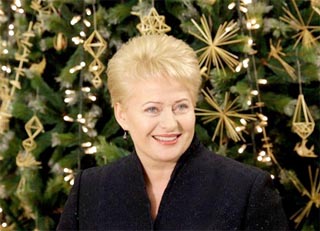
| Grybauskaitė and Obama most respected in 2010 | 4 January 2011 |
Lithuanians nominated Lithuania’s President Dalia Grybauskaite as the Lithuanian Person of the Year 2010 and US President Barack Obama as the World’s Person of the Year 2010, in an annual poll conducted by Lietuvos Rytas and published on 31 December. Grubauskaite received 39.3% of all votes, well ahead of Kestutis Kemzura, the coach of the Lithuanian National Men’s basketball team, who collected 8.3% of nominations. Drasiuis Kedys, the central figure in the Kaunas paedophile case, who was found dead this year, came in third with 3.7%. Lithuanians thought that the death of former President Algirdas Brazauskas was the most important local event in 2010. The plane crash near Smolensk which killed Polish President Lech Kaczynski and many other high ranking Polish dignitaries was thought to be the most important world event of 2010. |
|
| Lithuanian support for EU remains high | 4 January 2011 |
The support of Lithuanian citizens for the country’s membership in the European Union remains steadfast and high, the opinion poll results show. On 3-12 December, this public opinion survey was carried out at the request of the Ministry of Foreign Affairs. The survey showed that more than 6 out of 10 Lithuanians took interest in the EU and in Lithuania’s EU membership. The percentage did not change significantly during the half-year. |
|
| Around the clock consular assistance | 4 January 2011 |
From 3 January 2011, consular assistance will be provided to Lithuanian citizens around the clock in case of emergency. For information, please call +370 5 2362444 or contact us by e-mail at pilieciai@urm.lt. At a press conference recently, Head of the Division of Services for Citizens G.Kilinskaitė, Chancellor of the Foreign Ministry K.Jankauskas and Director of the Consular Department V.Pinkus presented this initiative to the public more broadly. |
|
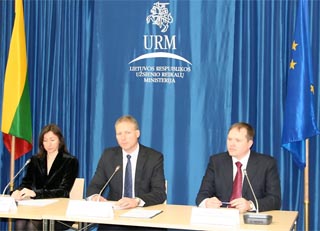
| New Year by candlelight | 4 January 2011 |
Thousands of Lithuanian residents were forced to celebrate New Year by candlelight as the raging blizzard left 34,000 users without electricity. Even on New Year's Day some 10,000 residents still had no electricity at homes. |
|
| Statement of Lithuanian MFA regarding the events in Minsk on 19 December | 20 December 2010 |
Lithuania closely follows the situation after the elections in the neighbouring state of Belarus, and regrets and expresses concern that on 19 December, the presidential election day, Belarusian authorities failed to grant the freedom of assembly to Belarusian citizens and used force against demonstrators. Especially alarming are the brutal actions of Belarusian police against opposition candidates for president, independent media representatives and opposition activists, their arrests and raids at homes and offices of representatives of the democratic opposition. Lithuanian Ministry of Foreign Affairs calls on the authorities of Belarus to refrain from the use of force against peaceful demonstrators, to release detainees, and to investigate and evaluate all the incidents as soon as possible. Lithuania is consulting with its partners within the Organization for Security and Co-operation in Europe and the European Union regarding the evaluation of the course of the elections in Belarus and their results. |
|
| Cigarette-Smuggling Gangs Sap Lithuania Budget | 20 December 2010 |
A man in a black wetsuit straps nine boxes to his body in the Russian exclave of Kaliningrad, wades into the Nemunas River and swims 200 yards to Lithuania and the European Union. He drops his cargo as officers close in and 4,500 packs of cigarettes sink to the bottom of the river, according to photographs from the state Border Guard Service. The authorities aren’t always so successful, with the government estimating 110 million packs are smuggled into the country each year, costing it LTL500 million ($193 million) in lost taxes. Lithuania declared war on smuggling to boost revenue in the 2011 budget after the deficit swelled to 9.2% of economic output during the global recession. The so-called grey economy is said to have grown to 30% of gross domestic product as people look for bargains and gangs flood the country with untaxed tobacco, alcohol and fuel from Russia and Belarus. “Everyone must realize that by smoking illegal cigarettes you not only harm your health as it says on the pack but you also harm your parents and your children,” Prime Minister Andrius Kubilius said on 9 November in an interview with Ziniu Radijas. “You take away money from the school your children attend or you take away money from the pension your parents get.” Lithuania, Latvia and Estonia experienced the world’s deepest recessions last year. All three border Russia, while Latvia and Lithuania also share frontiers with Belarus, making them their gateway into the EU. Prison Sentences Lithuania plans to collect an additional LTL1.2 billion next year, or about 1% of GDP, by curbing illicit activity, according to the draft budget. The government has pledged to cut the deficit to the EU limit of 3% of GDP by 2012. On 17 November he government approved tougher penalties for smugglers, replacing fines with prison sentences of as much as eight years. Lithuania also plans to increase spending on customs enforcement by 15% next year, including LTL8 million to install x-ray scanners at border crossings. The crackdown is fueling tensions. One smuggler was killed and two officers injured in a June shootout. Last month a border guard found a rag doll hanged from a wooden cross in his driveway less than two weeks after his sauna was set on fire. Targeting smuggling may be the easiest avenue left to rein in the deficit after the government implemented austerity measures equal to 14% of GDP in the past two years, said Vilija Tauraite, a Vilnius-based economist at SEB AB, the second-biggest bank in the Baltic states. “Fighting smuggling is a rather realistic and effective measure, given how widespread the illegal imports are,” Tauraite said. “The illegally imported fuel, tobacco products and alcohol are no secret to anyone living in Lithuania.” Excise Taxes The growth in smuggling led to faltering excise-tax income, the second-biggest source of state budget revenue after the value-added tax. Consumption of taxed cigarettes fell 53% from a year earlier in the first nine months of the year according to the Finance Ministry, which missed its revenue target for the excise duty by 8.3% in the period. “Alcohol and tobacco consumption are falling,” said Violeta Klyviene, chief Baltic economist at Copenhagen-based Danske Bank A/S. “This doesn’t mean people resolved to healthier lifestyles, but rather shows booming smuggling.” Tomas, from Klaipeda, Lithuania’s third-largest city, says he buys illegal cigarettes at half price, saving about LTL180 a month, “a very substantial sum” compared with his monthly income of LTL1,200. “Nobody in my family buys cigarettes from a shop,” said Tomas, 26, who asked only to be identified by his first name because buying smuggled goods is a crime. “I don’t remember the last time I filled up my tank at a gas station. You simply pre-order and get Russian products delivered in a day or two.” No Easy Solution Forty-nine percent of the cigarettes smoked in Lithuania this year carried foreign-language, mostly Russian, warning labels, according to the Lithuanian Free Market Institute, a Vilnius-based researcher whose motto is: If you don’t create a free market, a black market will emerge. The grey economies of the three Baltic states are the biggest in the EU behind Romania and Bulgaria, according to Friedrich Schneider, a professor at Austria’s Johannes Kepler University of Linz, who studies illegal economies. The shadow economy accounts for about 30% of GDP in Lithuania and Estonia and 27% in Latvia, Schneider estimates. The EU average is 20%. The growing reliance on smuggled goods makes people more tolerant of the grey economy, raising concern the crackdown won’t work, said Jekaterina Rojaka, a Vilnius-based economist at DnB Nord Bank, the Baltic unit of DnB NOR ASA. About 64% of Lithuanians approve of buying smuggled goods, according to a survey of 1,009 people conducted 28 July - 6 August by Spinter Tyrimai. “There’s no easy solution,” Rojaka said. “To succeed with the plan, the state will have to stitch up the borders and fight.” From: http://www.freetobacco.info |
|
| GDP per inhabitant in the Member States ranged from 44% to 271% of the EU27 average in 2009 | 20 December 2010 |
In 2009, the Gross Domestic Product (GDP) per inhabitant in Luxembourg, expressed in purchasing power standards (PPS), was more than two and a half times the EU27 average, while the Netherlands recorded a level more than 30% above the average. Ireland, Austria and Denmark were between 20% and 30% above the EU27 average, while Sweden, Germany, Belgium, Finland and the United Kingdom were between 10% and 20% above average.
France, Italy and Spain registered GDP per inhabitant between 0% and 10% above the EU27 average, while Cyprus and Greece were between 0% and 10% below the average. Slovenia, the Czech Republic, Portugal, Malta and Slovakia were between 10% and 30% lower than the EU27 average. Hungary, Estonia, Poland, Lithuania and Latvia were between 30% and 50% lower, while Romania and Bulgaria were between 50% and 60% below the EU27 average. The data for 2009, 2008 and 2007 was published by Eurostat, the statistical office of the European Union, based on revised purchasing power parities, and the latest GDP and population figures. They cover the 27 EU Member States, three EFTA Member States, three EU Candidate Countries and four Western Balkan countries. |
|
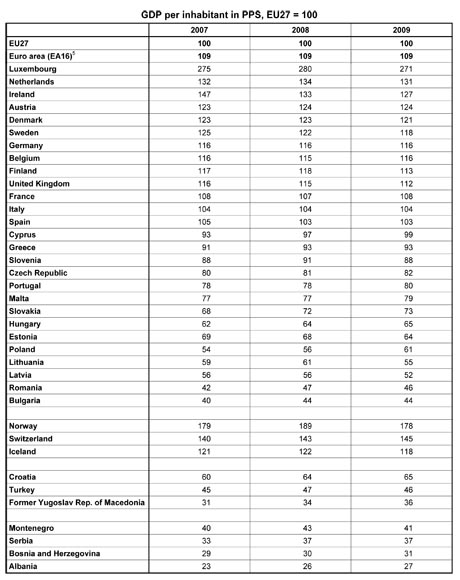
| Lithuania seeks clarification of Belorussian nuclear plant | 15 December 2010 |
Delfi reports that Lithuania's Ministry of Foreign Affairs has asked Belorussian officials to explain statements related to the construction of a nuclear power plant, and reminded them that Vilnius still has environmental objections. "The Ministry of Foreign Affairs of the Republic of Lithuania (...) kindly requests for explanations from Belarus on the statements of the officials of Belarus alleging on the presumably finished procedures on the Environmental Impact Assessment of the planned Belarusian Nuclear Power Plant, as well as to alleging that Lithuanian has no objections regarding the Final Report of the Environmental Impact Assessment," from a note, a copy of which was received by BNS, was signed on 6 December states. Yakov Kenigsberg, the head of the National Commission on Radiological Protection at the Council of Ministers of Belarus, said at a press conference in late November that Lithuania no longer has objections to the Environmental Impact Assessment of the planned Belarusian Nuclear Power Plant. "Lithuanian experts removed all objections to the Belarusian EIA report after the last visit to Minsk. We have answered all the questions that troubled the Lithuanian side, and all the contradictions have been removed," Kenigsberg was cited by the Interfax news agency. |
|
| Ukraine set to start tours of Chernobyl next year | 15 December 2010 |
Ukraine's Emergency Situations Ministry recently announced that they will begin conducting tours of Chernobyl from 2011. Chernobyl was the site of the world's worst nuclear disaster back in April 1986, resulting in extensive contamination in Northern Europe. A 48 kilometre radius exclusion zone has since been in place, sealing the area from visitors. In spite of a government ban, hundreds of former residents have returned to their villages and a number of private firms have been operating tours of the area. An AP report quotes ministry officials as saying that the government approved tours will be safe and educational, and will provide an opportunity for visitors to fully understand the extent of the damage, as well as the historical lesson to be taught. Chernobyl is currently undergoing renovation to the hastily constructed concrete enclosure which was erected immediately after the melt-down. The new safer shell will be 105 metres tall, 260 metres wide and 150 metres long, and big enough to house the Cathedral of Notre Dame, and is being funded by international donors. The renovations are expected to be complete by 2015, and the government approved tours are expected to begin in 2011. |
|
| First hazardous waste management facility to start operations | 15 December 2010 |
The first hazardous waste management facility will start operations in Lithuania this year. The facility has been installed in the Šiauliai Region, at the Šiauliai branch of UAB Toksika. Up to 8,000 tons of hazardous waste are expected to be incinerated annually. Thermal energy generated by the operation of the facility will be used for power production. The construction of the facility has been financed by almost LTL87 million allocated from the EU Cohesion Fund and state budget funds. According to Vidmantas Svečiulis, the Director of Šiauliai Regional Environmental Protection Department of the Ministry of Environment, the structure of the facility guarantees maximum safety when handling hazardous waste in liquid, solid or paste forms. The incineration temperature gets as high as 1100 °C, where substances that are potentially hazardous to human health are decomposed. The community receives automatic monitoring system-generated real time information about the release of carbon monoxide, carbonic oxides, hydrochloric acid, sulphur dioxide, total organic carbon and solid particles. This facility can be used for the management of waste generated only in the territory of Lithuania. The facility has been designed and installed by Hafner, an Italian company specializing in the field of environmental protection solutions. The principal activity of this company is related to the recovery of waste and biomass by generating energy as heated water, steam or electricity. |
|
| Press Release from the Ministry of Energy of Lithuania upon the withdrawal of South Korea's tender | 15 December 2010 |
The Concession Tender Commission, which has been delegated to organise a tender for the selection of a Strategic Investor into Visaginas nuclear power plant, having analyzed the submissions to the request for binding proposals, announces that:
The tender for granting a concession was announced on 10 December 2009. Five companies met the prequalification requirements. The requests to submit binding proposals were issued on 10 September 2010, after the non-binding proposals phase. The regional Visaginas nuclear power plant is one of the most advanced new nuclear developments in Europe. The preparatory works have already been completed, including environmental impact and site suitability evaluations, the results of which have obtained positive IAEA evaluations. EU Commissioner for Energy Gunther Oettinger and regional partners are informed about the situation. |
|
| Fire on Kiel - Klaipėda Ferry | 9 October 2010 |
MFA STATEMENT Lithuania’s Ministry of Foreign Affairs is in contact with German institutions that are providing assistance to the Lithuanian citizens evacuated from a combined passenger/freight vessel ferry en route from Kiel to Klaipėda. According to primary data sources, there were over 200 passengers, mostly citizens of Lithuania, on board of the combined passenger/freight vessel DFDS Lisco Gloria. After a fire broke out on the vessel on the night of 8/9th October, all the passengers were evacuated and are now in Kiel. About 30 passengers have undergone physical examination. There are no serious injuries. Currently, the State Criminal Police Office in Kiel is working to confirm the identities of passengers and will later specify the number of Lithuanian citizens that were on board the Lisco Gloria. For further information please contact the police call centre at 0049 43 11606666 in Germany. Employees of Lithuania’s Embassy in Germany, German institutions and representatives from the company DFDS Seaways are coordinating the organizational issues of transporting Lithuanian citizens to Klaipėda. A consular officer is currently on the way to Kiel and will provide all the necessary consular assistance. Lithuania’s MFA provides consular information during the office hours, Tel: +370 5 236 2400 and after office hours, Tel: +370 5 236 2444. |
|
| Mayoral Mayhem | 8 October 2010 |
With municipal elections just around the corner, it has been anything but politicking in the hallowed halls of Vilnius and Alytus. First, the mayor of VIlnius, Vilius Navickas was caught on tape instructing his colleague Sarunas Skucas to delay the publication of a document critical of the Homeland Union - Lithuanian Christian Democrats for up to three years, and at the same time to make immediately available a document that was favourable to the party. BNS reports that Navickas has been thrown out of the Homeland Union - Lithuanian Christian Democrats for his unethical behaviour, and Skucas has had his membership suspended. Navickas has stated that he will step aside as soon as a new candidate has been chosen by the ruling coalition. Meanwhile down in Alytus, the Special Investigation Service has detained Mayor Ceslovas Daugela and he will initially be held for 15 days. Mayor Daugela was arrested on suspicions of illegal dealings in the reconstruction of Alytus City Stadium, document falsification and embezzlement of more that LTL500,000. Three other Alytus municipal officers were detained, as well as a director of Krotas, a construction company owned by Daugela. The four were questioned and released on the undertaking that they do not leave Lithuania. |
|
| Unemployment falls for second month | 6 October 2010 |
On 1 October there were 309,400 registered unemployed in Lithuania, or 14.3% of the country's workforce, according to the Ministry of Social Security and Labour. Unemployment in September, as in August, fell 0.5%. In the first month of autumn there were 20,300 registered job vacancies, which is 5.9% more than in August. In greatest demand were painters, cooks, heavy truck and lorry drivers, sales managers, tailors, carpenters and builders. For the first time since the global financial crisis began, there were more people placed in employment than there were people registering as unemployed, with 18,500 new registrations making way for 21,100 people placed in new jobs in September. The unemployment rate fell in 52 out of Lithuania's 60 municipalities. The highest rate was in Mazeikiu (20%), Ignalina and Salcininkai (19.6%) and Vilnius (19.3%). The lowest number of unemployed are in Neringa (5.1%) Birstonas (9.9%) Pakruojis (10.6%) and Elektrenai (11.1%) |
|
| EU land usage survey results | 6 October 2010 |
Forests and other wooded areas occupy almost 40% of the total area of the EU, cropland nearly a quarter and grassland a further fifth, while built-up and other artificial areas, such as roads and railways account for 4%. Regarding socio-economic use, over 40% of the land in the EU is used for agriculture and almost 30% for forestry. The use of land for residential, commercial and industrial purposes accounts for just over 10% of the total area of the EU. This data was published for the first time by Eurostat, the statistical office of the European Union and is based on a large scale land survey, the Land Use/Cover Area frame Survey (LUCAS), conducted in 2009. Land was surveyed in 23 EU Member States, where both the physical cover of the land and its visible socio-economic use were recorded. LUCAS is the largest harmonised land survey ever implemented in the EU. The resulting dataset is unique as it is fully harmonised and comparable with the same definitions and methodology among all Member States. Almost 40% of the EU covered by forests and other wooded areas In Finland (68%), Sweden (66%), Slovenia (63%), Estonia (55%) and Latvia (52%) more than half of the country is covered by forests and other wooded areas. Lithuania has 37%. The highest shares of land cover by crops are observed in Denmark (48%), Hungary (47%), Poland (36%), the Czech Republic (35%), Germany and Italy (both 33%), Spain and France (both 30%). Lithuania has 24%. Ireland (64%) has almost two thirds of the country covered by natural or agricultural grasslands, followed by the United Kingdom (42%), the Netherlands (38%) and Belgium (33%) and Lithuania 31%. The largest shares of shrubland are found in Greece (21%), Spain (14%), Portugal (11%) and the United Kingdom (10%). Lithuania has 1%. The Netherlands (13%) and Belgium (10%) have the largest shares of land covered with built-up and other artificial areas. Lithuania has 3%. More than 10% of EU land used for residential, commercial and industrial purposes The socio-economic use of land reflects to a large extent the physical land cover. However, there are some differences. For example, the use of land for residential, commercial and industrial purposes differs from land covered by built-up and other artificial areas, because some areas covered by vegetation and/or water are used for residential purposes (gardens, parks, small lakes, etc.). The Member States with the highest shares of areas used for residential, commercial and industrial purposes are the Netherlands (37%), Belgium (25%), Denmark and the United Kingdom (both 16%) and Sweden (15%). Lithuania has 7%. |
|
| Regions request LTL454 mln. for waste recycling at EU level | 6 October 2010 |
Ten regional waste management centres operating in Lithuania have submitted applications by for LTL454 mln. worth of support from the EU Structural Funds. The total value of the projects intended for waste sorting and recycling amounts to LTL 565 mln. Implementation of these projects will solve the problem of odours from landfills as well. Support funds granted for the development of the waste management system meeting EU requirements in 2007–2013 make up LTL 813 mln., of which LTL 450 mln. are to be allocated this year for developing waste sorting, recycling and other use capacity. The projects should be completed by the end of 2013. This is the second stage of the waste management system development. The first stage which has involved the closure of old landfills (a total of about 450) and construction of new landfills (11) is nearing completion with success. The first stage has already utilised LTL 369 mln. of Community and national budget funds granted. These measures have allowed fulfilling the requirements of the EU Landfill Directive, in particular terminating waste disposal in non-compliant landfills by July 2009 and achieving the target of a greater than 90% share of the population using a centralised waste collection service (in 2006, that share was 60% only). Household expenditure for waste management in individual regions depends on the chosen waste sorting and recycling solutions. Six regions are planning biodegradable waste management with biogas extraction, three regions have plans for biodegradable waste composting, and Klaipėda should install a sorting facility which, together with on-site composting solutions, would ensure the maximum separation of secondary raw materials from the remaining part subject to incineration. In addition, individual composting will be promoted in many regions through the purchase of individual composting containers for the population. This will essentially reduce the dissatisfaction of those residing in the vicinity of landfills with odours as biodegradable waste is sorted and recycled before reaching the disposal sites. |
|
| Degutiene sees no possibility of early election | 6 October 2010 |
Vilnius, Oct 6 (ELTA) - The Social Democrats' proposal to hold early elections to the Seimas and dissolve the present Parliament is a mere pre-election theatrical performance, Seimas Speaker Irena Degutiene says. At its Saturday meeting, the council of the Lithuanian Social Democratic Party appealed to President Dalia Grybauskaite asking to initiate early parliamentary elections. The Social Democrats seek that the head of state would approve early parliamentary elections that could be held together with the municipal election. "First of all, I would like to say that this appeal is insincere. Everything is clearly regulated by law, including the dissolution of the Seimas and early election. First, all this must happen in the Seimas itself," Degutiene commented on the Social Democrats' proposal on the Ziniu Radijas on Wednesday morning. The Seimas speaker noted that the votes of the Seimas opposition alone would not be enough to have early election. The opposition has not discussed its proposal with the ruling coalition yet. Meanwhile, President Grybauskaite advised the Social Democrats to read the Constitution. "I wish they read the Constitution. The president has no such power," the head of state said on Tuesday. Under the Constitution, early elections to the Seimas may be held on the decision of the Seimas adopted by not less than a 3/5 majority vote of the MPs. The President of the Republic may announce early elections in two cases: if the Seimas fails to adopt a decision on the new programme of the Government within 30 days of its presentation, or if the Seimas two times in succession gives no assent to the programme of the Government within 60 days of its first presentation; on the proposal of the Government, if the Seimas expresses direct no-confidence in the Government. |
|
| Star1 Airlines loans will not be covered from budget - Kubilius | 6 October 2010 |
Vilnius, Oct 5 (ELTA) - The prime minister has voiced his doubts as to the transport minister's proposal to reimburse part of the losses incurred by the passengers of Star1 Airlines from the state budget. "No such funds are available in the budget. I really do not know whether it would be wise to (...) transfer the losses suffered by a private company on the shoulders of taxpayers," Andrius Kubilius said on the Lithuanian Radio. "In this situation, all the insurance mechanisms should operate to help people to avoid greater losses," the prime minister said. On Friday, Transport Minister Eligijus Masiulis said that the state could recover its money from the company in court afterwards. It is estimated that Star1 Airlines has sold almost 16,000 tickets to the flights that will not be operated. The airline owes about 3.5 million litas (0.99 million euros) to its passengers. Star1 Airlines sold almost 16,000 tickets to cancelled flights (ELTA) - In the face of a bankruptcy, Star1 Airlines has sold 15,924 tickets to the flights that will not be operated; 1,286 clients have been affected by the bankruptcy of the tour operator Star Holidays, Head of Star1 Airlines Martynas Laivys says. According to Laivys, the airline owes 3.5 million litas (0.99 million euros) due to the non-operation of flights and 1.7 million litas (0.485 million euros) due to the tours that were cancelled. Star Team Group is most heavily indebted to its suppliers - the amount is estimated to reach some 10 million litas (2.85 million euros). The company owes 1.3 million litas (0.37 million euros) to its employees and SoDra. The company suspends its activities for an indefinite period, but it would resume its work with a help of a strategic investor, Laivys said referring to the Chinese HNA Group which operates Hainan Airlines. The visit of HNA Group representatives is due on October 20. Star Team Group, the only shareholder of Star1 Airlines, commissioned the airline's CEO to draw up and submit the application on initiating bankruptcy proceedings against Star1 Airlines and other necessary documents to Vilnius district court by October 5. |
|
| Courts must be as effective as possible in solving cases - Grybauskaite | 6 October 2010 |
Vilnius, Oct 4 (ELTA) - President Dalia Grybauskaite calls on judicial authorities to seek reserves and optimise their performance. The authorities say that such a task could only be accomplished after changing some of the courts' organisational measures which would be implemented no sooner than in 2012. On Monday, the president received the heads of the Judicial Council and the courts of higher instances. According to presidential spokesman Linas Balsys, Grybauskaite urged courts to look for reserves, optimise their performance, avoid administrative failings which result in a loss of large resources. "The president welcomes the fact that the chairpersons of courts have expressed their support to the president's key points as to the extended confiscation, tightening penalties, other essential legislative amendments that would further improve and accelerate the fight against corruption and corrupt crime in the broad sense," Balsys said after the meeting. The meeting also focussed on the problems caused by the heavy workload of judges. It was agreed that the workload of judges was a matter of judicial autonomy which must not be a reason for delays in solving cases. Chairman of the Lithuanian Supreme Court (LAT) Gintaras Kryzevicius says that optimum reserves must be sought to reduce the workload so that each judge would hear approximately equal number of cases. The second step would be the introduction of electronic cases, the LAT chairman said. Among the organisational measures considered is the regulation of legal relations in proceedings in such way that all the cases falling into a single category would be heard by a court having the lowest workload. According to Kryzevicius, as a result, there would be a decrease by about 40-50 percent in the workload of other courts. |
|
| Shopping centres take advantage of consumers by raising profit margins - Grybauskaite | 6 October 2010 |
Vilnius, Oct 4 (ELTA) - Shopping centres take the advantage of consumers by raising profit margins on foodstuffs in the wake of the difficult economic situation, President Dalia Grybauskaite says. The president considers proposing the legal regulation of mark-ups unless an understanding is reached on this issue. "We speak about the main foodstuffs such as milk, bread, sugar, butter here. Retail trade chains have inflated their profit margins despite the hard times. The president referred to shopping centres' actions as blatant consumer exploitation. Especially given the fact that there is a completely different situation regarding profit margins in other European Union member states," presidential spokesman Linas Balsys said after Grybauskaite's meeting with Chairman of the Competition Council Jonas Rasimas on Monday. During the meeting, the Competition Council head informed the president about the profit margins that had widened remarkably over the past year. President Grybauskaite proposed fighting the "impudent actions" by making them public, i.e. announcing the prices of the basic foodstuffs in different shopping centres. In Grybauskaite's opinion, it could be implemented by the Competition Council via the agricultural products information system. The president noted that a draft proposal on regulating mark-ups by law had already been registered at the Seimas. "If an agreement is impossible to reach, there is no goodwill and understanding, we may need to resort to the law," Grybauskaite stated. |
|
| Grybauskaitė to speak to head of Competition Council | 1 October 2010 |
Vilnius, September 30 (ELTA) - President Dalia Grybauskaite intends to speak to head of the Competition Council over the increasing food prices. "To my mind, a number of agencies fail to perform their jobs, and the Competition Council is one of them. In the short time I am ready to meet with the heads of the Competition Council," Grybauskaite said on Thursday. The Competition Council is headed by Jonas Rasimas. As reported, the Government committed the Competition Council to investigate the changes in food prices. |
|
| There are no reasons for food prices rises - Kubilius | 1 October 2010 |
Vilnius, September 30 (ELTA) - Prime Minister Andrius Kubilius sees no objective reasons for food prices to increase. "(&). I want to repeat once again - we see no objective reasons for, let's say, bread prices to increase, except for one single fact that over the last few years, the part in the final bread price that goes to distributors or bread bakers increased significantly," Andrius Kubilius said. The head of the Government skeptically evaluated the proposals to reduce the value added tax (VAT). |
|
| Gazprom, E.ON Should Redirect Unbundling Complaints to EU, Lithuania Says | 1 October 2010 |
Brussels, September 30 (Bloomberg-ELTA) - OAO Gazprom and E.ON AG, majority shareholders of Lithuania's gas utility Lietuvos Dujos AB, should complain to Brussels about the nation's unbundling plans to the European Commission, Premier Andrius Kubilius said. The Lithuanian government decided on May 19 to split the gas sales and transmission ownership of Lietuvos Dujos, spurring criticism from Gazprom and E.ON. The initiative is part of the European Union's drive to force dominant energy companies to give competitors access to transmission networks, according to the government. Gazprom and E.ON said on Sept. 20 in an open letter that "an overhasty implementation of ownership unbundling" in Lithuania could "cause disruption of gas supplies." These are "nervous statements" and they aren't "a big surprise," Kubilius said an interview in Copenhagen yesterday. "We can understand that Gazprom is a little bit worried about unbundling development in European gas markets," Kubilius said. "But we see that Estonia decided to follow. The Poles are also going with something similar. If somebody is unhappy in how we implement European directives they should complain to Brussels." Without competition, Lithuania risks staying in the position where it has to pay $100 more than Germany for 1,000 cubic meters of Russian natural gas, Kubilius said. "It's really a big issue for us to get rid of our dependence on the monopoly supply of gas," he said. "It's not politics, it's economics. We need to get rid of that dominating monopoly situation." EU lawmakers in April 2009 approved legislation forcing members to choose one of three options to ease access to power and gas grids. The choices are to force the companies to sell or spin off the transmission businesses, to require them to hand grid management over to an independent operator or oblige them to make the unit more independent through internal action. Estonian Prime Minister Andrus Ansip on July 29 said that gas ownership unbundling for Estonia is "certainly as important as for Lithuania." The country has started a discussion though hasn't decided how the unbundling will be carried out, he said. |
|
| Lithuania may sign nuclear power plant contract before July | 1 October 2010 |
Brussels, September 30 (ELTA) - Lithuania wants to sign in the first half of next year with the winner of a contract to build a nuclear power plant in the country, Prime Minister Andrius Kubilius said. By "the end of November we'll know the bids," Kubilius said in an interview in Copenhagen yesterday. "We plan to finalize agreements in the first half of next year. I'm quite confident that we'll see a positive outcome." The government wants to replace the Soviet-made Ignalina facility that was shut in December to comply with European Union rules. It invited binding offers to build the power plant to reduce the Baltic nation's dependence on Russian energy. Lithuania, which imports almost 50 percent of electricity supplies, wants to complete the nuclear plant in Visaginas between 2018 and 2020. The government in February short listed five companies it declined to name to invest in and build the power station, which may cost as much as 5 billion euros. Iberdrola SA, Spain's largest electricity supplier, in May said it was one of the finalists. |
|
| Proposal to set up food price control and monitoring group | 1 October 2010 |
Vilnius, September 29 (ELTA) - Elder of the Seimas Order and Justice political group Valentinas Mazuronis appealed to Prime Minister Andrius Kubilius calling for the immediate establishment of the permanent group for the control and monitoring of the increase in food prices. According to Valetinas Mazuronis, this group would have to daily collect information and analyze the trends and causes of the increase in food prices. According to members of the Order and Justice political group, the prime minister and the economy minister should not only state or complain that the food prices have been increasing; they have to as soon as possible take decisive actions to prevent potential abuse, whether it would take place in the area of agricultural production, processing or trading. "In our opinion, it is necessary to establish a group that would be made up of respective specialists and headed by Prime Minister Andrius Kubilius himself. The prime minister should not only gesticulate and explain what is already clear, but all possible steps to stop these processes," Mazuronis explained. |
|
| The second soldier wounded in Afghanistan will be brought back to Lithuania | 1 October 2010 |
On October 1, Friday, in the evening 1st Lt Linas Novogreckis of Chaghcharan Provincial Reconstruction Team who suffered injuries in the incident on September 24. |
|
| Lithuanian Arms Inspectors to visit Belarus | 1 October 2010 |
September 28-30, three arms control experts of the Lithuanian Armed Forces will conduct an evaluation visit in the Belarusian Air Force's Attack Air Base in Lida. *** Lithuanian Ministry of National Defence provides data about the Lithuanian Armed Forces, defence budget, defence planning and scheduled training events to OSCE annually under the Vienna Document 1999 requirements. In 2005 Lithuania became a member of the 1992 Treaty on Open Skies that may be joined by any OSCE member. |
|
| Grybauskaite dismisses Judge Putrius | 1 October 2010 |
Vilnius, September 28 (ELTA) - President Dalia Grybauskaite signed a decree upon which Klaipeda District City Court Judge Saulius Petrius was dismissed from office for discrediting the judge's name. On September 17, the judge was driving drunk and was arrested by the police. Having reviewed the administrative violation file and the explanation of the judge, the head of the state decide that such behaviour was incompatible with the duties of the judge and demeaned the judge's name. "Such violations discredit the judicial community and undermine the people's confidence in justice, and thus cannot be tolerated. A judge must serve as an example not only at work, but in real life. Impeccable reputation - is one of my main requirements for the judges," the president said. |
|
| Lithuanian yachties looking for business ideas and the R1 gene | 23 September 2010 |
A group of Lithuanians from business and other fields calling themselves the Lithuanian Icebreakers77 have hoisted the sail of the yacht Ambersail, which has sailed around the world, and started an intriguing expedition. The team left Porto Harbour in Portugal recently and intend to visit the main harbours in southern Europe and North Africa within 360 hours, and to find beneficial business ideas and ideas for the development of business infrastructure in Lithuania and to see if R1 gene is responsible for similarities of local inhabitants and Lithuanian inhabitants. A crew of 15 people, including businesspeople, lawyers, public figures and representatives of various professions, will be sailing the Atlantic Ocean and Mediterranean Sea for two weeks and will visit such cities as Porto, Kaskai, Lisbon (Portugal), Cadiz, Malaga, Almeria, Cartagena, Ibiza, Mallorca and Barcelona (Spain), Casablanca, Rabat (Morocco) and Gibraltar (Gibraltar). “We have contacted government and business representatives of these cities. They will be our source of ideas on how to improve the business environment in our country, look for new opportunities for mutual communication, and we will present possibilities for investment in Lithuania”, said Rokas Volungevičius. the initiator of the expedition, navigator and head of the company Redhaus. A researcher has suggested that this gene came to southern Europe from Sarmatia, which was located in the current territory of Lithuania 2000 years ago. Therefore, Spaniards, Portuguese and other inhabitants of this region all originated from the same tribes, and the common R1 gene may determine similar relation with environment, point of view to business and its principles. This expedition has received ideological support from Vilnius Municipality and the Ministry of Foreign Affairs that have assisted in making contact with municipalities of foreign cities. Rotary International in Lithuania is also supporting the journey. |
|
| Lithuania Collecting Best of Baltic Investment and Talent | 23 September 2010 |
IBM’s decision to set up a research center with the Lithuanian Government may stoke concern that Estonia and Latvia are falling behind as the Baltic neighbors vie for foreign investment after Europe’s deepest recessions, Bloomberg reports. Since the beginning of last year, Lithuania has attracted investments from international companies including London-based Barclays Bank, which opened an information technology center in Vilnius, and Colorado-based Western Union, which plans to establish a regional service center in the country. Stock of foreign investment in Lithuania rose 7 % last year, compared with Estonia’s 3 % drop and Latvia’s 2 % increase. “Lithuania is winning as Prime Minister Andrius Kubilius acts as “investment czar,” said Kitty Kubo, who heads the foresight division of the Estonian Development Fund in Tallinn, which advises the country’s government. “If Lithuania continues successfully, it has a good chance of grabbing the best investments in the region and the best talents with it.” Andrius Kubilius’ government plans to boost FDI to EUR 20 billion within five years by focusing on computer services and energy as the country seeks to establish itself as a service hub for the Baltic and Nordic regions, Economy Minister Dainius Kreivys said in June. “Countries that market themselves by focusing on their capabilities in specific clusters of economic activities find it easier to communicate their specific advantages,” said Christian Ketels, a professor at Harvard Business School’s Institute for Strategy and Competitiveness and also a member of the Baltic Development Forum’s advisory board. “As far as the Lithuanian campaign fits that bill, I think it is a step in the right direction.” |
|
| UBS Ranks Vilnius Least Expensive Baltic Capital | 23 September 2010 |
Swiss financial corporation UBS ranked Vilnius 63rd least expensive capital among 73 cities, and less costly to live in than Latvia’s Riga (57th) and Tallinn in Estonia (61st). The most expensive cities in the world are Oslo, Zurich and Geneva, followed by Tokyo, Copenhagen, New York, Stockholm, Toronto, Montreal and London. The analysis that is an update to the UBS Prices and Earnings Report 2009, was carried out to adjust 2009 data for cumulative inflation and exchange rate movements, and surveyed 73 cities comparing 122 various products, services and wage data of 15 different professions across the board. The Prices and Earnings survey is published every three years. |
|
| Butkevičius becomes leader of opposition | 23 September 2010 |
Vilnius, September 21 (ELTA) - Elder of the Seimas Social Democratic Party political group Algirdas Butkevicius became the new leader of the Seimas opposition. On Tuesday, Speaker of the Seimas Irena Degutiene informed about that from the Seimas tribune. "I pledge to work constructively and seriously, with due responsibility," said the leader of the Seimas opposition. The Seimas opposition was led by Elder of the Seimas Labour Party political group Vytautas Gapsys during the previous spring session. |
|
| E.on and Gazprom letter an unacceptable threat - Kubilius | 23 September 2010 |
Vilnius, September 20 (ELTA) - Prime Minister Andrius Kubilius calls the statements regarding the Government's plans to nationalize the assets of "Lietuvos Dujos", which were published in several daily newspapers on Monday morning, an unacceptable threat. "This is a publicly expressed threat to disrupt gas supplies if the Lithuanian Government implements the EU directives, and such a threat is completely unacceptable and intolerable. I believe that these words will be heard by shareholders of "Lietuvos Duhos" as well," Kubilius said. "The too premature implementation of the ownership unbundling model could lead to disruptions in the supply of gas," the statement of "E.on" and "Gazprom" says. Currently, "Gazprom" both sells gas to Lithuania and supplies it via "Lietuvos Dujos". Gazprom, a state Russian company, is one of the largest shareholders of "Lietuvos Dujos". |
|
| Lithuanian gas company tells government to halt change to law | 23 September 2010 |
London, September 20 (ELTA) - Lithuanian gas company Lietuvos Dujos has gone public once again with its dispute with the government over the unbundling of the country's gas supply and network operations, the Platts informs. As a member of the EU, Lithuania is bound by the gas directive that calls for unbundling in some form, and the country's government has opted for the most extreme of the three forms that the directive allows: ownership unbundling. In an open letter the company said the government is in breach of its obligations under international investment protection instruments. "We again call for a halt to the expedited legislative process and for direct and meaningful consultations with the Lithuanian government to discuss all options for amending the draft gas law," the letter said. It was signed by representatives of the company's two shareholders, Germany's E.ON Ruhrgas and Russia's Gazprom. The letter also sought to refute allegations that the Lithuanian company was not fostering market development as well as a number of other statements that the company said were not true. These claims and statements have been made by Lithuanian politicians over the past few months, the company said, and include suggestions that: energy independence may only be reached if the state controls the grid; LD has discriminated against third parties over access; LD has underinvested in the grid; LD has not cooperated with plans to build an LNG import terminal; unbundling will reduce prices; and LD shareholders have been involved in discussions on the new gas law. With regard to the last point, the letter said, the government approved the concept for implementing ownership unbundling without involving the major shareholders or the company itself. They were invited to a working group, but that only discussed how to implement ownership unbundling and not the alternatives that the directive also offers. The authors said they have published the letter as direct and confidential letters to the president, the government and the prime minister of Lithuania, as well as a public appeal to enter into direct constructive talks on implementing the third directive had all been ignored. |
|
| Having committed to Gazprom, Lithuania is paying highest gas prices in Europe | 23 September 2010 |
Vilnius, September 20 (ELTA) - Leader of the Christian party, former Prime Minister Gediminas Vagnorius is satisfied that finally Energy Minister Arvydas Sekmokas publicly admitted the consequences of his own and the head's of the Government inactivity - Lithuania is already paying 1.5 times higher prices for the privileged monopoly's gas supply than Western European countries. "The minister declared determination to establish a liquefied gas terminal as an alternative source of supply as soon as possible. However, the political courage to take action for the sake of people and national interests vanished straight away. As if deprived of basic sense, the minister proposed to trust the liquefied gas terminal to Lietuvos Dujos, which is controlled by the same monopolist, and even promised to pay half of the sum of its establishment from the state funds," Vagnorius says. Gediminas Vagnorius cannot understand how the minister decided to strengthen the Russian gas supply monopoly by Lithuanian tax payers' money. "It is absolutely clear that having gained the control over the liquefied gas terminal with the support of such weak-willed politicians, the Gazprom will not only not reduce mark-ups, but will continue raising the gas prices, because there will be no opportunity for other suppliers to enter the fully monopolized Lithuanian gas market. (...)," Vagnorius said. The prices of gas gas supplied to Lithuania, which has no alternative gas supply, by Russian company Gazprom stands at around one third higher than for Germany, last week Energy Minister Sekmokas told ELTA. |
|
| State has to act in an organized way against organized crime - Grybauskaitė | 23 September 2010 |
Vilnius, September 13 (ELTA) - Having named the fight against corruption one of her top priorities, President Dalia Grybauskaite emphasized that only joint attempt of the politicians and public intolerance of corruption would help to curb this phenomenon. Continuing the tradition of parliamentary cooperation, President Dalia Grybauskaite received members of the Parliamentary Group "For Citizens' Efforts to Create Lithuania Free of Corruption" on Monday. "Criminals manage to operate in an organized way, however, the state - not always. While declaring the fight against corruption, we have to set personal example and work together. The fact that different political forces show their attempts to cooperate for crucial decisions that are necessary to curb corruption is promising and shows that we are beginning to create a more transparent Lithuania," the head of the state said. The president pointed out that political will and agreement was necessary not only in making responsibility for the corruption crimes stricter, adopting important laws for the fight against corruption but also in implementing the National Anti-Corruption Program and reorganizing law enforcement institutions, the press service of the president reports. |
|
| Lithuania Government and IBM Announce Research Partnership | 16 September 2010 |
The Government of Lithuania and IBM today announced a joint research partnership in Lithuania that will enable research and development of nanotechnology, healthcare and intellectual property (IP) management innovations. |
|
| Nearly Twice as Many Russian Tourists in Lithuania This Year | 17 September 2010 |
The Statistics Department of Russia announced that, though in 2009 the amount of Russians travelling abroad declined due to the global economic recession, in the first half of 2010 it picked up by 42.7 %, and the number of Russians visiting Lithuania has increased nearly by 100 %. The major growth in Russian tourism was recorded in Thailand (118.5%) and Lithuania (92.3%). Lithuania is ranked 27th among the most popular Russian vacation destinations, and attracts Russians, as they indicate it themselves, as a great country for high European level holiday for a competitive price as well as being easily accessible by train. |
|
| Sventoji port to be launched next year | 17 September 2010 |
“I had a discussion with experts. They all agree that there is a possibility to open the port of Sventoji on 1 June 2011 and start to moor boats. We have developed a nineteen-measure plan of what needs to be done. Klaipeda State Sea Port Authority has already accepted it. The Government transportation and transit committee meeting will take place shortly. We will offer the discussion on the first phase of Sventoji port development”, Klaipeda State Sea Port CEO Eugenijus Gentvilas noted. Various Klaipeda State Sea Port Authority units have already initiated the proceedings related to the port’s readiness to receive small boats. Clearing the inside of the port and its approaches of soil siltation would probably require the biggest share of funds. Based on preliminary estimates, to grand mooring conditions for small boats in Sventoji port by 1 June 2011 would cost around 2-3 million litas. By that time, it is expected to install 60-70 boat mooring spots. Seimas of the Lithuanian Republic could theoretically prevent our plans to moor boats in Sventoji port. The Seimas has to adopt the Sventoji port amendment, which would allow the Klaipeda State Sea Port Authority to take over the management of Sventoji Port Authority. “It makes no sense to create a separate Sventoji Port Authority. This would be an office with at least 35 posts. I believe that the Klaipeda State Sea Port Authority is fully capable of carrying out the administrative functions of Sventoji port. The Government has already ruled that the port should be administered by Klaipeda State Sea Port Authority. It will enter into force once the Sventoji port amendment is adopted”, E. Gentvilas explained. In E. Gentvilas’ words, “so far, there is no entity to quickly carry out an ambitious plan of adapting the Sventoji port for tourism purposes”. Lately, we’ve been focusing on abstract preparations by coordinating the future works and the works in progress. It seems that the Seimas could adopt the one-point Sventoji port amendment quickly. But it is not the case. “We addressed the parliament with the issue on 30 October last year. I cannot guarantee that the decision will be reached soon. Ten months passed, and the Seimas has not begun reading the Sventoji Port Law amendments yet”, E. Gentvilas was wondered. |
|
| Proposals to improve pensions systems of all European Union Member States | 17 September 2010 |
In autumn, Lithuania will join other European Union Member States in the public debate concerning the improvement of the pension system. This will be achieved through responses of EU Member States to the questions raised by the European Commission in the Green Paper “Towards adequate, sustainable and safe European pension systems”. This consultation document describes the most relevant problems encountered by EU Member States with regard to pensions and proposes to every country to decide on the means to overcome these problems. Lithuania will organise meetings with social partners, non-governmental organisations, academic society and other interested institutions. After all states submit their discussed proposals by mid-November, the European Commission will start drafting a White Paper, setting out the guidelines of the proposed changes. The Green Paper highlights that a considerable share of public finance has been allocated to the pension systems; therefore, discussions on the sustainability of the systems should not exclude the security of the sustainability of public finance. The main task for all pension systems of the Member States is to overcome the growing expenditure on pensions with the share of persons of working age shrinking and time spent in retirement increasing. The document enumerates the priorities for modernising pension policy and raises specific questions to help define the means to achieve them. |
|
| Investors Invited to Submit Tenders for Nuclear Plant | 17 September 2010 |
On September 10, 2010, Ministry of Energy sent to potential strategic investors of Visagino nuclear power plant (VAE) requests to submit binding proposals. After Mr. A. Sekmokas, minister of energy, approved the evaluation of results of non-binding proposals, performed by the Concession Commission, invitations were sent to tender participants, whose submitted non-binding proposals met the tender conditions. The potential strategic investors shall submit binding proposals in November, this year. It is expected that subsequent to the evaluation of proposals, submitted by tender participants, the future strategic investor will be selected by the end of this year. ”It is highly important that the work is performed by the defined schedule and we hope that by the end of this year we will have a partner we can start negotiations with”, - said Mr. A. Sekmokas, minister of energy. The political support to VAE project was once again confirmed on September 7 in Brussels by Mr. Günther Oettinger, Energy Commissioner of the European Union. After the meeting with Mr. A. Sekmokas, Minister of Energy, the Commissioner emphasized that this regional project is significant to entire Europe. The political support to Lithuanian strategic energy project, among which is VAE, was expressed by Germany. The project of Visaginas nuclear power plant is one of strategic energy projects, enabling to ensure Lithuanian energy independence and joining the implementation of the European Energy strategy. |
|
| US House of Representatives Speaker Nancy Pelosi greets Chairman of the Foreign Affairs Committee of the Lithuanian Parliament | 17 September 2010 |
US House of Representatives Speaker Nancy Pelosi greeting Chairman of the Foreign Affairs Committee of the Lithuanian Parliament, Emanuel Zingeris, during a meeting of the Community of Democracies in Washington, DC on September 14th. Chairman Zingeris and the Speaker of the Lithuanian Parliament, Irena Degutiene, were leading the Lithuanian delegation at these meetings. Lithuania currently holds the Chairmanship of the Community of Democracies. |
|
| Lithuania and Germany United by common interests | 17 September 2010 |
Monday, September 6, Vilnius - President of the Republic of Lithuania Dalia Grybauskaitė met with the Federal Chancellor of Germany, Angela Merkel. The German Chancellor is visiting Lithuania at the invitation of the President of Lithuania. |
|
| MP Zilinskas concerned about the arrest of a Belarusian green activist | 12 September 2010 |
Vilnius, Sept 10 (ELTA) - Chairman of the Seimas' Nuclear Energy Commission Rokas Zilinskas expresses deep concern about the reports on the arrest of an activist of Belarus' green party, Vladimir Volodin, in Minsk. The Belarusian public activist has contributed significantly to an alternative environmental assessment of the planned alternative nuclear power plant which was carried out by nongovernmental organizations opposing the official stand of Minsk. MP Zilinskas believes that something is wrong because Volodin was arrested on September 8 and allegations were brought against him on setting the door of a bank's unit on fire in Minsk in April. "It seems like a fabricated case against a man who is unhandy for the government," the politician said. Volodin "is still detained; he is mostly interrogated not about the incident he is suspected of, but about his membership in some parties and movements he has never heard of", the report says. According to Zilinskas, Volodinas is a historian, art critic, the member of the green party of Belarus, the expert of the Public Ecology Expertise which criticises the report on the evaluation of environmental impact of the planned nuclear power plant in Belarus, near the Lithuanian border. |
|
| Lithuania invites bids for nuclear power plant to cut Russia dependence | 12 September 2010 |
Vilnius, Sept 10 (Bloomberg-ELTA) - Lithuania invited investors to bid on building a nuclear power plant to reduce the Baltic country's dependency on energy imports from Russia. Pre-selected bidders have until November to make binding offers, while the government wants to have a partner selected by the end of the year, the Vilnius-based Energy Ministry said in an e-mailed statement today. Lithuania wants to replace the Soviet-made Ignalina facility that was shut in December to comply with pre-accession commitments to the European Union. The country, which imports almost 50 percent of its electricity supplies, wants to complete the atomic power plant in Visaginas between 2018 and 2020. The government said in February it shortlisted five companies it declined to name to invest in and build the power station, which may cost as much as 5 billion euros (6.4 billion dollars). Iberdrola SA, Spain's largest electricity supplier, said in May it was one of the finalists. |
|
| Lithuania and Cyprus register most marriages in EU | 12 September 2010 |
Luxembourg, Sept 10 (dpa-ELTA) - The number of marriages continues falling in Europe as it reached the record lows in 2008 since 1964, when such statistical data were collected for the first time. In 2008, there were only 4.9 marriages per 1,000 residents in the European Union, Eurostat reports. In 1990, the figure stood at 6.3. Most marriages were registered in Lithuania and Cyprus, while Slovenia and Bulgaria saw fewest marrying couples. Meanwhile, more and more divorces take place in Europe. Presently, there are two divorces per 1,000 residents in the EU. |
|
| Labour Party leader Uspaskikh prepares for municipal election | 12 September 2010 |
Vilnius, Sept 9 (ELTA) - After losing his legal immunity on Tuesday, Leader of the Labour Party Viktor Uspaskikh does not dismiss his earlier promise to stand for municipal council election in Vilnius or Kaunas next year. Uspaskikh would refuse his MEP mandate if he succeeded in the election. "I will run in municipal elections, as I promised, in Kaunas or Vilnius, as decided by the party. If people have such confidence in me so that I will be able to become a mayor, I will refuse my mandate of the member of the European Parliament," Uspaskikh said after the meeting of the opposition parties on Thursday. Under the Law on Elections to Municipal Councils, Uspaskich would obtain legal immunity again during the election period. As reported, Uspaskikh is one of the accused in a criminal case on false accounting of the Labour Party. The MEP may face imprisonment of up to 4 yours, if sentenced. Uspaskikh denies his guilt and says that the case is politicized. |
|
| Lithuania and Belarus may sign local border traffic agreement soon | 12 September 2010 |
Minsk, Sept 8 (ELTA) - Lithuania and Belarus may sign an agreement on small-scale local border traffic in the near future, Foreign Minister of Belarus Sergei Martynov told media after the September 8 meeting of the foreign ministers of Belarus, Lithuanian and Ukraine in Minsk, the Belarusian news agency BelTA reports. Lithuanian Foreign Minister Audronius Azubalis met with the foreign minister of Belarus prior to the third round of consultations between the foreign ministers on September 8. Among other matters the meeting touched upon the signing of the agreement on small-scale local border traffic. "I am optimistic about the resolution of the issue," said Azubalis. In turn, Foreign Minister of Belarus Sergei Martynov said that "the optimism is a short-term one in a good sense". |
|
| Children should pay parents 5 pct of their income, MP Valkiunas says | 12 September 2010 |
Vilnius, September 7 (ELTA) - Member of the Seimas Valdemaras Valkiunas will propose to introduce a new tax, under which children would have to pay their parents 5 percent of their income. According to the MP, this would help Europe not to get old. "This idea came to me five years ago. It would be a very big breakthrough and the last chance for Europe to avoid extension of the retirement age and not to get old," Valkiunas said. Member of the Liberal and Centre Union political group argues that such tax would increase birthrate. "Your children will pay you, so you will be motivated to have more children and educate them better, so that they would receive better education and better employment. The more you give your children, the more you will get back," Valkiunas says. |
|
| Relations with Russia will improve if Lithuania guarantees its security and independence - Kubilius | 12 September 2010 |
Vilnius, September 7 (ELTA) - The implementation of Lithuanian energy independence strategy will have a positive impact on the Lithuanian-Russian relations, Prime Minister Andrius Kubilius is convinced. "Our good relations with Russia, what he have always been striving for, will depend on whether we will guarantee our safety and independence in the most important matters, relations, including energy sector. And if we do that, I am sure that our relations with Russia will only get better," the head of the Lithuanian Government said. |
|
| Award to Russian citizen Yakunin - illegal - Constitutional Court | 12 September 2010 |
Vilnius, September 7 (ELTA) - On Tuesday, the Constitutional Court ruled that former President Valdas Adamkus awarded Russian citizen Vladimir Yakunin illegally. The court ruled that the decree on the award contradicted the Constitution and the Law on State Orders, Medals and Other Awards. |
|
| Uspaskikh will have to attend all the sittings - Prosecutor Verseckas | 12 September 2010 |
Vilnius, September 7 (ELTA) - Upon the lifting of Viktor Uspaskikh's legal immunity by the European Parliament, criminal proceedings will be held as usual, says representative of the Prosecutor's General Office. On Tuesday, Members of the European Parliament have decided to lift the legal immunity of Leader of the Labour Party Viktor Uspaskikh. According to Prosecutor at the Department of Organized Crime and Corruption at the Prosecutor's General Office Saulius Verseckas, the Prosecutor's General Office should now receive an official report from the European Parliament confirming the lifting of Uspaskikh's immunity. "If the European Parliament has lifted the immunity, the criminal proceedings will take place as usual - the sittings will be held and the case will be investigated," the prosecutor told ELTA. "It is difficult to say how long it will take to receive the answer. To my mind, we should receive it in a month or so. (...). Under the Lithuanian Criminal Code, Uspaskikh's participation in the sittings is mandatory. He will have to attend all the sittings," Verseckas said. |
|
| Youth emigration is inevitable, Kubilius | 12 September 2010 |
Vilnius, September 7 (ELTA) - The emigration of Lithuanian citizens, and especially youth, is an inevitable phenomenon, however, those who spent some time abroad, come back with priceless experience and knowledge, Prime Minister Andrius Kubilius is convinced. "The crisis that struck Lithuania, as well as Latvia and Estonia, has resulted in a very high unemployment. (...). It is really very painful that the unemployment rate among young people or those who are entering labour market for the first time is much higher than the average. We have adopted certain laws and instruments on how to help those people to enter the labour market, that would allow employers to employ young people with bigger enthusiasm and certain incentives, and they are being implemented. But it is absolutely obvious that in the light of such unemployment rates, a sufficiently high amount of people, especially young people, having youthful courage, will definitely go abroad in search for a better life there. It is probably inevitable," Kubilius said in an interview to Lietuvos Radijas. The head of the Government is convinced that young and educated people, who have gained experience abroad, will have advantage in the further Lithuanian perspective, where, according to Kubilius, a modern, dynamic and competitive economy will be based on knowledge. The head of the Government reminded of the information technology centre that was opened in Vilnius by the English bank Barclay's, where Lithuanians who returned from London, are also employed. |
|
| Foreigners 1.2% of Lithuania's population in 2009 | 12 September 2010 |
Brussels, September 7 (ELTA) - According to Eurostat, the statistical office of the European Union, foreign citizens made up 6.4 percent of the EU27 population. On January 1, 2009, 31.9 million foreign citizens lived in the EU27 Member States, of which 11.9 million were citizens of another EU27 Member State. The remaining were citizens of countries outside the EU27, in particular from other European countries (7.2 million), Africa (4.9 million), Asia (4.0 million) and the American continent (3.3 million). Foreign citizens accounted for 6.4 percent of the total EU27 population. In 2009, the largest numbers of foreign citizens were recorded in Germany (7.2 million persons), Spain (5.7 million), the United Kingdom (4.0 million in 2008), Italy (3.9 million) and France (3.7 million). More than 75 percent of the foreign citizens in the EU27 lived in these Member States. Among the EU27 Member States, the highest percentage of foreign citizens in the population was observed in Luxembourg (44 percent of the total population), followed by Latvia3 (18 percent), Cyprus and Estonia3 (both 16 percent), Spain (12 percent), Ireland (11 percent) and Austria (10 percent). The percentage of foreign citizens was 1 percent or less in Poland, Romania, Bulgaria and Slovakia. In 2009, 37 percent of the foreign citizens living in the EU27 were citizens of another EU27 Member State. The largest groups were from Romania (2.0 million or 6 percent of the total number of foreign citizens in the EU27), Poland (1.5 million or 5 percent), Italy (1.3 million or 4 percent) and Portugal (1.0 million or 3 percent). Among the citizens of countries outside the EU27, the largest groups were from Turkey (2.4 million or 8 percent of the total number of foreign citizens in the EU27), Morocco (1.8 million or 6 percent) and Albania (1.0 million or 3 percent). On average in 2009, foreign citizens living in the EU27 were significantly younger than the population of nationals (median age4 34.3 years compared with 41.2 years). This was true in all Member States except Estonia3, Latvia3 and Poland. The largest differences were recorded in Italy (32.3 compared with 43.9), Finland (33.0 compared with 42.1) and Denmark (32.1 compared with 41.0). Amongst foreign citizens, those from countries outside the EU27 were younger than those from other EU27 Member States (median age 33.0 years compared with 36.9 years). |
|
| EP lifts Uspaskikh's legal immunity | 12 September 2010 |
Strasbourg, Sept 7 (ELTA) - MEPs have decided to lift the legal immunity of Leader of the Labour Party Viktor Uspaskikh. Members of the European Parliament voted on abolishing the legal immunity of Uspaskikh in Strasbourg on Tuesday. The Prosecutor General's Office addressed the EP on Uspaskikh's legal immunity in June 2009, following the ruling of Vilnius district court in the case regarding the Labour Party's fraudulent accounting. It was asked to prosecute the MEP and and restrict his freedom through a supervision measure appointed by the court - a bail. In October of the same year, in accordance with the EP regulations, an application for annulment of Uspaskikh's legal immunity was referred to the EP's Legal Affairs Committee. In September this year the latter decided to adopt a decision to recommend lifting Uspaskikh's legal immunity. |
|
| SoDra asks 875m litas to finance its deficit | 12 September 2010 |
Vilnius, Sept 7 (ELTA) - SoDra plans to borrow 875 million litas (253.3 million euros) to pay social benefits to residents without any delay by the end of 2010 as it predicts its deficit to reach almost 3 billion litas (868.48 million euros) this year, vz.lt reports. SoDra has appealed to the Government for a loan of up to 375 million litas (108.56 million euros) and plans to borrow 500 million litas (144.74 million euros) from banks, the Financial Ministry says. The Cabinet of Ministers will decide on the loan for SoDra from the funds borrowed by the state at its sitting on Wednesday. SoDra would like to borrow at the annual interest of 5.351 percent and repay the loan by 20 December 2015, starting from 20 January 2013. |
|
| Lithuanian government sees faster inflation, reversing deflation forecast | 12 September 2010 |
Vilnius, Sept 7 (Bloomberg-ELTA) - Lithuanian consumer prices will probably rise this year because of higher commodity and food prices, the Finance Ministry said, reversing an earlier forecast for deflation. The inflation rate will average 1.1 percent this year, compared with a May 13 forecast of 0.1 percent deflation, the Vilnius-based ministry said in an e-mailed statement today. Consumer prices will average 1.8 percent next year. The government reiterated its economic growth forecast of 1.6 percent for this year and 2.8 percent in 2011. Inflation in the Baltic nation was the fastest in 10 months in July at 1.9 percent. Lithuania, which maintains a fixed exchange rate for the litas to the euro, has been using deflation and wage cuts to restore competitiveness after a credit-fueled boom led the European Union's second-worst recession last year. Prices will accelerate on "a depreciating euro rate against the dollar, higher global oil and food prices and also changing compensation trends," the ministry said. The inflation rate is expected to jump to 2.5 percent by the end of the year, it said. Wages rose 1.2 percent in the second quarter from the previous three months for the first time since 2008 as the economy began to recover and emigration trimmed the workforce. Economic growth may accelerate to between 4 percent and 5 percent in the second half this year on export growth and "stabilization of domestic demand," the ministry said. Output returned to growth last quarter, driven by foreign sales and industrial production. Gross domestic product advanced 1.3 percent from a year ago after a 2.8 percent contraction in the first quarter. Unemployment will probably accelerate to 17.9 percent this year before slowing to 16.2 percent in 2011. |
|
| Merkel voices political support for new power plant in Lithuania | 12 September 2010 |
Vilnius, Sept 6 (ELTA) - German Chancellor Angela Merkel has expressed her political support for the construction of a new nuclear power plant (AE) in Lithuania and vowed to put her every effort to ensure that such a project would draw the attention of investors. "In Germany, we have always, including the period of shutting down the Ignalina AE, said that we support Lithuania's plans to have a new modern nuclear power plant, if it is what the country wants. (...) We will do everything in our power to make sure that this building which has our support would be presented to certain investors," Merkel said at a joint news conference with President Dalia Grybauskaite on Monday. The president said willing that Germany would be interested in the construction of the new nuclear power plant. Grybauskaite also expressed her appreciation of the political support. "We would wait for European investors very much, and the very fact that the new nuclear power plant is viewed politically as a very favourable step for Lithuania and the entire region means very serious support from such a country as Germany," Grybauskaite said. |
|
| Baltic States are main consumers of potatoes in Europe | 12 September 2010 |
Tallinn, Sept 6 (LETA-ELTA) - An average Estonian resident consumes 188 grams of potatoes per day, Latvian and Lithuanian residents - 274 and 234 grams, respectively, Statistics Estonia reports. According to Estonian media Postimees, the amount of potatoes, consumed by the residents of the Baltic States is the highest in Europe, as data of European Food Consumption Database DAFNE (Data Food Networking) shows. Consumption of fish and vegetables was also smaller in Estonia than in Latvia and Lithuania and is still continuously smaller than recommendable from healthiness viewpoint. Consumption of fruit has increased in Estonia during last years, but is still significantly smaller than for example in Southern European countries (Greece and Portugal). However, Estonian people love more and more milk products year by year. The reason here can be continuously expanding selection of milk products. In 2003, the consumption of sugar was the biggest in Estonia compared to other European countries. Here the reason may be that before joining the European Union people were afraid of price increase and stored up sugar in large quantities. For now the consumption of sugar in Estonia has stabilized and stayed on the average level of European countries. Consumption of added lipids (fats) has slightly decreased during the years and is significantly smaller than for example in Greece, who thanks to consuming olive oil is in the forefront in consuming fats among other European countries. In Estonia the food consumption of urban and rural households differs. Urban households consume more fruit, nuts, non-alcoholic beverages, juice and olive oil. Rural households consume more potatoes, milk, cereals and meat products, also sugar and sweets. DAFNE contains data on Estonia since autumn 2010. |
|
| I am attacked because of on-going investigations - Komskis | 12 September 2010 |
Vilnius, September 6 (ELTA) - Chairman of the Seimas Anticorruption Commission Kestas Komskis argues that he is being attacked because of the investigations that are not welcomed by the opponents and because of pursuits of popularity. Komskis intends to appeal to the Seimas Committee on Ethics and Procedures asking to evaluate the actions of Speaker of the Seimas Irena Degutiene. He had already appealed to the commission headed by Algimantas Salamakinas once. "All the actions against me and my family members, blackening television shows, articles and ignorance in preparations for the meeting to discuss fight against corruption, is only the attempts of the conservatives to remove me as a political opponent, and to strengthen their position in the light of the upcoming municipal election where they are the weakest, namely, at the seacoast," Kestas Komskis said at a press conference at the Seimas on Monday. As reported, Speaker of the Seimas Irena Degutiene intends to appeal to the opposition asking to think about the new chairman of the Anticorruption Commission, because she does not trust its current Chairman Kestas Komskis. The latter was not even invited to the meeting at the Seimas to discuss corruption problems. |
|
| National Anticorruption Program to be updated | 12 September 2010 |
Vilnius, September 2 (ELTA) - Speaker of the Seimas Irena Degutiene asks chairmen of the Seimas Budget and Finance, Law Enforcement and National Security and Defence committees to review and update the National Anticorruption Programme. The current programme was adopted by the resolution of the Seimas in 2009. According to the data available to the head of the Seimas, in the first quarter of 2010, only third of all measures of the programme was being implemented. The Special Investigation Service is responsible for the monitoring of the programme. It provides the special inter-departmental committee, which was established upon the decree of the prime minister, with information and the latter, in turn, informs the Seimas, the Government and the Presidential Palace on the current situation. "As we can see and as life shows, it is whether the measures are too soft or the implementation control is too law, or the measured are inefficient, and corruption, smuggling and shadow economy is flourishing," Irena Degutiene said after a meeting at the Seimas on Thursday. At the meeting, Speaker of the Seimas Irena Degutiene committed Chairmen of the Seimas Budget and Finance, Law Enforcement and National Security and Defence Kestutis Glaveckas, Arvydas Anusauskas and Stasys Sedbaras to review and update the programme. |
|
| Whistle-blowers should feel safe - Grybauskaite | 12 September 2010 |
Vilnius, Sept 2 (ELTA) - Amendments to the Criminal Code, which were drafted at the initiative of President Grybauskaite and registered at the Seimas, should guarantee the anonymity for a larger number of people who denounce corruption and other unlawful acts. Under the existing law, the anonymity could only by applied after proving that there is a threat to the whistle blower's life, health, freedom or property. However, the residents who decide not to accept corruption are not protected from potential prosecution or such an administrative as sacking. "Public involvement in the fight against bribery is one of the most effective ways to prevent corruption. However, a person who acts as a real citizen must be sure that he is not jeopardized by that. Whistle blowers are at risk, therefore, the state must provide real protection for these persons against possible revenge and persecution," the presidential press service cites the head of state. |
|
| The number of "economic" pessimists down in July - survey | 12 September 2010 |
Vilnius, August 30 (ELTA) - In the end of July, slightly more than half of Lithuanian population (56 percent) indicated that the economic situation in the country deteriorated over the past few months. However, the indicators of this public opinion poll are slightly better than in June. Over the past month, the number of "economic" pessimists dropped by 8 percentage points. According to a survey conducted by the market research and public opinion company Baltijos Tyrimai on July 20-30 for the news agency ELTA, 6 percent of those polled indicated that the economic situation in Lithuania enhanced over the past two months. One third of the respondents (35 percent) thought that the situation remained unchanged. Compared with the survey conducted last year, the number of people saying that the economic situation was worsening dropped by 29 percentage points. In July, the number of Lithuanian residents saying that their financial situation in the family was worsening fell by 8 percentage points. In the end of July, 3 percent of those polled stated that their financial situation enhanced over the past two months. Half of the residents said that the situation deteriorated (50 percent) and 46 percent of the respondents said that their financial situation remained unchanged. |
|
| The scale of corruption forces radical measures - Grybauskaite | 12 September 2010 |
Vilnius, August 26 (ELTA) - Upon the initiative of President Dalia Grybauskaite, amendments to the Criminal Code that will provide a real opportunity to confiscate illegally acquired property have been prepared and will be registered at the Seimas. "Extended confiscation - a completely new and effective tool in the fight against economic crimes and corruption. It will create a sound legal presumption to confiscate all illegally acquired property, no matter how well it is hided. Having provided the law enforcement with an effective weapon we will demand real results," said the president. The widespread and unregulated phenomenon when persons who acquired property illegally register it on behalf of other people's name, makes the confiscation process very complicated. Therefore, it is proposed to establish broad possibilities to seize the property transferred to third parties. According to the head of the state, the project of the Ministry of Justice that was made public some time ago is more lenient, leaving gaps for persons who acquired property illegally to evade punishment. "It is disappointing that draft projects promising substantive changes are being amended until they lose effectiveness. The scales of corruption, the insolence and inventiveness of the criminals in trying to evade responsibility force to take the most radical measures," Dalia Grybauskaite says. |
|
| Bankauskas refrains from comments on details of his detention | 29 August 2010 |
Vilnius, August 27 (ELTA) - Having returned to Vilnius, chief of Vilnius mounted police Laimonas Bankauskas refrains from commenting on the details of his detention in Belarus and says he will answer all question on allegations of drug smuggling later. Speaking publicly for the first time after the detention, Bankauskas thanked all those who supported him. "I would like to thank all people, officials, the government and everyone who believed me," Bankauskas said on Friday and promised to answer all questions later. According to unofficial data, Lithuanian and Belarusian leaders have agreed not to disclose the details of Bankauskas' detention. So far, Lithuanian Prosecutor General's Office did not receive any official data on Chief of Vilnius mounted police Laimonas Bankauskas from the Belarusian law enforcement authorities. As reported, the State Security Committee of Belarus (KGB) refrains from any comments on the release of high-ranking Lithuanian police officer Laimonas Bankauskas. The Vilnius mounted police chief was detained by Belarusian border guards, customs and KGB officers at the Ashmyany border post on August 16. It was reported that 45.5 grammes of amphetamine had been found in the Lithuanian officer's car. Bankauskas was released late Wednesday. KGB spokesman Alexander Antonovich said "no comments" after journalists asked him whether the case against Bankauskas had been dropped. Bankauskas denied the allegations and said that the drugs had been planted in his car. Analysts predicted a rapid release of the Lithuanian officer, saying that Minsk was unwilling to sour relations with Vilnius. Upon his return to Lithuanian, Laimonas Bankauskas was questioned at the State Security Department. |
|
| Lithuania moving away from Gazprom | 29 August 2010 |
Vilnius, August 27 (ELTA) - Lithuanian energy minister said that diversification of the gas market in Lithuania will eliminate the need for ties to the Russian energy sector by 2020, news agency UPI reports. Poland and Lithuania are exploring ways to break the Russian grip on the energy sector by expanding their relationship with Europe and exploring alternative energy supply routes. Ministers from Lithuania, Latvia, Estonia and Poland met in May with European energy officials to discuss integrating the Baltic electricity sector to the European energy market. Plans were also discussed for the development of a nuclear power plant in Lithuania, the Energy Ministry noted. Lithuanian Energy Minister Arvydas Sekmokas said integration with Poland made it possible to eliminate the need for ties to Gazprom by 2020, Russia's state-run news agency RIA Novosti reports. Polish gas company Gaz System and Lithuania's Lietuvos Dujos signed a memorandum of understanding recently to build the so-called Amber pipeline with the help of funds from the European Union. Poland said the 300-mile pipeline could go online by 2015 carrying around 175 billion cubic feet each year between both Baltic nations. Gazprom abandoned the Amber pipeline in favor of the Nord Stream gas pipeline through the Baltic Sea to Germany. |
|
| Unemployment in Lithuania stabilises | 29 August 2010 |
Vilnius, Aug 27 (ELTA) - On August 26, there were 323,600 jobseekers registered with labour exchanges in Lithuania, which accounted for 14.97 percent of the total population of working age. Compared with August 1, the unemployment fell by 0.32 percent in the country. "At the end of July, the unemployment reached the peak as there were a total of 330,600 jobseekers registered with the Lithuanian Labour Exchange. The monitoring of the labour market over the past few weeks shows that the unemployment has stabilised, including the labour markets of the major cities, which is very important," Head of the Lithuanian Labour Exchange Mindaugas Petras Balasaitis said. On August 20-26, some 1,000 unemployed addressed labour exchanges per day. Over the said period, territorial labour exchanges helped 3,800 jobseekers get employment. Active labour market policy measures, mostly public work, were applied to 1,300 people. Employers registered over 3,000 vacancies. |
|
| Lithuania wants Belarus to join NATO - Jukneviciene | 29 August 2010 |
Vilnius, Aug 26 (ELTA) - Lithuanian Defense Minister Rasa Jukneviciene has expressed hope that Belarus will become a member of NATO one day, the European Radio for Belarus reports. "We see that today there is a very strong defense integration between Belarus and Russia. We would like Belarus to turn more to the West and NATO," Jukneviciene said. "As a politician and as a Minister of Defence I believe that we must work not only with the opposition, but also have the relations that could change the situation in the future. For example, the Belarusian armed forces learn English at our military academy. If more your servicemen know that Lithuania, which is a NATO member, is not an enemy, and that they no longer need to hold such large-scale Russian-Belarusian manoeuvres as "West-2009" against Lithuania and Poland, everything would only get better. It's better to establish Belarusian-Lithuanian state programs, isn't it? There is little cooperation in the military field, but we need to improve that," Jukneviciene said. Jukneviciene added that Belarusian Defence Minister Yury Zhadobin would visit Vilnius in October. Lithuanian politicians hope that the meeting will promote cooperation in the defense area. "If Belarus joins NATO and the European Union and if I see this in my life, then I will be happy not less than when Lithuania became independent and became a NATO member. This is our pragmatic concern, because we do not want any borders. But it's a decision of Belarus to join neither the European Union nor NATO. And these borders between our countries will remain, until Belarus decides the opposite," Jukneviciene said. |
|
| Belarusian KGB refrains from comments on Bankauskas' release | 29 August 2010 |
Minsk, Aug 26 (ELTA) - The State Security Committee of Belarus (KGB) refrains from any comments on the release of high-ranking Lithuanian police officer Laimonas Bankauskas. The Vilnius mounted police chief was detained by Belarusian border guards, customs and KGB officers at the Ashmyany border post on August 16. It was reported that 45.5 grammes of amphetamine had been found in the Lithuanian officer's car. Bankauskas was released late Wednesday. KGB spokesman Alexander Antonovich said "no comments" after journalists asked him whether the case against Bankauskas had been dropped. Bankauskas denied the allegations and said that the drugs had been planted in his car. Analysts predicted a rapid release of the Lithuanian officer, saying that Minsk was unwilling to sour relations with Vilnius. |
|
| The scale of corruption requires radical measures - Grybauskaite | 29 August 2010 |
Vilnius, August 26 (ELTA) - Upon the initiative of President Dalia Grybauskaite, amendments to the Criminal Code that will provide a real opportunity to confiscate illegally acquired property have been prepared and will be registered at the Seimas. "Extended confiscation - a completely new and effective tool in the fight against economic crimes and corruption. It will create a sound legal presumption to confiscate all illegally acquired property, no matter how well it is hided. Having provided the law enforcement with an effective weapon we will demand real results," said the president. The widespread and unregulated phenomenon when persons who acquired property illegally register it on behalf of other people's name, makes the confiscation process very complicated. Therefore, it is proposed to establish broad possibilities to seize the property transferred to third parties. According to the head of the state, the project of the Ministry of Justice that was made public some time ago is more lenient, leaving gaps for persons who acquired property illegally to evade punishment. "It is disappointing that draft projects promising substantive changes are being amended until they lose effectiveness. The scales of corruption, the insolence and inventiveness of the criminals in trying to evade responsibility force to take the most radical measures," Dalia Grybauskaite says. |
|
| Trump-owned company takes Lithuanian firm to court for breach of Miss Universe trademark | 25 August 2010 |
Vilnius, Aug 25 (ELTA) - Lithuanian lawyers say the U.S.-based company that owns the Miss Universe trademark has filed suit against a local firm that held its own "Universe" beauty pageant, the Associated Press reports. Lawyers said Tuesday at a Lithuanian court the U.S. company will seek damages from the Mrs. Universe pageant organizer. It might sound like a nifty promotional idea for a small East European country like Lithuania, but owners of the Miss Universe trademark - entrepreneur Donald Trump and NBC Universal - aren't amused. The U.S.-based Miss Universe Organization L.P. filed suit Tuesday in a Lithuanian court claiming copyright violation by the organizers of the Mrs. Universe pageant that was held Saturday in the Baltic state. "Our claim is very simple. The title was used illegally because all rights belong to the U.S.-based company," Erikas Saukalas, a lawyer representing Miss Universe Organization L.P., told reporters in Vilnius. "We will also demand compensation for losses. I believe the court will evaluate the damage done to this trademark," Saukalas said, adding that the size of losses was still being calculated. The organizer of the Mrs. Universe pageant, which was shown live on TV3, a regional cable TV channel, denied any wrongdoing. "Universe is a generic word, so the U.S. company's claims are ungrounded," said Evelina Gruzdiene, director of pageant organizer Pramogu Akademija. Jennika Hannusaari of Finland won the Mrs. Universe pageant, which featured competitors from 22 countries such as Venezuela and Armenia. As the name suggests, all contestants had to be married. On Monday a 22-year-old Mexico woman, Jimena Navarrete, was crowned Miss Universe in a Las Vegas show that boasted 83 contestants. One of the main thrusts of the Lithuanian pageant was awareness of human trafficking, which continues to plague many East European countries. Participants held a discussion on the topic in Lithuania's government, which helped sponsor the pageant, and presented a project, "Beauty Against Human Trafficking," as a possible idea to combat the problem. Gruzdiene did not rule out that it was the trafficking aspect that triggered a lot of the criticism of the pageant. "Huge amounts of money is involved in that business, so we can only guess that someone disliked this idea," Gruzdiene said. |
|

| Lithuania to produce electric buses | 25 August 2010 |
Before the end of this year Lithuanian transport equipment manufacturer and trader UAB Ziemgalos Automobiliai is planning to manufacture electric buses running on Lithium 200 AH batteries, enabling a charged bus to drive up to 200 km, according to Invest Lithuania. This new type of electric bus will be manufactured with the latest technology, will be safe and eco-friendly. Electric buses will reduce the costs of fuel and maintenance by a factor of approximately 5. UAB Ziemgalos Automobiliai is collaborating with one of the most experienced manufacturers of electric buses - GT Bus - and has already started creating a prototype following EU regulations and will later be manufactured in Lithuania. Though popular in China, the US and South Korea, electric buses are not yet in widespread use in Europe. |
|
| Lithuanian Tourism Campaign in Lonely Planet | 25 August 2010 |
The Lithuanian Tourist Information Centre (TIC) in London has started an advertising campaign of Lithuania with one of the most popular magazines and travel guide book producers - Lonely Planet. This is the first Lithuanian tourism campaign of its kind for the UK market. The aim of the campaign is to present British travellers the tourism opportunities in Lithuania and to encourage them to visit. A new and practical guide of Vilnius was released in summer in collaboration with Lonely Planet, and in September a 16-page supplement about tourism opportunities in Lithuania as well as advertisements of Lithuania will be published in the Lonely Planet magazine. Also, readers of Lonely Planet will have the opportunity to win a trip to Lithuania. Already in the first half of the present year, five tours for 14 journalists from the Daily Mail, The Independent on Sunday, Sunday Mirror and Sunday Herald were hosted in Lithuania by the Lithuanian Ministry of Economy in collaboration with the TIC in London, and last June Channel 4 filmed five episodes of the popular reality show Coach Trip in Lithuania. Lonely Planet is one of the most popular travel magazines of BBC Media, read by more than 70,000 travellers, who on average travel 32 days annually and spend 3 to 4 thousand pounds on their trips. |
|
| President looks forward to good news from Belarus on detained Lithuanian officer | 25 August 2010 |
Vilnius, August 25 (ELTA) - President Dalia Grybauskaite said she was looking forward to good news from Belarus on the detained Head of Vilnius mounted police force Laimonas Bankauskas. "We see positive trends in cooperation with Belarus, first of all, in the area of business. Our businessmen have better political conditions to work there. This has been obvious and very visible over the past year. On the state level, our relations have also been improving. And within the framework of these improving relations I am looking forward to good news," Grybauskaite told journalists on Wednesday. As reported, Bankauskas was detained at the Lithuanian-Belarusian state border on August 16. According to the media, the officer faces charges of smuggling 45.5 grammes of amphetamine. Last Friday, a spokesman of the Belarusian KGB, Alexander Antonovich said that Bankauskas would be held in custody for 10 days more. |
|
| Energy among key issues of Merkel's visit - Azubalis | 25 August 2010 |
Vilnius, August 24 (ELTA) - Implementation of the Baltic energy links plan is mentioned among key issues in talks with German Chancellor Angela Merkel during her visit in Lithuania in September. "We hope to talk like neighbours, who are united by the Baltic Sea and common interests in implementing the Baltic energy links plan. In my opinion, it is very important. We expect Germany's cooperation and support. To my mind, the discussion on how Baltic countries, including Lithuania, could get out of the energy island and build an energy bridge to the European continent, will be one of the key issues of this visit," Lithuanian Foreign Minister Audronius Azubalis said on Tuesday at the joint conference with German Ambassador to Lithuania Hans Peter Annen. The German ambassador did not give any further comments on the visit, he only said that the visit should take place soon and its details were carefully coordinated. It is planned that Angela Merkel will arrive on September 6. The visit of the German chancellor to Lithuania was planned in early June, however, it was cancelled due to the resignation of German President Horst Koehler. |
|
| Nineteen civic organizations to solve state problems together | 25 August 2010 |
Kaunas, August 23 (ELTA) - Nineteen civic organizations decided to solve the essential state problems together. At the joint meeting of the civic movements that took place in Kaunas this weekend, the participants signed the joint protocol of intent to coordinate their actions. At the meeting, representatives of civic organizations discussed the capability of the Government and the Seimas to solve the problems of the state and how individual civic organizations could contribute to the solving of those problems. It was decided that in order to change the current situation, civic organizations need to unite, coordinate their goals, and accumulate common resources. According to the participants of the meeting, non-political non-governmental organizations will not solve the essential problems alone, therefore, it is necessary to unite and try to achieve common goals together, by discussing, finding solutions and implementing them. |
|
| Lithuanian energy dependence decreased over year - Eurostat | 25 August 2010 |
Luxembourg, August 23 (ELTA) - According to Eurostat, the statistic office of the European Union, last year Lithuanian energy dependence went down from 59.1 to 52.9 percent, as compared with the year 2008. The largest increase in energy dependence was recorded in Latvia (from 58.2 percent to 63.4) and Slovakia (from 64.3 to 69.1 percent), whereas Romania and Bulgaria registered the largest decline - from 28.4 to 19.4 percent and from 52.8 to 45.2 percent respectively. Estonia's energy dependence fell from 27.2 to 25.1 percent over the past year. The biggest energy dependence rate was recorded in Luxemburg - 98.1 percent, Cyprus - 96.3 percent and Ireland - 94.9 percent, and the lowest - in the Czech Republic and Great Britain - 26.8 and 28.5 percent respectively. According to Eurostat, Denmark exports more energy than imports, therefore, its energy independence rate stands at 22.1 percent. Last year, energy consumption in the EU fell by 5.5 percent up to 1.66 tons of oil equivalent. |
|
| Kubilius does not remember whether he allocated money to Mrs Universe contest | 25 August 2010 |
Vilnius, August 23 (ELTA) - Responding to the proposals of the opposition to allocate money from the Government reserve fund to victims of natural disasters only, Prime Minister Andrius Kubilius said he did not remember whether the Government allocated money to the beauty contest "Mrs. Universe" that ended last Saturday. "I really do not remember," said the prime minister. In July, the Government allocated LTL63,000 to the beauty contest. In March this year, the Ministry of Finance issued a draft resolution on how the reserve funds should be used starting from the year 2011. "To liquidate extreme situations, to compensate damages ordered by the court, the losses caused by fires, famous people's funerals, to provide humanitarian aid. (&)," said Finance Minister Ingrida Simonyte. The largest part of the reserve fund was allocated to the events dedicated to 20th anniversary of Lithuanian independence and fires. |
|
| Lithuanians more optimistic - survey | 25 August 2010 |
Vilnius, Aug 23 (ELTA) - The number of optimists in Lithuania is increasing, says the research company RAIT which has been recording consumer sentiment since last year. Consumer sentiment covers the changes of life quality, financial situation and consumption. This indicator reveals not only the changes in the consumer situation and behaviour, but also expectations. RAIT questions 1,000 Lithuanian residents each month. At the beginning of the investigation period, May 2009, consumer sentiment was negative and stood at -27%. Last December, consumer sentiment was -29%. In January this year, consumer sentiment went up by two percentage points and reached -27%. In February, consumer sentiment saw a more significant rise of 4 percentage points, to -23%, which remained unchanged in March. In April, consumer sentiment surged by 7 percent to -16, yet in May it dropped by 2 percent. In June, consumer sentiment stood at -17%. In July, consumer sentiment grew up 3 percent at -14%. In July, compared with June, there were fewer respondents saying that the Lithuanian economic situation would worsen over the coming three months (31.8% and 38.4% respectively). Also, in July, there were more respondents who planned to increase their family spending and consumption over the next three months (11% and 5.6% respectively). According to RAIT board chairwoman Inga Nausediene, the increase in July's consumer sentiment was influenced by residents' plans to boost their families' consumption in the future. "We also notice a further decrease in pessimism as an increasing number of Lithuanians start believing that the economy will improve," Nausediene said. Pensioners and the unemployed are most pessimistic about the situation in the country, the survey shows. |
|
| Unemployment down to 15.3 % | 24 August 2010 |
On 1 August 2010, there were 330,600 unemployed in Lithuania which is 15.3 % of the country's working age population. This is 0.3 % more than the month earlier, but down from 30,900 in 2009 (a drop of 16.9%). In July, more young people applied to the local labour exchange offices (11,600, including 7,700 graduates). During July, 25,700 unemployed registered at the local labour exchange offices. Employers registered 17,300 vacancies. In the same period last year there were only 11,000 vacancies, a rise of 57%. In the current year to date 105,000 people have been placed in jobs, whereas in the same period last year the figure was 67,000, a rise of 56%. All figures supplied by the Lithuania Labour Exchange. |
|
| Vilnius mounted police chief in custody for 10 more days | 24 August 2010 |
Minsk, Aug 20 (ELTA) - Belarusian intelligence agencies have not decided yet on who will investigate the case of Lithuanian officer Laimonas Bankauskas who faces drug smuggling charges, the Belarusian news agency BelaPAN reports. "If it was drug smuggling, the case should have been referred to the KGB. So far I have no such information," a spokesman of the Belarusian KGB, Alexander Antonovich, said on Friday. He also said that Bankauskas would be held in custody for ten days more. The Vilnius mounted police chief was detained by Belarusian border guards, customs and KGB officers at the Ashmyany border post on August 16. It is reported that 45.5 grammes of amphetamine were found in the Lithuanian officer's car. |
|
| Unemployed to help repair storm damage in Kaunas region | 24 August 2010 |
Kaunas, August 19 (ELTA) - Unemployed people will help to repqir the damage caused by the storm in Kaunas region. The Kaunas Labour Exchange will send 50 people tothe most affected Taurakiemis, Rokai, Neveronys, Karmelaba and Raudondvaris districts to remove the fallen trees, restore fences and electricity poles. The Labour Exchange will pay wages to the unemployed, however, the municipalities will have to supply them with all the necessary tools - saws, axes, working gloves, etc. It is intended to allocate LTL3,500 from the Kaunas City Municipality Administration Fund for this purpose. |
|
| Lithuanian population down this year; less babies born | 24 August 2010 |
Vilnius, Aug 18 (ELTA) - In early August this year, Lithuania's population stood at 3.281 million, a decrease by 47,600 people compared to the beginning of this year. According to Statistics Lithuania, in January-July this year, 21,079 babies were born, a fall by 347 year-on-year. Over the said period, the number of deaths dropped by 423 compared with the same period last year. Over the past seven months of this year, the number of marriages fell by 1,127, while the number of divorces went up by 206 year-on-year. In January-July 2010, 46,691 emigrants declared their departure from Lithuania, which made a growth of 35,223 year-on-year. Over the given period, the number of immigrants decreased by 1,438. |
|
| Detained police officer denies drug smuggling accusations | 24 August 2010 |
Vilnius, Aug 19 (ELTA) - After being detained in Belarus, Chief of Vilnius mounted police Laimonas Bankauskas claims that drugs were planted in his car. On late Wednesday, diplomats visited the Lithuanian officer held on remand in Grodno. Bankauskas denies his guilt. "The man does not feel guilty; everything was plotted in his opinion, this bag of drugs. Anyway, he is doing well," Lithuanian Consul General in Belarus Rimantas Latakas told the LTV news service. Bankauskas was detained at the Lithuanian-Belarusian state border on August 16. According to the media, the officer faces charges of smuggling 45.5 grammes of amphetamine. |
|
| Vilnius mounted police chief detained in Belarus | 24 August 2010 |
Vilnius, Aug 18 (ELTA) - On Monday evening, Vilnius Mounted Police Commissioner Laimonas Bankauskas, aged 37, was put into custody by Belarusian police officers in Grodno, the daily Respublika writes. Belarusian customs and security officers informed Lithuanian Ambassador in Minsk Edminas Bagdonas that the officer who was on his holiday was caught carrying drugs at the Ashmyany frontier post. The diplomat had not seen the imprisoned Bankauskas by Tuesday night. The ambassador planned to visit the Lithuanian national soon. The commissioner's next of kin claimed that the officer denied Belarusian accusations and stated that the drugs were placed as his deliberately as a provocation. Head of Vilnius County Chief Police Commissariat Kestutis Lancinskas was aware of his subordinate's detention on Tuesday evening. The police chief was very surprised at the news and stated that he believed more in the case of a provocation rather than in the possibility that Bankauskas could have carried drugs. |
|
| School holidays in Lithuania longer than in rest of Europe | 18 August 2010 |
Lithuanian secondary school pupils enjoy one of the longest holidays in Europe, the European education information network Eurydice concluded. According to the data Lithuanian students will have almost three months of holidays in 2011. The data shows that the Lithuanian elementary students will have 89 days off school including the summer holidays, while the upper grades students will have ten days shorter holidays. The data also showed that the Latvian pupils enjoy the similar holidays to Lithuanians, while the Estonians have three days less to enjoy their holidays. The Lithuanian students enjoy the longest summer holidays; the secondary students have 11 weeks summer holidays and the elementary students enjoy 13 weeks of holidays in summer. |
|
| In I quarter 2010, 58% of the population aged 16–74 regularly using the internet | 18 August 2010 |
In I quarter 2010, based on the data of the survey on the use of information and communication technologies (ICT) in households, carried out by Statistics Lithuania, 54% of households had personal computers, 55% – Internet access at home. Over the year, the share of households having personal computers grew by 2%age points, while that of households having Internet access remained unchanged. |
|
| New cars will reach Lithuanian market more rapidly | 18 August 2010 |
The Ministry of Transport and Communications makes efforts to accelerate and simplify the registration procedures for evaluation of new type vehicles’ conformity. This would enable new vehicles to reach Lithuanian market in a shorter period of time. Certain terms of administrative services related to the type approval of vehicles are being presently reduced already. The aforesaid issues of simplification of procedures have been discussed by Vice-Minister Rimvydas Vaštakas together with representatives of the State Road Transport Inspectorate under the Ministry of Transport and Communications, SE Regitra and Lithuanian businessmen of road vehicles business. Efforts are made to find solutions enabling acceleration of State institutions’ work and ability to solve problems faced by representatives of road vehicles’ producers in Lithuania. |
|
| Lithuania report on bathing water | 18 August 2010 |
The European Environment Agency presents the annual report of bathing water quality – 2009 bathing season. Bathing water quality in EU Member States remains high. Clean bathing water is of vital importance for the economic sector such as tourism; it is also vital for the living nature – flora and fauna. The annual report of bathing water quality presented by the European Commission and the European Environment Agency shows that 96% of coastal bathing waters and 90% of inland bathing waters (rivers and lakes) meet the minimum standards of 2009. The report overviews the continuously updated information about bathing water quality in Lithuania. Coastal bathing waters In Lithuania, 100% of the coastal bathing waters met the mandatory water quality in 2009, the same as in the previous year. The rate of compliance with the guide values was 81.3%. This is a decrease compared to 2008, when 100% of the bathing waters met the guide values. Since the start of reporting in 2004, no coastal bathing water had to be closed during the season. In 2004 the compliance rate in coastal bathing waters was relatively low, due to a large number of insufficiently sampled bathing waters. Since 2005, the compliance rate with mandatory values reached 100% with a dip in 2007. The compliance with the guide values decreased to above 80% in 2009 after a significant improvement from above 50% in 2005 to 100% in 2008. Freshwater bathing waters 97.9% of the freshwater bathing waters met the mandatory water quality in 2009 compared to 100% in the previous year. The rate of compliance with the guide values was 60.4%, which is a decrease of 1%. No bathing water was non-compliant with the mandatory value for Escherichia coli. Two bathing waters did not meet the mandatory water quality since they were classified as insufficiently sampled. Since 2005, no freshwater bathing water had to be closed during the season. Since 2005, the compliance rate with mandatory values remained about 98%, except in 2008 (100%). The compliance rate with the guide values reached above 60% since 2008 after a moderate increase during the previous years. |
|
| Key international events hosted by Lithuania may suffer from budget cuts - trade unions | 18 August 2010 |
Vilnius, Aug 17 (ELTA) - Cutbacks in the financing for statutory officers may harm important international events that are to be hosted by Lithuania next year - the meeting of the OSCE Ministerial Council, the meeting of the ministers of the Community of Democracies, the FBA European Basketball Championship and others. "Without a doubt, the events will need additional working hours and funds to ensure public safety. With the present funding, interior affairs institutions are incapable of performing the tasks they are given," said Loreta Soscekiene, head of the Lithuanian republican trade union for the interior affairs system which defends the interests of statutory officers. On Tuesday, the trade union submitted a letter to the Government demanding the restoration of social guarantees, compensation of state pensions that were reduced and negotiations over the 2011 state budget which may be cut for the system of interior affairs by as much as a tenth. The decision on such categorical requirements was adopted by the council of the Lithuanian republican trade union for the interior affairs system which unites the heads of 23 trade unions. International organizations have also been informed about the situation. |
|
| "Klaipedos Nafta to handle Venezuelan test oil cargo | 18 August 2010 |
Klaipeda, Aug 17 (ELTA) - On August 29, a tanker carrying the test batch of oil from Venezuela will approach the embankment of the state-owned company Klaipedos Nafta. Almost 80,000 tonnes of oil intended for Belarusian oil refineries will be handled. The oil will be transferred to Klaipedos Nafta containers and to rail tankers afterwards. Then, it will be transported to Belarusian oil refineries. "It is very important for the company to secure new contracts and diversify services, but contracts for handling oil on a constant basis will be possible only if our technical and investment capabilities ensure full safety and a smooth process of handling. It is clear only that substantial funds will be necessary for the improvement of the environmental and handling equipment, thus we will hold talks on long-term contracts with out Belarusian partners," Klaipedos Nafta CEO Rokas Masiulis noted. Masiulis also said that Venezuelan oil is volatile, thus the experts of the company's experts will observe oil vapour propagation. "City residents will be given a special phone number to inform officers about a noticeable smell. In this way, we expect to set the territory of oil vapour and decide on the proper vapour collection equipment which would be mounted before handling oil in bulk and constantly," the Klaipedos Nafta CEO said. |
|
| Newsweek rates Lithuania 34th among the world's best countries | 18 August 2010 |
New York, Aug 17 (ELTA) - Lithuania was ranked 34th among the world's best countries to live, the US weekly magazine Newsweek reports. The magazine compiled the list of 100 countries following such categories as education, health, quality of life, economic dynamism and political environment. In the list, Lithuania outpaced such neighbouring countries as Latvia (ranked 36th), Belarus (56th) and Russia (51st), yet it lagged behind Estonia (32nd) and Poland (29th). Lithuania achieved its best scores in the categories of political environment, which focused on the level of democracy and political stability, and the quality of education. The list of the World's Best Countries was topped by Finland, Switzerland, Sweden, Australia, Luxembourg, Norway, Canada, the Netherlands, Japan and Denmark. The United States ranked eleventh. The list rounded off with African countries - Uganda, Zambia, Cameroon, Nigeria and Burkina Faso. |
|
| Less young people registered with labour exchanges past week | 18 August 2010 |
Vilnius, August 16 (ELTA) - Over the past week (August 6-12), Lithuanian territorial labour exchanges registered 5,600 jobseekers. On August 12, there were 327,100 unemployed people in Lithuania. The unemployment rate stood at 15.16 percent of the total working age population, a decrease of 0.06 percentage point as compared to the previous week. On August 6-12, Lithuanian labour exchanges helped 3,000 people get employment. Employers registered more than 3,000 vacancies over the said period. Over the past week, labour exchanges sent 2,100 jobseekers to active labour market policy measures. |
|
| PKN Orlen picks Nomura to advise on Lithuanian Unit - Rzeczpospolita | 18 August 2010 |
Warsaw, August 16 (Bloomberg-ELTA) - PKN Orlen SA, the country's biggest refiner, picked Nomura Holdings Inc. to advise on whether to sell its Lithuanian unit, Rp.pl, the website of the Rzeczpospolita newspaper, reported. PKN may consider selling part or all of its stake in Orlen Lietuva, the newspaper said. Nomura may collect initial offers from potential buyers, Rp.pl reported, citing PKN Chief Executive Officer Jacek Krawiec. |
|
| Prosecutor's General Office to ask foreign experts to carry out examination of Kedys' body | 18 August 2010 |
Vilnius, August 13 (ELTA) - A decision has been adopted at the Prosecutor's General Office to apply to foreign experts asking them to carry out the expertise of the body of Drasius Kedys. Such a decision was adopted in order to disperse any doubts in the ongoing pre-trial investigation. The decision was also made in order to involve the victims into the process who would be entitled to ask questions, suggest experts or institutions and provide additional data to the expertise. On Friday, the Prosecutor's General office also received the finding of the forensic expertise on the injuries found on the body of Drasius Kedys, and the findings were not substantially different from previous conclusions. |
|
| Diplomats prepare for president's visit to Moscow - media | 18 August 2010 |
Vilnius, August 10 (ELTA) - President Dalia Grybauskaite intends to visit Moscow upon the invitation of Russian President Dmitry Medvedev. The possibilities of the president's visit and agenda are currently being settled through diplomatic channels, newspaper "Lietuvos zinios" writes. Dmitry Medvedev invited the head of the state to pay a visit to Russia half a year ago. The Russian president sent a letter of congratulations on the occasion of the 20th anniversary of Restoration of Lithuanian Independence and informed that he could not attend the festive events in Vilnius due to previous commitments. In the very same letter, the Russian president invited Dalia Grybauskaite to visit Moscow at a time convenient to her. It is said that such a visit could take place already in autumn. According to the Ministry of Foreign Affairs, diplomats are working actively to arrange the president's visit to Moscow and a pile of bilateral agreements is being prepared. It is said that the date of the president's visit to Russia will depend on how successful the coordination of bilateral agreements will be and whether how soon other important details of the visit will be agreed upon. Deputy Chairman of the Seimas Committee on Foreign Affairs Justinas Karosas is convinced that the visit of President Dalia Grybauskaite to Russia will help to strengthen bilateral relations between the two countries. "We have to maintain friendly relations with Russia. It is necessary to talk with neighbours, and visits - is one of the measures to do it directly," he explained. |
|
| Survey: little more than half of Estonia's population support the euro | 18 August 2010 |
Tallinn, August 9 (LETA-ELTA) - A recent survey carried out by Faktum & Ariko revealed that 52 per cent of Estonian residents support the adoption of the euro, writes the National Broadcasting. Among the Russian-speaking population, the support for the euro is only 32 per cent. In comparison to a poll carried out in November 2009 with the same questions and choices and just as big a sample, the number of those who support the adoption of the euro has increased. Last autumn, the adoption of the European single currency was supported by 47 per cent of respondents and only 23 per cent of the Russian-speaking population. The survey indicated that the higher an individual's income and level of education, the more they support the euro. The support for the single currency is also higher in major cities. Three quarters of nearly 500 respondents predicted that the adoption of the euro would bring an overall price growth. Hence most of those who support the euro also predict an increase in prices. 89 per cent of respondents feel that they have enough information on the adoption of the euro. According to Kalev Petti, the sociologist who presented the survey, the assessment is an adequate one as the actual level of awareness about the adoption of the euro is high. 85 per cent of the sample noted the exact or very close exchange rate at which kroons will be replaced with euros. 79 per cent of those polled know that during one year the prices of all goods and services have to be indicated in two currencies in parallel. Nearly 85 per cent know that an unlimited number of kroons can be exchanged for the euros. Persons with low income levels, Russian-speaking individuals and the youngest and the most elderly groups of residents are slightly less informed about the issue than average respondents. "However, in none of these groups the low awareness level is critical," stated Pettai. |
|
| Natural disasters hasten to implement project on warning about impending risk - Anusauskas | 18 August 2010 |
Vilnius, August 9 (ELTA) - Chairman of the Seimas Committee on National Security and Defence Arvydas Anusauskas calls to implement the project on informing the residents about the impeding dangers by SMS messages as soon as possible. The Fire and Rescue Department is in charge of the project. "The first steps that are needed to implement the new system have been done, however, there is a need to resolve legal disputes as soon as possible," said Anusauskas. On Monday, Arvydas Anusauskas met with Deputy Director of the Fire and Rescue Department's internal service Vytas Kaziuliunas and pointed out that natural disasters force to adjust the laws and adopt hasty decisions. |
|
| Flash floods kill four people in Lithuania | 18 August 2010 |
Warsaw, August 9 (ELTA) - Flash floods brought on by rains in central Europe and the Baltic have killed at least 15, BBC reports. Rivers overflowed their banks, sending torrents of water through Bogatynia in south-west Poland and Goerlitz in eastern Germany. The Neisse river, on the border with Poland, reached its highest recorded level in Goerlitz. Three Poles, three Germans and five Czechs were killed, while further north in Lithuania four people were killed. Three other Czechs were reported missing after the downpours on Saturday triggered the floods. The army, police and fire services were using helicopters and boats to move people away from the flood zones and clear flood debris. The heavy downpour caused Poland's Miedzianka river to overflow, flooding Bogatynia before swelling the Niesse river. One woman drowned in Bogatynia while a 55-year-old firefighter was swept away when a dyke burst its banks. Another woman drowned in the nearby town of Zgorzelec, across the Niesse from Goerlitz. The Neisse reached its highest recorded level of 7.07 metres (23 feet). "The flood wave hit the town in a few hours. We couldn't do anything to get ready for that," the mayor of Goerlitz, Michael Wieler, told German TV. Police said 1,500 people evacuated their homes in Goerlitz as torrents of water rushed through the streets. Further west, near Chemnitz, three Germans were found drowned in the flooded cellar of the building they lived in Neukirchen, near the Czech border. Police said they had been trying to carry furniture upstairs. An additional five people drowned over the weekend in the Czech Republic where people were plucked by helicopter from the roofs of their homes in the towns of Chrastava and Frydlant. As the storms moved north, four people were killed in Lithuania. Two campers died when a tree collapsed on their tent, local media reported. The same region was hit by heavy flooding in May and June this year, killing nearly 30 people. Poland's Prime Minister Donald Tusk has promised emergency aid payouts to help people affected by the floods. |
|
| Suspected terrorist Kusaite released | 8 August 2010 |
Vilnius, Aug 5 (ELTA) - On Thursday, alleged terrorist Egle Kusaite was released in a court hall under the ruling of the Court of Appeal of Lithuania. This ruling of the Court of appeal of Lithuania is final and not subject to any appeal. The 20-year-old girl had been kept in Lukiskes prison since October last year. Kusaite from Klaipeda allegedly contacted Islamic terrorist organisations in Russia on June-October 2009 on the internet at first and by phone later. She received US$500 from members of the extremist organisations for her trip to Russia, obtained her Lithuanian passport and was preparing to go to Russia on 29 October.. The woman denied the allegations brought against her. She said that her testimony had been distorted and that she had been beaten during interrogations. Kusaite was detained on her departure to Russia six months ago. Kusaite was accused of plotting to strike at Russian military targets related to the conflict in Chechnya. |
|
| Almost a third of Lithuanians unable to forget their jobs on holiday - survey | 8 August 2010 |
Vilnius, Aug 3 (ELTA) - Almost a third of the Lithuanian residents do not forget their work on their holidays - 28.8 percent of intend to make a call on work issues when they are by the seaside, by a lake or travelling. The Fins and the Norwegians pay similar attention to their work during holidays, while the Danes seem to be least concerned about their jobs when taking a holiday, Omnitel's study on summer tendencies shows. On average, one (21.8 percent) out of the five surveyed Lithuanians plan to read their work-related e-mails, 25.5 percent of the respondents intend to respond to such e-mails and 18.5 percent of the respondents say that they will send e-mails themselves when having a holiday. "The broadest Omnitel 3.5G network connection and the opportunities offered by smart phones allow people not to be" tied" to their work places as one may not cancel their long-planned holidays because of some unexpected work-related issues as it is much more convenient to send a few e-mails while sitting on a shore of a lake," said Remigijus Staras, Omnitel deputy president for commerce. The study was carried out for TeliaSonera in June 2010, in cooperation with the research company United Minds. The results were classified into groups to represent the population by sex, age and geographical location. |
|
| Lithuanian funded school opened in Afghanistan | 8 August 2010 |
A school, which had been reconstructed with the funding from Lithuania’s Special Mission in Afghanistan, was opened in the village of Suri, the Zabul Province in the South of Afghanistan. The money for the reconstruction was allocated taking into consideration the initiative of Lithuanian soldiers serving in southern Afghanistan and their application for support. In accordance with the contract signed under this project, the funds were received by the local administration which was responsible for the reconstruction and the absorption of funds. The implementation of the project was supervised by Lithuanian soldiers. This educational institution in the village of Suri was closed a year ago due to poor conditions of the building, and the reconstruction works began two months ago. A new wall was built, a new iron gate was installed, as well as new windows, tables and benches for pupils. The school yard was arranged: some trees and bushes were planted, a water pump was repaired. During the opening ceremony, Lithuanian soldiers presented two hundred pupils with stationery items. Another five hundred kits for the future pupils were given to the school. At the opening ceremony, the head of local administration expressed satisfaction with the fact that the school was re-opened and thanked the Zabul Provincial Reconstruction Team (PRT) and the Lithuanians for their contribution to the reconstruction. He noted that the school was opened after the security situation in the region had improved. Support to Afghanistan’s education sector is one of the priorities of the development cooperation that is coordinated by Lithuania. Since 2006, 19 schools were built, the community education programme was funded and the first public library was founded in the capital of Ghor Province Chaghcharan with the financial resources provided under Lithuanian Development Cooperation and Assistance Programme. Civilians from Lithuanian Special Mission in Afghanistan and servicemen from PRT work with the local authorities to create a safe environment for educational development. Japanese government also pays great attention and allocates financial resources to the development of education sector in the province of Ghor. |
|
| Eastern Europe growth likely to disappoint - Capital Economics | 8 August 2010 |
London, Aug 2 (Bloomberg-ELTA) - Print Eastern Europe's economic recovery may be weakening after manufacturing confidence, the driving force behind the rebound, fell last month in every country in the region except Russia and Hungary, Capital Economics said. The figures are "still consistent with double-digit annual increases in industrial production," though the pace of expansion will be difficult to sustain in the coming months as a global recovery is slowing and domestic demand remains sluggish, Neil Shearing, a senior emerging market economist at London- based Capital wrote in an e-mailed note. Growth in the region will "disappoint next year and the pace of monetary tightening" will "be much slower than the market currently expects," Shearing wrote. The former communist countries in Europe and Central Asia are recovering from their deepest recessions since switching to free-market policies two decades ago. The European Bank for Reconstruction and Development last month lowered its forecast for growth in eastern Europe and Central Asia, citing higher risks from budget cuts and volatile markets in the euro region. The EBRD forecasts economic growth in the 30 countries in which it invests averaging 3.5 percent this year and 3.9 percent in 2011. "The bad news is that pressures facing manufacturers in the region are only going to increase from here," Shearing wrote. As the global recovery flags, "there is little chance of domestic demand taking up the slack. Credit remains tight, a fiscal squeeze is looming in pretty much every country and the labor market has been slow to recover." Poland's Purchasing Managers Index fell unexpectedly in July to 52.1 from 53.3 in June, the highest in almost three years, HSBC Holdings Plc said. Czech manufacturing confidence eased to a four-month low of 56.8, from 57.6 in June, HSBC said. Turkey's July PMI declined to 52.8, from 53.2, falling for a second consecutive month, HSBC and Markit said on Monday. "The dip in new orders in Poland and Turkey appears to have been driven by domestic factors; in the case of the Czech Republic it seems to have been driven by a slowdown in new export orders," Shearing wrote. Hungary's manufacturing index rose to 53.5 in July from 49.6 the previous month, the Hungarian Logistics, Purchasing and Inventory Society said today. Russian manufacturing confidence also expanded, VTB Capital said, rising to 52.7 from 52.6 in June. Emerging-market stocks rose, lifting the benchmark index to a three-month high, on speculation China will reverse policies aimed at cooling the nation's economy. A decline in China's Purchasing Managers' Index to 51.2 in July from 52.1 led analysts to speculate the government may roll back policies aimed at slowing the economy. The MSCI Emerging Markets Index climbed 2.1 percent to 1012.19 as of 3:46 p.m. in London and was poised for the highest close since May 3. |
|
| LTL22 Million Allocated for Reducing Youth Unemployment | 8 August 2010 |
As from now, employers who wish to give jobs to young people with no work experience will be able to use the support from the European Social Fund. They will be able to receive subsidies and use them to pay up to 50% of a young person’s salary and obligatory social insurance contributions calculated from the salary. These privileges will be granted to the employers who will participate in a new project of the Lithuanian Labour Exchange entitled Be Active in the Labour Market and will employ youth under 29 years of age registered at the Lithuanian Labour Exchange. LTL22 million has been allocated for the implementation of this project. These funds will be used to subsidise employment (average duration is 5 months) and to support the acquisition of work skills (average duration is 9 months). This is the first project of this kind, designed to support young people and stimulate their employment in the labour market. The project is to last until the end of 2012. It is oriented towards the amendments to the Law on Support for Employment, intended to reduce unemployment, which were drafted by the Ministry of Social Security and Labour, then approved by the Seimas and later signed by the President of the country. According to Donatas Jankauskas, Minister of Social Security and Labour, these amendments that came into force in the summer provide more opportunities to help youth to secure their position in the labour market. “Previously, young people under 29 years of age did not qualify for additional support in the labour market, therefore they were not entitled to subsidised employment, if they did not belong to other groups of persons supported in the labour market. It has become possible now to involve them in different projects,” stated Mr. Jankauskas. These privileges will encourage employers to hire people with no work experience and train them so that these employees will already be able to work at full capacity, when subsidization has finished. This support is also expected to help people to permanently secure their position in the labour market. More than 5,200 young people under 29 are expected to become involved in the measures for supporting the acquisition of work skills and subsidising employment, and at least half of them are expected to be given jobs within six months after their participation in the measures. On 1 May, the number of young job seekers under 25 years of age in the country was 46,400, i.e. 14.6 per cent of all unemployed people registered at the labour market. |
|
| Lithuania and Poland will co-operate with regard to the development of the Baltic Functional Airspace Block Initiative | 8 August 2010 |
Lithuania and Poland will co-operate in the development of the Functional Airspace Block (FAB) Initiative, which should enable safe, effective and cost-efficient use of airspace. This is agreed in the Letter of Intent on co-operation with regard to the development of the Baltic Functional Airspace Block Initiative, which has been signed by the Ministry of Transport and Communications of the Republic of Lithuania and the Ministry of Infrastructure of the Republic of Poland. Both countries will co-operate in carrying out the Feasibility Study on the Polish and Lithuanian functional airspace block (hereinafter FS). The FS will assess possible scenarios for the establishment of the Baltic FAB, and will analyse its practical and technical aspects. The FS, which is partly financed by the European Commission, is already in progress, and it should be completed by October 2010. |
|
| German police arrests four Lithuanians | 8 August 2010 |
Dusseldorf, July 30 (ELTA) - During a raid in Essen, the German police detained four 19-25 year old residents of Panevezys, who stole on-board computers and navigation devices from cars. The police confiscated items the value of which stands at around 40,000 euros, the country's media reports. The officials talk about a "great blow" to the thief gang. However, the leaders of the gang have not been caught yet. The police found 15 on-board computers and navigation devices that were stolen in various locations this month. It is thought that the gang committed many more crimes. |
|
| In July 63% of Lithuanians note deterioration of their financial situation | 8 August 2010 |
Vilnius, July 29 (ELTA) - In July, only 2 percent of the Lithuanians stated that their financial situation improved over the past year, 63 percent stated that the situation worsened, while 34 percent of those polled said that the situation remained the same (3, 65 and 31 percent in June respectively). According to the Department of Statistics, in July, consumer sentiment in Lithuania reached minus 30, an increase of 5 percent as compared with June. The increase was determined by more optimistic forecasts for the economic situation in the country. In their evaluation of possible changes in their household budget, 12 percent of the respondents expected an improvement, 33 percent of the respondents feared that it would worsen, while 50 percent of the respondents thought that their financial situation would remain unchanged over the coming 12 months. When evaluating the economic situation in the country, 76 percent of respondents said that it deteriorated over the past year, 5 percent indicated that the situation improved, and 19 percent of the respondents said that the economy had been stable over the past twelve months (in June - 85, 2, and 12 percent respectively). In July, 20 percent of the respondents, compared with 13 percent in June, expected the economic situation to improve slightly over the nearest 12 months. Among those polled, 37 percent predicted that things would get worse, while 39 percent were confident that the general economic situation in the country would remain stable (52 and 32 percent in June respectively). A decrease in the unemployment rate was expected by 8 percent of the respondents, while as much as 71 percent of the respondents predicted a further growth of the unemployment in the coming 12 months. Consumer sentiment in urban and rural areas differed: it stood at minus 30 in urban areas and at minus 29 in rural areas (increases of 4 and 9 percent respectively as compared with June). |
|
| Kubilius promises facilitated visa regime to Belarus next year | 8 August 2010 |
Minsk, July 29 (ELTA) - Prime Minister Andrius Kubilius, currently on his cycle tour in Belarus, says that Lithuania will undertake visa facilitation for the citizens of the neighbouring country. After the expansion of the Shengen Area since 2007, a single Lithuanian entry visa costs 60 euros for Belarusians who have to wait for it for 2-3 months. Kubilius admits that Lithuania's consular posts in Belarus fail to deal with visas effectively, although there are quite a number of people working there. The prime minister said that discussions with the Foreign Ministry were held to prevent Belarusians from facing big problems in an attempt to obtain visas for their holidays during the tourist season in Lithuania. "I believe that the so-called facilitated regime for the state border residents, which covers the territory of 50 kilometres each in the both sides from the state border, should also be finally harmonized and signed so that people would be able to visit each other without any visas, which would help solve the problems that we are discussing about," Kubilius told the Ziniu Radijas on Thursday morning from Belarus. The prime minister promised that the solution of visa-related problems would be sought even more actively after his tour in Belarus. Kubilius expressed his hope that the "the situation will be better in the next tourist season." The simplified rules would be applied to some 600,000 residents in Belarus and some 800,000 residents in Lithuania. The Lithuanian-Belarus state border is the first eastern border of the European Union that was demarcated. |
|
| Lithuanian prisoners knit for poor Afghans | 8 August 2010 |
Vilnius, July 29 (ELTA) - Lithuanian female prisoners have started knitting socks, gloves and scarves to help poor families in Afghanistan's central Ghor province keep warm in winter, a prison official said Wednesday, AFP reports. "About 100 or one third of all prisoners - all those who know how to knit - are knitting socks, gloves and scarves. They happily joined this goodwill action," Edvardas Norvaisas, director of Panevezys prison, told AFP. Norvaisas said the campaign at the prison in northern Lithuania would last for a few months. Lithuanian troops will then take the hand-made clothing to Afghanistan in autumn, when they begin their rotation as part of the NATO-led International Security Assistance Force. Lithuania is leading a reconstruction team in Afghanistan's Ghor province. |
|
| Lithuania to start building its first crematorium in August | 8 August 2010 |
Kedainiai, July 28. (ELTA) - In August, Lithuania will begin the erection of its first crematorium. A symbolic capsule was dug in at the construction site of the future Lithuanian centre of funeral services with a crematorium in the Kedainiai industrial park. The capsule was planted by Vytenis Labanauskas, head of K2 LT which implements the crematorium project, and Kedainiai District Mayor Nijole Naujokiene. The ceremony was attended by Deputy Seimas Speaker Virginija Baltraitiene, Member of the Seimas' Committee on Health Affairs Vida Marija Cigriejiene. "I think that most Lithuanian residents have been waiting for this moment to bury their loved ones who passed away in this way. The crematorium will stand in a place which is a geographically convenient location to all the residents, they will not need to bring the bodies to Riga or Warsaw any longer," said Labanauskas. The company will employ from four to six people. A public opinion survey carried out in November 2008 showed that about 83 percent of the Lithuanian residents approved the construction of the crematorium. |
|
| Building collapse claims the life of Czech scout | 4 August 2010 |
Kaunas, Aug 4 (ELTA) - On Wednesday morning, a 19-year-old Czech boy died in the clinics of Kaunas University of Medicine after suffering injuries in a collapse of a building in Kaunas district on July 25, lrytas.lt reports . Two sisters who have suffered pelvic fractures will be carried for further treatment to the Czech Republic. The accident happened as the scouts from the Czech Republic were taking their cycle tour in Lithuania in the afternoon of July 25, in Pakapiai village of Kaunas district. They hid from a heavy rainfall in an abandoned building that collapsed with them being inside. Eleven people were injured, nine scouts were transported to the clinics of Kaunas University of Medicine, two were carried to Kedainiai hospital. Some of them were released from health care facilities earlier. |
|
| Lithuanian troops resist attack in Ghowr province | 4 August 2010 |
Vilnius, August 4 (ELTA) - On August 2, at night, the Lithuanian military and civil personnel who were patrolling in the south-western part of the province of Ghowr, about 200 kilometers from its capital Chagcharan, in the region of Shahrak, were fired upon. Automatic and anti-tank weapons were used in the attack against them, informs Ministry of National Defence. Lithuania-led PRT troops, in response, opened fire by using mortars, projectors and light rifles. The gunfight took about 10 minutes. No casualties among the Lithuanian troops were reported. It is still unknown who carried out the attack against the PRT patrol. The Afgan National Police were informed of the incident. "The soldiers resisted the situation professionally. Long training in Lithuania and the participation in previous international missions provided our troops with sufficient experience to prepare well for such incidents," the commander of PRT-11 Col. Gintaras Smaliukas said. PRT-11 patrol of military and civil personnel paid a visit to the southwestern part of the Ghowr province of Afganistan to meet with representatives of local authorities, provide the Afgan National Police Forces with training, and evaluate the construction work financed by Japan and Lithuania and give lectures. Lithuania-led PRT of Ghowr is a joint civil and military mission, a part of NATO ISAF, which started operating in the province of Ghowr in 2005. The main tasks of the mission are to provide assistance to local authorities so that they can expand their influence in the province, to ensure security and create appropriate conditions for restoring the province. The mission will be finished only when the national security forces are capable to ensure the security of state and local inhabitants. In the meantime, a lot of attention is paid to the projects on training of the Afgan National Police Forces which is a part of the new NATO ISAF force strategy for Afganistan. Due to its geographical position and poorly developed infrastructure, the Ghowr province which is in the central mountainous part of Afganistan, is considered one of more secure provinces in the country. However, the security situation is still defined as relatively calm. As the province borders the southern provinces where additional large numbers of allied forces were deployed in 2010, sometimes movements of insurgents are recorded in Ghowr. Lithuania-led PRT has been paying more attention for training the Afgan National Police Force, therefore, at the end of 2010 a POMLT (Police Operational Mentoring and Liaison Team) is to be established in Ghowr. The present PRT-11 is comprised of mainly Lithuanian troops of the Lithuanian Grand Duke Kćstutis Motorized Infantry Battalion located in Taurage district. This is the second time the Kćstutis Battalion takes part in the PRT mission. Many of the soldiers have served in the Balkans, Iraq and Afganistan before. Along with the Lithuanian military and civil personnel, representatives from Denmark, Georgia, Japan, the USA, Poland, Finland and Ukraine, serve in the PRT camp in Chagcharan, Ghowr. |
|
| Lithuanian population down by 6.2% in 2009 - Eurostat | 28 July 2010 |
Luxembourg, July 27 (ELTA) - According to Eurostat, the statistical office of the European Union, on January 1, 2010, the population of the EU27 was estimated at 501.1 million, compared with 499.7 million on January 1, 2009. The population of the EU27 grew by 1.4 million in 2009, an annual rate of 2.7 per 1000 inhabitants, due to a natural increase of 0.5 million (+1.0 percent) and net migration of 0.9 million (+1.7 percent). Compared with 2008, the demographic situation in 2009 in the EU27 is characterised by a slight decrease in the crude birth rate and a constant crude death rate, while net migration fell more significantly. The population of the euro area was estimated at 329.5 million on 1 January 2010, compared with 328.6 million on 1 January 2009. The population of the euro area grew by 0.9 million in 2009, an annual rate of +2.7 percent, due to a natural increase of 0.3 million (+1.0 percent) and net migration of 0.6 million (+1.8 percent). In 2009, 5.4 million children were born in the EU27. The crude birth rate was 10.7 per 1000 inhabitants, slightly down compared with 2008 (10.9 percent). The highest birth rates were recorded in Ireland (16.8 percent), the United Kingdom (12.8 percent), France (12.7 percent), Cyprus (12.2 percent) and Sweden (12.0 percent), and the lowest rates in Germany (7.9 percent), Austria (9.1 percent), Portugal (9.4 percent), Italy (9.5 percent), Latvia and Hungary (both 9.6 percent). There were 4.8 million deaths registered in the EU27 in 2009. The crude death rate was 9.7 per 1000 inhabitants, the same as in 2008. The highest death rates were observed in Bulgaria (14.2 percent), Latvia (13.3 percent), Hungary (13.0 percent) and Lithuania (12.6 percent), and the lowest rates in Ireland (6.6 percent), Cyprus (6.7 percent), Luxembourg (7.3 percent) and Malta (7.8 percent). Consequently, the highest natural growth of the population was registered in Ireland (+10.2 percent), well ahead of Cyprus (+5.5 percent), France (+4.3 percent), Luxembourg (+4.0 percent) and the United Kingdom (+3.7 percent). Ten Member States had a negative natural growth, with the largest declines in Bulgaria and Latvia (both -3.6 percent), Hungary (-3.4 percent) and Germany (-2.3 percent). In 2009, just over 60% of the increase in the EU27 population came from migration. In relative terms, Luxembourg (+13.2 percent), Sweden (+6.7 percent), Slovenia (+5.8 percent), Italy (+5.3 percent) and Belgium (+5.1 percent) had the largest net inflows, while Ireland (-9.0 percent) and Lithuania (-4.6 percent) recorded the highest net outflows. In conclusion, the population increased in nineteen Member States and decreased in eight, with considerable variations between Member States. The largest relative increases were observed in Luxembourg (+17.2 percent), Sweden (+9.1 percent), Slovenia (+7.2 percent), Belgium (+7.1 percent) and the United Kingdom (+6.7 percent), and the largest decreases in Lithuania (-6.2 percent), Latvia (-5.7 percent), Bulgaria (-5.6 percent) and Germany (-2.5 percent). |
|
| In Kaunas, representatives of different countries seek for ways to reduce unemployment | 28 July 2010 |
Kaunas, July 27 (ELTA) - On Tuesday, a workshop-training for youth from Estonia, Germany, Norway and Lithuania will be held at Kaunas City Municipality. The main topic of the workshop - young people's integration into labour market. The organizers of the project that is supported by Kaunas City Municipality aim at facilitating the employment for students who are completing university studies. By arranging such seminars and trainings, they aim at educating citizenship, motivation and entrepreneurship in young people. The project is implemented in cooperation with the Youth International Cooperation Agency and Kaunas City Municipality. "I hope that the city of Kaunas will leave you a good impression and you will return here. I am glad that young people are looking for new contacts and share experience in solving the acute problem of our and other countries - youth unemployment," said Kaunas City Municipality Deputy Mayor Rimantas Mikaitis welcoming the participants of the event. |
|
| Usackas with delegation paid a visit to Chaghcharan | 28 July 2010 |
Vilnius, July 27 (ELTA) - On July 22, the EU Special Representative and Head of the EU Delegation to Afghanistan Vygaudas Usackas paid an official visit to Ghor, province of Afghanistan protected by the Lithuanian-led Chaghcharan PRT. In his delegation Ambassador of France in Afghanistan Jean de Ponton d'Amecourt, Head of the Lithuanian Special Mission in Afghanistan Valteris Baliukonis, Assistant Head of the Mission of Japan Fumio Shimizu, Assistant Head of the EU Police Mission to Afghanistan (EUPOL) Uwe Mainz, and other representatives of the EU Representation and EUPOL officers arrived to Chaghcharan, capital of Ghor, informs Ministry of Foreign Affairs. The EU Special Representative in Afghanistan and Head of the EU Delegation to Afghanistan Usackas with delegation participated in a graduation ceremony of Afghan National Police Officers Training Course. Over 50 representatives of law enforcement institutions of Ghor received the course graduation certificates; officers of EUPOL team based with the Lithuanian-led PRT in Chaghcharan joined the staff of course instructors. The EU Special Representative and Head of the EU Delegation to Afghanistan Usackas expressed his joy that Afghan policemen took the opportunity to undergo EUPOL training and acquire knowledge and skills that later could be employed in providing security for peaceful residents of Afghanistan and ensuring the rule of law in the country. Afterwards the guests met with Public Prosecutor of Ghor Gul Ahmad Haidari and Judge of the Provincial Appeal Court Bakht Yari. Diplomatic personnel and EUPOL officers took interest in the tendency of authorities of Ghor to conform with the law, and in the scope of influence that Public Prosecutor has in Ghor. G. A. Haidari named corruption prevalent in various layers of authority as the main problem with particular emphasis on the problems in law enforcement system and smuggling drugs across the territory of the province. The guests were particularly interested in the efforts to concert traditional and modern systems of law in Afghanistan, they discussed the necessity to strengthen cooperation between the police and prosecutor's office, and the capacity of organising special training. The delegation also visited the site where a Police Training Centre, a Japan-financed project, will be built. The EU Special Representative and Head of the EU Delegation to Afghanistan Usackas held a meeting with Commander PRT-11 Col Gintaras Smaliukas, and other representatives of the PRT. Lithuanian-led Provincial Reconstruction Team of Ghor based in Chaghcharan, provincial capital, is a joint military-civilian mission operating under the NATO's International Security Assistance Force. Lithuania took responsibility for the PRT of Ghor province based in Chaghcharan in summer of 2005. The main objective of the PRT mission is to assist the Central Government of Afghanistan to extend its authority throughout the province, to ensure security and to help built environment favourable for provincial reconstruction. International community pays major attention to preparing and training Afghan National Security Forces as fulfilment of strategy of NATO's presence in Afghanistan that entails gradual transfer of responsibility for ensuring national security to the Government of Afghanistan. Police Operational Mentoring and Liaison Team (POMLT) is planned to be established in Ghor by the end of 2010. Ghor province, found in the central part of Afghanistan, is relatively safe because of its geographical position and underdeveloped infrastructure; however, insurgent movement was spotted in the province as well. The current PRT-11 is formed on the basis of the Lithuanian Grand Duke Kestutis Motorised Infantry Battalion. The Battalion is providing personnel for ISAF mission for a second time. The majority in the 11th shift of the PRT have already been deployed to the Balkans, Iraq and Afghanistan. Together with around 150 of Lithuanian military and civilian personnel representatives of Denmark, Georgia, Japan, the USA, Poland, Finland and Ukraine provide security in Ghor. |
|
| Russian-Lithuanian border section along Neman equipped with video cameras | 28 July 2010 |
Vilnius, July 26 (Itar-Tass-ELTA) - The Russian-Lithuanian border section along the river Neman has been equipped with a stationary video surveillance system, the Lithuanian border service reported on Monday. Video cameras have been mounted on special 25 to 35-meter towers located along the 30-kilometre-long section. The cameras can be operated both in the daytime and at night. The video surveillance system is equipped with motion sensors, which are automatically oriented towards a moving object. The signal is displayed at a control monitor at a border check point. A total of 10 million litas (2.9 million euros) have been spent to finance the mounting works. The Russian-Lithuanian border section along the river Neman is often violated by tobacco smugglers, who seek to bring cheap Russian cigarettes to Lithuania. |
|
| VMVT Head Lukauskas leaves his office | 28 July 2010 |
Vilnius, July 26 (ELTA) - As of this Monday, Director of the State Food and Veterinary Authority (VMVT) Kazimieras Lukauskas leaves his office. The VMVT head handed his resignation letter to Prime Minister Andrius Kubilius in early June. As reported, Prime Minister Andrius Kubilius had formed a commission to investigate the alleged official misconduct of Lukauskas who was suspected of issuing documents to companies aiming at using the funds of the European Union. The commission found out that the VMVT kept records negligently, poorly regulated the submission of project applications and its internal control operated ineffectively. |
|
| Health sector pay down by 10% y-o-y - Health Ministry | 28 July 2010 |
Vilnius, July 23 (ELTA) - The prime minister's statement about the absent cuts in the wages of health care providers and teachers continues to provoke indignation. The Health Ministry announced that the average pay for a health provider fell down by over 10 percent and the budget of the Compulsory Health Insurance Fund dropped by 14.5 percent in 2009-2010. On Thursday, the Lithuanian Medical Association also issued a statement saying that the total wage bill of the medical staff decreased by some 15-40 percent over the year. As reported, Prime Minister Andrius Kubilius referred to the wages of health care providers and teachers after President Dalia Grybauskaite's criticism of austerity measures in the public sector. "Civil servants' pay dropped by almost 10 percent over the year. However, besides civil servants, the public sector also includes such wide groups as teachers or health care providers whose salaries were not cut last year. And teachers' pay even went up," the prime minister said. |
|
| Prime Minister: Construction of Gas Terminal Increases Energy Independence and Reduces Prices | 28 July 2010 |
At the sitting on Wednesday, the Government adopted a decision to construct a liquid natural gas (LNG) terminal in Klaipėda. The public company “Klaipėdos nafta” was chosen as the main terminal building tool. The proposed capacity for the LNG terminal would be 3 billion cubic metres a year. “This decision is very important, however, it is not the only step in realizing the Government`s strategy to seek full energy independence”, Prime Minister Andrius Kubilius pointed out. He noted that the construction of the terminal was directly related to the implementation of the European Union directive known as third energy package in Lithuania, announced by the Government in May. The third package calls for the separation of gas production and supply from transmission networks. The construction of the LNG terminal would be pointless without separating gas supply and distribution since Lithuania would fail to distribute gas shipped to Klaipėda as the state does not control the gas mains. At this moment in time, gas supply and distribution is owned by the “Lietuvos dujos”, with Russian monopolist „Gazprom” being its main shareholder. In the Prime Minister’s opinion, a huge strategic mistake was made during the privatisation of “Lietuvos dujos” by A. Brazauskas’ Government: the main network of gas transmission was left in the hands of “Lietuvos dujos”, and the implementation of the third energy package is expected to correct this mistake. The Prime Minister stressed that nearly nothing specific had been done in the gas market to pave way for alternative gas supplies; on the contrary, the „Gazprom” monopoly was virtually left intact. Other steps are being planned alongside with the construction of the LNG terminal and the implementation of the third energy package, ultimately leading to the opening of the Lithuanian gas market: the creation of gas exchange and construction of Klaipėda-Jurbarkas gas pipeline (thereby establishing a main gas transmission network ring in Lithuania). The “Gazprom”has been taking full advantage of his monopolistic positions, hence the price it charged per 1000 cubic metre of natural gas for Lithuania was 100–150 U.S. dollars higher than the gas prices in Western Europe. Globally, gas prices dropped due to the growing oil shale gas consumption and the relevant decrease in liquid gas prices. The absence of alternative supply in Lithuania enables the Gazprom to keep prices high for the time being. “The third package and the terminal will translate into a higher degree of energy independence and lower gas price for Lithuanian consumers”, said the Prime Minister. During his meeting back in March with Russian Prime Minister Vladimir Putin, Andrius Kubilius pointed out the need for modernisation of the Gazprom pricing policy, otherwise, Lithuania would be pressed for looking for gas supply alternatives. In parallel, consideration is given to Belarus’ bid to build the LNG terminal in Lithuania. According to the Prime Minister, Lithuania understands Belarus’ determination to seek alternatives to Russian gas and it only confirms the regional character of the energy security problem. At the same time, it is noted that the terminal servicing Belarusian needs is considered separately from the terminal project for Lithuania. Another important issue in the energy independence strategy is an independent electricity market and its redirection from Russia to the European Union (the previous governments had not done anything in this respect over the period of twenty years again). The immediate tasks of the current government in this area are the development of the Lithuanian power exchange, electricity links to Sweden and Poland, construction of NPP in Visaginas, and the ultimate accession to the European Union`s electricity distribution system. The Government also promotes the development of alternative energy prospects, particularly with a view to the strategic objective of using only internal renewable sources for heat generation in the long run, bio-fuels in the first place. This would not only significantly reduce dependence on imported gas, but would also bring down the price for consumers. The government will continue to consistently seek to reduce heat energy consumption through public buildings and apartment houses renovation programme. “The Government believes that in such a way we will manage to achieve a breakthrough in Lithuania in creating an independent, secure and transparent energy system, beneficial for people and integrated with European power systems”, said the Prime Minister. |
|
| Pre-trial investigation into Kusaite's case ends | 20 July 2010 |
Vilnius, July 20 (ELTA) - A pretrial investigation into the case of Egle Kusaite who allegedly planned a suicide-bombing act in Russia has been completed. On Tuesday afternoon, court will decide on the extension of Kusaite's custodial measure, ELTA learnt from spokeswoman of the Prosecutor General's Office, Jurgita Barzdziuviene. Kusaite from Klaipeda allegedly contacted Islamic terrorist organisations in Russia on June-October 2009 on the internet at first and by phone later. She received 500 U.S. dollars from the members of the extremist organisations for her trip to Russia, obtained her Lithuanian passport and was preparing for going to Russia on October 29. Kusaite was detained on her departure to Russia six months ago. She headed for the neighbouring country with the intention to blow herself up in these Russian military facilities which hosted more people. |
|
| Ažubalis to attend conference in Kabul | 20 July 2010 |
Vilnius, July 20 (ELTA) - On Tuesday, Foreign Minister Audronius Azubalis will take part in an international conference in Afghanistan. The conference will be attended by the president of Afghanistan, the secretary general of the United Nations, the U.S. secretary of state. Over 70 delegations of states and international organisations are expected to participate in the event. In the Kabul conference, the Afghan government and the international community will approve Afghanistan's action plan on the strengthening of the country's administration, social and economic development as well as security. By this plan, the Afghan government will commit to a gradual takeover of the responsibility for the country's security while the international community will take pledge on the further manifold support to Afghan security forces. The Afghan government will create a special peace and re-integration programme of Afghanistan which would be financed by the International Trust Fund. Over five years, the programme is expected to assist up to 36,000 former militants in their re-integration process. In the conference, the Lithuanian head of diplomacy will draw the attention of the Afghan government and donors to the necessity to allocate more aid to the Ghor province and inform conference participants about Lithuania's decision to hold a conference on the transfer of the responsibility for Afghanistan's administration and development to Afghan people in Vilnius this autumn. |
|
| Confidence in Catholic Church wanes - survey | 20 July 2010 |
Vilnius, July 19 (ELTA) - Most Lithuanians were not indifferent to the event when it was not permitted to take the coffin of Algirdas Brazauskas, the first president of Lithuania since its restored independence, to Vilnius Cathedral, a public opinion survey shows. In early June, the confidence in the Church was expressed by 61.3 percent of the respondents while only 12.7 percent of the residents voiced their no-confidence in it. The representative poll conducted by the public opinion and market research centre Vilmorus on July 2-11 showed quite different results. The daily Lietuvos Rytas on Saturday published the poll's results, according to which, the Church enjoyed the confidence of 47 percent of the respondents. Among those polled, 25.8 percent said that they had no confidence in the Church. The ratings of Cardinal Audrys Juozas Backis faced even more dramatic changes. Although on the sidelines of the authorities there have been talks that the hierarch's decision not to take Brazauskas' coffin to the Cathedral was influenced by the right wing politicians, most of the respondents blamed precisely Backis for the decision making. Among those polled, as much as 33.8 percent of the respondents viewed Backis unfavourably while 24.2 percent of them voiced their support to him. The majority of those polled had a clearly different opinion about Backis a month ago. Then, only 5.6 percent of the respondents said that they distrusted the cardinal, while 46.5 percent viewed him favourably. In the ratings, the head of the Lithuanian Catholic Church fell from the long-standing third place to the ninth. |
|
| International Monetary Fund - Report on the Republic of Lithuania | 20 July 2010 |
Staff Report for the 2010 Article IV Consultation Prepared by the Staff Representatives for the 2010 Consultation with the Republic of Lithuania Context: However, domestic demand will remain subdued amid high unemployment, falling incomes, and weak credit prospects. Confidence in the banking system was maintained while sizeable fiscal adjustment was rewarded with continued market access, providing crucial support to Lithuania’s long-standing currency board arrangement. Challenges: Meanwhile, deteriorating asset quality is a challenge for the financial sector. Growth needs to rebalance towards exports to sustain the recovery. The consultation focused on the policies to address these challenges which would also enhance prospects for euro adoption. Authorities’ response: While acknowledging staff’s assessment of remaining vulnerabilities in the banking sector from less well provisioned banks and lower prospective profits, they emphasized the system is sound and better equipped to deal with new challenges due to higher capital and liquidity ratios. Various structural reforms are underway and increased EU funds absorption is being targeted at programs that create jobs and promote growth. Previous IMF advice: The fiscal adjustment implemented in 2009 and 2010, was consistent with that envisaged in the last Article IV consultation, but financial sector recommendations on purchase and assumption frameworks, semi-annual audits, and preemptive increases in capital based on enhanced stress tests exercises, were viewed as operationally difficult to implement. The authorities also benefited from Fund technical cooperation on bank resolution, tax policy, social benefits reform, corporate and household bankruptcy frameworks. |
|
| New state pensions of the first or second degree for merits will not be awarded anymore | 20 July 2010 |
The Seimas approved of the proposal not to award new state pensions for merits and to pay only one pension, at the request of persons, to those persons who become entitled to both state and social insurance orphans’ pensions as of 2011. The President has already signed the law. As of the next year, the new state pensions of the first or second degree for merits will not be awarded in cases when they are assessed by the commission, keeping to the annual limit of awarded pensions. According to the effective procedure, not more than 15 pensions of the first degree and not more than 45 pensions of the second degree may be awarded within the course of one calendar year. As of 2011, persons entitled to both state and social insurance orphans’ pensions will have to choose only one pension to be granted in the future. It should be noted that the new procedure will be applied only to new state and social insurance orphans’ pensions awarded as of 2011. Whereas persons who have been already receiving these pensions will be paid both of them. State pensions for merits are additional benefits paid in conjunction with the state social insurance pensions; therefore, this procedure reasonably causes resentment from part of society. In 2008 and 2009, almost LTL 6 million each year were allocated for the payment of these pensions; LTL 6.2 million have been envisaged for 2010. After the proposed amendments are adopted, LTL 463,200 will be saved in 2011, and LTL 510,000 – in 2012. |
|
| Less young people registered with labour exchanges past week | 17 July 2010 |
Vilnius, July 16 (ELTA) - Over the past five-day working week (July 10-15), Lithuanian territorial labour exchanges registered 6,000 jobseekers, a decrease of 27.1 percent than the four-day working week before. Over a day, 1,204 unemployed people registered with labour exchanges on the average (compared to 2,065 people the week before). Among the registered jobseekers, a significant drop in the number of young people was observed. Young jobseekers accounted for 45.3 percent of all the jobseekers (compared to 51.3 percent the week before). A total of 2,700 jobseekers under 25 years old addressed labour exchanges the past week. On July 10-15, territorial labour exchanges helped 3,500 people get employment. Employers registered almost 3,032 vacancies over the said period. Over the past week, labour exchanges sent 800 jobseekers to active labour market policy measures. On July 10, there were 324,700 unemployed people in Lithuania. The unemployment rate stood at 15.1 percent of the total population of working age. |
|
| Lithuania to reform state-owned enterprises that are often a mess in eastern Europe - The Economist | 17 July 2010 |
London, July 16 (ELTA) - Dig into the political undergrowth anywhere between the Baltic and the Black Seas and you soon find curious connections between state-owned enterprises, officials and politicians. They mostly escape public scrutiny-not least because politicians of all stripes tend to benefit from the state firms' largesse, the influential British weekly The Economist writes. Lithuania's government, faced with suicidally unpopular tax rises and spending cuts as it tries to reduce its deficit of nearly 9 percent of GDP, has just launched a rare attempt to run these firms properly. A new analysis shows that state-owned assets in energy, transport and land at the end of 2009 were worth some 18 billion Lithuanian litas (6.6 billion U.S. dollars) but provided only 45m litas in dividends. The return on equity was negative, at -6 percent. A glaring example of mismanagement comes from the forestry industry. Lithuania has 830,000 hectares of state-owned forests, run by 42 companies. The average yield in 2008 was only 4 litas per cubic metre of wood (a quarter of the Swedish figure, see table), and even that trickles away into company costs: the state receives no dividend. The government now proposes to set up a single forestry company, charged with managing the industry on a commercial basis. It has similar plans for state-owned land: in future, ministries and other public bodies, many of which have notably spacious buildings and compounds, will have to pay market rents. When that was tried in Estonia, it led to sharp downsizing. If Lithuania ran its public-sector businesses as efficiently as Sweden or Finland, the revenues would be 1.5-2.5 percent of GDP, says the prime minister, Andrius Kubilius. That would keep the country out of the arms of the IMF, and also end the reputation of Mr Kubilius's coalition government for dithering. Merely highlighting the scale of the problem should provoke similar inquiries elsewhere. But sorting out the mess will mean overcoming some of the most powerful lobbies in the country. For nearly 20 years they have stymied all attempts to introduce public scrutiny and competitive pressure on their cosy business arrangements. For a government with a slender majority in parliament, that is tricky. But Lithuania's president, Dalia Grybauskaite, a former European Union budget commissioner, has thrown her weight behind the plan. She said the new report revealed "powerlessness and lack of responsibility". The black economy-smuggling and corruption-represented a "mass of reserves", she said, which would be a better source of revenues for the state than raising taxes. That may be optimistic: though some of the money siphoned off from state enterprises goes into foreign bank accounts, much is spent at home. Higher revenues for the state will come at the cost of lower rents for its cronies, and less spending. Despite the element of double-counting, the scheme has attracted interest from outsiders such as the European Bank for Reconstruction and Development. Bankers close to the scheme think a similar approach could also work in southern European countries like Greece. Better-run state industries would also be more attractive candidates for privatisation, which, after vigorous efforts in the 1990s, has largely stalled in the ex-communist world. Estonia has renationalised its railways and is buying back its poorly run national airline; Latvia had to nationalise one of its biggest banks in 2008. Across the region industries like energy are still regarded as too vulnerable to Russian influence to privatise further. Lithuanian officials say they plan partial sell-offs of at least some firms once they are properly managed. But even the most rigorous politicians may find it hard to sacrifice the state-owned firms' adhesive attractions. |
|
| Prosecutors ask cause of Kedys' death to be clarified | 17 July 2010 |
Vilnius, July 16 (ELTA) - Prosecutors have additional questions to forensic experts about post-mortem injuries of Drasius Kedys. The Prosecutor General's Office reported that it would address State Forensic Service to clarify the conclusions on the cause of Kedys' death that were announced on July 14. "The Prosecutor General's Office emphasises that prosecutors have no doubts as to the reliability and validity of the conclusions presented by Lithuanian forensic experts. Additional information is requested only to clarify the nature of the injuries that were received after the death and to inform the public about that," the Prosecutor General's Office said in its statement. As reported, forensic experts found out that Kedys died because of foreign bodies - a leaf of grass and his stomach contents - stuck in his airways. Before the death, Kedys drank a large amount of alcohol which might have obstructed his airways. Traces of prescription sedatives and inhibitory substances were also found in the organism, the Prosecutor General's Office said. There were minor bruises on Kedys' right wrist, face, forehead and slight bruising was detected under his right eye. The experts' findings were based not only on the examinations carried out in Lithuania, but also on the analysis of the Institute of Forensic Medicine of the University of Munich. Moreover, the State Forensic Service addressed their colleagues in Denmark and Switzerland for their opinion which did not contradict the conclusions of Lithuanian experts. |
|
| Sedatives found in Kedys' body | 17 July 2010 |
Vilnius, July 14 (ELTA) - Drasius Kedys died because of foreign bodies - a leaf of grass and his stomach contents - stuck in his airways, forensic experts found out. Before the death, Kedys drank a large amount of alcohol which might have obstructed his airways. Traces of prescription sedatives and inhibitory substances were also found in the organism, the Prosecutor General's Office said. There were minor bruises on Kedys' right wrist, face, forehead and slight bruising was detected under his right eye. 'The injuries occurred after the death. Kedys died a day or a day and a half ago before his body was examined at the site it was found," Prosecutor General Darius Valys announced the findings of experts at a news conference on Wednesday. The alcohol bottle that was found next to Kedys' body contained water. According to experts, Kedys used medicines for about ten months. The prosecutor general stated that the amount of medicines found in Kedys' organism was usual for a person and did not relate the alcohol and drugs to his death. The experts' findings were based not only on the examinations carried out in Lithuania, but also on the analysis of the Institute of Forensic Medicine of the University of Munich. Moreover, the State Forensic Service addressed their colleagues in Denmark and Switzerland for their opinion which did not contradict the conclusions of Lithuanian experts. Valys said that the application of Kedys' family members to be recognised as the injured party in the pre-trial investigation was satisfied on Wednesday. They will be able to familiarise themselves with the case closer, if willing. The representatives of the Prosecutor General's Office said that so far they did not reject the version that Kedys could have been hiding at his uncle Teisutis Markauskas'. Kedys' body was found not far away from Markevicius' house. |
|
| It was worse last year - survey | 17 July 2010 |
Vilnius, July 15 (ELTA) - In June, two thirds (64 percent) of Lithuanian residents thought that the economic situation worsened over the several past months. Among those polled, only 5 percent of the respondents said that the economic situation improved, while 28 percent of the respondents noted that the situation remained unchanged over the past two months. According to a survey conducted by the market research and public opinion company Baltijos Tyrimai on June 15-22 for the news agency ELTA, over the month, the evaluation of the economic situation remained the same. In June a year ago, there were more residents were more pessimistic about the economic development. Over the year, the number of the respondents who said that the economic situation was worsening dropped by 21 percent. There was a 17-percent increase in the number of the residents who believed that the economic situation remained stable for the two past months. In June this year, one (10 percent) out of the ten respondents stated that the economic situation moved towards improvement, while even nine (88 percent) of the ten respondents said that the situation deteriorated. Among those polled, 2 percent said having no opinion on the issue. In June, only 3 percent of the Lithuanian residents said that their financial situations in the family had improved over the past two months. Over a half (58 percent) of the respondents stated that their household financial situation worsened, while 38 percent of the respondents said that their financial situation remained unchanged. A year ago, in June 2009, 73 percent of the respondents stated that their financial situation deteriorated over the past two months. The good news is that in June this year the number of the said respondents dropped by as much as 15 percent. |
|
| Seimas Speaker Degutiene becomes grandmother again | 17 July 2010 |
Vilnius, July 15 (ELTA) - On Thursday, Seimas Speaker Irena Degutiene became a grandmother for the fourth time. A girl was born to the politician's son, Gediminas, ELTA learnt from the spokesman for the Seimas speaker, Juozas Rugys. Seimas Speaker Degutiene has four grandchildren: three girls and a boy. |
|
| Lithuanian residents invited to public consultations | 17 July 2010 |
Vilnius, July 15 (ELTA) - With an aim to get the public involved in the decision-making, the Government has announced public consultation on important issues. The first consultation will focus on the fight against smuggling which affects the competitiveness of the country's companies and hinder the collection of state budget revenues as well as affects the welfare of all the residents. All the Lithuanian residents, civil society groups, social partners, representatives of businesses and associated organisations as well as various experts are encouraged to voice their opinion and proposals in public consultation. Public proposals and ideas presented during consultations will be analysed and summarized. After the consultations, all the material, including proposals, summaries and decisions, will be placed on the Government's website. |
|
| Compensations should also reach future pensioners - Austrevicius | 17 July 2010 |
Vilnius, July 15 (ELTA) - MP Petras Austrevicius, member of the Seimas' group of the Liberal Movement, emphasises that in the wake of stabilisation in the economic situation, pensions have a right to fair compensation for the lost share of their future pensions and proposes to compensate the reduced percent transferred to pension funds in 2014-2018. The politician registered such an amendment to pension system reform law at the Secretariat of the Seimas' sittings. Austrevicius expects that the draft law will be deliberated in the coming autumn session. If the law is passed, the Government should assess Lithuania's economic indicators and adopt the 2014-2018 procedures for compensation of the pensions that were cut on 1 January 2009 by the end of 2013. According to the MP, the SoDra deficit is covered at the expense of the future pensioners. It is estimated that this year alone the residents who contribute to funded pensions have lost 370.7 million litas (107.33 million euros) after cutbacks in the percent of pension funded pensions. Next year, they may lose another 612.5 million litas (177.34 million euros), a total of almost a billion litas over two years. |
|
| Most countries fail to deliver on Haiti aid pledges, Estonia does not - CNN | 17 July 2010 |
London, July 15 (LETA-CNN-ELTA) - Six months after a devastating earthquake struck Haiti, most governments that promised money to help rebuild the country have not delivered any funds at all, only four countries have paid anything at all: Brazil, Norway, Estonia and Australia, a CNN investigation has found. Donors promised 5.3 billion dollars at an aid conference in March, about two months after the earthquake - but less than two percent of that money has been handed over so far to the United Nations-backed body set up to handle it. The United States pledged 1.15 billion dollars. It has paid nothing, with the money tied up in the congressional appropriations process. Venezuela promised even more - 1.32 billion dollars. It has also paid nothing, although it has written off some of Haiti's debt. Former President Bill Clinton, a U.N. special envoy for Haiti, said he plans to put pressure on governments that have been slow to deliver on their promises. "I'm going to call all those governments and say, the ones who said they'll give money to support the Haitian government, I want to try to get them to give the money, and I'm trying to get the others to give me a schedule for when they'll release it," Clinton told CNN's Anderson Cooper earlier this week. He said the worldwide economic crisis was at least partly to blame. "I think that they're all having economic trouble, and they want to hold their money as long as possible," Clinton said. Altogether, about 506 million dollars has been disbursed to Haiti since the donors' conference in March, said Jehane Sedky of the U.N. Development Program. That's about nine percent of the money that was pledged. But about 200 million dollars was money that had been in the pipeline for aid work before the earthquake, and about another 200 million dollars went directly to the government of Haiti to help it get back on its feet, Sedky explained. That has left the commission with about 90 million dollars in donations since the conference, Sedky said. There is some dispute about the World Bank's contribution The bank says it has made available 479 million dollars, and of that 56.6 million dollars have "already been used" for different government-led projects. The World Bank says that this money was provided directly to the Haitian government and did not go into the Interim Haiti Recovery Commission. CNN compiled the information for this report by reviewing commission figures and surveying the donors that had made pledges to determine the disposition of those pledges. Spain, France and Canada are also among the countries that have not yet followed through on their pledges, CNN found. No countries told CNN they do not plan to deliver the money eventually. The pledges are for fiscal year 2010-2011, so the donors have until the middle of next year to get the funds to the Haiti recovery commission, Sedky said. U.N. spokesman Farhan Haq said Wednesday that aid delivery to Haiti is going relatively well compared to other disaster relief efforts the world body has been involved in. "Compared with other disasters, coordination systems in Haiti have actually functioned reasonably well," he said, adding that there was no requirement for aid efforts to work within systems. "But within that constraint, what we've been trying to do is coordinate the aid responses as best as we can, and we are trying to provide food as quickly as possible," he said. Some charities, meanwhile, are spending money as fast as they get it, while others are planning long-term projects. Doctors Without Borders - primarily a disaster-relief organization - has received 112 million dollars and spent 65 million dollars, it says. The group plans to spend more than 109 million dollars by the end of the year, spokesman Michael Goldfarb told CNN. The Red Cross has spent 148 million dollars of the 468 million dollars it has taken in, and is holding some money in reserve for more permanent projects such as shelter and water. Private money has also come in from the Clinton Foundation, from Mexican telecommunications billionaire Carlos Slim Helu and Canadian mining investor Frank Giustra, but that's not part of the 5.3 billion dollars pledged by countries at the conference in March. The January 12 quake left more than 220,000 dead, 300,000-plus injured and more than one million homeless. According to recent U.N. reports, the quake destroyed 60 percent of government infrastructure and left more than 180,000 homes uninhabitable. Six months later, more than 1.5 million remain in overcrowded displacement camps. According to the United Nations, 1,300 camping sites and 11,000 latrines have been built, and thousands of kilos of food and humanitarian resources have been delivered to those in need. |
|
| Lithuania to overhaul US$6.6bn of state assets to trim budget deficit | 17 July 2010 |
Vilnius, July 14 (Bloomberg-ELTA) - Lithuania will overhaul its 300 state-owned companies and prepare them for sale to narrow the budget deficit as the Baltic nation looks for ways to rebound from the European Union's second-deepest recession. The government values the assets, mainly in the energy, transport and forestry industries, at 18 billion litas (6.6 billion euros). The overhaul, presented in Vilnius today, aims to increase the 45 million litas in dividends earned from the enterprises last year and sell stakes later, Finance Minister Ingrida Simonyte said in a telephone interview yesterday. "The biggest benefit is the fiscal effects that this may bring," said Simonyte. The revenue may amount to 1 percentage point of gross domestic product and "this is especially important when we have a substantial consolidation to do and the economic upturn is still very fragile." Prime Minister Andrius Kubilius' government pushed through one of the EU's toughest austerity packages last year, with budget cuts equal to 12 percent of GDP as the economy shrank 14.8 percent. The International Monetary Fund expects GDP to grow 2 percent this year, it said on May 24. The government sees a 1.6 percent expansion. Kubilius aims to narrow the deficit to 3 percent of GDP in two years from 8.9 percent last year. That will require further spending cuts of about 5 percent of output, Kubilius said last month. The European Commission on May 5 forecast a shortfall of 8.4 percent of GDP this year. The 1 percentage-point goal may be "feasible" in 2012 through the efficiency program introduced today, Simonyte said. The companies may become net contributors to the budget within a year, she said. The government would also offer shares in the companies, including state railway operator Lietuvos Gelezinkeliali AB, LEO LT AB, the energy holding company, and Lietuvos Pastas AB, the postal service. Since joining the EU in 2004, Lithuania's biggest asset disposal was the sale of oil refinery AB Mazeikiu Nafta to Poland's PKN Orlen SA. Investors are looking more favorably on Lithuania. The yield on Lithuania's bond due 2020 fell 0.05 percentage point to 6.55 percent today from a week earlier. That compares with a 7.6 percent yield in February. The Vilnius NASDAQ OMX stock index is up 18 percent this year. The cost of protecting Lithuanian debt with credit-default swaps fell 10 basis points to 257.57 yesterday according to CMA DataVision. The country has secured investment this year from Barclays PLC, Western Union Co., IBM Corp., Moog Medical Devices and Systemair AB. The government seeks to double the level of foreign direct investment in the next five years, Economy Minister Dainius Kreivys said in an interview on June 22, aiming at luring 20 billion euros after attracting half that much in the 20 years of independence from the Soviet Union. In the other Baltic states, Estonia and Latvia, asset sales have been piecemeal. Baltic Rail Services OU, a group of local and international investors, in 2001 paid 1 billion krooni (80 million dollars) for 66 percent of AS Eesti Raudtee and pledged to invest another 4.7 billion kroon by 2010. The stake was bought back by the Estonian state for 2.35 billion krooni in 2006. Stockholm-based Swedbank AB bought the 40 percent of Tallinn-based Hansapank AS, the largest Baltic bank, that it didn't already own for 1.7 billion euros (2.2 billion dollars) in 2005. Latvia last sold an asset when it auctioned off its 38.6 percent stake in refinery Ventspils Nafta AS to the Vitol Group in October 2006 for 74.2 million lati (133.2 million dollars). The government is breaking up Parex Banka AS, the lender it took over in 2008, to prepare it for a sale. Prime Minister Valdis Dombrovskis said on July 2 the government was carrying out an inventory of all state-owned enterprises and assets. Lithuanian asset sales would attract private capital and increase accountability, though initially the state would hold on to a majority of the shares for a year or two, said Simonyte. "Nobody can preclude privatization when the time is right or when it's the best option, but we see that, at least in the beginning, there is a need to improve the return on the assets," she said. The government plans to introduce more professional management, set clearer goals, maximize the value of the enterprises and make their operations more transparent, according to the review. The book value of the assets is equivalent to about 25 percent of the economy, making the government the biggest owner of commercial assets in the country and the biggest single employer, according to today's review. The state companies had revenue of 8.46 billion litas last year, compared with 9.46 billion in 2008, the review shows. Return on equity was a negative 6.1 percent last year, compared with 0.1 percent in 2008, according to the review document. If Lithuanian state assets were run as efficiently as in Sweden or Finland, the government could generate revenue equivalent to 1.5 percent to 2.5 percent of GDP, Kubilius wrote in the review. The government's fiscal measures prompted Moody's Investor Service, Standard & Poor's and Fitch Ratings to raise the outlook on Lithuania's credit ratings this year to stable from negative. |
|
| I admire fiscal discipline demonstrated by Lithuania - Clinton | 17 July 2010 |
Vilnius, July 13 (ELTA) - Extraordinary and Plenipotentiary Ambassador of the United States of America to Lithuania Anne Elizabeth Derse presented a letter of the U.S. State Secretary Hillary Clinton to Prime Minister Andrius Kubilius, in which she thanks for their productive meeting in Vashington in May that gave "the opportunity to discuss a broad agenda of bilateral issues". According to Hillary Clinton, the U.S. appreciated Lithuania's efforts in implementing the NATO mission in Afghanistan, and she personally admired the work of the Lithuanian Government in difficult times. "I personally admire the fiscal discipline that Lithuania demonstrates in the light of the crisis. The U.S. is fortunate to have such a close ally and a reliable friend as Lithuania," the U.S. Secretary of State writes in her letter to the prime minister. Among other issues, Hillary Clinton thanks the head of the Lithuanian Government for the invitation to visit Lithuania in 2011, however, she was unable to confirm her arrival so far. "I very much appreciate Lithuania's leading role in the activities of the Community of Democracies and congratulate Lithuania, that will preside over the Organization for Security and Cooperation in Europe (OSCE). I will seriously consider your invitation to visit Lithuania," the letter reads. |
|
| Romanian President Basescu to visit Lithuania | 17 July 2010 |
Vilnius, July 13 (ELTA) - Romania's President Traian Basescu is to pay an official visit to Lithuania on Wednesday. At a meeting with President Dalia Grybauskaite, Basescu intends to discuss bilateral relations, prospects for economic cooperation, common interests in the European Union and NATO, foreign and security policies as well as possibilities for promoting regional cooperation. "Lithuania and Romania are active partners in the European Union and NATO. We enjoy good bilateral political relations, common priorities in foreign and security policies. I expect that this meeting with President Basesku and the following ones in the European Council will strengthen the bilateral relations between Lithuania and Romania, foster economic cooperation, contacts of businessmen, culture figures and all the people of the two countries and serve in defending Lithuanian and Romanian interests in the transnational area," President Grybauskaite said. |
|
| Only two people of 1,009 view Government's work favourably | 17 July 2010 |
Vilnius, July 13 (ELTA) - Only two people (0.2 percent) out of over a thousand respondents have evaluated the work of the Government headed by Prime Minister Andrius Kubilius favourably. Among those polled, 8.6 percent said that they viewed the work of Kubilius and ministers more favourably than unfavourably, while 41.6 percent of the respondents noted that they saw it more unfavourably than favourably; 41.8 percent of the respondents expressed their dissatisfaction with the Cabinet's work. Another 7.8 percent of the polled did not answer the question or pointed out that they had no opinion. According to a survey conducted by the market research and public opinion company Spinter Tyrimai for Delfi a month ago, there were 0.8 percent of the respondents who assessed the Government's work positively, 9.9 percent of the polled saw it more favourably than unfavourably, 33 percent of the respondents were more dissatisfied with the ministers' work than satisfied and 52.1 percent said that they viewed the Cabinet's work negatively. In May, there were less people who gave no answer to the question or had no opinion - 3.9 percent as compared with 7.8 percent in the later survey. Political scientist Lauras Bielinis, associated professor of the Institute of International Relations and Political Sciences of Vilnius University, said that the Government absorbed bad emotions constantly and only an economic upturn could rescue it from this pit of no-confidence. According to the survey's results, only 3.9 percent of the respondents expressed their will to see Prime Minister Kubilius continue holding his office in June. The respondents tended to prefer Seimas Speaker Irena Degutiene (20.2 percent of the respondents) and leader of the Social Democrats Algirdas Butkevicius (11.5 percent of the respondents) to Kubilius in the prime minister's office. |
|
| Road toll down by 28.3% | 11 July 2010 |
Vilnius, July 9 (ELTA) - This year, Lithuania's roads became much safer for children and cyclists. In January-June 2010, compared with the six months of last year, the number of children killed in traffic accidents plunged by 68.4 percent, the number of cyclists' deaths fell by 40 percent. In total, the death toll dropped by 28.3 percent year-on-year. In January-June 2010, compared with the same period of 2009, the police recorded an 8.4-percent decrease in traffic accidents (1,721 accidents in 2009; 1,577 accidents in 2010). The number of the dead on the roads slumped by 28.3 percent (166 persons killed in 2009; 119 in 2010), the number of persons injured in traffic accidents fell by almost 4 percent (2,002 in 2009; 1,923 in 2010). The Department of Statistics concludes that drivers act more responsibly and carefully this year. During the first half of this year, compared with the same period of last year, the number of traffic accidents caused by drivers fell by almost 20 percent. A similar decrease was observed in traffic accidents caused by drunk drivers and the people who drove having no driver's license. |
|
| Kubilius believes that Belarus may change its AE plans | 11 July 2010 |
Vilnius, July 9 (ELTA) - Cooperation with Belarus in nuclear energy projects could convince the neighbours to abandon their plans of erecting a new nuclear power plant (AE) near Lithuania, Prime Minister Andrius Kubilius said on Friday. "I think that by seeking such cooperation we could convince them that it is not very wise to build a nuclear power plant near the state border with Lithuania. But it is an issue to be decided upon in the future," the prime minister said on the Lithuanian Radio. "Maybe our neighbours will change their plans seeing our determination in carrying out our own plans without any hesitation, consulting our neighbours and moving forwards step by step. For this purpose, no misunderstanding over our plans should be allowed," Kubilius added. The prime minister noted that the work related to the construction of the nuclear power plant was in a progress. Kubilius is confident that a strategic investor would be found by the beginning of the next year and construction works would start in cooperation with the neighbours Latvians, Poles and Estonians soon afterwards. Belarus intends to build a plant some 50 kilometres from Vilnius, at the Ostrowiec field. The plant would be brought into operation in 2016. Russia also has plans of erecting a new nuclear power plant in the Kaliningrad region, the Neman district. |
|
| Lithuanian Sailor Released | 11 July 2010 |
Dmitrijus Baškirovas, skipper of the “Argo” owned by Limarko Shipping Company, was released from kidnappers who had taken him as a hostage during a raid at the Port of Douala in Cameroon on 17 May. The skipper is alive and well. Following a medical exam and the testimony to Nigerian officials, D.Baškirovas will return home at an early date. The family of the skipper has been informed of his release. An agent of Limarko Shipping Company is taking care of D.Baškirovas at the Port of Lagos in Nigeria. Lithuania’s Minister of Foreign Affairs Audronius Ažubalis thanks partner countries and the inter-institutional working group for their support. |
|
| Protests held against policies impoverishing Lithuania | 11 July 2010 |
Vilnius, July 9 (ELTA) - On Friday, the party Order and Justice called on nationals to take part in protest campaigns against flawed government policies not only in the major cities, but in ten towns of the country's counties. The protest campaign "Lithuanian, knock the nail into the vat!" [the surname of the prime minister, Kubilius, means a cooper] was attended by 200 people in Vilnius and Kaunas each. During the campaign, each citizen is able to hammer a nail into the vat which symbolizes the policies conducted and decisions made by the present-day authorities which impoverish the people of the country. "By this campaign, we want to show that the Government's aims to "knock" new taxes into laws and cut social benefits only aggravate the country's life and push the country into the abyss. It is possible to damage a good thing, a vat, as by hammering it in nails it will not be suitable for its intended use. We hope that this obvious example would force Prime Minister Andrius Kubilius and the entire ruling majority to realise the situation," said MEP Rolandas Paksas, the chairman of the party Order and Justice. According to Paksas, during the rally in central squares people will have an opportunity not only to voice their disapproval and indignation at the present policies. Nails into the vat are driven by students in protest against tuition fees, young people of working age who have become unemployed, parents of emigrants who have gone abroad to earn their living. The rally participants adopted a resolution which condemned the harmful decisions of the Conservatives and the prime minister and demanded resignation of specific officials. |
|
| Lithuania eyes sale of state-owned assets | 11 July 2010 |
London, July 8 (ELTA) - Lithuania is considering initial public offerings of its state-owned energy and real estate companies as part of a sweeping overhaul of the country's troubled public sector, informs British international financial newspaper the Financial Times. The Baltic government is hoping to raise hundreds of millions of euros to help finance the construction of a nuclear reactor to replace the Soviet-era Ignalina power plant, which closed last year. "We're pushing our state-owned enterprises to create the possibility of attracting private capital through IPOs and the capital markets," Andrius Kubilius, prime minister, told the Financial Times. "Energy will be the first priority because we have big investment projects, such as the new nuclear reactor, which need capital." Mr Kubilius said the plans showed that Lithuania, which joined the European Union in 2004, was starting to refocus on long-term structural reforms after spending the past year battling one of the deepest recessions in the European Union. Bankers said that the potential IPOs, which Mr Kubilius said could take place next year, would transform Lithuania's underdeveloped equity market and help improve corporate governance among state-owned assets, which account for about a quarter of the economy. "These companies have a good chance of becoming national champions," said Zygintas Macenas, head of corporate finance for SEB Enskilda in Lithuania. Officials stressed that the government would stop short of full privatization, keeping control of the assets in public hands. Ingrida Simonyte, finance minister, said the government's top priority was to increase dividends through improved performance rather than raising money from asset sales. "I don't think you can get a good price by selling companies at this time, but there is a possibility we could increase the flow of money into the state treasury by improving management," she told the Financial Times. Lithuania's plans are part of a broader trend towards improved corporate governance among state-owned companies in central and eastern Europe, with neighboring Poland and Latvia planning similar measures, while Estonia has already done so. Ms Simonyte said the proposals marked a break from the "fire sale" disposals that often characterized the first round of privatizations in the region after the fall of communism. She estimated that annual dividends could be increased by the equivalent of 1 per cent of gross domestic product, helping Lithuania reduce its hefty budget deficit as part of efforts to join the euro in 2014. The government is planning to launch its restructuring drive after issuing a report on Thursday that will highlight the poor return on equity delivered by state-controlled companies in Lithuania compared with European peers. Proposed reforms include the creation of a holding company structure to separate the companies from direct political control and the strengthening of financial disclosure rules. This would break the grip of individual ministries over the companies and help to tackle widespread corruption and waste. "The state, being a very large owner of important companies, can have a very positive impact on the general business and market climate by setting a new benchmark in transparency," said Arminta Saladziene, president of Nasdaq OMX, the exchange operator, in Lithuania, and chair of the Baltic Group on Corporate Governance. Lithuania's nearly 300 state-owned enterprises have combined assets that are worth about 18bn litas ($6.6bn) and generated revenues of 8.46bn litas last year - nearly half of it in energy. Other assets include forest land, railways and other transport infrastructure. The energy sector has been plagued by controversy since the creation of Lithuanian Electricity Organization in 2007 to finance the construction of a nuclear reactor and other energy infrastructure projects. Critics accused the government of striking an unfavorable deal with NDX Energija, controlled by VP Market, one of Lithuania's most powerful business groups, which received a big stake in LEO. The government bought out NDX last year and created a holding company for its energy assets, called Visagino Atomine Elektrine. |
|
| Lithuania and Belarus to analyse possibilities for gas terminal together | 11 July 2010 |
Vilnius, July 2 (ELTA) - Prime Minister of Belarus Sergei Sidorsky and Lithuanian Prime Minister Andrius Kubilius have signed a communication on economic cooperation, focusing on energy security issues mostly. The document summed up the results of the prime ministers' meeting in Minsk and provided for promoting cooperation in energy security issues and setting up a joint working group, which would carry out a feasibility study on the construction of a liquefied gas terminal in Lithuania with regard to a possible gas supply to Belarus by November 1. Another bilateral working group is supposed to carry out a feasibility study on oil supply to Belarus by sea and via Lithuania by November 1. According to the communication, the countries are ready to cooperate in nuclear energy issues. The document also envisages strengthening transport cooperation by implementing the East-West transport corridor project. Particular attention should be given to the regional express train Vilnius-Minsk project. The Lithuanian and Belarusian Ministries of Transport were commissioned to present coordinated proposals by September 1. Kubilius noted that the communication rounded off successful meetings with the prime minister of Belarus in Minsk and earlier in Vilnius. "The communication on economic cooperation between Lithuania and Belarus shows that not only Lithuania is concerned about energy independence and energy security. This is a regional problem the solutions to which open interesting opportunities to cooperate with Belarus, while urging this country to mote towards to the European Union gradually," Kubilius said. |
|
| Lithuania and Belarus consider oil supply via Lithuanian ports | 11 July 2010 |
Vilnius, July 2 (BELTA-ELTA) - Belarus and Lithuania are considering possibilities of supplying oil and liquefied gas via Lithuanian ports, Deputy Prime Minister Viktor Buria of Belarus said after a meeting with Lithuanian Prime Minister Andrius Kubilius. According to the Belarusian deputy prime minister, the meeting focused on the revised details of the joint Belarusian-Lithuanian projects that had been agreed upon during Kubilius' visit to Minsk at the end of June. "We spoke about the possibilities of supplying oil and liquefied gas via Lithuanian ports," Buria said. "Lithuanian officials introduced us to the communique on specific projects intended to diversify the supply of energy resources." Moreover, according to Buria, the officials also discussed projects on improving transport service between the two countries and increasing the speed of trains between Minsk and Vilnius. |
|
| US President Commends Lithuania for its Leadership of the Community of Democracies | 7 July 2010 |
In the statement by US President Barack Obama on the 10th Anniversary of the Community of Democracies that was released on 3 July, the President commended Lithuania for its Presidency of the Community and efforts to focus on the pressing challenges of today. Among the challenges, the U.S. President mentions growing threats to civil society, the empowerment of women, as well as the linkages between poverty, democracy, and development. To commemorate the 10th Anniversary of the Community of Democracies, the High Level Democracy Meeting was held on 3 July in Krakow and 75 governmental representatives from around the world participated in it, including Lithuania’s Minister of Foreign Affairs Audronius Ažubalis, U.S. Secretary of State Hillary Clinton and President of the European Parliament Jerzy Buzek. In Krakow, Lithuania’s Minister of Foreign Affairs said that the world’s democratic community was facing numerous challenges in implementing common goals, and that the economic downturn caused new threats to democracy worldwide. According to Minister A.Ažubalis, democracy-building required serious and concerted efforts of the world’s entire community. |
|
| Statehood is to be strengthened every day | 7 July 2010 |
"I strongly believe that the creative vision of our people, their ability to come and stand together in the face of challenge, their determination to overcome even the most difficult obstacles, and their unfailing faith in the future of the nation are the royal moral values handed down to us by King Mindaugas - values that we have always been, and will continue to be, proud of," President of the Republic of Lithuania Dalia Grybauskaitė said at the state flag-hoisting ceremony dedicated to the Statehood Day - King Mindaugas Coronation Day, held on the Daukanto Square. The President underlined that the development of the nation was no less important today. According to the President, even more important are the foundations of the State - whether it is built on brutal force, fear and hatred or on love, unity, tolerance, mutual understanding, and trust. It is especially vital today, when people have less confidence in their state, its institutions, support, and protection of each and every person, the President said. The President sent her greetings to all people on the Statehood Day and wished that we never have to repeat history and rebuild Lithuania again. "It is only in a strong and secure state that we will be strong and secure," President Grybauskaitė said. |
|
| Foreign Heads of State attend funeral of President Algirdas Mykolas Brazauskas | 7 July 2010 |
Heads of foreign states bid farewell to the late President of the Republic of Lithuania, Algirdas Mykolas Brazauskas. Estonian President Toomas Hendrik Ilves, Latvian President Valdis Zatlers, Georgian President Mikheil Saakashvili, Chief of the Russian Presidential Administration Sergey Naryshkin, Belarusian Deputy Prime Minister Viktor Buria, Azerbaijani Deputy Prime Minister Elchin Efendiyev, Azerbaijani Minister of Taxes and Chairman of the Lithuanian-Azerbaijani Intergovernmental Cooperation Commission Fazil Mamedov, European Commissioner Algirdas Šemeta, Austrian special representative Michael Schwartzinger, and a governmental delegation from Kazakhstan came to Lithuania to attend the funeral. Also, former heads of neighboring states who had maintained close friendly relations and had multiple contacts with the late President came to say their last good-bye to the deceased: former President of Estonia Arnold Rüütel, former President of Latvia Guntis Ulmanis and former Prime Minister of Latvia Andris Bērziņš, former Presidents of Poland Aleksander Kwaśniewski and Lech Wałęsa, former President of Finland Martti Ahtisaari, and former President of Ukraine Vladimir Kuchma. |
|
| International community offers condolences to Lithuania | 7 July 2010 |
Vilnius, July 1 (ELTA) - As Lithuania bids farewell to its first president since the restoration of the country’s independence, countries worldwide and international organisations have extended their deepest condolences to the close ones of the late president and the people of Lithuania. The condolences to Lithuania were offered by President of Finland Tarja Halonen and former President of Finland Marti Ahtisari, President of the United States Barack Obama and U.S. Secretary of the State Hillary Rodham, UNESCO Director General Irina Bokova, Chairman of Germany’s Bundesrat and Acting President of Germany Jens Bohrnsen, former Prime Minister of Russia Jevgenij Primakov, former President of Georgia Eduard Shevardnadze, President of Ukraine Viktor Yanukovych, President of Kazakhstan Nursultan Nazarbayev, Prime Minister Jean-Claude Juncker of Luxemburg, President of Hungary Laszlo Solyom, President of Bulgaria Georgij Parvanov, Latvia’s President Valdis Zatlers, former Latvia’s President Guntis Ulmanis and Chairman of Saeima’s Committee on Foreign Affairs Andris Berzins, the Embassy of Italy, the Government of the Kaliningrad Oblast, the Embassy of the United States, the Embassy of India, President of the Baltic Assembly Erica Zommere. At the moment, the coffin of former President Brazauskas is being taken by a procession to the pantheon of presidents in Antakalnis cemetery. |
|
| It’s not the time to discuss Church’s decisions - Kubilius | 7 July 2010 |
Vilnius, July 1 (ELTA) - Prime Minister Andrius Kubilius says that the funeral is the time to give respect to first president of Independent Lithuania Algirdas Mykolas Brazauskas, not to discuss the decisions of the Church. “Today is the day when we are bidding farewell to the first president, a person who did a lot for Lithuania. Maybe his activities will have different evaluations in history. Today is the day of respect for a person, not the day of debates upon the ceremonies or the relations between the state and the Church,” Andrius Kubilius told on Ziniu Radijas on Thursday. The prime minister said he would attend the Holy Mass at the Archicathedral and he did not see the need to evaluate the decision of the Church. “The Church is a millenary organization with its own clear canons and procedures, and I do not think I have the right to question its decisions on the day like this. To my mind, today, we should evaluate the late Brazauskas, his deeds and merits, maybe, some mistakes, but not what ceremonies should be followed.” said Kubilius. President Dalia Grybauskaite, EU Member States’ ambassadors resident in Lithuania, the majority of Brazauskas’ relatives and associates are not attending the Holy Mass at the Archicathedral. |
|
| Opposition succeeds in preventing law on raising retirement age | 7 July 2010 |
Vilnius, June 30 (ELTA) - On Wednesday, the Seimas’ opposition managed to turn two votes on raising the retirement age into a failure. The decision was not adopted due to the lack of votes as the opposition members did not take part in the voting. During the first vote, 60 MPs supported the proposal to extend the retirement age, two MPs voted against it and one MP abstained from voting. The second vote ended with similar results as 58 MPs voted for the proposal, two MPs objected it while other two parliamentarians abstained from voting. The Government proposes amendments to the Law on State Social Insurance Pensions which provide for the equal retirement age of 65 years old to both men and women. At present, Lithuanian women reach retirement at 60, whereas men start receiving retirement benefits at 62.5 years old. The retirement age would be increased gradually starting from 2012. |
|
| Lithuania to mourn President Brazauskas for three days | 28 June 2010 |
Vilnius, June 28 (ELTA) - Lithuania will hold three days of mourning for the death of former President Algirdas Mykolas Brazauskas. The mourning will last from Tuesday 7 a.m. until Thursday 10 p.m., the Cabinet of Ministers decided at its extraordinary sitting on Monday. The ministers paid honour to the memory of the former president by a minute's silence. As Prime Minister Andrius Kubilius departed for Belarus, the sitting was chaired by Finance Minister Ingrida Simonyte. "It is also proposed to refrain from entertainment events. Each establishment, company should decide itself on how to mark the mourning," Chancellor of the Government Deividas Matulionis said after the sitting. The former president, who was diagnosed with cancer, passed away on Saturday. Brazauskas' funeral will take place on Thursday. The Government's chancellor emphasised that it would be Lithuania's first presidential funeral. According to preliminary data, Brazauskas will be laid in state at the Presidential Palace on Tuesday. A commission for the funeral of the first President of Lithuania after it regained its independence will convene for a sitting on Monday. |
|
| Brazauskas will remain outstanding figure in Lithuanian political life - Landsbergis | 28 June 2010 |
Vilnius, June 27 (ELTA) - Although Algirdas Brazauskas had been away from politics for some time, he remains and will remain an outstanding figure in the political life of Lithuania, linked with the national revival and the way towards independence, Chairman of the Supreme Council - Reconstituent Seimas, Member of the European Parliament Professor Vytautas Lansdbergis told ELTA. According to him, the actions of Brazauskas as president and as prime minister were important. Vytautas Landsbergis extends deep condolences to the family of President Algirdas Mykolas Brazauskas and all to whom he was dear. |
|
| Prosecutor suspected of taking a bribe released | 28 June 2010 |
Vilnius, June 23 (ELTA) - The prosecutors will not request to extend the supervision measure - arrest - to Prosecutor of the Pre-trial Investigation Control Division of the Prosecutor's General Office Erikas Vaitiekunas, who is alleged of having taken a bribe. Erikas Vaitiekunas, who was arrested on Monday, was released on Wednesday. On Wednesday evening, his 48-hour detention period was over. As reported, Erikas Vaitiekunas was detained for replacing the supervisory measure - arrest - by a softer supervisory measure - a bail, when the declarant gave him 30,000 litas. The new prosecutor general launched a pre-trial investigation on the potential criminal offence. Prosecutor Erikas Vaitiekunas investigated human the cases of human trafficking and cyberspace crimes. Deputy Speaker of the Seimas Virginija Baltraitiene stated that the actions of new Prosecutor General Darius Valys regarding the future career of Erikas Vaitiekunas will show his readiness to fight against corruption. |
|
| Kidnapped Lithuanian skipper unharmed | 28 June 2010 |
Vilnius, June 23 (ELTa) - A Lithuanian skipper kidnapped during a raid on his ship off Cameroon last month is unharmed, the Ministry of Foreign Affairs informer on Wednesday, as the Baltic state works with Russia and other nations to win his release. "Captain Dmitrij Baskirov is unharmed. Lithuanian authorities are making every effort to free him," Lithuania's foreign ministry said in a statement. It said it would not disclose any further details in order to ensure the safety of Baskirov, who was abducted on May 16. Unidentified attackers using a motor boat seized Baskirov during a night-time assault on a Lithuanian refrigerator ship off the port of Douala in Cameroon, his employer confirmed at the time. Three Russian sailors were also snatched from a cargo vessel. The kidnappers have demanded a ransom, a Cameroonian source said last month. On Monday, Lithuanian President Dalia Grybauskaite said her country was working with Russia to try to win the victims' release. "Our foreign ministry is in direct contact with Russian authorities and the search is being carried out together," Grybauskaite told reporters. The foreign ministry said Lithuania's European Union and NATO partners were also involved in the operation. The Movement for the Emancipation of the Niger Delta (MEND), the main armed militant group in Cameroon's neighbour Nigeria, has denied involvement in the kidnapping but said last month it knew where the men were and that they were in good health. MEND, which in January called off a three-month truce with government, has in the past claimed responsibility for kidnappings of mostly oil workers and for attacks on oil installations in the region. MEND has also claimed to have been involved in securing the release of people kidnapped by other militant groups in the region. - Sapa-AFP |
|
| I see Lithuania as country that relies on smart technology and intellect - Kubilius | 28 June 2010 |
Vilnius/London, June 23 (ELTA) - The objective of the strategy Lithuania 2030 is to develop the widest possible dialogue with the Lithuanian society, Lithuanians residing in other countries, friends and neighbours of our country and very thoroughly discuss what Lithuania we can and want to live in. Prime Minister Andrius Kubilius presented such position in his lecture at London School of Economics and Political Science. "The creation of the strategy is linked with the desire to create an ambitious vision on what Lithuania might be in 20 years time, trying to discern the main opportunities and major challenges. In 20 years time I see Lithuania as a strong country of North Baltic region, capable to compete in the global economy. I see Lithuania as a country that relies on smart technology and intellect. We have all the opportunities for that. Of course, in order to implement this vision, not only us, the government, has to change - the way people think and a lot of other things has to change as well," said the prime minister. According to the prime minister, in recent years, Lithuania and its people have suffered a number of significant changes. Lithuanians have become full members and representatives of NATO, EU, World Trade Organization and many other major global institutions. However, the dynamic country is determined to create an innovative Lithuania that has all opportunities of becoming a modern Nordic high-tech and information technology centre. "We believe we really can achieve a lot. However, we have to clearly see the main challenges, to know what we need to change in our economy, education, to develop creative society and people's ability to compete in the world without fear," Andrius Kubilius named the ambitious objectives. According to him, investments do not only create new jobs in Lithuania, but also increase exports of Lithuanian services. The prime minister assured the listeners that "everything is fine with Lithuania. There are challenges, we have to overcome our inner complexes, coming from the past, but we have all the opportunities to become a very successful country, capable of competing globally". |
|
| Belarus refuses to extradite Valdimiras Uschopchik, suspect in January 13 case | 28 June 2010 |
Minsk, June 23 (ELTA) - Belarus sees no reason to extradite General Vladimir Uschopchik, a suspect in the January 13 case to Lithuania, reports Grigory Vasilevich, Prosecutor General of Belarus. "Uschopchik answered the questions of Lithuania Prosecutor's Office. There is no new information. According to our Constitution, we cannot extradite our citizen to another country," Grigory Vasilevich said at a press conference held in Minsk. Prosecutor's General Office of Belarus informed that in response to repeated applications of legal aid of the Republic of Lithuania, it interrogated Vladimir Uschopcik, who is residing in Belarus. The Prosecutor's General Office of Belarus reported that according to the existing bilateral Lithuanian-Belarusian agreement, there was no legal grounds to extradite the suspects of the January 13 case. As reported, Lithuania seeks prosecution of General Vladimir Uschopchik and Stanislava Juodiene, who presently reside in Belarus, but the neighbouring country so far has refused to grant legal aid to Lithuania in this case. |
|
| Case of detained prosecutor a test for Valys - deputy Seimas speaker | 28 June 2010 |
Vilnius, June 23 (ELTA) - The way Prosecutor General Darius Valys acts with regard to the future of the detained Prosecutor Erikas Vaitekunas, who is suspected of bribery, will show how the new head of the Prosecutor General's Office deals with corruption, says Deputy Seimas Speaker Virginija Baltraitiene. According to the deputy Seimas speaker, the detention of the prosecutor of the Pre-trial Investigation Control Division of the Prosecutor General's Office does not mean that the new prosecutor works well since the prosecutor has been arrested not by the Prosecutor General's Office, but by the Special Investigation Service (STT). "Now, the actions of the new prosecutor will show how this man will be treated and whether he will ever be allowed to work in law enforcement institutions. (...) The prosecutor general will have to show how strong and firm he is so that this person who has taken a bribe would never be allowed to work in the public service as well, which, I suppose, would be greater punishment than imprisonment. Now, the prosecutor should show how much he is determined to fight against corruption and this would be the proof of his work, the first steps," Baltraitiene said in an interview on the Ziniu Radijas on Wednesday. As reported, Prosecutor Vaitekunas demanded a bribe for changing the supervision measure for a less coercive one in a criminal case. He requested money for changing the pre-trial detention for a suspect by a possibility of releasing him on bail. Vaitekunas was arrested on Monday when the claimant handed him 30,000 litas (8,684 euros). The prosecutor general has launched a pre-trial investigation. Vaitekunas was detained for 48 hours. In the short run, it will be decided on the pre-trial supervision measure. Prosecutor Vaitekunas investigated cases related to human trafficking. |
|
| MP Stoma proposes raising retirement age after the hard times only | 28 June 2010 |
Vilnius, June 23 (ELTA) - MP Saulius Stoma proposes extending the retirement age only when the difficult economic situation ends. The politician registered a draft proposal for draft amendments to the Law on State Social Insurance Pensions at the Secretariat of the Seimas' Sittings. "The pension reform, the reinforcement of the principle of gender equality is vital, but the retirement age should be started to be extended only with an improvement in the subsistence level and the same size of pensions as in 2008," Stoma said. The MP argued that in the present difficult economic situation the raising of the retirement age would cause negative reactions in the public and it would not lead to a significant cut in the deficit of the SoDra budget. |
|
| 34,700 Lithuanians emigrated in 2009 | 25 June 2010 |
The Department of Statistics, on the basis of data and surveys, estimates that in 2009 34,700 emigrants left Lithuania to live in other countries. This was 50% more than in 2008 Over the last five years 160,800 people have moved from their homeland, including 48,100 in 2005, the first full year of EU membership. Between 2006 - 2008 emigration slowed down to between 23,700 and 27,800 per year before climbing again last year. The main reason for Lithuanian citizens leaving for another country is work, where 86% reported employment as their major reason for leaving. In 2008 it was 70%. In 2009 33% went to the UK, 14% to Ireland, 9% to Belarus, 8% to the US, 6% each to Germany and Spain, and 5% to the Russian Federation. Over the past five years two thirds of emigrants have headed to the United Kingdom, Ireland, the USA or Germany.
The percentage of males emigrating is growing. In 2009 - 60% were male and 40% female (2008 - 49% and 51%). More than two thirds of women (65%) were 18 years or older were single, divorced or widowed (2008 - 55%). Almost half of the men emigrating (48%) were married. Over the last five years two of every three emigrants were between 20 - 49 years of age. In 2009 one fifth were 25 - 29, 14% were 30 - 34, 13% 20 -24 or 35 - 39, 8% 40 - 44 and 7%45 - 49. People over 60 made up just 3 - 4% of emigrants. Meanwhile, immigration which had been growing in previous years fell in 2009. In total 6,500 people came to live in Lithuania in 2009 which was 2,800 less than 2008. Immigration numbers had grown each year since 2003 (4,700) up to 9,300 in 2008. The largest percentage of immigrants were Lithuanians returning from abroad (4,800 or 74%). Over the last five years 38,900 people immigrated, and of them 27,500 (71%) were Lithuanians returning home and 11,400 were foreigners moving to Lithuania. More than half of those returning (58%) were 20 - 39 years of age. Last year most immigrants had returned from the UK (1,600), Ireland (800), Belarus and the Russian Federation (600 each) and the USA (500). In the first five months of this year around 330 people per month people arrived in Lithuania to live, making 1,700 for the year, 766 less than in 2008. |
|
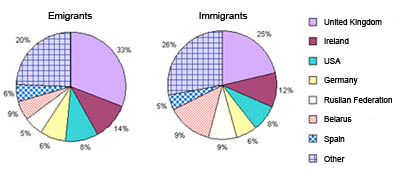
| Lithuanian Purchasing Power 53% of EU average | 25 June 2010 |
Based on first preliminary estimates for 20091, Gross Domestic Product (GDP) per inhabitant expressed in Purchasing Power Standards (PPS) varied from 41% to 268% of the EU27 average across the Member States.
In Finland, France, Spain, Italy, Cyprus and Greece, GDP per inhabitant was within 10% of the EU27 average. Ireland, the Netherlands, Austria, Sweden, Denmark, the United Kingdom, Germany and Belgium were between 15% and 35% above the average, while the highest level of GDP per inhabitant in the EU27 was recorded in Luxembourg. Slovenia, the Czech Republic, Malta, Portugal and Slovakia were between 10% and 30% lower than the EU27 average. Hungary, Estonia, Poland and Lithuania were between 30% and 50% lower, while Latvia, Romania and Bulgaria were between 50% and 60% below the EU27 average. |
|

| 10% of Estonian residents fear losing their home next year | 25 June 2010 |
Tallinn, June 22 (LETA-ELTA) - 10 per cent of Estonian residents that due to high costs they would have to leave their home during next year, writes Aripaev Online. 10 per cent of Estonian residents estimated that it is either very likely or rather likely that in the next 12 months they would have to leave their homes due to high expenditure, appeared from a Eurobarometer survey on the social impact of the crisis. This was the fourth highest result in the EU, while the EU average was 5 per cent. The survey carried out in May determined that 60 per cent of the EU citizens feel that the level of poverty grew in the entire union in the past year. In Estonia only 44 per cent of people felt so. While 73 per cent of EU citizens estimate that their pensions would either certainly decrease or they would have to work longer before retirement, in Estonia 58 per cent of those polled thought so. 54 per cent of the respondents in the EU are either very or rather concerned that their income during retirement would not guarantee dignified subsistence, but Estonians are more optimistic than average - 45 per cent of respondents here were of that opinion. |
|
| Lithuanian men are not able to become pensioners - Ziemelis | 25 June 2010 |
Vilnius, June 22 (ELTA) - Critically assessing the intention to extend the retirement age, Vidmantas Ziemelis, Elder of the Seimas Christian party political group, predicts that the greater part of Lithuanian men will not live to become pensioners. "Our men can rejoice - there is no risk for them to become pensioners, because the average life expectancy stands at 67 years, thus a significant number of men will not become pensioners," he stated ironically at a press conference on Tuesday. According to the politician, the Government should raise the retirement age not forcibly, but voluntarily. "The Government should promote the survival of pensioners in the labour market, reward them for agreeing to retire later. This should be an incentive measure, and thus we will not lose numbers in the labour market," Ziemelis said. By reducing maternity (paternity) benefits, the ruling majority, in Ziemelis' view, is prompting a new wave of emigration and decline in birth rates. |
|
| Degutiene interested in investigation of Pagegiai smuggling case | 25 June 2010 |
Vilnius, June 22 (ELTA) - Speaker of the Seimas Irena Degutiene addressed Prosecutor General Darius Valys asking to inform the society and her in person on the process and results of the case regarding smuggling that disappeared from Pagegiai frontier stores. The head of the Seimas drew the prosecutor's general attention to the fact that during her meeting with local residents and journalists in Silute and Taurage in April this year, this resonant case was remembered, and the officers that took part in the meeting could answer the question on how the case ended. The speaker of the Seimas thinks that this event was the open challenge of the smugglers for the state, therefore, the outcome of the case is very important for the society. "Because I believe that the smugglers threw an open challenge to the state and because the outcome of this case is very important for society, as well as taking into account the Law on the Prosecutor's Office, providing that the prosecutor's office organizes and patronizes the pre-trial investigation, I am asking to inform the society and me in person on the process and results of this case," Speaker of the Seimas Irena Degutiene writes in her letter to the prosecutor general. |
|
| STT officers detain Prosecutor Vaitiekunas | 25 June 2010 |
Vilnius, June 22 (ELTA) - The Special Investigation Service officers detained Prosecutor of the Pre-trial Investigation Control Division of the Prosecutor's General Office Erikas Vaitiekunas. This was confirmed by Jurgita Barzdziuviene, Spokesperson of the Prosecutor's General Office. Erikas Vaitiekunas was detained for taking a bribe and is in a detention facility. Vaitiekunas was detained upon the permission of new Prosecutor General Darius Valys. |
|
| Honest business-people need support and respect - Grybauskaitė | 25 June 2010 |
Vilnius, June 21 (ELTA) -, President Dalia Grybauskaite received representatives of companies taking part in the Transparent Business Initiative Baltoji banga and pointed out that socially responsible companies bearing the mark Baltoji Banga and employers not fooling their employees have to receive support and respect from Government and society. The objective of the movement Baltoji Banga is to promote the development of transparent and responsible business in the country, to help to reject the inappropriate practice of paying part of a salary in "envelopes", to avoid tax. According to the president it is very important that the business community itself is becoming socially responsible and is searching for ways to promote honest business. The more companies that join this movement, the less corruption there will be, Lithuania will become more attractive for foreign investors and the country's economy will recover faster. "It is vital to show confidence in fair and transparent business, thus, it is essential to enable representatives of small and medium businesses to exit the 'shadow' and operate legally," the press service of the president quotes the head of the state. |
|
| Law amendment to protect children from passive smoking | 25 June 2010 |
Vilnius, June 21 (ELTA) - Member of the Seimas Liberal Movement political group Gediminas Navaitis proposes to prohibit smoking inside cars when they carry children or pregnant women. The parliamentarian registered an amendment to Article 19 of the Law on Tobacco Control at the Secretariat of the Seimas Sittings. "The proposed amendment protects children's right and protects them from passive smoking. Unborn babies, whose mothers are in smoky rooms, are more likely to develop slower. Later, due to passive smoking, children are more likely to suffer from respiratory diseases," says Navaitis. The current Law on Tobacco Control, as MP navaitis notes, does not ban smoking in vehicles when they carry children or pregnant women. In Canada, some U.S. states and Australia, it is prohibited to smoke in a car when it carries children. |
|
| Education minister would disagree with lower wages for education workers | 25 June 2010 |
Vilnius, June 17 (ELTA) - Education Minister Gintaras Steponavicius sees saving possibilities in the system next year, but emphasises that he disagrees with the reduction of education workers' salaries. "Do you ask whether I would support the reduction of remuneration of education workers? I will disagree with that because education is one of the priorities," Steponavicius said at the Government's Hour in the Seimas on Thursday. The education minister said that there would be saving possibilities in other areas, for example, due to a decrease in the number of pupils next year. "We see a possibility of cutbacks in the state's investment programme. Especially this year, as we have had funds by several times more than the ones allocated over the several past years from the money allocated to the renovation of dormitories. Next year we would predict expenditures less by 10 million litas (2.89 million euros) in this area. In this way, we see reserves," Steponavicius said. However, the education minister stressed that consistent funding should be retained for the continuity of structural reforms. |
|
| Medvedev awards former president Brazauskas Order of Honour | 25 June 2010 |
Moscow, June 17 (ITAR-TASS-ELTA) - Russia's President Dmitry Medvedev has awarded former President of Lithuania Algirdas Brazauskas the Order of Honour for his significant contribution to cooperation between Russia and Lithuania and good neighbourly relations. Brazauskas was elected as the first president of Lithuania in February 1993. During his term of office, Lithuania and Russia signed important documents. Brazauskas had also served as the prime minister of Lithuania from July 2001. However, due to a governmental crisis, he resigned from the office on 31 May 2006 and retired from politics. Brazauskas headed the Government for five years, which made him the longest serving prime minister. He entered the history of Lithuania as a pragmatic politician who managed to improve relations with the neighbouring countries, including Russia. The Order of Honour is a state order which was founded by the President's Decree of the Russian Federation of 2 March 1994. The Order of Honour is awarded to citizens for high achievements in government, economic production, scientific research, sociocultural, public and charitable activities which essentially made it possible to improve conditions of life in the country, for merits in training highly skilled personnel, training the growing up generation, and the maintenance of legality and law. |
|
| NATO heads and Afghan National Army visited Ghor | 25 June 2010 |
June 17, Lt. Gen. David M. Rodriguez, Commander of the ISAF Joint Command, Brig. Gen. Claudio Berto, Commander of the ISAF Regional Command West, and Chief of ANA General Staff Gen. Bismullah Khan visited camp of the Lithuanian-led Chaghcharan Provincial Reconstruction Team in Ghor province, Afghanistan. |
|
| Kubilius: No plans to raise taxes - yet | 25 June 2010 |
Vilnius, June 17 (ELTA) - In the light of the new saving measures provided by the Government, Prime Minister Andrius Kubilius says that so far, there are no plans to raise taxes, however, he does not exclude such possibility in the future. This would depend on economic situation and tax collection to the state budget. Asked whether there were plans to increase value added tax, the prime minister said that because of the current budget deficit problems no discussions on increase of taxes were being held. According to Andrius Kubilius, it is necessary to reduce the difference between the state income and expenditure by around 4.5 billion litas in two years time. Thus, it would be possible to achieve 3 percent budget deficit in 2013. "At the moment, we have no plans regarding taxes," Prime Minister Andrius Kubilius, who is currently on a visit to Brussels, said to Ziniu Radijas over the phone. When asked whether there were plans to increase taxes this year, Andrius Kubilius said there were no such plans, however he did not exclude such possibility in the future. As reported, the Government proposes to freeze the salaries of politicians and state officials, to retain the 2 percent contributions to private pension funds, and to gradually increase retirement age starting from 2012. These proposals were agreed upon at a Government sitting on Tuesday; appropriate law amendments will soon reach the Seimas. |
|
| No deadline for withdrawing its troops from Afghanistan | 25 June 2010 |
Vilnius, June 16 (ELTA) - As the Poles consider withdrawing its troops from Afghanistan by 2013, Lithuania has not named any deadlines for that yet. "Right now in NATO we are talking about a transition period, it is a new and important step. We are probably in the middle of that, but still not at the end. The sooner we will be able to train Afghan police, soldiers, the sooner our troops will return home," National Defence Minister Rasa Jukneviciene said in a press conference on Wednesday. Polish Defense Minister Bogdan Klich, currently on a visit to Lithuania, said that his country had not made political decisions on its troops' withdrawal from Afghanistan yet and that it was still under discussion. "There is a very serious political debate in Poland about how and when to transfer the responsibility of the ISAF (International Security Assistance Force Operations - ELTA) into the hands of Afghans," said Klich. Earlier the Polish defense minister said to Poland's television TVN24 that it was planned to withdraw the Polish troops from Afghanistan by 2013 and that the country's contingent would be reduced as early as next year. |
|
| Let's not be afraid of truth - Degutiene | 25 June 2010 |
Vilnius, June 16 (ELTA) - At an international conference dedicated to commemorate the occupation and annexation of Lithuania and other Baltic States in 1940, Seimas Speaker Irena Degutiene urged everyone not to be afraid of truth no matter how unpleasant or unfavourable it was. In her opinion, it is the only way to reach agreement, mutual understanding and respect. "I wish all of us, and the participants of this conference and all the people of our countries, all nations: let's not be afraid of truth. No matter how unpleasant or unfavourable it sometimes is to one or another country, a nation, a person. This is the only way leading to agreement, mutual understanding and respect, to humane, ethnic and national solidarity. And it is the only way for Europe not to lose its fundamental values, its face and soul. This is the only way to destroy the Iron Curtain once and for all not only in a historical and political sense, but also in a human sense," said Degutiene when welcoming the participants of the international conference "1940 in the Baltic States: the Iron Curtain Falls" at the Seimas March 11 Hall. According to the Seimas speaker, the beginning of summer for Lithuania will always bear the mark of painful and tragic historical events. Since 1940, when Soviet troops occupied our country and forcibly incorporated it into the last empire of the 20th century, we have been marking this date in honour of the fallen and exiled people, remembering all the victims of the regime. The international conference "1940 in the Baltic States: the Iron Curtain Falls" was organised by the Office of the Seimas and the Lithuanian Genocide and Resistance Research Centre. The conference's aim was to assess the first year of the Soviet occupation, the period between 1940 and 1941, and its tragic consequences for the Baltic States. The conference dealt with the Soviet aggression against the Baltic States and a legal assessment of non-recognition policy of annexation, the mechanism and methods of the incorporation into the Soviet Union, outcomes of the Soviet terror, sovietization of the cultural life, the annexation's manifestation in the press and the resistance of the Lithuanian residents to the Soviet occupation. The conference was attended by historians and scientists of Lithuania and foreign countries (Poland, Latvia and Estonia) who delivered their reports. |
|
| Government decides on maternity benefits | 25 June 2010 |
Vilnius, June 16 (ELTA) - As of July 1 next year, the nationals having children will be able to choose maternity (parental) leave of one year or two years. In the former case, the SoDra will pay maternity benefits would comprise 100 percent of the former salary, while in the latter, the SoDra would pay 70 percent of the ptrvious pay in the first year and 40 percent of the pay in the second year. Such a decision on maternity leave and benefits was adopted by the Government at its Wednesday sitting. It was also decided to introduce a ceiling on maternity benefits of the 2.5 part of the insured income. It means that a maximum maternity benefit would amount to about 2,500 litas (723.74 euros). The Government also decided that the nationals on maternity (parental) leave would not be prohibited to earn extra income. After the Government's sitting, Prime Minister Andrius Kubilius said that these decisions would allow saving about 670 million litas (193.96 million euros). All these proposals of the Government are yet to be approved by the Seimas. |
|
| No matter how far from home, you protect the interests of Lithuania | 17 June 2010 |
* Photo: Dzoja Gunda Barysaitė Vilnius, June 14 (ELTA) - June 11, Friday, President Dalia Grybauskaite, accompanied by the Chief of Defense of Lithuania, Major General Arvydas Pocius, visited Lithuanian troops in Afghanistan's Ghor and Kandahar provinces, and in Kabul, the presidential press service reports. The president and her delegation flew to Afghanistan by a small jet plane offered for the trip by the United States European Command. President Grybauskaite went to Afghanistan to get on ground information about the activities of Lithuanian troops serving within the International Security Assistance Force and to discuss with members of the Lithuanian-led Provincial Reconstruction Team in Ghor the province's development agenda. According to the president, it is important that specialists from the US, Japan, Denmark, Ukraine, and Georgia stationed with the Lithuanian-led PRT are engaged not only in security operations, but are also actively involved in civil work and joint projects. Lithuania's partners within the PRT context are the European Commission, Germany, Greece, and Iceland. Such a wide circle of support shows that Lithuanian initiatives have international backing and respect from local people, the president said. This was also asserted by members of the Chaghcharan community who held poetry readings and a concert at a public library built by the Provincial Reconstruction Team. President Grybauskaite handed over religious and other books in the languages used in Afghanistan as well as Afghan music instruments to the library. The president also visited the Lithuanian Special Operations Forces deployed in Afghanistan's southern Kandahar Province to get acquainted with its tasks and preparedness. The president gave high assessment to the fact that NATO partners describe the special operation unit of Lithuania as one of the most professional in Afghanistan. High ranking Allied officers confirmed it when they met with Dalia Grybauskaite at the military base. According to the US Ambassador to Lithuania, Anne Derse, who travelled to Afghanistan together with Dalia Grybauskaite, Lithuania is a very good NATO partner and a great friend of the United States in Europe. In her meetings with Lithuanian servicemen in Chaghcharan, Kandahar and Kabul, President Grybauskaite underlined that the successful activities of our troops created Lithuania's reputation as a reliable partner in the eyes of its allies. "No matter how far from your homeland you serve, your work and dedication protect the interests of Lithuania and make it stronger. The experience you have gained is and will be needed. You are the pillar of further modernization of the Lithuanian Armed Forced. I wish you to serve safely and successfully here and - when you come back home - in Lithuania," the president said. According to NATO's standard practice, the visits made by heads of state to "hot spots" are not announced for security reasons. |
|
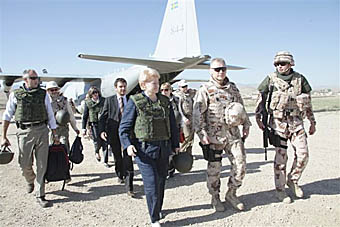
| Genocide day commemorated in Baltics | 17 June 2010 |
• Photo: Valdas Kopūstas (ELTA)(alfa.lt) Lithuanian, Latvian and Estonian leaders commemorated the remembrance of the victims of Soviet oppression on Monday. President Dalia Grybauskaitė said in a commemoration event that all of the bereavements have to be evaluated for the good of the future, the Baltic News Service reported. “All of those losses – not forgetting a single man – have to be named and evaluated for the good of the future. So that it would never repeat again, and those losses would remain the most painful period in the history of this nation,” the Lithuanian president said. The day of the mourning and hope is commemorated in Lithuania, remembering the June 14 of 1941, when the exile began after the Soviet Union had occupied Lithuania in 1940. Seimas speaker Irena Degutienė emphasized that June 14 is not only mourning, but also a hopeful day for Lithuania. “Commemorating the defenders of the freedom today, let‘s not forget, that today it‘s also a day for hope, a hope that withstands the threats of alien militaries and nurtures generations for freedom, a hope, that transforms a small nation into a proud fighter and helps to win the fight for truth,” said Degutiene. Latvian president Valdis Zatlers, speaking to thousands of Latvians gathered around the monument of Freedom, said that what happened, cannot be forgotten. “It cannot be forgotten, it was genocide of Latvian people.” The Estonian president stated that the historical truth has to be protected, because hard work has been done to ascertain it, BNS reported. |
|
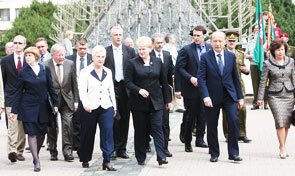

| Ūsas drowned - autopsy | 17 June 2010 |
Vilnius, June 15 (ELTA) - An autopsy has showed that Andrius Ūsas drowned; no external violence marks were found on his body. According to preliminary data, it is likely that Ūsas had health problems. Such information was presented by chief prosecutor Zenonas Burokas of the Division of Pre-trial Investigation Control of the Prosecutor General’s Office at a news conference on Tuesday. “It is likely that he drove into the water and climbed down, then perhaps stumbled. It is likely that he might have had health problems”, the prosecutor said. It is not clear yet whether Ūsas was drunk, had taken medicines or other substances. As reported, Ūsas, the only defendant in the so-called Kaunas pedophile, was found face down in water in a ditch in Eigirdonys village at about 4 p.m. on Sunday. One of the locals found Ūsas’ body, next to him there was Ūsas’ four-wheeled motorcycle with the engine still running. At the end of May, Panevėžys city local court was supposed to start hearing the case on the sexual abuse of Drąsius Kedys’ daughter, which involved only one suspect - Ūsas, however, the hearing was postponed until June 16 as Ūsas’ lawyer did not arrive to the court. |
|
| Prosecutors should invite independent experts - Degutienė | 17 June 2010 |
Vilnius, June 16 (ELTA) - Speaker of the Seimas Irena Degutiene says that the prosecutors investigating the death of businessman Andrius Usas and other deaths in the famous Kaunas pedophilia case should invite independent forensic experts. According to the head of the Seimas, the society is so overheated, that it is hard to believe in what is published in the media. According to Irena Degutiene, in order to avoid speculation it is necessary to invite independent forensic experts. “From what I hear, everything is very strange - Drasius Kedys choked, Usas drowned. Everything is like in a detective story. Indeed, it is necessary to ensure more clarity and transparency, and this is what is needed most of all today, because the case is very responsible and scandalous, in order to ensure that the question of whether a pedophile network is really operating in Lithuania, the prosecutor’s office has to find out everything and provide society with answers to all questions,” Irena Degutiene told on Ziniu Radijas on Wednesday. Irena Degutiene pointed out that there were a number of unclear things in the deaths of Drasius Kedys, Andrius Usas and Jonas Furmanavicius, and those deaths needed to be investigated very thoroughly. That would be a real test for new Prosecutor General Darius Valys. |
|
| Grybauskaitė Address to the Nation: Citizen - State - Future | 17 June 2010 |
Photo: Džoja Gunda Barysaitė.Vilnius, June 8 (ELTA) - At the Seimas Lithuanian President Dalia Grybauskaitė delivered her Annual State of the Nation Address. As required by the Constitution, the president reviewed the country’s political, economic, social, and cultural affairs and presented proposals on how to solve certain problems. The head of the state was not assessing the state of each sector of the state economy, but analysing the moral state of the country and its citizens, the reasons of the crisis in the underlying values, discussing human values and the importance of each and every citizen in supporting the state and creating the future of Lithuania. According to the president it is not the lack of money that makes people indignant, but the lack of justice and solidarity. “If we truly seek for real changes in the country, we have to turn to its highest values - the people. This guide is applied generally - from the highest officials to the servants of the lowest units, and at the same time - to each and every citizen,” said the head of state. The president called corruption one of the vices that demean human dignity and called to strengthen penalties for corruption-related crimes and to adopt the drafted laws aimed at fighting against corruption as soon as possible. In her annual report the President also named specific ways to reform the judicial system and to return public confidence in justice. The person, the state, the future - are the key words that according to the president should serve as guidelines in legislation in the fight against the non-transparent activities of interest groups, the dominance of departmental goals over the interests of the state. According to Grybauskaitė the interests of Lithuanian people are the priority not only of domestic, but also of foreign policy. “The strategic direction is one and unquestionable. It is the representation of the interests of the people of Lithuania and their goals, the assertion of national dignity in the international arena. This has to be achieved through the protection of state interests in the European Union, guaranteeing national security by maximizing Euro-Atlantic cooperation, by developing mutually respectful and beneficial relations with neighbouring countries,” said the president. Summarizing the situation of the state the president highlighted the alienation of society, the painful expression of this alienation - emigration - and called upon citizens for the responsible creation of the future of Lithuania. “I invite all of us to relate to the state as ‘our own’, to perceive its problems as ‘our own’, and to address them resolutely and creatively as ‘our own’. I invite each and every citizen of Lithuania to vote with great responsibility, to put forward just and fair demands, and to show a good personal example,” said the president. |
|
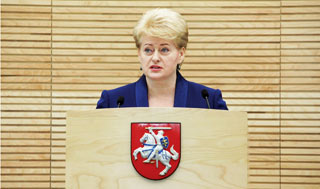
| Seimas allows more people to have dual citizenship | 17 June 2010 |
Vilnius, June 4 (ELTA) - The Seimas decided to allow more people to have dual citizenship. Under the amendment to the Law on Citizenship, those people who departed from Lithuania after March 11, 1990 - the restoration of Lithuanian independence - will be able to have a dual citizenship, if they are of Lithuanian origin and if they have a citizenship of a European Union or North Atlantic Treaty Organizations country and live in a country that is separated from the Republic of Lithuania by a state border. On Friday, such a proposal was approved of at the Seimas. 74 MPs voted in favour, 3 MPs against, and 14 MPs abstained from voting. Under the current Law on Citizenship, persons of Lithuanian origin who had Lithuanian citizenship and were evicted or departed from Lithuania over the period of 15 June 1940 and March 11, 1990 can have dual citizenship. |
|
| Government proposes to extend retirement age and retain current saving measures | 17 June 2010 |
Vilnius, June 15 (ELTA) - The Government proposes to freeze the salaries of politicians and state officials, to retain the 2 percent contributions to private pension funds, and to gradually increase retirement age starting from 2012. The retirement age would be gradually raises up to 65 years, by annually adding 4 months for women, and 2 months for men. So far, the Government has not decided upon the maternity (paternity) leave benefits. The Government aims at reducing the budget deficit to 3 percent of GDP. This means that around 4.5 billion litas need to be found. It is expected that additional 2 billion litas would be received from the recovering economy, the remaining amount - from various saving measures. |
|
| Politicians’ salaries to remain reduced next year as well - Kubilius | 17 June 2010 |
Vilnius, June 14 (ELTA) - The salaries of politicians and civil servants will remain reduced next year. Prime Minister Andrius Kubilius intends to propose to extend the validity of reduced salaries for the following year as well. “We decided that politicians’ salaries, as well as the other reductions, should remain reduced next year as well. “First of all, I have in mind the reduction of politicians’, civil servants’ and other officials’ salaries,” Prime Minister Andrius Kubilius said after the meeting of the ruling coalition partners with Speaker of the Seimas Irena Degutienė on Monday. According to him, the Constitutional Court has determined that while the emergency financial situation continues, the politicians - the Seimas and the Government - were entitled to take measures to address the problems of the emergency finance situation. “The emergency financial situation, we believe, will continue until we return back to the main macroeconomic parameters of 2008. And this is not certainly going to happen next year,” said Kubilius. According to him, it is also planned to implement the SoDra reform, decide upon the retirement age, the transformation of maternity benefits, and other issues, such as state pensions. |
|
| There should be less MPs - poll | 17 June 2010 |
Vilnius, May 11 (ELTA) - The number of parliamentarians at the Seimas should be smaller than 141, as it is now. Such opinion is shared by 91.7 percent of Lithuanian residents, however, people do not have a unanimous opinion on what the optimum number of parliamentarians should be. According to the poll conducted by the public opinion and market research company Spinter Tyrimai, 3.2 percent of the respondents thought that the number of MPs should be reduced from 141 to 120, 25 percent - to 100, and 85 percent of the respondent thought that the number of MPs should stand at 85. Another 40.4 percent of the polled said there should be less than 85 parliamentarians at the Seimas. Moreover, 69.3 percent of Lithuanian voters would like to elect representatives to the parliament in one-mandate constituencies, where it is directly voted for the candidates, not for the list drawn up by the party. Only 5.8 percent of the respondents would like to elect members of the Seimas from the list drawn up by the parties, whereas 7.6 percent of those polled did not have opinion or did not answer the question. Another 17.3 percent of people said that the Seimas election system could remain as it is - mixed. Under the mixed electoral system, half of the Seimas members are elected in one-mandate constituencies, and half - in one multi-mandate constituency, where the parliamentarians are elected from the lists drawn up by the parties and the voters can slightly change the sequence of the candidates in the list. |
|
| No matter how far from home, you protect the interests of Lithuania | 17 June 2010 |
Vilnius, June 14 (ELTA) - June 11, Friday, President Dalia Grybauskaitė, accompanied by the Chief of Defence of Lithuania, Major General Arvydas Pocius, visited Lithuanian troops in Afghanistan’s Ghor and Kandahar provinces, and in Kabul, the presidential press service reports. President Grybauskaitė went to Afghanistan to get on real information about the activities of Lithuanian troops serving within the International Security Assistance Force and to discuss with members of the Lithuanian-led Provincial Reconstruction Team in Ghor the province’s development agenda. According to the president, it is important that specialists from the US, Japan, Denmark, Ukraine, and Georgia stationed with the Lithuanian-led PRT are engaged not only in security operations, but are also actively involved in civil work and joint projects. The president also visited the Lithuanian Special Operations Forces deployed in Afghanistan’s southern Kandahar Province to get acquainted with its tasks and preparedness. The president gave high assessment to the fact that NATO partners describe the special operation unit of Lithuania as one of the most professional in Afghanistan. US Ambassador to Lithuania, Anne Derse, travelled to Afghanistan together with Dalia Grybauskaitė. “No matter how far from your homeland you serve, your work and dedication protect the interests of Lithuania and make it stronger. The experience you have gained is and will be needed. You are the pillar of further modernization of the Lithuanian Armed Forced. I wish you to serve safely and successfully here and - when you come back home - in Lithuania,” the president said. |
|
| Amendment proposes to deprive Paksas of presidential title | 17 June 2010 |
Vilnius, June 4 (ELTA) - It is proposed to deprive the persons who were removed from office following impeachment proceedings, of the title of President of the Republic of Lithuania. The draft project proposes to leave the title of the president only to those persons who carried out their duties by fair means and were not removed from presidency via impeachment. “Retaining the title of president of the republic of Lithuania for life is a privilege granted by legislature to a person who was elected to this position, who had the nation’s confidence and carried out his duties with dignity. Therefore, a person who lost the nation’s confidence and was removed from office through impeachment proceedings for violating the Constitution, law, who put personal or group interests above public interests, and discredited the state by his actions cannot be granted such privilege. The state cannot grant such privilege to a person who discredited it,” said Pečeliūnas. Should Parliament approve of the changes to the law, Leader of the Order and Justice political party, MEP Rolandas Paksas would no longer hold the title of President of the Republic of Lithuania. On Thursday, the Seimas adopted amendments to the Diplomatic Service Act, allowing Rolandas Paksas to retain his diplomatic passport. |
|
| New Visaginas Nuclear Power Plant - important project for the region: IAEA head | 17 June 2010 |
Visaginas, June 15 (ELTA) - The construction of new Visaginas Nuclear Power Plant is an important project for the entire region, says International Atomic Energy Agency (IAEA) Director General Yukiya Amano, who visited Ignalina on Tuesday. During his visit, Yukiya Amano inspected the Ignalina Nuclear Power Plant that was closed in 2009, he was presented with the plant’s decommissioning process and the process of the new power plant implementation project. Energy Minister Arvydas Sekmokas, who spoke at the presentation, noted that the two projects were coordinated by strong teams. According to the minister, Lithuania’s energy sector is currently experiencing an exceptional period when one power plant is closed and the construction of another plant is being planned. All these processes mean that the Lithuanian energy sector is switching to a market economy. The construction of a new power plant will ensure our energy independence and integration into the international energy community. Welcoming the attendees, IAEA Director General Yukiya Amano said that it was of a great interest for him to inspect the ongoing Ignalina Nuclear Power Plant decommissioning project. The IAEA head is convinced that the construction of the new nuclear power plant is an important energy project for the entire region. New Visaginas Nuclear Power Plant Director General Šarūnas Vasiliauskas welcomed the fact that Lithuania had the infrastructure necessary to develop nuclear energy that would contribute to the development of the European nuclear energy. |
|
| Lithuania seeks EU support to build new nuclear power plant | 17 June 2010 |
Vilnius, May 27 (Bloomberg-ELTA) - Lithuania is seeking the European Commission’s support to it help build a new nuclear power plant. “We are in talks with the European Commission to provide us with some financial instruments,” Energy Minister Arvydas Sekmokas said at a briefing in Vilnius on Thursday. “Lithuania has fulfilled its commitments by closing its nuclear power plant and we expect European solidarity and a joint-effort to develop the Visaginas nuclear plant.” The Baltic nation wants to build a new nuclear source of energy to replace the Soviet-era Ignalina plant, which stopped production in December to comply with pre-accession commitments to the EU. The government is looking for a strategic investor for the plant, which may cost as much as 5 billion euros. Lithuania is in talks with Iberdrola SA, Spain’s largest power producer, and four other undisclosed candidates to build the plant. The government will invite the five shortlisted investors to place binding bids by September 1, Sekmokas said on Thursday. |
|
| Government to raise pension age and balance maternity benefits | 14 June 2010 |
Vilnius, June 14 (ELTA) - In the short run, the Government will present draft laws on raising pension age, the extension of the duration of the reduced payments transferred to private pensions funds and "balancing the budget line on maternity benefits", Finance Minister Ingrida Simonyte says. The minister did not disclose what the Cabinet intended to do with maternity benefits, saying that specific decisions had not been made yet. After the Government's meeting on Monday, Finance Minister Simonyte told journalists that final decisions on the SoDra reform would be adopted in autumn, after all the estimations. |
|
| Pedophilia case to be investigated further if Usas's relatives wish | 14 June 2010 |
Vilnius, June 14 (ELTA) - A pre-trial investigation into the death of businessman Andrius Usas has been launched and will be continued only if his relatives want it to be continued, otherwise, the case will be closed, says Acting Prosecutor General Raimondas Petrauskas. According to Raimondas Petrauskas, on Sunday, at noon, Andrius Usas arrived at his friend's summer house in Eigirdonys village. At around 1 p.m. the man went to ride his four wheel motorcycle that he bought a week ago. Andrius Usas chose another than usual route. At around 3.40 p.m. the villagers heard the sound of a motorcycle and saw the vehicle and the man in the water. A local resident pulled out the body without life signs and informed special services. "A pre-trial investigation into the death has been initiated, the body's examination will show everything in the short run," Acting Prosecutor General Raimondas Petrauskas said on the Lithuanian Radio. According to Petrauskas, Usas' body initial inspection did not find any signs of violence. As stated by Petrauskas, the full inspection of Usas' body might be carried out on Monday. This would provide significant additional information."We cannot say that it was a violent death, the examination will reveal everything," the acting prosecutor general said. So far, it is not clear whether there was alcohol in Usas' blood. The acting prosecutor general did not disclose any specific data, but assured that all possible witnesses were being questioned. He said it was the first such experience in his practice when two main characters of the case died. When asked what were the prospects of the so-called pedophilia case, Raimondas Petraukas said that everything would depend on the relatives of Andrius Usas. Petrauskas is convinced that the death of Andrius Usas, differently from Drasius Kedys, is not beneficial to anybody. |
|
| EU ambassadors visit Medininkai on European Day for Border Guards | 11 June 2010 |
On the occasion of European Day for Border Guards, June 10, the heads of diplomatic missions of the European Union member states in Lithuania visited the Border Guard School in Medininkai. The visit was held at the initiative of Lithuania's Ministry of Foreign Affairs, the State Border Guard Service and the Ministry of the Interior, the press service of the National Defence Ministry, the press service of the Foreign Ministry reports. Lithuania's Deputy Minister of Foreign Affairs Asta Skaisgiryte Liauskiene presented the role of the Border Guard School in professionally training border guards for the protection of the EU's external border and spreading the good practice in the third countries. "Every day we guard the EU's external border that is nearly a thousand kilometres long. Therefore, we are interested in improving the external border control, perfecting on the professional training programmes for border guards and strengthening the cooperation with the third countries. Lithuania supports the initiatives to strengthen the role of Frontex and is ready to participate in this process actively," the Deputy Minister said. The European Agency for the Management of Operational Cooperation at the External Borders of the Member States of the European Union (Frontex) is a specialized and independent institution of the EU. Frontex coordinates operational cooperation between member states as regards management of external borders, helps member states train their national border guards by developing common training standards, analyses the risks, monitors research relevant to the control and surveillance of external borders, assists member states in circumstances requiring increased technical and operational assistance at external borders. Lithuania is a member of the agency. The Border Guard School in Medininkai belongs to the network of Frontex Training Units. The school ensures training of personnel in compliance with the strict requirements for the control and surveillance of the EU's external borders. The ambassadors also visited the memorial and the museum at Medininkai road post. The exposition of the museum is dedicated to the tragedy that happened at Medininkai road post on 31 July 1991. |
|
| Financing issues touched upon at meeting of NATO defence ministers | 11 June 2010 |
Brussels, June 11 (ELTA) - At a formal NATO defence ministers' meeting on Thursday, Lithuanian National Defence Minister Rasa Jukneviciene stressed the importance of increasing NATO visibility in the member states of the Alliance and proposed to host a NATO Response Force exercise in the region, the press service of the National Defence Ministry reports. The Lithuanian national defence minister called on the Allies to take part in activity of Energy Security Centre in the course of its establishment in Lithuania. "Our goal is to create a top-level NATO research centre to process analyses in the energy security sector," said Jukneviciene. In the discussion on financing the minister backed up proposals to save on NATO's resources. On the same occasion Jukneviciene also noted the necessity to maintain vital financing for NATO operations and strengthening of collective defence capabilities. During the formal session, the Lithuanian defence minister is also to meet with her Ukrainian and Georgian counterparts. On Friday, Jukneviciene will discuss regional security situation with her colleagues from Latvia, Estonia and Poland. Later a separate meeting of the national defence ministers of the Baltic States will be held to discuss on current issues of defence cooperation. |
|
| Rail Baltica to continue | 11 June 2010 |
Zaragoza, June 9 (ELTA) - The representatives of the transport ministries of Poland, Lithuania, Latvia, Estonia and Finland have expressed their political will to continue the project Rail Baltica by signing a memorandum. The memorandum was signed in Zaragoza, the city of Spain currently holding the EU presidency. At present, Zaragoza hosts the conference TEN-T Days 2010: Trans-European Transport Networks - drawing up the EU Core that is organised by the European Commission. In the conference, Lithuania is represented by Deputy Transport Minister Arunas Staras. This memorandum obliges Lithuania to carry out all the works that were laid down in the Government's approved plan of urgent actions that are to be taken to implement the Rail Baltica project. The project provides for the reconstruction of the broad gauge (1,520 mm) of the railway line the Polish-Lithuanian border-Marijampole-Kazlu Ruda-Kaunas by linking this to a standard rail gauge (1,435 mm) or building an additional European rail gauge along the existing railway line. All the works will be carried out by January 2014. In addition, the Kaunas public logistics centre will be set up by the beginning of 2015. |
|
| Estonia will help fight oil pollution in Mexico | 11 June 2010 |
Tallinn, June 8 (LETA-ELTA) - The Estonian interior ministry intends to send oil pollution fight beams to the Gulf of Mexico area in the coming days, Eesti Paevaleht reports. The request to send any kind of equipment suitable for fighting the oil pollution was sent to the interior ministry in the middle of May by Finland-based environmental company Lamor Corporation AB, which cooperates with British Petroleum that caused the oil pollution in Gulf of Mexico. Interior minister Marko Pomerants said that the Estonian state wants to help liquidate the environmental pollution in the Gulf of Mexico any way it can and for now, can send oil fight beams in the region. According to the Lamor Corporation AB this is what there is an urgent need for in the area. The equipment won't be given for free and new would be acquired to replace it since Estonia needs to preserve the ability to fight oil pollution near its coast too. Estonia does not intend to send any other pollution fight equipment nor human resources into the region as for now. |
|
| President Dalia Grybauskaitė's State of the Nation Address | 7 June 2010 |
* Photo: Dzoja Gunda Barysaitė Dear Fellow People of Lithuania, Distinguished Participants of the Parliamentary Sitting, Let us learn these lessons. Let us review our values and let us revive our ideals. The individual person must be the first consideration and the only measure of progress across all institutions and policies. Therefore, the priorities of my presidency are the following:
Ladies and Gentlemen, Only the principle of the INDIVIDUAL PERSON as the highest value will help us find answers to many questions. Only by making it strong and respected will we channel the energy of the government and the people in positive direction. I specifically do not mention any institutions or decisions because it has become a regular situation. Its scope and range expose some serious defects of our public life. Institutions and political parties have become "small Lithuanian duchies" with their own sovereign objectives and interests. The result of such fragmental and often contradictory activities is a legal environment that is unstable, indistinct and unreliable - an environment created already in the process of legislation that has no clear strategic purpose. And surely that is not because timidity, indifference or clichéd Lithuanian submissiveness are part of our national identity. That is certainly not so. Or the recent environmental campaigns which brought together crowds of young people with strong belief that they can make Lithuania clean and beautiful. It is all the more painful and shameful that the same people do not believe that they can also clean up Lithuania by voting. The decision to leave your homeland is a difficult one. But the number of those who decide to take this step is growing, and more and more Lithuanians are contemplating this possibility. We console ourselves by saying that it is but a natural consequence of the downturn. But the countries where our fellow citizens emigrate are also challenged by the crisis, unemployment, social vulnerability, and uncertainty. And it is not only those without a job who are leaving. So let us look the reality in the face and admit that people are emigrating not only for economic reasons. They are moving abroad because they feel aliens at home. Let us do it and start changing ourselves and our life. "To serve the Homeland, democracy, and the welfare of the people of Lithuania" - are these not the words of the oath that you and I have taken? Let us take concrete action to achieve real and important results for the people. We are talking about it every day. But if our concern is true and honest, we must acknowledge that the immediate budget will not support large financial injections to accelerate the economy. We know that we cannot make the tax burden much lighter. So let us do what we can: let us ease bureaucratic obstacles. Let us develop and promote the approach that IT PAYS TO BE HONEST. Fair and transparent businesses must have our trust. Let us create conditions to allow small business people in the shadow zone to provide for their families, straighten up, regain confidence, and start working legally with dignity and self-respect. We analyze its roots and project its consequences. We are indignant and angry. Last year alone, more than 700 pre-trial investigations into corruption were initiated. But only every second case reached the court. Only one person was actually sentenced for abuse of power. No one was convicted for bribes. First, a civil servant who abused his position for personal gain must be dismissed and the possibility of his return to office should be examined very carefully. We have no right to put the public interest at risk by readmitting those who treat civil service as a tool of enrichment back to office. What is more, it is the courts that are conducive to establishing a new quality relationship, based on mutual trust and confidence, between citizens and the state. Such a relationship is impossible without reliable, justice-serving courts. Regrettably, today people see the courts in a different light. Experts in law point to their evident shortcomings. The courts are criticized by the judges themselves. The system has become overly bureaucratic. It has become arrogant. Court leaders and self-government focus on the academic discourse and own inter-relations. Unfortunately, there is no place left for justice and human grievances in such discussion. The closed system, which is poorly controlled by the public, tolerates the spread of double standards. Delaying has become a tradition which is making us known across Europe. Lastly, the selection of judges and their evaluation, ethics and discipline case procedures. They will receive my special attention because I am convinced that only a corps of competent and devoted judges can serve justice in the name of the state. There is only one definite thing: the state cannot afford to be generous in the several years ahead. For this reason, it will have to be fair and wise - more than ever. Our pathway has been greatly challenging. We can feel either sad or angry about it. I INVITE US ALL TO RELATE TO THE STATE AS "OUR OWN", TO PERCEIVE ITS PROBLEMS AS "OUR OWN", AND TO ADDRESS THEM RESOLUTELY AND CREATIVELY ON OUR OWN! I INVITE EACH AND EVERY CITIZEN OF LITHUANIA TO VOTE WITH GREAT RESPONSIBILITY, TO PUT FORWARD JUST AND FAIR DEMANDS, AND TO SHOW PERSONAL EXAMPLE! I believe that we will overcome any crisis if we overcome the crisis of trust and responsibility in our hearts. Dalia Grybauskaitė, President of the Republic of Lithuania |
|
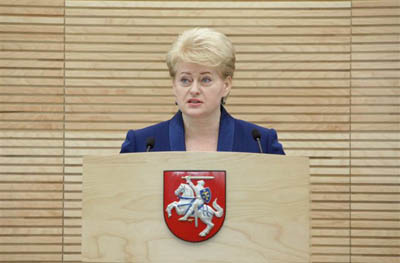
| Prosecutor to appeal to Seimas on Grazulis' and Uoka's immunity withdrawal | 7 June 2010 |
Vilnius, June 7 (ELTA) - The Prosecutor's General Office Adviser for Public Relations Jurgita Bardziuviene confirmed to ELTA that the Seimas will be appealed to on the withdrawal of immunity of Members of the Seimas Petras Grazulis and Kazimiras Uoka. Acting Prosecutor General Raimondas Petrauskas says that Grazulis and Uoka are suspected of possible disturbance of public order and resistance to officers. According to him, so far, there are no allegations of inciting riots. The acting prosecutor general intends to ask the permission of the Seimas to launch pre-trial investigation. "We have questions and we want to get the answers," said Petrauskas. On Monday, MP Petras Grazulis paid a visit to the Prosecutor's General Office. According to Raimondas Petraukas, Grazulis was questioned as a witness. The parliamentarian called the investigation an absurd and said he did not regret anything. As reported, group of the Seimas members "For equality" has officially addressed the Prosecutor's General Office and the Police Department under the Ministry of Foreign Affairs asking to investigate the behaviour of MPs Petras Grazulis and Kazimiras Uoka during the homosexual parade in Vilnius. |
|
| Austrevicius to investigate if trees in Minge were cut down legally | 7 June 2010 |
Vilnius, June 7 (ELTA) - Member of the Seimas Petras Austrevicius addressed Environment Minister Gediminas Kazlauskas asking him to launch an investigation in order to find out if longevous trees in Minge (Minija) village were cut down legally, as the media puts it. Because of its unique character the village is called the Lithuanian Venice and is a favorite destination for holidaymakers. "Unfortunately, too often various projects in Lithuania are being implemented without their full harmonization with relevant authorities. Such situations are very often related to environmental or cultural objects. This can no longer be tolerated. We need to increase sense of responsibility in project promoters and consciousness of public on these issues," says Member of the Liberal Movement political group Petras Austrevicius. According to the media, around 150 longevous trees, mostly poplars, were cut down in Silute district Minge village in preparation for managing the quay of the river Minija. The permits to carry out preparatory works were not harmonized with all the relevant bodies, and the project itself was not based on the requirements of Minge village landscape. |
|
| Returning Lithuanian peacekeepers will be met in Alytus | 7 June 2010 |
Vilnius, June 7 (ELTA) - On June 8, a solemn homecoming and decorations ceremony of the 10th rotation of the Provincial Reconstruction Team (Chaghcharan PRT-10) of Lithuanian peacekeepers in Afghanistan will take place in Alytus, informs Ministry of National Defence. In the event Minister of Defence Rasa Jukneviciene, Chief of Defence of Lithuania Maj. Gen. Arvydas Pocius, Ambassador of the United States in Lithuania HE Anne E. Derse, members of Seimas, leadership of the Armed Forces' subdivisions, leading officials of Alytus City administration, and families of returning troops are planned to participate. Homecoming ceremony of PRT-10 is scheduled to begin by a holy mass at St. Casimir's Church and a following solemn parade in the Alytus Town Hall Square. PRT-10 was based on the 1st Territorial Unit of Dainava Military District of the National Defence Volunteer Force. The 10th shift were deployed on a half-year duty in the mid-November of 2009. |
|
| President dismissed šiauliai City District Court Judge Pilitauskiene | 7 June 2010 |
Vilnius, June 7 (ELTA) - President Dalia Grybauskaite dismissed Siauliai City District Court Judge Vilija Pilitauskiene, who performed her duties with negligence, from office. Judicial local authorities determined that the judge delayed a number of administrative violation cases until their limit and, as a result, potential offenders remained unpunished, did not make the judgments on time and prevented any possibilities to appeal against her decisions, systematically and very seriously violated the order and terms of the litigation process and the principles of judicial ethics. The Judicial Council advised the head of the state to dismiss Pilitauskiene from office. According to Dalia Grybauskaite, the judge, who seriously and repeatedly violates the law, is not worth a name of a judge, as she discredits and demeans it. The conduct of the judge did irreparable damage to the reputation of the whole judicial system and undermined public trust into justice. The head of the state claimed that the situation in Siauliai City District Court revealed serious problems of judicial administration, therefore, the president will present proposals on how to strengthen the control of judicial system in the short run. |
|
| Child molesters face up to five years jail | 7 June 2010 |
Vilnius, June 4 (ELTA) - It is proposed to sentence child molesters to up to five years in prison, eliminating the possibility of paying a fine. On Friday, the Seimas approved of the amendments to the Article 153 of the Penal Code proposed by President Dalia Grybauskaite. Under the draft project, "the persons, who abused a child, shall be punished by restriction of freedom, arrest or imprisonment of up to five years". The draft project proposes to strengthen criminal penalties for abuse of a minor, because the penalties for some very dangerous methods and forms of child abuse are very soft. Under the current law, a person who abused a child should be punished by a fine, restriction of freedom or arrest or imprisonment for up to two years. |
|
| Seimas allows more people to have dual citizenship | 7 June 2010 |
Vilnius, June 4 (ELTA) - The Seimas decided to allow more people to have dual citizenship. Under the amendment to the Law on Citizenship, those people who departed from Lithuania after March 11, 1990 - the restoration of Lithuanian independence - will be able to have a dual citizenship, if they are of Lithuanian origin and if they have a citizenship of the European Union or North Atlantic Treaty Organizations country and live in a country that is separated from the Republic of Lithuania by a state border. On Friday, such proposal was approved of at the Seimas. 74 MPs voted in favor of such proposal, 3 MPs were against, 14 MPs abstained from voting. Under the current Law on Citizenship, persons of Lithuanian origin who had Lithuanian citizenship and were evicted or departed from Lithuania over the period of June 15, 1940 and March 11, 1990 can have dual citizenship. |
|
| Lithuania faces no immediate Greek crisis | 3 June 2010 |
Lithuania does not face the immediate prospect of a Greek debt and deficit crisis, but would do in a couple of years if it does not take fiscal consolidation measures now, Prime Minister Andrius Kubilius said on Tuesday. Last week Kubilius told parliament that his country, which has slashed spending and raised taxes amid a deep recession, must steel itself for more austerity if it wants to avoid a Greek-style debt crisis. "That was some kind of a metaphor used to convince Lithuanian politicians not to think that all has been done," Kubilius said an interview with Reuters Insider television. "My metaphor was very simple: if we hope that we can do nothing for the next two years we shall have problems we see now in south Europe," Kubilius said. Kubilius said he was optimistic about being able to reduce the budget deficit by another 5% of GDP after the country was able to implement austerity measures equal to some 12% of GDP in 2009 and 2010. But he wanted parliament to act fast and was concerned that "That is why we need to have our consolidation package as soon as possible, we cannot wait until the problems become more serious in international markets...That's why I sent the message to the parliament," Kubilius said. The finance minister has said Lithuania still needed to borrow about 2 billion Lithuanian litas after raising a record US$2 billion international bond in February. Despite the austerity measures already implemented, Lithuania still faces a deficit of 8% of GDP in 2010. Kubilius said Lithuania was not considering the option to break its peg to euro, despite the fall and that euro adoption in 2014 was the goal. Asked whether he saw Greek problems dealing with euro zone enlargement, he said: "No, I don\'t think so." Lithuania pledged to the European Union to cut its deficit to 3% of GDP by 2012, qualifying it to adopt the euro in 2014. The country targets a deficit of 8.1% of GDP in 2010 and 5.8% in 2011. |
|
| Lithuanian Police Help Crack Hostage Case | 1 June 2010 |
The Isreali press has been running a story about an Isreali Diamond Merchant who was abducted during a trip to VIlnius. A ransom of around $60,000 was demanded by the adductors, who were said to be known to the victim, according to reports in Ynetnews.com and Itar-Tass. The man was abducted on arrival in Vilnius last Sunday, and rang his girlfriend to notify his family of the ransom demand, and she in turn contacted Isreali police and Interpol. The Lithuanian police were soon pulled into the investigation, including Lithuania's elite ARAS unit, and on tracing the phone calls started to close in on the kidnappers. Police representatives in Moscow phoned the kidnappers to tell them the money was transferred for them, but on arrival at the bank two men were ambushed and arrested in a special rescue operation and charged on suspicion of kidnapping and holding a hostage. The victim was with the kidnappers at the time of the arrest and had been held for two days. He was released unharmed. There were almost certainly other accomplices and more arrests are expected. Lithuanian police are said to be grateful for the international cooperation between Interpol, the Isreali police and their representatives in Russia. Other sources have claimed that the kidnappers were former business associates and had a claim of being owed $57,000 by the Isreali businessman. |
|
| Baltic Development Forum Focuses On Overcoming Baltic Energy Isolation | 1 June 2010 |
One of the most important topics for Lithuania - efforts to overcome energy isolation of Lithuania and other Baltic States and to strengthen energy security in the Baltic Sea region – is included into the agenda of the Baltic Development Forum (BDF) Summit, which started on 1 June in Vilnius. Participants of the Summit will discuss the implementation of projects, which are foreseen under the Baltic Energy Market Interconnection Plan that was approved last June. The projects aim to overcome energy isolation of Lithuania and other Baltic States, to reduce dependence on a single external supplier of gas, to create a common region’s energy and gas market and to integrate it into a common energy system of the European Union. The financial instruments that are necessary for the implementation of the projects under the Baltic Energy Market Interconnection Plan will also be discussed. Lately, some progress has been achieved in the area of the creation of electricity energy market. Therefore, gas projects and issues relating to the creation of gas market will receive a lot of attention during the event. During the Summit, the Visaginas Nuclear Power Plant project will be presented to the countries of the Baltic Sea region. Lithuania, Latvia, Estonia and Poland are participating in the implementation of the project. It is expected that the implementation of this project will strengthen energy security in the region and will reduce the pollution that negatively affects the climate change. The event will stress the role of the region’s countries in tackling climate change and in respecting commitments on the use of renewable energy sources. Participants of the Summit will discuss technology development opportunities and their significance for modelling the low emissions economy. Discussions will be held on particularities of the use of renewable energy resources in the region, possibilities to increase the competitiveness and energy efficiency by integrating the energy markets of the Baltic Sea region. During the Summit, a discussion “Green Corridors - New Transportation and Logistical Concept” will take place at Lithuania’s initiative. The core of the Green Corridors is the adaptation of region’s transport links and infrastructure for developing new technologies, as well as making intermodal and energy efficient decisions. The discussion aims to promote regional cooperation and exchange experience in the area of the development of Green Corridors, to help attract investments, to apply new technologies and, eventually, to accelerate the creation of high-quality, efficient and environmentally friendly transportation system in the entire Baltic Sea region. The BDF has organized such Summits in the countries of the Baltic Sea region annually since 1999. Influential personalities from business, politics and academic community gather to discuss the current economic situation and possibilities to improve it, the European Union’s policy in the Baltic Sea region, and to search for mutual cooperation opportunities. The fact that the Baltic Development Forum Summit is held in Vilnius shows that Lithuania has established itself as an active state in the Baltic Sea region. |
|
| It's a country's decision whether to have a power plant - Barroso | 1 June 2010 |
Vilnius, June 1 (ELTA) -President of the European Commission Jose Manuel Barroso has said that the issue of financial instruments to the construction of the Visaginas nuclear power plant will be considered as soon as the construction project is presented. "We have to look at it, I cannot say anything now. I have not seen any projects and specific applications yet," the president of the European Commission said on Lithuania's possibility of receiving financial assistance on Tuesday. Barroso also emphasises that it is a decision of a member state to have or not to have a nuclear power plant. "The European Commission does not promote a specific type of energy. It (the construction of the nuclear power plant - ELTA) is a decision of countries, we do not advise a member state to have or not to have a nuclear power plant. As you know, some European Union countries have it, some do not have it. When the project is presented, we will analyse it and consider the possibility of funding the project," Barroso said. As reported, last week Energy Minister Arvydas Sekmokas said that Lithuania asked the EU for "financial instruments" to support the erection of the nuclear power plant in Visaginas. According to Sekmokas, the Visaginas AE project is a regional one, thus, not only Lithuania should take care of minimizing its risks, but the entire European Union. Sekmokas noted that potential investors also expected EU financial instruments. |
|
| Pickets against gas price increases to be held three days | 1 June 2010 |
Vilnius, June 1 (ELTA) - On June 1-3, the New Union (the Social Liberals) will hold pickets against an increase in gas prices for household consumers. The pickets will start near the buildings of the National Control Commission for Prices and Energy (VKEKK), Lietuvos Dujos, the Government and the Energy Ministry at 16:00 everyday. "Did gas operators recall Lithuania's economic situation when presenting their proposals? Although they do not feel the crisis themselves, they should know about the increasing unemployment rate and businesses going under at least from newspapers. An increase in gas prices would lead to an increase in heating prices. What should we expect in winter?" the New Union said in its statement. As reported, natural gas prices for residents will go up by 15-20 percent as of July 1. Last Thursday, the VKEKK confirmed the prices for household consumers that had been proposed by the company Lietuvos Dujos. The residents who consume up to 500 cubic metres of gas per year will have to pay 0.28 litas more for a cubic metre. Presently, they pay 1.87 litas for this amount of gas. A cubic metre of gas will cost 1.56 litas (the present price is 1.29 litas) to the residents who consume 500-20,000 cubic metres of gas a year, while the ones who consume over 20,000 cubic metres of gas a year will have to pay 1.56 litas as of July 1. Under the existing Law on Natural Gas, gas prices for residents are estimated twice a year. |
|
| Visit of German Chancellor Merkel cancelled | 1 June 2010 |
Vilnius, June 1 (ELTA) - The visit of German Chancellor Angela Merkel to Lithuania that was scheduled for Tuesday afternoon has been cancelled. Lithuanian Ministry of Foreign Affairs did not comment on the details of the cancellation. In Vilnius, Chancellor Angela Merkel was supposed attend a dinner for heads of government of the Baltic Sea states. In a meeting, Lithuanian President Dalia Grybauskaite and German Chancellor Merkel were supposed to discuss bilateral relations between Lithuania and Germany, possibilities for strengthening cooperation in energy and transport sectors and increasing the volume of transit cargo transported from Germany to Afghanistan via the Lithuanian seaport of Klaipeda. The consequences of the economic and financial crisis for the European Union and the most effective ways of resolving the existing problems will be on top of the meeting agenda. |
|
| Second Iceland volcano likely to erupt | 1 June 2010 |
London, May 31 (LETA-AFP-ELTA) - Experts warn: An Icelandic volcano neighbouring Eyjafjöll, whose eruptions paralysed Europe's skies last month, could come to life in the near future, AFP is quoted by The Swedish Wire. "An eruption in the short term is a strong possibility," experts said, referring to Katla, which is larger and fiercer than Eyjafjoell, in a report from the University College London (UCL) institute for risk and disaster reduction. The researchers also cautioned that Europe's skies were likely to be hit by further ash cloud shutdowns, following April's widespread closures and several smaller scale shutdowns since. The report warned that "future moderately to highly explosive Icelandic eruptions combined with appropriate weather conditions are highly likely to cause a repeat of the recent air transport disruption." The Eyjafjoell volcano began erupting on April 14, and spewed out an ash cloud that drifted over Europe and led to massive flight disruption throughout the continent for several days. It caused the biggest airspace shutdown in Europe since World War II, affecting more than 100,000 flights and eight million passengers. As reported, Estonian national carrier Estonian Air suffered ten to fifty million kroons of damages due to the Icelandic volcano ash cloud. Lately, several flights from Riga International Airport have been cancelled on May 17 due to volcanic ash and fog. The UCL experts - encompassing scientists, engineers and statisticians also criticised the response to the eruption. "The severe disruption to European airspace in April from (the volcano's) ash clouds reflect a lack of integration between the monitoring, warning and risk management systems," said Carina Fearnley, of UCL's hazard research centre. In a second report released Thursday, a team of British researchers said they had discovered a significant electrical charge in the ash plume. The scientists, from the Institute of Physics, said they found that "the ash plume which hovered over Scotland carried a significant and self-renewing electric charge." They warned that the charge could pose a risk to both planes and passengers. "Charged particles can cause aircraft radio interference and, if introduced into aircraft cabins, charged ash may present an electrostatic hazard to occupants or aircraft systems," said the report. The scientists used a specialist weather balloon to conduct research on a section of the ash cloud floating over Scotland. |
|
| People should not be intimidated with new taxes - Social Democrats | 1 June 2010 |
Vilnius, May 31 (ELTA) - Elder of the Seimas Social Democrats Party political group Algirdas Butkevicius is convinced that it would not be right to introduce the property tax now. "In order to impose a property tax, it is necessary to decide upon the minimum non-taxable property. However, this tax cannot be adopted now, because to burden people with another tax when the consumption is decreasing and people's incomes continues falling would be simply socially unjust," Butkevicius said at a press conference on Monday. Member of the Seimas Social Democrat Algirdas Sysas also criticizes the proposals to introduce the property tax. "To my mind, the introduction of the property tax should be considered well and people, whose income decreased dramatically over the last year and a half, should not be intimidated with one or another additional tax." Prime Minister Andrius Kubilius and Finance Minister Ingrida Simonyte started speaking of the "green" motor vehicles and property taxes after the visit of the International Monetary fund representatives in Lithuania. |
|
| There should be less MPs - poll | 31 May 2010 |
Vilnius, May 11 (ELTA) - The number of parliamentarians at the Seimas should be smaller than 141, as it is now. Such opinion is shared by 91.7 percent of Lithuanian residents, however, people do not have a unanimous opinion on what the optimum number of parliamentarians should be. According to the poll conducted by the public opinion and market research company Spinter Tyrimai, 3.2 percent of the respondents thought that the number of MPs should be reduced from 141 to 120, 25 percent - to 100, and 85 percent of the respondent thought that the number of MPs should stand at 85. Another 40.4 percent of the polled said there should be less than 85 parliamentarians at the Seimas. Moreover, 69.3 percent of Lithuanian voters would like to elect representatives to the parliament in one-mandate constituencies, where it is directly voted for the candidates, not for the list drawn up by the party. Only 5.8 percent of the respondents would like to elect members of the Seimas from the list drawn up by the parties, whereas 7.6 percent of those polled did not have opinion or did not answer the question. Another 17.3 percent of people said that the Seimas election system could remain as it is - mixed. Under the mixed electoral system, half of the Seimas members are elected in one-mandate constituencies, and half - in one multi-mandate constituency, where the parliamentarians are elected from the lists drawn up by the parties and the voters can slightly change the sequence of the candidates in the list. |
|
| Lithuanian-Polish gas pipeline necessary - European commissioner for energy | 31 May 2010 |
Vilnius/Madrid, May 28 (ELTA) - National and regional energy projects are a stimulus for a growth of the entire Europe, therefore Europe must show solidarity in its support for strategic projects, European Commissioner for Energy Gunther Oettinger said to Lithuanian Energy Minister Arvydas Sekmokas in Madrid on Friday. The capital of Spain holds the conference on European energy infrastructure. The bilateral meeting focused on the integration of the Baltic States into European energy networks. It also assessed progress in energy interconnection projects of the Baltic countries. The EU commissioner was particularly interested in the development of the new regional Visaginas nuclear power plant project. "Oettinger was interested in what support instruments are needed for the new nuclear power plant to ensure as rapid implementation of this important regional project as possible," Sekmokas said after the meeting with the EU commissioner. Speaking in the conference, Sekmokas emphasised that the reliability and security of energy supply would be guaranteed not only by gas and electricity connection infrastructure projects, but also new generation capacity. Commissioner Oettinger in his speech stressed that the requirements of the EU's third package of energy and the focus on the development of infrastructure projects were like a new business plan for Europe. "For example, the Lithuanian-Polish gas pipeline. It costs a lot. However, it is necessary for European solidarity, competition, the single market and the security of supply," the EU commissioner said. |
|
| New British foreign secretary looks forward to developing cooperation with Lithuania | 31 May 2010 |
Vilnius, May 28 (ELTA) - New British Foreign Secretary William Hague sent a letter to Lithuania's Minister of Foreign Affairs Audronius Azubalis, highlighting the determination to continue and to broaden the close working relationship that the UK and Lithuania shares both bilaterally and within the framework of the EU and NATO. In the letter, Hague writes that he knows of the ambitious programme of public sector reform that Lithuania is currently undertaking and hopes that the UK is able to share good practice and experience with the Lithuanian institutions to assist in this. The new British Foreign Secretary also writes that he admires Lithuania's contribution to the international effort in Afghanistan. "Our continued effort is necessary to enable the Afghanistan government and police to stabilise security and civilian development. I saw for myself there last week the scale of the challenge: but also the changes that are happening," Hague writes in the letter of 26 May. Hague expresses gratitude for the consultations that Lithuania is carrying out on the subject of the priorities of Lithuania's chairmanship of the Organization for Security and Co-operation in Europe next year and stresses that he looks forward to cooperating closely on this, the press service of the Foreign Ministry reports. |
|
| Seimas is asked to annul Sacharukas' legal immunity | 31 May 2010 |
Vilnius, May 28 (ELTA) - Acting Prosecutor General Raimondas Petrauskas appealed to the Seimas asking it to annul the immunity of MP Aleksandras Sacharukas, to allow bringing him under criminal prosecution, and if necessary, otherwise restrict his freedoms. On Friday, the Seimas will decide on forming an ad hoc investigation commission on permission to prosecute MP Aleksandras Sacharukas. According to prosecutors, Sacharukas abused his office, forfeited documents and used a document of another person. Sacharukas voted on behalf of his colleagues during the sittings of the Seimas' plenary session on January 9 and 14. The Seimas appealed to the Constitutional Court for conclusions on whether the actions of MPs Sacharukas and Linas Karalius did not violate the Constitution. |
|
| President Grybauskaite and Chancellor Merkel to discuss Lithuanian-German relations and urgent EU issues | 31 May 2010 |
Vilnius, May 28 (Vilnius) - Next Tuesday, June 1 at 17.00 hours, President Dalia Grybauskaite will meet with the Chancellor of the Federal Republic of Germany, Angela Merkel, who will be in Vilnius on a working visit, informs press service of the president. Among the issues scheduled for discussion are bilateral relations, possibilities for strengthening cooperation in energy and transport sectors and increasing the volume of transit cargo transported from Germany to Afghanistan through the Lithuanian seaport of Klaipëda. The consequences of the economic and financial crisis for the European Union and the most effective ways of resolving the existing problems will be on top of the meeting agenda. "Germany is one of the largest and most important EU member states and Lithuania places special focus on cooperation with Germany. Together with Chancellor Angela Merkel we will discuss concrete measures to be taken by Europe to best ensure the EU's economic growth and prevent any possible crisis in the future. The downturn is a serious challenge to the EU economy and finances, but it is also an opportunity to carry out vitally important structural reforms in pursuit of the common economic policy," the President said. In Vilnius, Chancellor Angela Merkel will attend a dinner for Heads of Government of the Baltic Sea states. |
|
| Lithuania needs more austerity to avert crisis - Kubilius | 31 May 2010 |
Vilnius, May 27 (Reuters-ELTA) - Lithuania's prime minister said his country, which has slashed spending and raised taxes, must steel itself for more austerity if it wants to avoid a Greek-style debt crisis. The Baltic state was the among the states in the European Union that was worst hit by the global financial turmoil, last year seeing its economy shrink 14.8 percent while the budget deficit soared to 8.9 percent of gross domestic product. "If we do nothing, we will end up in the same situation as Greece. A default by the state would hit every ordinary person," Prime Minister Andrius Kubilius said at the Parliament. The International Monetary Fund (IMF) said last week that Lithuania needed a further fiscal adjustment of 5.5 percent of GDP if it wanted to hit its end-2012 target of cutting its deficit to 3 percent. "In order to secure our ability to borrow on international markets on acceptable terms we need to cut the deficit by 4.5 billion litas (1.302 billion euros)," Kubilius added. He said about 500 million litas of this should from tax rises. Earlier he told commercial radio that economic growth should help boost revenues by 1 billion litas, while spending cuts should provide 1.8-2 billion litas. Revenues from tax rises would raise another 500-800 million litas, he said. Plans to introduce a personal real estate tax or vehicle tax are being considered, but some members of the four-party ruling coalition oppose new taxes. Lithuania pledged to the European Union to cut its deficit to 3 percent of GDP by 2012, qualifying it to adopt the euro in 2014. The country targets a deficit of 8.1 percent of GDP in 2010 and 5.8 percent in 2011. Finance Minister Ingrida Simonyte told the Parliament Lithuania needed fiscal austerity rules to prevent high deficits in the future and stop debt spiralling. "Debt, not the deficit, is going to become a major problem in the long run," she told reporters later. The minister proposed tying budget figures to indicators of overall consumption, the main driver behind inflation, which prevented Lithuania from adopting the euro in 2007. "We should prevent political-cyclical influence on the budget," she said. Past pro-cyclical fiscal policies had aggravated the crisis when it came, she added. The IMF also warned that, without further fiscal adjustment, Lithuania's debt could rise to above 60 percent of GDP by 2013, though it raised its GDP growth forecast to 2 percent in 2010 from the previous forecast of a 1.6 percent contraction. |
|
| Lithuania seeks EU support to build new nuclear power plant | 31 May 2010 |
Vilnius, May 27 (Bloomberg-ELTA) - Lithuania is seeking the European Commission's support to it help build a new nuclear power plant. "We are in talks with the European Commission to provide us with some financial instruments," Energy Minister Arvydas Sekmokas said at a briefing in Vilnius on Thursday. "Lithuania has fulfilled its commitments by closing its nuclear power plant and we expect European solidarity and a joint-effort to develop the Visaginas nuclear plant." The Baltic nation wants to build a new nuclear source of energy to replace the Soviet-era Ignalina plant, which stopped production in December to comply with pre-accession commitments to the EU. The government is looking for a strategic investor for the plant, which may cost as much as 5 billion euros. Lithuania is in talks with Iberdrola SA, Spain's largest power producer, and four other undisclosed candidates to build the plant. The government will invite the five shortlisted investors to place binding bids by September 1, Sekmokas said on Thursday. |
|
| Degutiene thanks Congressman Shimkus for support to Lithuania | 31 May 2010 |
Vilnius/Washington, May 27 (ELTA) - On Wednesday, Seimas Speaker Irena Degutiene met with U.S. Congressman John Shimkus at the U.S. House of Representatives and thanked him for his constant support to Lithuania. "We hope that you will continue supporting Lithuania's interests whenever our country needs the support and help of U.S. congressmen," said Degutiene, currently on a visit to Washington. Shimkus emphasised that Lithuania and other Baltic States were important long-term partners of the U.S. in Europe and that the U.S. should rely on such partners more in its relations with Russia. "In this respect your visit to the U.S. is very important. It is very important that you are here and that you will meet with the heads of the Congress and committees tomorrow (Thursday - ELTA)," the U.S. congressman said. On Wednesday, the Seimas speaker also attended the discussion Strengthening of U.S., Nordic and Baltic Partnership: Parliamentary Prospects of the parliament speakers of the Baltic and Nordic states. On Wednesday evening, the Lithuanian Embassy hosted a working dinner in the name of the Seimas speaker for the Nordic and Baltic heads of parliament. On Thursday, Degutiene will attend the meeting of the Nordic and Baltic parliament speakers with Nancy Pelosi, speaker of the United States House of Representatives, Chairman of the House Committee on Foreign Affairs Howard L. Berman, the leadership of the International Republican Institute, and other high US officials. Degutiene will also visit Baltimore and meet with the local Lithuanian community. |
|
| Grybauskaitė refuses to comment on Russia's criticism against her | 31 May 2010 |
Vilnius, May 26 (ELTA) - President Dalia Grybauskaitė gives no comments on the words of the Russian Foreign Ministry which criticised her statements about postwar guerrillas. Spokesman of Russia's Foreign Ministry Andrei Nesterenko said that the political and information tone which was being set on bilateral relations showed that it was "too early to speak about the possibilities of achieving a completely new level in the dialogue between Lithuania and Russia." "I do not comment on statements of individual officials in all countries. It is not my level to do that," the president said after being asked to evaluate the criticism of the Russian official against her. Grybauskaite had said earlier that "guerrillas showed to the world that Lithuania's voluntary accession to the USSR had been nothing more than a myth." According to Nesterenko, such statements point to double standards in Vilnius policies. |
|
| Court postpones hearing of Usas case | 26 May 2010 |
Panevezys, May 26 (ELTA) - Panevezys District Court failed to begin the hearing of the case of businessman Andrius Usas, who is alleged of molesting a little girl. Due to the illness of Usas' lawyer, the hearing was postponed for several weeks. Upon arriving to Panevezys District Court, Andrius Usas was met by a crowd of journalists, and in order to avoid their attention, the man entered the court through a separate entrance. The hearing was closed. However, the trial was postponed, because the Lawyer of Andrius Usas Loreta Kraujutaitiene did not arrive to the court. The court received a statement that the lawyer was ill. The next sitting is scheduled for June 17. |
|
| Lietuvos Rytas takes LKL title in Game 7 | 26 May 2010 |
After a gruelling seven game series, Lietuvos Rytas lifted the LKL trophy with a 80 - 71 win in the final game. In a series that had a bit of everything, it will unfortunately most likely be best remembered for the controversy surrounding claims of match-fixing and corruption in the sport. It was widely believed that Vladimir Romanov, the owner of Žalgiris, fired coach Maskoliūnas after game three on the pretext of match-fixing so that he could get around the LKL regulation that changes to club rosters and coaching staff cannot be made after 1 March. However the rumours persisted, and amid claim and counter-claim Jonas Vainauskas, Chair of the Lietuvos Rytas board, vehemently denied the accusations and said he was still considering legal action for slander. Coach Kurtinaitis of Lietuvos Rytas also stated in the press conference after game seven that he was disappointed to be fielding questions from abroad about the corruption issue instead of the intriguing basketball series that had just concluded. With a ticket to Euroleague on the line for Lietuvos Rytas (Žalgiris already has a contractual right to play in Euroleague), a win in the LKL was paramount and all coaching and management staff steadfastly denied the accusations. Mantas Kalnietis, point guard for Žalgiris, also assured everyone that their team did all it could to win the series and there was no effort spared on the floor. Žalgiris did themselves proud by taking the series to seven games after having to play the last four without a coach on the sidelines. |
|

| Seimas appeals to Constitutional Court on Karalius and Sacharukas | 26 May 2010 |
Vilnius, May 25 (ELTA) - The Seimas decided to launch impeachment proceedings against MPs Linas Karalius and Aleksandras Sacharukas and to appeal to the Constitutional Court on their actions. 77 members of the Seimas voted for the resolution proposing to appeal to the Constitutional Court on the actions of Aleksandras Sacharukas, who voted on behalf of his colleagues at the Seimas sittings, 8 MPs were against and 14 MPs abstained from voting. The resolution proposing to appeal to the Constitutional Court on the actions of Linas Karalius was supported by 75 MPs, 4 MPs were against and 16 MPs abstained from voting. Ironizing, Member of the Seimas Labour Party Kestutis Dauksys proposed the Seimas "to appeal to the Constitutional Court on all issues". Member of the Christian Party political group Jonas Ramonas calls the appeal to the Constitutional Court politicking, and encourages to behave "prudently and reasonably in order to avoid politicking". Another member of this group Ligitas Kernagis called the MPs to think before voting, since there was a number of the Seimas members who also voted on behalf of their colleagues and who went on holidays without the permission of the Board of the Seimas. Meanwhile, member of the Seimas Homeland Union-Lithuanian Christian Democratic political group Saulius Peceliunas believes that there is no other way but to appeal to the Constitutional Court on the accusations cast on the two MPs. The Constitutional Court is asked to determine whether the actions of MPs Karalius and Sacharukas contradict the Constitution. On May 20, the Seimas approved of the conclusions of the special investigation commission proposing to launch impeachment proceedings against the two MPs, who possibly broke the oath as the Seimas members and violated the Constitution. |
|
| Kidnapped ship captain safe | 22 May 2010 |
Klaipeda, May 21 (ELTA) - The Lithuanian shipping company Limarko reports having contacted ship captain Dmitry Bashkirov who was captured near the West African coast. "He has affirmed that he is healthy. The company takes all the necessary measures together with state institutions to ensure as rapid return of the captain to Klaipeda as possible," the company said in its statement. Limarko refused to provide any further details on the situation to avoid any problems. Captain Bashkirov of the motor vessel Argo, owned by Limarko, was seized on May 16 night, at 2:00 a.m. (the Lithuanian time). Armed men captured one crew member, Captain Bashkirov, and went in a motor boat in an identified direction. At present, the motor vessel, which sails under the Lithuanian flag, is moored in the Cameroonian port of Douala. Other crew members are reported to be healthy and safe. An interdepartmental working group has been formed to coordinate the actions related to the freeing of the Lithuanian citizen. The group is headed by Foreign Minister Audronius Azubalis. |
|
| A quarter of Lithuanians trust no public figure - Baltijos Tyrimai | 22 May 2010 |
Vilnius, May 21 (ELTA) - In April, as earlier, Lithuanian residents trusted President Dalia Grybauskaite most. The head of state was mentioned first in a survey by four respondents out of ten. According to the survey conducted by the market research company Baltijos Tyrimai on April 20-26, respondents were asked to indicate what Lithuanian public figures they trusted most. The respondents named the persons by themselves; they were not given any preliminary list. A quarter (23%) of those polled said that there were no such public figures they could trust or they declined to answer the question at all. Among those polled, 42% of the respondents gave most favourable ratings to President Grybauskaite. The list of most trusted public figures also included Seimas Speaker Irena Degutiene (9%), MP Algirdas Butkevicius, leader of the Social Democrats (7%), ex-President Valdas Adamkus (6%), MEP Viktor Uspaskikh, leader of the Labour Party (5%), ex-President Algirdas Brazauskas (4%), Vilija Blinkeviciute (3%), MEP Rolandas Paksas, leader of the party Order and Justice (3%), MP Valentinas Mazuronis, leader of the Seimas' opposition (3%), and Deputy Seimas Speaker Social Democrat Ceslovas Jursenas (2%). |
|
| Russian Nashi movement calls for boycott on Lithuanian goods | 22 May 2010 |
Moscow, May 21 (ELTA) - Russia's youth movement Nashi of the Kremlin's supporters urges launching a boycott campaign against Lithuanian goods, the Russian media reports. According to Potupchik, the world community must condemn such a decision of the Lithuanian court. "We think that this court decision is in conflict with all international agreements and norms that prohibit the use of the swastika. Such acquittal of fascism is unacceptable," Potupchik told journalists. Potupchik said that as of May 21 Nashi activists would urge a boycott of Lithuanian goods in Russia by distributing leaflets with the lists of the most popular Lithuanian goods in the shops of the major retail traders. |
|
| Nine people killed in traffic accidents this week | 21 May 2010 |
Vilnius, May 21 (ELTA) - During the past seven days (May 14-20), nine people were killed and 113 were injured on the roads of Lithuania. Among those killed were four pedestrians, two drivers, two cyclists and a passenger. According to the police, a total of 105 traffic accidents injuring people took place on the roads of Lithuania over the week. Four traffic accidents were caused by intoxicated drivers. |
|
| Agent testifies in Real IRA trial | 18 May 2010 |
Rte.ie reports that a Lithuanian intelligence agent was questioned in the trial of Michael Campbell, accused of trying to smuggle arms to dissident paramilitary group the Real IRA. The witness spoke anonymously in a closed-door hearing in Vilnius. Agents involved in the January 2008 arrest of Campbell have been cross-examined in secret on the orders of the judge. Mr Campbell, on trial since last August, faces charges of attempted weapons smuggling, illegal firearms possession and seeking to aid a terrorist organisation. The 37-year-old was arrested in Vilnius while meeting a Lithuanian agent who allegedly posed as an arms dealer. He denies the charges and claims he was set up. There have only been a handful of sessions, with British and Lithuanian agents testifying. The next hearing is due Friday. Four of the total 10 witnesses still have to give evidence. The defence has protested the slow pace of the case and conditions in his remand jail. |
|
| Prime minister hopes experience will help in release of Lithuanian sailor | 18 May 2010 |
Vilnius, May 18 (ELTA) - Prime Minister Andrius Kubilius expects that previous experience and international practice will help Lithuania to release a Lithuanian captured near the coast of West Africa. "This is a painful event. We formed a working group headed by the minister of foreign affairs and we are taking steps to solve the problem in short term and in the most appropriate way," says Andrius Kubilius. "I believe that we will manage to solve the problem with the help of our previous experience and international practice," Lithuanian prime minister said on Lithuanian Radio on Tuesday. As reported, on Monday, a motor ship of a Lithuanian shipping company was attacked near the coast of West Africa. The Foreign Ministry reported that armed men captured a crew member and was taken in a motor boat in an inknown direction. The rest of the crew is reported to be safe and healthy. The ship was now moored in port safely. No requests for ransom of the Lithuanian national were received by 5 pm Monday 17 May. The Prosecutor General's Office has launched a pre-trial investigation into the incident. |
|
| Christian Party to expand | 18 May 2010 |
Vilnius, May 18 (ELTA) - Elder of the Seimas Christian Party Political Group Vidmantas Ziemelis denies media reports that some members of the party intend to join the ruling coalition. According to Ziemelis, the Christian Party Political Group intends to expand its ranks. "There are real talks with real people and this is only a matter of time," Ziemelis said at a press conference on Tuesday. Ziemelis said that there were representatives of the ruling among those people with whom the talks were being held. Member of the Christian Party Political Group Mantas Varaska said he also saw the possibilities to expand the group. As reported, Prime Minister Andrius Kubilius has been mentioning the possibilities to strengthen the ruling coalition. Within the next few weeks it should become clear who will join the Coalition of Change. On Monday, Andrius Kubilius did not elaborate on the expansion options, however, he did not rule out that the coalition might be joined not by a specific political group, but individual politicians. |
|
| Foreign experts to dispel doubts over Kedys' death | 18 May 2010 |
Vilnius, May 17 (ELTA) - The Prosecutor General's Office expects highly-experienced foreign investigators to assess the examination of Drasius Kedys' body which was carried out by Lithuanian experts without bias and to conclude that the Lithuanian experts performed all actions properly. Acting Prosecutor General Raimondas Petrauskas says believing that additional examinations carried out by competent foreign experts will contribute to obtaining "the most accurate results in this notorious case, increase public confidence in law enforcement institutions and dispel any doubts and speculations over the matter." The State Forensic Service under the Ministry of Justice, in agreement with the Prosecutor General's Office, addressed the following foreign experts as well as domestic specialists for consultations: the Institute of Forensic Medicine of the University of Copenhagen (Denmark), the Institute of Forensic Medicine of the University of Bern (Switzerland), the Institute of Forensic Medicine of the University of Munich (Germany) and the Vilnius university hospital. The consultations of foreign experts are expected to aid in making appropriate decisions and determining whether the forensic examination of Kedys' body was conducted properly. The examination carried out by the Lithuanian experts revealed that Kedys died after choking on his stomach contents. |
|
| Kubilius promises stronger ruling coalition | 17 May 2010 |
Vilnius, May 17 (ELTA) - Prime Minister Andrius Kubilius says that the ruling coalition will be joined by new members who will be named over the coming weeks. "We have also discussed common political issues, the possibilities of strengthening the coalition. We view such possibilities as very likely. I think that we will be able to make them a reality over the next few weeks. I would not like to comment on any further details now," Kubilius said after a working lunch with coalition partners on Monday. The prime speaker emphasised that the coalition had demonstrated its strength on Thursday, during the non-confidence proceedings against Transport Minister Eligijus Masiulis and the deliberation on the Government's performance report. Kubilius was not specific about the the larger coalition and implied that the coalition might be joined by individual politicians rather than a specific parliamentary group. The present ruling coalition is composed of 71 MPs who belong to the Homeland Union-Lithuanian Christian Democrats, the Liberal Movement, the Nation's Resurrection Party and the Liberal and Centre Union. |
|
| Around 260 000 EU asylum applicants registered in 2009 | 17 May 2010 |
In 2009, there were nearly 261 000 asylum applicants registered in the EU27, or 520 applicants per million inhabitants. The main countries of citizenship of these applicants were Afghanistan (20 400 or 8% of the total number of applicants), Russia (20 100 or 8%), Somalia (19 100 or 7%), Iraq (18 700 or 7%) and Kosovo under UN Security Council Resolution 1244 (14 200 or 5%). The data on asylum applicants in the EU27 is taken from a report issued by Eurostat, the statistical office of the European Union. Highest number of applicants recorded in France, Germany and UK In 2009, the highest number of applicants were registered in France (47 600 applicants) followed by Germany (31 800), the United Kingdom (30 300), Sweden (24 200), Belgium (21 600), Italy (17 500), the Netherlands (16 100), Greece (15 900) and Austria (15 800). When compared with the population of each Member State, the highest rates of applicants registered were recorded in Malta (5 800 applicants per million inhabitants), Cyprus (3 300), Sweden (2 600), Belgium (2 000) and Austria (1 900). In some Member States, a large proportion of the applicants came from a single country. The Member States with the highest concentrations were Malta (60% of the applicants came from Somalia), Lithuania (54% from Russia), Poland (54% from Russia), Hungary (38% from Kosovo under UN Security Council Resolution 1244) and the Netherlands (37% from Somalia). |
|
| IBM and Lithuanian Government sign Protocol of Intent to set up a large research centre in Lithuania | 12 May 2010 |
The Lithuanian Government and the multinational computer, IT and technology corporation IBM have signed a letter of intent setting up a joint research centre in Lithuania earlier today at the headquarters of the IBM in New York. The document has been signed by Prime Minister Andrius Kubilius, and Reeves Thomas, IBM\'s global vice president for research and intellectual property licensing. The agreement regarding the largest (as it is hoped) IT project in the history of Lithuania is expected to be signed within the current half year. The future centre will conduct research in the strategic IBM areas: nanotechnology, life sciences, healthcare innovation, and intellectual property for innovative management. Researchers will study advanced nanotechnologies, including an integrated silicon photonics, new photovoltaic and photonic materials. Lithuanian university researchers working in the field of innovations will cooperate in the centre. “Joint research centre with a global high-tech giant undoubtedly marks a huge achievement for Lithuania. This means that out of a country applying innovations we are turning into a country creating innovations for the entire world”, said Prime Minister Andrius Kubilius. “It is a concrete step towards our ambition to become a regional innovations centre in 2020”, said Minister of Economy Dainius Kreivys. According to the Minister, foundation of a joint research centre will keep Lithuania’s researchers from leaving the country and provide an opportunity to work in the world-class laboratories. IBM is among the companies holding the largest number of patents in the world: it ranked fourth in 2009 on the Top Ten list of 2009 patent recipients in the US, with the number of patents several times exceeding its closest high-tech rivals. In 2009 alone, IBM inventors received 4,914 patents for a range of potentially world-changing inventions, such as sending alarms to hearing impaired individuals during fire. Prime Minister Kubilius and Minister of Economy Kreivys are on a working visit to the US; the major aim is to attract investments to Lithuania’s high-tech sector. |
|
| Prime Minister positive on Russia' aspirations to move closer to West | 17 May 2010 |
Vilnius, May 13 (ELTA) - Prime Minister Andrius Kubilius positively evaluates Russia's aspirations to move closer to the West. "The new Russian doctrine contains thoughts that Russia should move closer to the West, the United States of America and large European countries in the first place, in order to attract capital for the modernisation of its economy. Such public decision is, to my mind, a positive thing," said Kubilius. However, the prime minister does not agree with the statement that "today the Baltic markets are of a great attraction to the Russian capital, because the Western capital is disappointed in them". "I really do not see any disappointment of the Western capital," said Kubilius. The head of the Lithuanian Government counters Russia's plans to strengthen its influence in the Baltic energy companies with Lithuania's aspirations to increase energy independence. "We seek for independence of our energy systems and the creation of alternatives, whether it would be a liquefied gas terminal or a new nuclear power plant. (&)," said Kubilius. |
|
| Three Lithuanian troops injured in southern Afghanistan | 13 May 2010 |
Vilnius, May 13 (ELTA) - On May 12, three troops of the Lithuanian Special Operations Forces Squadron "Aitvaras" experienced light injuries in southern Afghanistan when indirect fire was opened at them during night patrol, informs Ministry of National Defence. The troops received first aid and were put into medical care, but the injuries were not life-threatening. Next of kin have been notified about the incident. No further coverage of the incident will be provided to maintain security of the operation and participating troops. Lithuania has deployed the first Special Operations Forces Squadron in Afghanistan since 2007. |
|
| It was very unpleasant to watch veterans' parade at Cathedral Square - Degutiene | 12 May 2010 |
Vilnius, May 12 (ELTA) - Speaker of the Seimas Irena Degutiene says that it was very unpleasant for her to watch the parade of Soviet World War II veterans in Cathedral Square. Thus, she says, the question of the responsibility of Vilnius Mayor Vilius Navickas should be raised at the sitting of the Homeland Union - Lithuanian Christian Democrats political party. "It was very unpleasant for me to watch the parade of the World War II veterans at the Cathedral Square. After 20 years of independence, for me, a Lithuanian citizen, who waited for the freedom, it was very unpleasant to see veterans at the Cathedral Square," Irena Degutiene said on Ziniu Radijas on Wednesday. According to the speaker of the seimas, the war was cruel to all nations, however, for Lithuania, the end of the war meant occupation. When asked whether the question regarding the responsibility of Vilnius Mayor Vilius Navickas should be raised, Irena Degutiene said that most probably this would be done at the sitting of the party's leadership. The sitting of the Homeland Union -Lithuanian Christian Democrats political party leadership will be held on Wednesday. |
|
| More investment equals lower unemployment - Grybauskaitė | 12 May 2010 |
"Today, foreign investment is one of the main drivers of economic recovery that can potentially contribute to job creation, growth of production and export, improvement of the quality of goods and services, and more successful competition among enterprises under market conditions," President of the Republic of Lithuania Dalia Grybauskaitė said in the meeting with members of the Investors Forum. The Investors Forum is an association of investors to the Lithuanian economy which pursues the goal of improving investment climate in our country. The association was founded in 1999 and currently has 45 members representing banking, telecommunications, auditing, logistics and other economic sectors. The President invited the Investors Forum to work together, emphasizing that the recovery of the economy is possible only through joint effort. |
|
| Street Musicians Day | 2 May 2010 |
Thousands of musicians and general noise-makers celebrated the fourth Street Music Day on Saturday.It is estimated that this year's annual day of music and merriment attracted the most participants as the celebration continues to grow and is fast becoming an established fixture in Lithuania's already crowded list of public celebrations. Andrius Mamantovas, the original organiser of the event back in 2007 said he was pleased and hoped that one day The Street Musicians Day will take all over the world. Mamantovas, pictured above, took part in the traditional ending of the day's proceedings at the drumming marathon held on the steps of Vilnius Town Hall. Rain interupted proceedings in the late afternoon, but did little do dampen the enthusiasm of the record crowds or diminish the spirit of musicians and spectators alike who flocked to the Vilnius city centre, as well as to over 30 other towns throughout Lithuania. This year's event easily broke last year's record of 5000 participats, and then broke the bounds of Lithuania's borders as residents of Brussells joined in the joy by bringing their instruments into the courtyard of the old Lithuanian Embassy after police rejected an application to hold the event on public streets.
|
|
| Optimism suppressed because of high unemployment | 2 May 2010 |
Vilnius, Apr 30 (ELTA) - In April, compared with March, Lithuanian residents were more optimistic about the economic outlook and prospects of their household financial situation, but predicted a high increase in the unemployment rate. Last month, consumer sentiment reached -37 and remained unchanged compared with March. According to the Department of Statistics, 3% of the respondents said that their financial situation improved over the past year, 68% stated that the situation worsened, while 29% of those polled said that the situation remained the same (2, 69 and 28% in March respectively). In their evaluation of possible changes in their household budget, 10% of the respondents expected an improvement, 38% of the respondents feared that it would worsen, while 48% of the respondents thought that their financial situation would remain unchanged over the coming 12 months. When evaluating the economic situation in the country, 78% of respondents said that it deteriorated over the past year, 3% indicated that the situation improved, and 19% of the respondents said that the economy had been stable over the past twelve months (in March - 89, 2, and 9% respectively). In April, 16% of the respondents, compared with 15% in March, expected the economic situation in the country to improve slightly over the nearest 12 months. Among those polled, 45% predicted that things would get worse, while 37% were confident that the general economic situation in the country would remain stable. A decrease in the unemployment rate was expected by 4% of the respondents, while as many as 83% of respondents predicted a further growth in unemployment in the coming 12 months. In April this year, compared with April 2009, consumer sentiment went up 13%. This increase was determined by more optimistic prospects for the economy and household financial situation. |
|
| Mazuronis address prosecutors on prime minister's residence | 2 May 2010 |
Vilnius, Apr 30 (ELTA) - MP Andrius Mazuronis, member of the Seimas Committee on Audit, has addressed the Prosecutor General's Office on allegedly non-transparent calls for tender for reconstruction of the prime minister's residence. The MP asks for investigation into the circumstances and alleged corruption in these calls for tender. The member of the party Order and Justice stated that he had had suspicions about too large sums of money allocated to the repair work for a long time. The suspicions grew after inspecting the buildings under reconstruction. The estimated costs of materials, equipment, devices and the work are much higher than the present prices or prices in the economic boom. The costs fail to meet the real price for the work done and quality, the MP says. The reconstruction works at the prime minister's residence started in 2006. The MP also claims that the then Office of the Prime Minister allegedly did not assess the contract terms and conditions attentively and honestly. Moreover, the Office should have reviewed the conditions of the contract and cut the costs of the works and materials in the face of the economic downturn. "In 2006, the Government allocated LTL1.9 million (€550,040) to the reconstruction work; in 2008, the Cabinet gave another LTL1.5 million (€434,250), but the work has not been completed yet," the MP said. |
|
| Lithuania and US ready to cooperate closely in field of tolerance education | 2 May 2010 |
Vilnius, Apr 28 (ELTA) - On April 27, in Vilnius, Lithuanian Minister of Foreign Affairs Audronius Azubalis received US Special Envoy to Monitor and Combat Anti-Semitism Hannah Rosenthal. During the meeting, the implementation of the National Holocaust Education Programme, tolerance education and human rights protection were discussed, informs Ministry of Foreign Affairs. The minister emphasized that Lithuania was interested in strengthening relations with the world's Litvaks and in restoring common historical and cultural heritage. The minister acquainted the U.S. Special Envoy with ongoing projects and work in this area in Lithuania. The interlocutors also discussed Lithuania's preparation for the Chairmanship of the Organization for Security and Co-operation in Europe in 2011. Attention to tolerance education, human rights and freedoms will be among the key priorities of the chairmanship. Minister Azubalis and Special Envoy H.Rosenthal discussed cooperation between Lithuania and the USA in this field. H. Rosenthal, a daughter of a Holocaust survivor, leads the mission of monitoring and combating anti-Semitism at the State Department. Previously, she worked for President Bill Clinton's Administration, was an active participant of the civil rights movement. |
|
| Lithuanian agricultural products - of high quality and competitive | 2 May 2010 |
"I am happy to see that Lithuanian farmers and food producers become more and more competitive and that the quality of Lithuanian products is appreciated by millions of consumers both in Lithuania and abroad," President of the Republic of Lithuania Dalia Grybauskaitė said at the official opening of the 18th specialised trade fair for agricultural, food and packaging industries. Having welcomed the visiting Commissioner of the European Union for Agriculture and Rural Development, Dacian Ciolos, ministers of agriculture of the neighbouring countries, and other honourable quests, the President underlined that Lithuania's membership in the European Union had opened up new opportunities both for farmers and consumers and that the Community's support promoted business and helped it survive the economic hardship. The President noted that the AgroBalt trade fair offered a good opportunity for farmers, agricultural processing industry and consumers to meet and share their experience, learn about the best practices of foreign countries and thus strengthen the cooperation which is so important for region. AgroBalt 2010, the largest international exhibition of agricultural, food and packaging industries in the Baltic region, organised for the 18th time aims at enhancing regional cooperation, facilitating equal regional development, promoting small and medium business in rural areas, raising awareness about advantages and challenges of EU membership for regional development, and encouraging participation in the exhibition by companies not only from Lithuania but also from other European and CIS countries. |
|
| Valinskas behaviour should be assessed by ruling majority - president | 29 April 2010 |
Vilnius, Apr 29 (ELTA) - President Dalia Grybauskaite says that the ruling majority should assess the behaviour of the Leader of the Nation's Resurrection party (TPP) Arunas Valinskas, who has called the president a ‘boba’ (a hag or a resentful old woman). "I mean that there should be no personal evaluations. I am confident that the ruling majority should assess that politically," Grybauskaite told reporters at the exhibition AgroBalt 2010 on Thursday. The head of state refused to evaluate the TPP's candidature of Deividas Staponkus for the culture minister. According to Grybauskaite, questions about the new culture minister should be addressed to Prime Minister Andrius Kubilius. "I cannot evaluate any candidates before their official presentation. I do not want to speculate on that. This is a political decision of the ruling majority," the president noted. Grybauskaite also denied the talks that she had proposed inviting the Order and Justice Party to the ruling coalition. Earlier this week, Valinskas said that the head of state would like to see the Order and Justice Party in the ruling coalition. |
|
| Seimas agrees to increase pensions next year | 29 April 2010 |
Vilnius, Apr 27 (ELTA) - The Seimas has approved the draft law amendments on raising the reduced pensions to the pre-reduction level as of the beginning of next year. On Thursday, the amendments to the Interim Law of the Republic of Lithuania on Re-calculation and Payment of Social Benefits were favoured by 62 MPs, 10 MPs were against, and 43 MPs abstained from voting. The Seimas approved the opposition's proposal to deliberate the document under urgent procedure. Author of the amendment MP Vidmantas Ziemelis, elder of the Seimas group of the Christian Party, stated that bigger pensions would increase residents' purchasing power and contribute to the national budget. "More taxes would be collected; pensioners would feel stability which would allow them to get rid of their debts. It would ease social tension. By the way, pensions paid in Lithuania are lower than pensions in other Baltic States," Ziemelis said. According to the MP, the adopted amendments would prevent legal disputes over reduced pensions as organizations of pensioners are preparing for the coming marathon of trials. As reported, on April 22, the Seimas did not agree to shorten the period of paying reduced pensions and other social benefits. Such draft law amendments were presented by the parliamentary group of the Christian Party. After its presentation, the law amendment was favoured by 57 MPs, 20 MPs were against it and 39 MPs abstained from voting. The existing law stipulates that the reduced pensions and other social benefits will be paid until the end of 2011. |
|
| Impeached president Paksas expects justice | 29 April 2010 |
Vilnius/Strasbourg, Apr 28 (ELTA) - On Wednesday, the Grand Jury of the European Court for Human Rights (ECHR) heard arguments from the representative of the impeached president, Rolandas Paksas, on restoration of violated civil and political rights. The public hearing also involved representatives of the Lithuanian Government who said that the legal acts adopted in 2004 in Lithuania did not infringe the Convention for the Protection of Human Rights and Fundamental Freedoms. "During one-and-a-half-hour public hearings, my representative stated arguments on the admissibility of the appeal, the alleged violations of the right to a fair trial and the right to be elected to the parliament and other political posts," Paksas said. The politician said that he expected the court to adopt a ruling in two or three months and to restore justice. "I will be honest, the court ruling is very important to me as a person and as a politician. It is important to my family, relatives, and friends. On the other hand, it is also important as it will determine whether similar political overturns under the guise of legal matters will be possible in other countries as well," Paksas said. The politician emphasised that he did not litigate against Lithuania, but he wanted to prove that the then authorities took illegitimate and unfair decisions against him. "Paksas is not against the state of Lithuania, but against the then clan of power which organised and carried out the overturn to remove the head of state who had been elected by people in a legitimate way. The state of Lithuania and the Lithuanian government are two different things, no matter how good the latter believes it is." Paksas' case enjoys considerable attention in the European Court for Human Rights. Almost 300 people registered for the public hearing in advance. "The court hearing in Strasbourg has proved my belief once and again that a person should never be afraid of defending his own rights. Let us be persistent and pursue our goals always," MEP Paksas, leader of the Order and Justice party, said. President Paksas was impeached in April 2004 because for gross violations of the Constitution. Later on, the Supreme Court of Lithuania acquitted Paksas of divulging a state secret. |
|
| The most important task for NATO is to remain the guarantor of security for its members - Grybauskaite | 29 April 2010 |
Vilnius/Brussels, Apr 28 (ELTA) - The most important task for NATO is to remain the guarantor of security for its members, President of the Republic of Lithuania Dalia Grybauskaite underlined during her visit at NATO Headquarters, the presidential press service reports. While in Brussels for a one-day visit, the President met with NATO Secretary General Anders Fogh Rasmussen and spoke at the meeting of the North-Atlantic Council. NATO country ambassadors extended a very warm welcome to the President of Lithuania, for whom this was the first meeting of the North-Atlantic Council. In her speech covering the prospects of the Alliance, the President underlined that NATO must remain the key guarantor of security in Europe. "I call on the members of the Alliance to do everything possible, when they draft NATO's new strategic concept, to make sure that the Organisation does not find itself to be merely a forum for discussions on security, but remains a real and true guarantor of security for its members in military, political, and economic terms," President Grybauskaite said. The President informed the North-Atlantic Council of Lithuania's intention to establish a centre of excellence on energy security, which was very favourably accepted by many of the ambassadors. In the lively discussion with the ambassadors of the Alliance's partner countries, the President underlined the importance of open and constructive relations with Russia, emphasising that both sides need to be open and constructive. The President assured the ambassadors that Lithuania was supporting NATO's open door policy concerning further enlargement. "We have to apply uniform standards to our new members. A country must demonstrate political will and public support to the membership, and prove to the partners its readiness for the membership and successful implementation of the necessary democratic and economic reforms," the President said. In the meeting with NATO Secretary General, the President underlined the importance of the air policing mission for the Baltic States. The Secretary General assured the President that it was his personal belief that protection of the Baltic air space was a long-term commitment of the Alliance. "Lithuania is committed to contribute actively, in cooperation with other Baltic States, to this mission, by guaranteeing logistic and in-kind support to the forces of our partners," President Grybauskaite stressed. According to the President, Lithuania is the only Baltic country that has adequate training facilities for NATO military pilots and this opportunity must be fully made use of. NATO Secretary General highly welcomed Lithuania's contribution in Afghanistan, where Lithuania helps fight against terrorism and reconstruct the Ghor Province. |
|
| Former Vilniaus Vandenys CEO Norkus arrested for a month | 29 April 2010 |
Vilnius, Apr 28 (ELTA) - Vilnius 2nd local court has ordered former Vilniaus Vandenys CEO Darius Norkus be kept in custody for a month on allegations of bribery and abuse of his post, though prosecutors sought a three-month detention. The Special Investigation Service (STT) detained Vilniaus Vandenys CEO Darius Norkus, Director for Sales and Marketing Nerijus Laurinaitis, Head of the Maintenance and Economic Service Tomas Biknevicius and Public Procurement Consultant Saulius Lukosius on Monday. The pre-trial investigation was launched after the officers found evidence that the heads of Vilniaus Vandenys were involved in alleged bribery and abuse of their positions to organize and carry out public work and services contracts. It was reported that serious breaches had been detected in 26 public contracts out of the 31 examined. Presently, adviser to Vilnius mayor Darius Indriunas acts as the director general of Vilniaus Vandenys. |
|
| Seimas Audit Committee to inspect reconstruction works of prime minister's residence | 29 April 2010 |
Vilnius, Apr 28 (ELTA) - On Wednesday, members of the Seimas Audit Committee intend to pay a visit to Turniskes. There, the politicians will inspect the reconstruction works of the prime minister's residence. On Tuesday, three members of the Seimas Audit Committee, Agne Bilotaite, Saulius Stoma and Kazimieras Uoka, invited Member of the Seimas, former Prime Minister Gediminas Kirkilas to go to Turniskes with them. "It was the Government of Gediminas Kirkilas that started the expensive reconstruction works of the prime minister's residence. We want to hear from the former head of the Government why and exactly what the money was allocated for," said Member of the Committee Agne Bilotaite. Meanwhile, Member of the Seimas, former Prime Minister Gediminas Kirkilas was surprised by the fact that three members of the Seimas Audit Committee decided to invite him to inspect the reconstruction works of the prime minister's residence. "I understand the politicians' desire to organize public relations campaigns in order to receive more attention from the media, but the lack of confidence surprises me - since when do prime ministers make their own estimates of the construction costs and reconstruct residences?" MP Gediminas Kirkilas was surprised. According to him, it was coming into fashion for people of Andrius Kubilius' environment to poke their noses into whatever they were able to. "Instead of leading his Ministerial Cabinet, Prime Minister Andrius Kubilius is constantly sitting at the Seimas Plenary Hall. “Meanwhile, his people are taking care of the amendments to the Statute of the Seimas to ensure that there are enough activities for the prime minister and he could participate in the sittings of the Seimas committees. I would not be surprised, if he was giving estimates of the building and reconstruction costs in his leisure time, although, obviously, he is not successful at doing that, if he needs my advice," Kirkilas said ironically. The prime minister's residence is located in the neighbourhood of Presidents Valdas Adamkus, Algirdas Mykolas Brazauskas and President Dalia Grybauskaite. Currently, Andrius Kubilius lives in a rented apartment nearby, which costs around 9,000 litas (€2,600) monthly. |
|
| Polish fighter-jets to replace French on Baltic Air-policing mission | 29 April 2010 |
Vilnius, Apr 28 (ELTA) - April 28 is the set date of a four Polish Mig-29 fighter-jets' landing at Siauliai Air Base. Incoming fighters will take over the NATO's Baltic Air-policing mission from the French -Mirage 2000". Dates of landing may be moved to 29 or 30 with respect to weather conditions, informs Ministry of National Defence. On April 30, 10.00 hrs, rotation ceremony of Air Contingents conducting the Baltic Air-policing mission will be held. |
|
| Seimas to be informed about course of Kaunas events | 29 April 2010 |
Vilnius, Apr 27 (ELTA) - Acting Prosecutor General Raimondas Petrauskas intends to submit information on the course of investigation of events in Kaunas to the Seimas. On Monday, Lithuanian President Dalia Grybauskaite received Acting Prosecutor General Raimondas Petrauskas and Police Commissioner General Vizgirdas Telycenas and said that law enforcement institutions must answer all questions concerning the cases of the Kaunas murders and pedophilia to prevent speculation. The president called for as much publicity, openness and professionalism in solving these cases as well as much detailed answers as possible. "For example, the public has the right to know how the search of Kedys was conducted, how the cause of his death was determined and so on," said the President's spokesman, Linas Balsys. According to Balsys, Grybauskaite is convinced that the successful investigation of Kaunas' events could restore public confidence in law enforcement authorities. |
|
| Penalties for smuggling and corruption should be toughened - Grybauskaite | 29 April 2010 |
Vilnius, Apr 30 (ELTA) - President Dalia Grybauskaite calls on extending the limitation period on financial and fraud crimes, more transparent and simpler funding of political parties, stricter penalties for civil servants and officials related to legislation, quicker settling of cases and stricter punishment for smuggling and fraud. On Friday, the president received Justice Minister Remigijus Simasius and members of the Seimas' Committee on Legal Affairs. According to presidential spokesman Linas Balsys, the president urged MPs to work harder to pass the package of anti-corruption laws at the Seimas. Grybauskaite noted that the limitation period for financial crimes and fraud should be extended, while the limitation period should be abandoned altogether in the cases of especially serious crimes. The president also emphasised the necessity of publicity in courts and suggested recording interrogations and hearings. According to the head of state, it would force judges to have a more serious attitude to their work. The head of state expects that the Seimas will manage to pass the relevant legal acts by the end of its spring session. |
|
| No new coalition agreement is proposed - Kubilius | 29 April 2010 |
Vilnius, Apr 30 (ELTA) - Prime Minister Andrius Kubilius says that the agreement of the ruling coalition will not be changed, but there has been a proposal of a technical solution to make decision-making at the Seimas more effective. The major ruling party, the Homeland Union-Lithuanian Christian Democrats, made a proposal to its coalition partners to sign a document on observing the proprieties among themselves before the coming municipal council elections. "We do not propose any new coalition agreement. We have merely proposed a technical solution to make our decisions at the Seimas more effective," Kubilius told reporters on Friday. |
|
| Successful investigation of Kaunas events could restore confidence in law enforcement - President | 29 April 2010 |
Vilnius, Apr 26 (ELTA) - Law enforcement institutions must answer all questions concerning the cases of Kaunas' murders and pedophilia to prevent possible speculations, says President Dalia Grybauskaite. On Monday, the head of state received Acting Prosecutor General Raimondas Petrauskas and Police Commissioner General Vizgirdas Telycenas. The heads of law enforcement agencies said that the majority of questions would be answered after the completion of the internal investigation. However, Telycenas admitted that the failure to find Drasius Kedys, who was suspected of murdering two people, sooner pointed to the poor work of Kaunas' police officers. According to him, the internal investigation would reveal the reasons behind this failure. The acting prosecutor general and the police commissioner general assured the president that the internal investigation would be completed in two weeks. "The president said that the public was observing the situation closely. When people do not hear answers from law enforcement institutions, they make their own interpretations, their own versions of what could have happened. The president called for as much publicity, openness and professionalism in solving these cases as well as much detailed answers as possible. For example, the public has the right to know how the search of Kedys was conducted, how the cause of his death was determined and so on," presidential spokesman Linas Balsys said after the meeting. According to Balsys, Grybauskaite is convinced that the successful investigation of Kaunas' events could restore public confidence in law enforcement authorities. Acting Prosecutor General Petrauskas said that, if there were any suspicions, it would be possible to order a new expert report after prosecution investigation. |
|
| Lithuanian pavilion at EXPO 2010 expects 3-4 million visitors | 29 April 2010 |
Lithuania is to open its pavilion to visitors at EXPO 2010 in Shanghai on 1 May. Lithuania is taking part in the global exhibition for the tenth time. “With just over two weeks left until the opening of the exhibition, last preparations are made in the pavilion of our country, just like in the pavilions of most of the other countries. They are made according to schedule. Our pavilion will be prepared on time,” Romas Jankauskas, the head of the Public Information and Education Division of the Ministry of Environment and the commissioner general of Lithuania’s pavilion, said at a presentation of the Lithuanian exposition at the LITEXPO exhibition and congress centre. Gediminas Kazlauskas, the head of the Ministry of Environment which coordinates Lithuania’s participation in the global exhibition, wished the entire Lithuanian team a successful performance in Shanghai. Guo Zhijun, acting charge d’affairs of the People’s Republic of China in Lithuania, made a welcoming speech. Hosted by China’s largest city of Shanghai, EXPO 2010 will be the largest of all global exhibitions held so far. Some 70 million people are expected to visit the pavilions of 192 countries of the world, 50 international organisations, over a dozen large business corporations and several dozens of cities of the world covering an area of 5.28 km2 in six months. Lithuania’s pavilion is expected to be visited by some 3 to 4 million people, or about 20,000 per day. The theme of the exhibition is “Better City, Better Life”. The most innovative planning and design solutions of modern cities will be presented during the exhibition. Much attention will be given to areas of modern life and activities that are inseparable from a modern city. A balloon has been chosen as the symbol of Lithuania’s pavilion. Visitors will be invited to take an impressive flight over Lithuania where modern buildings reflecting urban progress are perfectly in keeping with an ancient architectural ensemble of buildings. The exposition will highlight the unique nature, culture and important events of the country. |
|
| Degutiene pleased that MPs spend parliamentary activities funds more carefully | 29 April 2010 |
Vilnius, Apr 21 (ELTA) - Speaker of the Seimas Irena Degutiene said that the report on the usage of the funds allocated to parliamentary activities shows that the funds are being spent more carefully. "For once I am glad that there is much more order. There is transparency, publicity and awareness of the parliamentarians. And what is more important, there are no more purchases of tea sets or food products," Irena Degutiene told Zinius Radijas on Wednesday. According to Degutiene, the costs of parliamentary activities fell by half a million litas over the year. In total, 83 million litas were spent on parliamentary activities over the year. |
|
| Smuggling raids alone will not solve problem | 29 April 2010 |
Vilnius, Apr 20 (ELTA) - The scale of the seized smuggling has doubled recently and continues to grow further. Some blame the increased tobacco, alcohol and fuel excise duties, others claim that it is only the amount of seized smuggled goods that has increased, but the scale of smuggling itself could not have increased so fast. "The increase in excise duty took place in Latvia, Lithuania and Estonia, and the trade scale fell in all the countries as well. I just would not say that it is due to excise duty, especially given that the collection of the excise duty has increased. We speak as if smuggling is a new phenomenon, but it existed in the past as well. Did tobacco production increase in Kaliningrad? No, there is no data proving that," said Chairman of the Seimas Committee on National Security and Defence Arvydas Anusauskas at a news conference "How smuggling influences Lithuanian economy?" held at the Conference Hall of ELTA news agency. According to him, the increase in excise duty did not have a direct influence on smuggling. "Probably, economic instruments would be the best antidote to smuggling. The ideal situation would be a slight difference in prices, if not equality," said Rainys. Former Chairman of the Seimas Committee on National Security and Defence Alvydas Sadeckas regretted that the decisions adopted by the Seimas, such as the increase in excise duty, were not assessed in terms of crime. All participants of the discussion agreed that a big problem was where the money received from smuggling was used. According to Vytautas Bakas, Chairman of the National Association of Officer's Trades Union of the Republic of Lithuania, it is no secret that political parties are being funded from smuggling money. Chairman of the Seimas Committee on National Security and Defence said that smugglers did not finance parties, however, they influence politicians of the regions in bordering areas. |
|
| Liberals against raising pension age to 65 years | 29 April 2010 |
Vilnius, Apr 20 (ELTA) - Social security should be linked to benefits, privileged pensions should be abandoned, people should be encouraged to insure themselves with third pillar pension funds, parents on parental leave should be allowed to work in the second year, the revenues of fund managers should be linked to their performance, and the retirement age should not be increased to 65 years. Such an alternative to the SoDra reform was presented by the parliamentary group of the Liberal and Centre Union (LiCS) at the Seimas at a news conference on Tuesday. The LiCS parliamentary group drew up its compromise proposals for the SoDra reform. In the first phase of the reform, the Liberals propose linking social security benefits to the income that is insured and the economic level, abandoning the payment of privileged pensions, allowing parents on parental leave to work in the second year in order not to lose their competence and skills. The Liberals also propose encouraging residents to insure themselves with the third pillar pension funds to enter the funded pension scheme gradually, and to link the income of fund managers to their results. The second phase of the SoDra reform, according to the LiCS, should start in 2012. First, a stabilisation reserve of state social insurance should be created. One% of SoDra's revenues would be transferred to the stabilisation fund. The money of the fund would be used to compensate "economic fluctuations." In the opinion of the LiCS parliamentary group, non-insurance benefits should be separated and passed to the state budget, the SoDra budget should be reimbursed from the state budget. The Liberals also believe that models of personal accounts could be applied in a few years and categorically oppose prolonging the retirement age to 65 years. According to Arturas Melianas, member of the Liberal and Centre Union and deputy head of the Seimas' Committee on Social Affairs and Labour, the said proposals have not been discussed with the coalition partners yet. Melianas said that the measures of the first SoDra reform stage would lead to a double decrease in SoDra's deficit, and the measures in the second stage would allow reaching a zero deficit and imbalance. |
|
| We might be unable to be NATO members because of cutbacks in finance - Jukneviciene | 29 April 2010 |
Vilnius, Apr 20 (ELTA) - Because of further cutbacks in funding of national defence Lithuania might be unable to be a NATO member state anymore as even now it lacks money for the most necessities, National Defence Minister Rasa Jukneviciene said after the Cabinet's sitting on Monday. The national defence minister said that she could not say calmly that the Lithuanian armed forces were prepared to defend the country taking into account the present circumstances. The minister agreed with the position of Arvydas Anusauskas, head of the Seimas' National Security and Defence Committee, that the ongoing situation might pose a threat to national security. "There is a lack of money to perform all functions. To compare with other states, Lithuania has the smallest army; there is a question whether we will reduce it even more. Soldiers receive lower pays, but we do not have money to ensure them a possibility of constant training, learning to defend their country," Jukneviciene said. The national defence minister noted that Lithuania had to abandon its defence attaches to Great Britain, Germany and France due to cut funding of representation offices, even though their presence was very important for communication with NATO. According to Jukneviciene, Lithuania might not be able to be an Alliance member due to the constant reduction of funding. The minister emphasised that our country was reproached for that all the time. NATO member states are obliged to allocate 2% of their gross domestic product (GDP) to national defence. "The Estonians retain the level of 1.8% of GDP, Lithuania has dropped to 0.9% and approaches 0.8% of GDP, which means that soon we will be unable to be NATO members. Our partnership is very important, solidarity is crucial, and if we do not make at least a minimum input to be ready to defend our country, NATO will soon raise a question whether we indeed want to be NATO members," Jukneviciene warned. The national defence minister said that she did not ask for additional money to national defence this year. However, the minister stressed that the state budget for next year should foresee that the funding for the national defence system would not be below 1% of GDP. Prime Minister Andrius Kubilius promised to find ways to increase funding. "In the difficult financial situation, it was not very easy to increase funding in any way. Our common goal is to ensure that at least 1% of GDP would be reached, though the NATO standard is 2%," Kubilius said. |
|
| Creation of new jobs and advanced vision "Lithuania 2030" - among Government's priorities | 29 April 2010 |
Vilnius, Apr 15 (ELTA) - The annual Government's performance report presented to the Seimas on Thursday, includes this year's priorities - creation of new jobs, reduction of unemployment, stimulation of economy. Public administration will be modernized, the fight against corruption improved, social care, healthcare, education and energy areas restructured, and the society will be mobilized to create advanced vision "Lithuania 2030". Presenting the report, Prime Minister Andrius Kubilius pointed out the management of crisis, stabilization of public finances, breakthroughs in energy sector, prevention of unjust increase of electricity tariffs, liquidation of LEO LT. "In 2009, it was focused on strategic challenges - to ensure smooth functioning of energy sector upon the closure of Ignalina Nuclear Power Plant, to protect consumers from sudden increases in electricity prices, to initiate the construction of new nuclear power plant and pave the way for the integration of Lithuanian energy systems into the EU system," said the head of the Government. It is pointed out in the report, that the reform of higher education was successfully implemented, the management and financing was modernized. Also, the public administration reform was initiated, and the bureaucratic apparatus was reduced. Since 2009, important systemic reforms have been started in the area of public administration - the audit of all public organizations' activities and cost-effectiveness analyses were carried out, unnecessary functions rejected, bureaucratic apparatus reduced. First of all, Office of the Government was restructured. Starting from 2009, August 5, the basic salaries of state politicians, lawyers, public officials and civil servants were reduced by 5%. The prime minister's representational expenses were reduced by 57%, the salaries of the members of the Seimas and Government reduced by 36%, although in general, the average salaries in Lithuania decreased by 8.7% (in public sector - 10.4%). Among the achievements of the government - significant works in fight against corruption, restructuring of public procurement system. Also, the Government signed the National Agreement together with social partners - the largest trade union, business and employers', pensioners' organizations. By signing the National Agreement, the Government undertook to continue discussions on long-term reforms and make decisions in consultation with social partners. |
|
| Grybauskaitė’s Prague snub shows changing relations between US and Central Europe - The Economist |
14 April 2010 |
* Photo: Mindaugas Kulbis London, Apr 9 (ELTA) - British weekly news magazine The Economist is surprised by the decision of Lithuanian President Dalia Grybauskaitė not to come to Prague, where President of the United States Barack Obama and President of Russia Dmitry Medvedev signed a strategic arms reduction treaty, and think that such a position of the head of Lithuania clearly showed the changing relations between the United States and Central Europe.Obama administration’s closest European allies are oddly tricky to please. An invitation to the leaders of the 11 ex-communist members of NATO to dine with the president in Prague on April 8th was meant to repair a relationship both cherished and moaned about. Instead, indigestion was looming even before the meal was cooked. It should have gone smoothly. The president is in Prague to sign a new nuclear disarmament agreement with Russia. Even the twitchiest ex-communist countries don’t mind that. The choice of Prague, the capital of a key American ally in the region, over a neutral location such as Geneva, was meant to signal America’s continued commitment to the region’s security. Mr Obama could have simply headed home after the ceremony, or travelled on to a meeting with one big ally. Instead, he chose to invite, admittedly at short notice, all of his ex-communist allies to talk. Admittedly, lines of responsibility between heads of state and government can be blurred. But the rationale for including the mainly ceremonial Baltic presidents but snubbing the Polish president, Lech Kaczynski, who has rather more clout, was mystifying. While heads were being scratched, Ms Grybauskaitė dropped a small bomb. She would not be going to Prague, she said. Her prime minister, Andrius Kubilius, would stand in for her. Explaining her decision, Ms Grybauskaitė complained that the dinner would involve “no decision-making”, that it was organised by junior officials, that its outcome was unclear and that she would have only two minutes to talk one-on-one with Mr Obama. Coming from a country roughly one-hundredth America’s size, that showed a startling self-confidence, even by Lithuanian standards. Next came a remark by a “senior US official” in the New York Times, that the president “will seek to impress upon regional leaders a new attitude toward Russia in which the outmoded fears of Russians hiding under the bed are a thing of the past”. That appeared to confirm the east Europeans’ darkest fears about America’s new cosiness with Russia. Senior officials dealing with the region in the White House and the State Department categorically denied that any such thinking lay behind the dinner. Clumsiness in American presentation of policy in the region is nothing new. Some Poles are still fuming about the botched announcement of a change in American missile defence plans on September 17th last year. That date, the anniversary of the 1939 Soviet invasion of Poland, matters there roughly as much as Pearl Harbour day does in America. The blunder followed a fretful public protest from leading figures in the region, such as Vaclav Havel, about weakening transatlantic ties. But since then the administration has worked hard to improve things. It has pushed through NATO contingency plans for the Baltic states, the alliance’s most vulnerable members, bringing a spectacular German flip-flop on this previously taboo issue. The new missile defence scheme is bigger and better than the one it ditched. And now the president, on yet another visit to Europe, has invited everyone to dinner. The lingering difficulties reflect the real problem in the US relationship with central Europe, which is in the ingredients, not the cooking. The days of instinctive Atlanticism in the region are over, as Ms Grybauskaitė’s haughty stance, which would once have been inconceivable, demonstrates. The ex-communist allies’ contribution to solving most of America’s problems is marginal, at best. Europe itself is divided and lacks credibility in the eyes of busy Americans. Sorting that out needs hard thinking and a long slog, not just a nice dinner. |
|
| President expresses deep condolences to Polish people | 14 April 2010 |
* Presidents Lech Kaczynski and Dalia Grybauskaite met in Vilnius recently. President Dalia Grybauskaitė expressed deep condolences to the people of Poland over the plane crash near Smolensk that resulted in tragic loss of life. A plane carrying the Polish state delegation, headed by President Lech Kaczyński, crashed near the Smolensk airport. President Kaczyński, his wife Maria and a group of high-ranking Polish officials were flying to commemorate the 70th anniversary of the Katyn massacre. “I am deeply shocked because President Kaczyński and I met in Vilnius only the day before yesterday. Lithuania has lost a good and true friend. The years of President Kaczyński’s leadership represent a most important phase in our bilateral cooperation. “On behalf of the people of Lithuania, I offer my deepest condolences to the Polish people, to President Kaczyński’s family and to all those who are mourning their loss. “I hope that the relationship between Lithuania and Poland will continue developing and that we will be able to translate the meaningful initiatives launched by President Kaczyński into reality,” President Grybauskaitė said. |
|
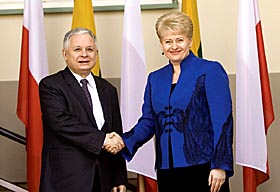
| Kaczynski built links between brotherly Lithuanian and Polish nations - Degutienė |
14 April 2010 |
Vilnius, Apr 10 (ELTA) - Seimas Speaker Irena Degutienė has offered her condolences to Poland on the tragic plane crash in Russia. Degutienė noted that Poland’s President Lech Kaczynski, killed in the crash, was a person who had built and strengthened links between the brotherly nations of Lithuania and Poland by his work and his example. “He was a most true politician. Together with the entire nation of Poles, we are full of overwhelming sadness over his death as well as the deaths of other prominent Polish nationals,” Degutienė said and wished strength and God’s comfort to the close ones of the victims. Polish and Russian officials said no-one had survived after the plane apparently hit trees as it approached Smolensk’s airport in thick fog, BBC reports. Poland’s army chief, central bank governor, MPs and leading historians were among more than 80 passengers. They were flying in from Warsaw to mark 70 years since the Katyn massacre of thousands of Poles by Soviet forces. |
|
| National, Personal and Political Tragedy | 14 April 2010 |
While most of the focus has been on the death of the Polish President Lech Kaczyński, there were also many other people aboard the plane who will also be darly missed. Kaczyinski’s wife, Maria, along with the national bank president, deputy foreign minister, army chaplain, head of the National Security Office, deputy parliament speaker, Olympic Committee head, civil rights commissioner and at least two presidential aides and three lawmakers were also aboard the flight, the Polish foreign ministry said. |
|
| 20 Years to Boredom | 14 April 2010 |
• Edward Lucas flanked by Prime Minister Kubilius and President Valdas Adamkus 'Boring Lithuania’ was Edward Lucas’ generous remark concerning Lithuania’s 20 years of independence. To achieve such a state from where the country was when he first arrived as Lithuania Visa holder 0001 back in 1990 was a ‘significant achievement’. When even making an international call would take hours or even days to arrange. Being a member of NATO, he said, was not just a responsibility in Afghanistan and elsewhere but a duty to defend oneself closer to home and not expect America or NATO to do it for you. He went on to recommend a five country Baltic alliance including Finland to Poland. He further suggested that the three Baltic states of Estonia Latvia and Lithuania should do more so that they do not fall for the old divide and rule strategy where one country is promoted by Russia while the others are either degraded or physically sanctioned for one reason or another, with the pattern randomly repeated on an ad hoc basis. Lithuania proclaimed independence on 11 March 1990, and on 28 March 1990 Edward Lucas took the only international flight to Lithuania which originated from Berlin. “It was especially important that Lithuania started controlling its state borders and implementing foreign policy”, Edward Lucas went on to say, his Lithuanian visa was “in a certain sense one of the founding documents of Lithuania’s diplomacy” and one of the symbols of Lithuania’s statehood from that period. |
|
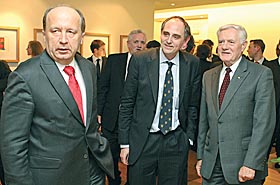
| Seimas to decide on PSD contributions - Šukys | 14 April 2010 |
Vilnius, Apr 12 (ELTA) - The decision on contributions of some residents who have not paid their compulsory health insurance (PSD) fees will have to be made by the Seimas in the form of law amendments, Health Minister Raimondas Šukys said. After the meeting of the ruling coalition partners on Monday, the minister stated that the present situation demanded both political and legislative solutions. “One of the possible variants that have been discussed seems to be the simplest one, but I think that it would be unfair to the major part of taxpayers to write off the outstanding payments to the ones who have not performed certain duties under law. This variant has been rejected after discussion,” Šukys said. According to the health minister, the working group will be proposed to consider the possibility of taking certain political decision. “We plan to propose the postponement of payment of the outstanding health insurance fees until 2011, to set clear obligations in law that the persons who have departed from Lithuania would declare their departure by a specific date and would indicate when they have left the country and whether they have been insured in other countries, whether these are the countries of the European Union or not. "I think that the residents who have no income and are not registered with the Labour Exchange should be informed about the date by which they must register with the Labour Exchange so that all the people of Lithuania would be included in the PSD system,” Šukys stated. |
|
| 70% of Lithuanians would not approve of gay parade | 14 April 2010 |
Vilnius, Apr 6 (ELTA) - According to the poll conducted by the public opinion and market research company Spinter Tyrimai, 70.3% of Lithuanian residents claimed they would not approve of a gay parade which is planned to be held in Vilnius in May; 69.8% of respondents said they did not know any homosexuals in person. Although the World Health Organization stated in 1992 that homosexuality is a not a disease, over 40% of respondents still believe otherwise. According to psychologist Jolanta Reingardė, Lithuanians would like homosexuals to be invisible and not to make their problems public. 16.4% of the respondents would approve of the gay parade in May, while 70.3% of those polled said they would not approve of the parade and 13.3% had no opinion. 69.8% of the respondents indicated that they did not know any homosexuals in person, whereas 20.6% suspected that there might be homosexuals in their environment. Upon learning that a relative, friend or colleague is homosexual, 6.5% of the respondents said they would try to support and understand them, 42.6% would pay no attention to the fact, 12.5% of the respondents said they would stop communicating with the person, for 28.1% it was hard to even imagine a situation like that, while 7.6% said they knew a homosexual person. |
|
| 19.6% of workers paid minimum or lower wages | 14 April 2010 |
Vilnius, Apr 8 (ELTA) - In October last year, compared with October 2008, the number of workers who received minimum wages or even lower pays increased by 6.4% and totalled 19.6% of all working people, an increase influenced by the worsened economic situation and fewer job offers. The statistics almost reached the level of 2004, when there were 20% of low-paid workers. According to the Department of Statistics, the number of workers who had full-time jobs and were paid minimum wages, compared with the total number of workers employed for full-time jobs, accounted for 9.7% in the economic sector, 6 percent in the public sector and 12.2% in the private sector. |
|
| Kedys sighting in Spain | 14 April 2010 |
Vilnius, Apr 8 (ELTA) - The Spanish police are also searching for Drasius Kedys, suspected of double murder. His surname was mentioned in the Spanish media who reported that their police, in cooperation with officials from Lithuania were searching for Drasius Kedys. According to them, the 37 year old suspect might be hiding in Alicante, in the east of Spain. It is also claimed that Drasius Kedys liaises with potential associates who might be staying in Costa del Sol, in the southern part of the country. |
|
| Forgive us - Russian dissident Kovalev |
* Photo: Dainius Labutis, ELTA. Vilnius, Mar 11 (ELTA) - During the solemn commemoration of the March 11th, Russian dissident Sergei Kovalev, human rights activist, repeated his words uttered 20 ago: "Forgive us." And you know, I must repeat these words now. (...). We need to ask for forgiveness for the fact that we still avoid the word "occupation" when talking about the Baltic States. We still think of something hypocritical, something which keeps us from the necessity to utter these words and apologize officially. Sincere and good relations are impossible without that. Who am I to apologize to you in the name of Russia? After all, our presidents are in no hurry to do that," Kovalev said. The Russian dissident noted that in the bloody January 1991 crowds of Moscow residents went on streets the next day, January 14. "I can assure you that there were over 100,000 people. And at least these 100,000 residents of Moscow prevented further violence in Vilnius, as well as in Riga and Tallinn. It is not the only miracle that happened in my country. Another one happened in August of the same year. Unfortunately, so far no more miracles have occurred," Kovalev said. The former political prisoner apologized for the disorder and politicized trials in Russia. He also rejoiced at Lithuania's return to Europe. "You have returned to Europe, to your homes. And I think that there, in Europe, you will also remember your neighbours," said Sergei Kovalev, dissident, political prisoner of the former Soviet Union, chairman of the Andrei Sakharov Foundation, chairman of the Russian Science, Education and Information Centre "Memorial", president of the Human Rights Institute. |

| We have a right to have a dream again, after 20 years - Landsbergis |
Vilnius, Mar 11 (ELTA) - On the 20th anniversary of the Restoration of Lithuania's Independence Lithuania has a right at least to wish for friendly European countries under the rule of law, both to in its east and west, and to live safely, said MEP Vytautas Landsbergis, chairman of the Supreme Council-Reconstituent Seimas, during a solemn event dedicated to the 11 March anniversary at the Seimas. According to the MEP, we have a right to dream after 20 years to live freely securely. Speaking about March 11 Landsbergis also noted the role of the Sajudis movement. "The people who gathered with the Lithuanian Sajudis movement in summer 1988 and started speaking about human rights and the rights of the nation firmly and loudly, about the right to have their own homeland, were considered to be dreamers by some people. “Sometimes they were even considered to be dangerous dreamers. There were so many of them they couldn’t be expatriated somewhere near the Arctic Ocean or shut in the institutions for the mentally ill. The numbers exceeded the powers of authorities. The head of the prison was also weaker and he only cared about preserving at least some part of the regime. Thus, he announced the reform of the prison and the Sajudis of the dreamers announced that there should be no prison at all if citizens did not want it. Let this perestroika continue till the end. For your and our freedom!" Landsbergis said. On Lithuania's road to 11 March, in Landsbergis' view, there were a number of very important steps. "First, it was necessary to reject lies. Then we had to reject fear and reject disbelief that the truth and good faith still had value and could still win in this world. “We can if we reject lies and fear, the Sajudis movement and Lithuania answered. And millions of people who signed Sajudis petitions and formed the Baltic Way, which was an unprecedented chain of live hearts from Vilnius to Tallinn, all yelling: We can! We will be free and we will build our lives, elect our real representatives, take a constitutional sovereign decision," said Landsbergis, recalling the events 20 years ago. In his concluding remarks, Landsbergis stressed "the inalienable wish of the people to live - then, today and tomorrow." |
| Leaders of foreign states congratulate Lithuania on March 11 |
Vilnius, Mar 11 (ELTA) - On the occasion of March 11, the Day of Restoration of Independence in Lithuania, President of the Republic of Lithuania Dalia Grybauskaite and all people of Lithuania were congratulated by leaders of France, Russia, Germany, the European Commission, and the European Union member states. |
| Your strength and unity demonstrated 20 years ago continues to inspire us today - Obama |
Washington/Vilnius, Mar 11 (ELTA) - President Dalia Grybauskaite and all people of Lithuania are congratulated on 11 March, the Day of Restoration of Independence, by President Barack Obama of the United States of America, reports the presidential press service. President Barack Obama underlines in the letter that the events of 11 March were pivotal in the return to democratic values in Central and Eastern Europe: "At the time, these brave citizens could not foresee the impact of their actions, but they never lost their resolve. They became a beacon of hope to those throughout the world seeking freedom, democracy, and respect for human rights." |
| March 11 is and will always be a holiday uniting us - Degutiene |
Vilnius, Mar 11 (ELTA) - The March 11th Act is not only a result of a regular national revival. It was a continuation of a history written in the times of Lithuanian King Mindaugas and continued in the fights of the insurgents of the 19th century, the first volunteers of the Republic and post-war guerrillas, emphasised Seimas Speaker Irena Degutiene in her congratulations to the people of Lithuania on the 20th Anniversary of the Restoration of Lithuania's Independence. "March 11th is and will always be a holiday uniting us. No matter how different we are and in whatever lands we live - for our common future, for our nation and state, in the name of Lithuania. Let the March 11th spirit spread more and more in our lives, strengthen our faith, inspire our words and lead us in our daily work," Degutiene said in her congratulations. |
| Spirit of 1990 helped us to survive - President |
Vilnius, Mar 10 (ELTA) - President Dalia Grybauskaite awarded the persons who contributed to the restoration of Lithuania's Independence with commemorative medals and noted that the signatories and initiators of the March 11 Act did not hesitate and summon people to the Sajudis movement, lead to elections and declare the Independent State of Lithuania 20 years ago. This honourable award a commemorative medal "Twenty Years of Re-established Independence of Lithuania" is given for the merits of re-establishing and strengthening an independent Lithuanian state. |
| President Grybauskaitė believes in improvement of Lithuanian-Russian relations |
Vilnius, Mar 10 (ELTA) - The relations of Lithuania and Russia are becoming better and better, President Dalia Grybauskaite says. "We conduct policies based on our principles, but also on our trust," Grybauskaite noted. |
| Centuries-old shipwrecks discovered in Baltic Sea |
Stockholm, Mar 9 (ELTA) - A dozen century-old shipwrecks - some of them unusually well-preserved - have been found in the Baltic sea by a gas company building an underwater pipeline between Russia and Germany, Swedish experts said Tuesday as reported by The Associated Press. It's unclear whether any of them will be salvaged but the board said it hopes they will be explored by divers - though Norman added many of them are at a depth that would require very advanced and costly diving operations. |
| Domestic violence - crime dangerous to society - MP Kuodyte |
Vilnius, Mar 8 (ELTA) - Member of the Seimas Liberal Movement Dalia Kuodyte registered a complex of law amendments at the Secretariat of the Seimas proposing to legitimize all the measures to prevent violence in a private area and protect the victims of violence. “Having changed the Law on Public Administration, the officials would be able to launch the administrative procedures without written complaint of the victim," says MP Kuodyte. |
| Seimas speaker wishes compatriots living abroad strong faith in Lithuania |
Vilnius, 8 Mar (ELTA) - Congratulating Lithuanians living abroad on the occasion of the upcoming 20th anniversary of the Restoration of Lithuanian Independence, Speaker of the Seimas Irena Degutiene calls them to always remember that their roots are here in Lithuania. The Seimas Speaker wished all the best to everyone in creating the life of their own and that of their nation, and the strongest faith in Lithuania. |
| 22,000 residents left Lithuania in 2009 |
Vilnius, Feb 26 (ELTA) - Last year 22,000 emigrants declared their departure from Lithuania, an increase of almost 5,000 residents compared with 2008. According to the information obtained by the Department of Statistics last year 6,500 people immigrated to Lithuania, a fall of 2,800 people compared with 2008. Lithuanian citizens accounted for the majority of international migrants (74.7% of emigrants and 74.3% of immigrants in 2009) and foreigners constituted a quarter of migrants. In 2008 and 2009, over a half of emigrants (56 and 52% of migrants respectively) who declared their departure went to the United Kingdom, Ireland, the United States, Germany. In 2009 as compared with 2008, more emigrants chose Ireland (by 1.4 times) and the United Kingdom (by 1.3 times). The majority of emigrants are aged 25-29. |
| Fee adjustment and new application forms for visas to the United States |
Since the implementation of the Visa Waiver Program (VWP) for the citizens of Lithuania in November 2008, thousands of Lithuanians have taken advantage of the program to travel to the United States for business or tourism without visas. In fact, between November 2008 and September 2009, the number of Lithuanians travelling to the United States for business or tourism increased by 40%. The US Embassy in Vilnius encourages Lithuanians to continue to take advantage of this program, and reminds travellers to consult the VWP rules to ensure that they are eligible. (The rules are available at: http://vilnius.usembassy.gov/non-immigrant_visas/myths-visa-waiver.html. First, beginning in early March the US Government will introduce a new schedule of fees for nonimmigrant visas. Unlike the previous fee system, in which applications for all classifications of nonimmigrant visa were subject to a $131 nonrefundable fee, the new fees differ based on the visa classification. Applications for visas for business and pleasure, as well as student and exchange visas, will cost $140. Petition-based visas for temporary workers, performers, and others, will cost $150. For complete information on the costs for each type of visa application, please visit http://www.travel.state.gov/news/press/press_4603.html. Second, beginning on 1 March, all applicants for nonimmigrant visas will be required to fill out a new form, the DS-160, online prior to their visa interviews. The new form replaces previous nonimmigrant visa application forms. For further information on these changes, please contact the Consular Section of U.S. Embassy, Vilnius, at consec@state.gov. |
| The US donates almost LTL3 million worth of radiation equipment |
On Tuesday 23 February, US Ambassador to Lithuania Anne E. Derse made an official presentation of Second Line of Defence radiation detection equipment, from the US Department of Energy, to representatives of the State Border Guard Service of Lithuania. The US Government’s donation of Second Line of Defence radiation detection equipment is designed to bolster the security of Lithuania and its European neighbours by preventing the transport of illicit radioactive material by land or air. The equipment, which totals US$1.115 million (LTL2.84 million) has been in use since autumn at Vilnius International Airport, the train depots in Kybartai and Kena and the highway crossings at Panemune, Ramoniskai, Kybartai, and Medininkai. |
| Pope Benedict XVI Invited to Visit Lithuania |
On 19 February in the Vatican, Lithuania’s Minister of Foreign Affairs Audronius Ažubalis met with the Holy See’s Secretary for Relations with States, Archbishop Dominique Mamberti. Ažubalis and Mamberti spoke about the necessity of an appropriate European evaluation of crimes committed by the totalitarian regimes and relations between the EU institutions and religious communities. The Minister acquainted the Archbishop with the dialogue that Lithuania initiated on the importance of moral values when creating the new NATO’s Strategic Concept. |
| Lithuania has highest optic fibre use in Europe |
Vilnius, Feb 25 (ELTA) - Lithuania has become the European country with the highest fibre broadband penetration, with fibre access to 18% of households, according to a survey from industry organization FTTH Council Europe, IDG news service reports. The former number one, Sweden, has dropped to second place, and is followed by Norway and Slovenia, which all have a penetration of more than 10%. Fifth to tenth place were Estonia, Denmark, Slovakia, Finland, the Netherlands and Italy. |
| France consults Lithuania on strategic issues |
Vilnius, Feb 25 (ELTA) – The President of the Republic of Lithuania Dalia Grybauskaitė received the French Secretary of State for European Affairs, Pierre Lellouche, who came to Lithuania on a working visit, informs the press service of the president. The French Secretary of State for European Affairs passed to the President of Lithuania regards from the President of France, Nicolas Sarkozy. According to Secretary Pierre Lellouche, one of the primary goals of his meeting with the President is to consult and inform Lithuania as a strategic partner of France on France's possible intention to sell a Mistral-class military vessel to Russia. The French Secretary of State informed the President that France had not received an official request from Russia to sell the Mistral yet, and assured the President that should the deal ever be concluded, the ship would be sold to Russia as a civil vessel without any military equipment. |
| Kubilius doubts Russia's intention to build plant in Kaliningrad |
Vilnius, Feb 25 (ELTA) - Russia accelerates the construction of its power plant in Kaliningrad region because of the successful development of the Visaginas power plant project in Lithuania, Prime Minister Andrius Kubilius said. According to the prime minister, great progress has been made in preparation for the erection of the Visaginas nuclear power plant. An international call for tenders for a strategic investor has been issued and should be successfully completed in two months. "I see that Russia makes decisions on the building of the power plant in Kaliningrad faster, depending on our progress in Lithuania," Kubilius said to the Ziniu Radijas on Thursday when commenting on the project of the power plant's construction in Kaliningrad region which had been confirmed by the Russian Government. The prime minister highlighted that in this case Russia was especially active in making various decisions, but he noted the lack of clarity and openness related to the potential use of electricity produced by the new plant. Kubilius also pointed out that environmental matters were important in the construction of the Kaliningrad plant. No explanations have been heard from Russia in this case. As an example the prime minister indicated the case of the Visaginas plant and said that neighbouring countries participated in its environmental impact study. |
| Grybauskaite calls on prosecutors to restore public confidence |
Vilnius, Feb 23 (ELTA) - The most important task of all law enforcement authorities is to restore public confidence in the prosecutor's office, said President Dalia Grybauskaitė. On Tuesday Grybauskaitė participated in the extended session of the Collegiate Council of the Office of the Prosecutor General during which the heads of the prosecutor's office and other law enforcement institutions analyzed the last year's activity report of the prosecutor's office and discussed the priorities of activities for 2010. This is the first time in 17 years when such a meeting was attended by the President. "The effective work of the prosecutor's office is impossible without public confidence. People's confidence in law enforcement can be brought back only by radical changes in the prosecutor's office and the entire law enforcement system; these changes have lacked political will for many years. 2010 should be the year of a qualitative turning point not only to the prosecutor's offices, but to the whole justice system as well," the president underlined at the meeting. According to the president, the public lacks confidence in the prosecutor's office because of the delayed hearings of cases, low competence of investigators, bureaucratic pre-trial procedures, ineffective control mechanisms as well as the influences of political and business groups on law enforcement authorities. To deal with the problems, Grybauskaitė suggested starting essential changes in the prosecutor's office itself. |
| British inspector to visit Irish man facing weapons charge in Lithuania |
London, Feb 23 (ELTA) - A prisons inspector is to travel to Lithuania to see a Dundalk man wanted over an alleged arms smuggling plot, the BBC reports. The inspector has been given permission for a meeting with Michael Campbell, who has been detained since 2008 in connection with the alleged offences. However, he will not be allowed to inspect the jail where Campbell is being held. Details emerged as extradition proceedings against his brother, Liam Campbell, 46, of Upper Faughart, Dundalk, were adjourned in Belfast. It heard the visit by Professor Rod Morgan, special adviser to the British Home Office and the Council of Europe's Committee for the Prevention of Torture, is likely to take place at a visitors centre in the Lukiskes compound in Vilnius. Extradition proceedings were adjourned at Belfast Recorder's Court on Tuesday. The delay is to facilitate a Lithuanian solicitor due to give evidence as part of defence claims that he will not receive a fair trial in the Baltic republic. Liam Campbell, one of four men held liable in a civil court for the Omagh bomb atrocity, is fighting attempts to be extradited. He has been in custody since he was arrested after crossing the border into south Armagh in May. A month later he was found to be liable, along with three other men, for the Omagh bombing following a landmark civil action brought by relatives of some of the 29 people killed in the August 1998 explosion. Mr Justice Morgan, now the Lord Chief Justice Sir Declan Morgan, said at the time there was cogent evidence that Liam Campbell was a member of the Real IRA's Army Council. Campbell is wanted in Lithuania over an alleged operation to acquire guns, ammunition and explosives and ship them into Ireland for the terror group. Campbell denies the charges. In evidence to the extradition hearing on Monday, Professor Morgan criticised prison regimes in Lithuania as part of his assessment that Campbell would suffer inhuman or degrading treatment if taken there. Judge Tom Burgess, who is hearing the case, was told on Tuesday that Lithuanian authorities have granted the inspector permission to see Michael Campbell. |
| Lithuania asks Gazprom for discount to gas supplies |
Vilnius/Moscow, March 1 (ELTA) - Lietuvos Dujos has asked the Russian gas company Gazprom to sell part of their gas supply for US$200 per 1,000 cubic metres, the same as Germany's spot prices. At present Lithuania pays US$320 for the same amount of Russian gas, the Russian newspaper Kommersant reports. The Baltic States receive gas supplies directly from Gazprom, and the remaining European countries receive them from Gazprom Export. These companies have different contracts for gas supplies and the Russian concern has a right to refuse to revise gas prices applied to Lithuania until 2011. The size of the gas market of all three Baltic States amounts to 4.9 billion cubic metres a year. Each year Lithuania receives 2.7 billion cubic metres. |
| Prime Minister thanks authorities for seizing cocaine smuggled through Klaipėda |
* Lithuanian Criminal Police photo. Vilnius, Jan 28 (ELTA) - On Thursday, Lithuanian Prime Minister Andrius Kubilius thanked Police Commissioner General Vizgirdas Telyčėnas and his team for the successful execution of an international operation, during which 500 kg of cocaine was seized in Klaipėda. This was the largest ever drug haul in Lithuania, and one of the biggest in the European Union. “The success of such a complex operation shows that Lithuanian police and police officers are capable of performing the tasks on a global level. We have something to be proud of,” said Kubilius. During the meeting, one of the priorities of the current Government was discussed - the reduction of corruption. Commissioner General Vizgirdas Telyčėnas assured Prime Minister Kubilius that special attention would be paid to combating corruption and bribery in the police system. As reported, the massive half tonne of cocaine was found in a container delivered in a ship from South America. The drug seizure operation in Klaipėda was carried out by the Lithuanian Criminal Police Bureau in conjunction with authorities from Latvia, America and Ecuador. According to various calculations, the value of the almost 500 kilos of cocaine hidden inside frozen fish stands at around LTL50-100 million (€14-29). According to recent trends, cocaine is mostly transported to European countries from Africa, which has already become a kind of logistic centre. |
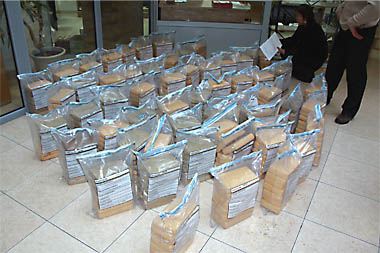
| Skikas admits guilt |
Lithuania takes top position in the EU by the percentage of students in the country. Compared to the EU’s average of 15%, only 7% of 18-24 year-old people in Lithuania are not engaged in institutionsVilnius, Feb 3 (ELTA) - Former Deputy Minister of Health Artūras Skikas, accused of bribery, admitted his guilt in court, however, he said he asked for the money as support for his party. When Judge Danutė Mickevičienė asked whether he admitted his guilt, Skikas said he did, however, during the pre-trial investigation, the former minister of health denied it. According to Skikas, he changed his opinion because when he was arrested he suffered an emotional trauma. “Yes, I admit guilt. I admit that I asked Kalibatas to support the party’s division (Lithuanian Liberal and Center Party Šilutės Division - ELTA). I regret being stupid, because when I asked for support, I meant official support only. Maybe I was naive to having taken the money without arranging it officially. I did not do that, and I regret that,” he said in court. It was found that from November last year, Skikas and Kalibatas met six times, and at the seventh meeting, the latter gave Skikas money. During the meetings Skikas asked Kalibatas to turn off his mobile phone. “I admit everything. (...) I can only apologize once again for my indiscriminate behaviour and its consequences. I hope that the court will take the right decision,” said Skikas. ELTA reminds, that Skikas is accused of requesting and provoking Vytenis Kalibatas, Head of Nacionalinis Kraujo Centras (the National Blood Centre), to give him a bribe of LTL20,000-30,000 (€5,787- €8,680). The deputy health minister requested a bribe for not imposing a disciplinary penalty to the head of Nacionalinis Kraujo Centras as it was demanded by the National Audit Office. The bribe also was supposed to be a guarantee that the director would have protection against the leadership of the Ministry of Health, and that he could continue heading the public institution without any problems.. |
| Haiti earthquake – EU coordinates aid |
Over €130 million is being channelled into relief and rehabilitation efforts. More will follow. An earthquake measuring 7.0 on the Richter scale struck Haiti on 12 January. Within hours of the disaster the EU provided €3 million for immediate relief activities. An additional €27 million has since been released, along with €100 million for early rehabilitation and reconstruction. Half of this is new money, and half will be redirected from funds already set aside for Haiti. Some €200 million more will be available for longer term rehabilitation. All figures could rise if assessments show more money is needed. These contributions are in addition to the €92 million already provided by individual EU countries. The figures were announced following an emergency meeting in Brussels, where the deployment of European soldiers to Haiti was also on the table. No decision has yet been taken. An international conference on support for Haiti is also likely in the coming weeks. It will assess how to convert the international desire to help into practical solutions, said the EU high representative for foreign affairs, Catherine Ashton. The death toll is currently estimated at 200 000. Some 250 000 people are in urgent need of assistance and a staggering 3 million have been affected. |
| Irish court convicts four companies for discriminating against Lithuanian employees |
Dublin, Jan 19 (LETA-ELTA) - Four Irish companies have been ordered to pay a total of €24,500 to former staff who they discriminated against because they were not Irish nationals, the local newspaper Irish Times reports. The Irish Equality Tribunal issued four separate rulings yesterday involving three Lithuanians and a Latvian, who were either unfairly dismissed or not paid the same redundancy payments as their Irish colleagues. Two of the Lithuanians, Irmantas Stukonis and Vygandas Urbonavičius, worked with the ‘Coalport Building’ company. Stukonis was dismissed by the company following a robbery at a building site where he worked as a security guard. He alleges that he told his Lithuanian colleague at the firm that he was assaulted by two men during the robbery and was allowed to go home. He did not speak English well and relied on his colleague to help him communicate at work. At a subsequent meeting, the company’s officials demanded that he produce medical evidence to prove the assault and denied that it had allowed him to return home after the robbery took place. When he did not produce medical evidence he was dismissed. The tribunal found the firm did not make any credible effort to ensure the complainant understood the gravity of the allegations made against him. It did not provide interpretation during the disciplinary meeting or have a disciplinary policy at the time. It also failed to investigate the circumstances of the robbery before dismissing Stukonis and three colleagues, who were all Lithuanian. “I am satisfied on balance that this would not have happened to an Irish employee in similar circumstances as that worker would have understood the allegation against him/her, and would have been able to articulate a defence to the charges,” said the tribunal. It awarded Stukonis €8,500 compensation for his distress. In another case the tribunal ordered “Securazone Manhour” to pay Lithuanian Utaras Eimas €3,000 for discrimination and €10,000 for discrimination dismissal. It found the firm discriminated against foreign nationals by refusing to allow them to rotate the more dangerous night shifts – a perk enjoyed by Irish staff. It also dismissed all four foreign national staff when there was a downturn. |
| In US Kubilius argues that crisis is ending in Lithuania |
Vilnius, Feb 2 (ELTA) - Lithuania came out of the crisis and it is time to invest into long term state strategy, which is impossible without new technologies, said Prime Minister Andrius Kubilius at a meeting with heads of IT companies during his visit to the United States. In California, during a meeting with international corporations Oracle, Cisco and HP, the further development of these companies in Lithuania and new investments, the application of IT innovations in private and public sectors was discussed. Kubilius presented the possibilities in Lithuania, as an IT skills and service centre in the regional market. The prime minister noted that 40% of Lithuanians have a university degree, which is two times higher than the EU - 15 average, 92% use e-banking services and 88% declare their income to tax online, to illustrate the country’s openness to innovation.Oracle President Safra Catz agreed that crisis is the best time for new changes and essential reforms. The heads of Oracle expressed their willingness to share their experience in developing e-governance projects and interest in investing into the areas of education and tax collection.Cisco heads suggested setting up joint working groups to examine opportunities related to the development of e-governance, implementation of modern management systems, opportunities to set up data centres in Lithuania and develop the next generation computer infrastructure. The prime minister underlined the Government’s commitment to support the development of high technology, as well as ambitious Government’s plans to seek that IT, laser technologies, biotechnologies, nanotechnologies would reach 25% of GDP by 2015 and 80% of the country’s export. |
| Kubilius Presented Top Government Priorities to the President |
Prime Minister Andrius Kubilius says that, with the aim of seeking more guidance and clearer results, the working style of the Government is going to change by clarifying year-to-year priorities and presenting major works to be done to the President and the public at the beginning of every year. “We are planning our activities so that our people would know what the top priorities of the Government are and who is responsible for the work to be done. The Government intends to base its activities on strategic planning principles, priority setting and the tightening of responsibility of ministries for the implementation of those priorities”, Prime Minister Kubilius said. Reducing unemployment was among the most pressing priorities. “Last year our main goal was to maintain financial stability. This year we will focus on the reduction in unemployment and job creation. Unemployment has a tendency to continue growing for some time even after the economy has recovered; therefore this issue calls for increased attention by the central and local authorities. This should also help address the alarming and growing problem of immigration,” the Head of the Cabinet said. The Prime Minister identified four key priorities:
The Prime Minister also said that each minister would submit a list of specific priority actions of their respective ministries in 2010. Hence society will be able to see the results of Government activities and evaluate performance of separate ministries and the Government. |
| Palanga - One of Europe's Best Beaches |
One of the most popular resorts in Lithuania - Palanga has been listed in the ‘Hot List” by the British Sunday Times. The list compiled by Sunday Times Travel reveals Europe’s 20 best beaches for sun and sea for the summer of 2010. Palanga is portrayed as “a cracking little resort town with a white, sandy beach, pine forests, sand dunes and fizzing nightlife” – a perfect description of Lithuania’s most popular holiday destination. The article by Sunday Times mentions the relative low prices in the country, which should be a major selling point for visitors in the current economic climate. “A terrific amber museum” which houses one of the largest amber pieces in Europe, the “Sun Stone” and Botanical Gardens are highlighted as the most popular cultural activities in the resort. The Jewel in the crown – the Curonian Spit is listed on the UNESCO World Heritage List, is just a short drive from Palanga. Augusta Jaudegytė, UK Director of the Lithuanian National Tourism Office said: “Lithuanian seaside is a perfect choice for a beach holiday, which is sometimes overlooked by British tourists. The vibrant towns surrounded by shifting dunes and pine forests have lots to offer from beautiful beaches to vibrant towns and unique culture.” |
| Firemen trusted most, MPs least - survey |
Vilnius, Jan 19 (ELTA) - At the end of 2009, Lithuanian residents trusted the Fire and Rescue Service most and, almost traditionally, members of the Seimas least. Over 85% of all participants of a public survey expressed trust in the fire-fighters. A lot of trust was shown in the Church (71%), the Presidential Service (69%), national defence (59%), the Lithuanian media (53%), the State Border Guard Service (52%), the Constitutional Court (55%), the state social insurance fund SoDra (51%). More than half of adult residents trusted each of these institutions. According to the same survey conducted by the public research and marketing company Baltijos Tyrimai on December 1929, people distrust the Seimas and the Government most: 84% distrust the Seimas, 76% distrust the Government. More than half of all residents also distrust courts (69%), the prosecutors’ office (61%), commercial banks (61%) and municipalities (57%). Since November, the number of people satisfied with the Government, the police and State Border Guard Service increased slightly - by 3 percentage points. Over a month, the number of people satisfied with the state social insurance fund SoDra slumped 8 percentage points. Over November, the number of respondents satisfied with the State Security Department decreased by 4 percentage points, Special Investigation Service and trade unions - by 3 percentage points. |
| Sausio 13 – from the ashes of the barricade |
Story: Ray Vyšniauskas
The events of 13 January are well known to all Lithuanians; a night of callous attack and animal savagery that resulted in the deaths of 14 Lithuanian citizens. These events were in a large part the result of Lithuania’s declaration of independence on 11 March 1990, and eventually culminated in international condemnation, the recognition of Lithuania as an independent republic, and the fall of the Soviet Union. On the 19th anniversary of Sausio 13, or 13 January, we thought we’d talk to Arūnas Ramanavičius (pictured), who was so very nearly the 15th victim of the Soviet attack on Vilnius Television Tower that night. Arūnas was the most heavily wounded person to survive, and he underwent 13 months of rehabilitation to repair the damage of taking two bullets to his right leg, between his knee and groin. First I asked him what he remembered of that night: “I remember a lot of things. It was interesting weather, cold, but I could still get around on my bike. It all started on the night of the 12th. “I was riding from place to place around Vilnius, going to various installations that the Soviets might want to overtake, joining in the human barricades with the other people of Vilnius and Lithuania. I’d been to a number of places during the day, and I just wanted to drop in at home and have some dinner before heading out again. “It was on my way home when I saw the armada of tanks heading to the TV Tower, so instead of going home I decided to follow them. Once they arrived at the TV Tower I joined in the other people who had gathered there – it was quite a large crowd. That’s how I ended up there, and the rest is history.” Arūnas nonchalantly glossed over the horror of the next couple of hours, so I pressed him for more detail. “We were just gathered there, we didn’t really have any plans. We didn’t think they would attack, let alone shoot at us or intentionally kill anyone. I guess all we knew was that we were not going to move. “I saw the aggression, the tanks were blocked by the crowd of unarmed people and the soldiers started shooting percussion cartridges that created terrible blasts. Twenty minutes later, the Russian soldiers come in armoured vehicles, they emerged without any warning and started the attack against unarmed people. The attack could only be called animalistic. The soldiers were wild and they were hitting women and children indiscriminately, and then they started shooting. As I already mentioned there was no warning at all, they just started shooting at the people from just a few steps away into the crowd assembled in front of them. In the eyes of those soldiers you could clearly see that they were doped on some drugs. “But anyway we tried to withstand this terrible aggression, then they ran by tanks directly into the people and tried to squash them. “I saw them pointing guns at us but we were not going to move, they advanced, they threw percussion grenades, they had all sorts of weapons, and then they just attacked with everything they had. A few moments later I was shot twice in the leg. It was terrible with the pain shooting around my body accompanied by the blasts from all of the tanks. “We still could not believable that peaceful people could have been attacked that way, it was so brutal.” Arūnas was given help and taken to St Jacobs (Švento Jokubo) hospital where the full extent of his wounds became apparent. While two shots to the leg might not sound totally life threatening, it turned out that the Soviets were using dumb-dumb bullets, which were long banned by the Geneva Convention, and on hitting his leg the bullets exploded into many many smaller fragments causing all sorts of internal injuries, shattering bones and shredding muscle and sinew. They are intended to cause death from internal bleeding. “I had at least five very long operations and lay in hospitals because of these wounds for 13 months. First in Lithuania, then in hospitals in Hungary and Germany who also offered support and operated further on me. The various doctors managed to get some the shrapnel out and put together what was left of my bones and flesh.” And did these wounds cause a lot of problems? “I was in the last year of high school and a good student, best in class in fact, and it was a hassle. My studies were heavily interrupted, but I managed to continue.” I guess the one question I wanted to ask all along was - was it worth it? Arūnas is circumspect. “We have a nation of our own. We may complain about it, but it’s not that different from the other countries in Europe. It is comfortable to live here and if you look past the current economic situation, it isn’t so bad here. “I have been to a lot of countries in Europe and throughout the world, and have had many offers to live and work elsewhere, tempted by better wages and better facilities, but neither I nor my wife have any inclination to leave. We always come home. “Maybe we have to work a bit harder here, but what can you do? This is our home.” So how did Arūnas’ life continue after the shooting? He finished biochemistry at Vilnius University in 1991 and in 1998 became a doctor of physical science. In 2002 he became Doctor Habilitus of Physical Sciences and in the same year he has was awarded the title of full professor at Vilnius University. By the age of 36 he become youngest professor at Vilnius university. In 2006 he established and is head of the Centre of Nanotechnology and Material Science – Nano Technas - at the Vilnius University Faculty of Chemistry, where they undertake academic, research and commercial work in nanobiotechnology and nano-medicine. Arūnas is proud that his centre has become world regarded and attracts professors, students and researchers from all over the world. Arūnas has employed a number of young scientists from different scientific institutions around Lithuania and even from abroad. He personally and some members of this group have worked for governmental and non-governmental institutions in Belgium, Ireland and Austria and have co-operative agreements with other countries that they help out, often for love rather than money. On the eve of the 13 January anniversary I ask him about his thoughts on the occasion, again I’m surprised. “I no longer look back on those days, and now that my leg is no longer hurting I just look to the future. Life is busy and sometimes I have to work up to 20 hours a day. Maybe when I get older I’ll have time to look back and think about things. “If you work hard you always find plenty of opportunity. In fact I read about unemployment and would love to be unemployed for a while, but I just don’t have the time – there’s too much to do.” All of us in Lithuania can be thankful that there was not another fatality that night, and well may we remember the cost of lost potential in those who were not as lucky as Arūnas on that cold January night 19 years ago. |

| 13 January Remembered |
The events of January 13 actually took place between 11 and 13 January of 1991. It was in the aftermath of Lithuania’s declaration of independence on 11 March 1990, and the Soviet imposed blockade that caused hardship and discontent among minority sections of the Lithuanian public. A conflict between Vytautas Landsbergis and Kazimira Prunskienė resulted in her resignation, and she sought assurances from Moscow that force would not be used, which was not given. Extra Soviet forces were flown into Lithuania, including the counter-terrorist Alpha Group and the 76th Airborne Division, ostensibly to ensure constitutional order. Gorbachev addressed the Supreme Council on 8 January and demanded the restoration of the constitution of the USSR in Lithuania, and threatened military intervention. Lithuania asked for guarantees of a peaceful solution, but Moscow did not reply. From 11 January Soviet forces began seizing Lithuanian communication facilities including the National Defence Department building in Vilnius and the National Printing Works, where live rounds are used against civilians and the first casualties were registered. Later the Soviets seized a TV retranslation station in Nemenčinė. On 12 January the Soviets further took over the offices of the OMON, tried to seize a Police Academy building and attacked a Lithuanian border post at Varėna. Columns of military personnel were seen heading towards the TV Tower and citizens gathered to help protect it from Soviet occupation. At 1.25 on 13 January the Soviets arrived at the TV Tower and started to fire blanks and percussion rounds from their tanks. By 1.50 they had surrounded the TV Tower and started to fire live ammunition into the crowd and then drive their tanks into the assembled masses. In total 14 people were killed in the attack, mostly from bullet wounds, but some were crushed by tanks. A Soviet soldier was also killed by so-called friendly fire. The last vision transmitted from the TV Tower that night was of a Soviet soldier running towards the camera and turning it off. In Kaunas a regional TV station managed to get word out about the attacks and a Swedish station picked up the news and broadcast it around the world. The next day up to 50,000 people gathered around the Seimas and began building tank barricades. Although military occupation and raids continued over the ensuing period, strong condemnation from the West and even urges of constraint from within Moscow itself led to the signing of a treaty on 31 January. On 4 February Iceland was the first country to recognise Lithuania as an independent Republic and diplomatic relations were established between the two countries. The 14 people killed on 13 January were: Loreta Asanavičiūtė, Virginijus Druskis, Darius Gerbutavičius, Rolandas Jankauskas, Rimantas Juknevičius, Alvydas Kanapinskas, Algimantas Petras Kavoliukas, Vytautas Koncevičius, Vidas Maciulevičius, Titas Masiulis, Alvydas Matulka, Apolinaras Juozas Povilaitis, Ignas Šimulionis and Vytautas Vaitkus. |
| New Partners in Ghor Province |
On 30 December the Ambassador of Greece, Konstantinos Katsabis, met with Lithuania’s Foreign Minister Vygaudas Ušackas and informed him about the Greek government’s decision to provide Afghanistan’s Ghor Province with €0.5 million allocated to health service development. Lithuania leads a Provincial Reconstruction Team in Ghor Province. The Ambassador stressed that Greece is ready to become a reliable partner to Lithuania in implementing the reconstruction of the provincial central hospital. The Minister expressed his gratitude to the Greek Government’s decision to provide support to the Afghan people. “I hope that our new collaboration helping to reconstruct the Ghor Province will continue in the future and will take new forms,” Minister Ušackas said during the meeting. Since 2005, Lithuania has led the Provincial Reconstruction Team in the Ghor Province. The team is comprised of military and civilian personnel not only from Lithuania, but also from Croatia, Denmark, Georgia, Japan, Romania, Ukraine, and the USA. |
| Another tough year for the average Lithuanian, say analysts |
(alfa.lt) Although there are indications of an economic recovery looming on the horizon, ordinary Lithuanians still face a long wait before they begin seeing improvements in their living standards say analysts. Experts interviewed by Alfa.lt agreed that unemployment will stay stubbornly high, wages will fall, and consumer prices won’t be coming down for most of 2010, although things may start to pick up in the second half of the year. “I don’t see any prospective improvement in these three areas (this year),” said DnB Nord analyst Rimantas Rudzkis, although he added that he sees unemployment levelling off around the middle of the year. He also said Lithuania’s economy will fare better during the second half of 2010 than in the first half. Rudzkis was seconded by Swedbank analyst Tomas Andrejauskas, who said unemployment rolls will continue to grow this year and cautioned that improvements in economic indicators don’t immediately translate into material gains for ordinary people. “I think statistics will show that everything is improving, but I’m not in a rush to claim that things will suddenly start to get better for people,” Andrejauskas said. “Perhaps we’ll see that happening in the second half. (In the meantime) unemployment will rise even higher, and purchasing power will drop.”
|
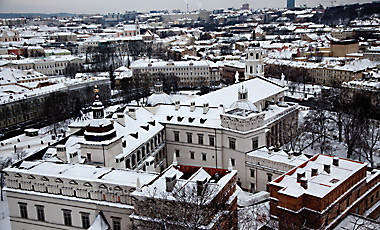

| Number of deaths on roads lowest since 1965 - Masiulis |
Vilnius, Jan 4 (ELTA) - In 2009, the number of deaths on Lithuanian roads was down 26.3% compared to 2008 (there were 368 people killed in traffic accidents in 2009, and 499 persons killed in 2008). Over the same period the number of people injured during traffic accidents dropped by 23%. In 2009, there were 4,484 people injured in traffic accidents compared to 5,818 people in 2008. “Measures that we have taken to increase road safety, the active work of the police and educational campaigns through the media, give these results as there have been the fewest deaths on Lithuanian roads in 2009 since 1965, but now there are around 2 million vehicles on the roads compared with tens of thousands in 1965,”said Transport Minister Eligijus Masiulis. According to the minister the good news is that the number of traffic accidents caused by intoxicated road users halved. In 2009 there were 288 such accidents compared to 508 accidents in 2008. Last year, compared with 2008, the number of traffic accidents which affected people fell by 1,000 compared with (3,844 accidents in 2009 compared with 4,796 accidents in 2008). Compared with 2005, traffic accidents fell by almost 3,000. “Each human life persevered is important for us, so we will continue the ongoing work in the area of traffic safety, we will seek new ways and means to raise people’s self-awareness and responsibility,” Minister Masiulis emphasized. No deaths on Lithuanian roads over past week Vilnius, Jan 8 (ELTA) - During the past seven days, on January 1 - January 7, no persons were killed in traffic accidents on Lithuanian roads. According to preliminary data, a total of 36 traffic accidents took place and 48 people were injured. According to the police, intoxicated drivers caused two traffic accidents and injured two people. |
| The EU and You in 2009 - The European Commission give themselves a rap |
The EU does make a difference to people’s everyday lives in Europe, even though they’re not always aware of it. The goal is always to respond to the real concerns that people have, as citizens, consumers or workers. This year, we’ve been dealing with the consequences of the financial crisis. The EU has worked hard to limit the damage with an economic recovery plan designed to protect people’s jobs and savings. We’ve also been busy defending consumers’ interests. The price of making and receiving mobile calls and sending text messages to and from other EU countries has come down for instance. And the EU has carried out a major online shopping survey, looking at websites selling airline tickets, and ensuring that they respect consumer rights’ legislation. When you book a flight online, the site must tell you about any additional costs - such as a charge for paying by credit card - right at the start of the booking process. They can’t just add it on to the price of the ticket at the end. The EU has been active on green issues too, with new rules on emissions of harmful fumes at petrol stations and pesticide use. And it has been taking the lead in the fight against climate change. There have been a range of measures to cut down on the amount of energy consumed by everyday appliances, including basic items like light bulbs - the old incandescent ones are gradually being phased out in favour of low-energy bulbs. These measures should help deliver a 12% reduction in electricity consumption in the EU by 2020. Finally, the EU has come to the aid of people in need. For example, it granted €500m to help Italy deal with the aftermath of the earthquake in Abruzzo in April 2009. And the EU is still the biggest donor of development aid, and takes an active role in fighting poverty and hunger in the world. |
| Foreign citizens in the EU27 in 2008 |
On 1 January 2008, 30.8 million foreign citizens lived in the EU27 Member States, of which 11.3 million were citizens of another EU27 Member state. The remaining 19.5 million were citizens of countries outside the EU27, of which 6.0 million were citizens of other European countries, 4.7 million of Africa, 3.7 million of Asia and 3.2 million from the American continent. Foreign citizens accounted for 6.2% of the total EU27 population. In 2008, the largest numbers of foreign citizens were recorded in Germany (7.3 million persons), Spain (5.3 million), the United Kingdom (4.0 million), France (3.7 million) and Italy (3.4 million). More than 75% of the foreign citizens in the EU27 lived in these Member States. Among the EU27 Member States, the highest percentage of foreign citizens in the population was found in Luxembourg (43% of the total population), followed by Latvia (18%), Estonia (17%), Cyprus (16%), Ireland (13%), Spain (12%) and Austria (10%). The percentage of foreign citizens was less than 1% in Romania, Poland, Bulgaria and Slovakia. In 2008, 37% of the foreign citizens living in the EU27 were citizens of another EU27 Member state. The largest groups were from Romania (1.7 million or 15% of the total number of foreign citizens from another EU Member State), Italy (1.3 million or 11%) and Poland (1.2 million or 11%). Among the citizens of countries outside the EU27, the largest groups were from Turkey (2.4 million or 12% of the total number of foreign citizens from countries outside the EU27), Morocco (1.7 million or 9%) and Albania (1.0 million or 5%). |
| Lithuanians keen students |
Lithuania takes top position in the EU by the percentage of students in the country. Compared to the EU’s average of 15%, only 7% of 18-24 year-old people in Lithuania are not engaged in studies, the least in the EU, announced the European Commission. The European Commission’s latest report on education in the EU shows that Lithuania is also leading the EU by the number of 20-29 year-olds in higher education. Moreover, Lithuania has made significant progress (3rd place in the EU) increasing the number of young people in the secondary education. 89% of 20-24 year-old Lithuanians are engaged in secondary education, while the average of the EU is 78.5%. There are 76.6% of pre-school age children in Lithuania attending primary education institutions. |
| Two additional units of Lietuvos Elektrinė switched on |
Vilnius, Dec 30 (ELTA) - On Wednesday - a day before the shutdown of the Ignalina nuclear power plant (IAE) - two units of Lietuvos Elektrinė in Elektrėnai with the capacity of 300 megawatts were switched on, said Energy Minister Arvydas Sekmokas. According to the minister the units have not been operating to maximum efficiency. “On December 31 we will start talks on additional supply of electricity to be purchased. Power purchase agreements have been planned. An agreement has been signed with Estonia, there is a general agreement with Belarus and we will work further on an agreement with Ukraine,” Sekmokas said. According to the energy minister, talks with Ukraine may be prolonged and still continue even in February. “The process is ongoing, Ukrainians work on the issue of the transit via Belarus, and these are their mutual decisions. We have signed a general contract with Ukraine and it will come into force after the agreement on the amount and prices is reached,” Sekmokas said. |
| Crisis encourages Traditional Christmas |
According to Maxima funded research conducted by RAIT in all three Baltic states, this year Lithuanians are more likely to greet Christmas at home, with family, and more modestly than in the recent past. The research conducted in November showed that people will be buying cheaper presents, will mostly be setting the Christmas table with more traditional and simpler meals, and most of it will be prepared at home, rather than bought prepared from the store. “The crisis has taught people to save and to better plan their spending, to buy less expensive products, and to cut down on spontaneous purchases. People appreciate the current economic climate, their own financial standing and are not sure when the downturn will ease, and for that reason they are largely deciding not to waste money on food or presents,” Saulius Jonaitis, Maxima LT Marketing and Sales Department Director. This year 76% of respondents indicated that the economic situation will have a negative impact on Christmas celebrations. Last year the figure was 71%. At the same time 38% said that their family is planning to spend less money this year than last, and more than half (58%) said they would be spending the same amount as last year. Cheaper presents are planned by 44%, and 37% will buy less presents, while 33% will spend time looking for discounts and Christmas sales. Almost two thirds (64%) will cook at home, and 52% will spend between LTL51 and LTL200 on the Christmas meal. Last year most people said they would be spending between LTL101 – LTL300. Christmas Spending An EU initiated customer information campaign known as Know Your Rights and Win ordered their own Christmas research which showed that 40% of Lithuanians plan to spend up to LTL50 on their presents this year, 23% said they would be putting aside up to LTL100 for their presents, 15.9% up to LTL200, 4% up to LTL400, and 1.9% would spend over LTL701. Respondents were also asked if they had ever received unwanted or inappropriate presents and 30% said that had happened to them, while 63% said that had never happened to them. But surprisingly 63% also indicated that they would prefer if receipts were included with presents so they could exchange them for other items if they wanted. |
| Refugees in Europe |
THE EU27 MEMBER STATES granted protection to 76,300 asylum seekers in 2008. In 2008, the highest number of persons granted protection status were registered in France (11,500), followed by Germany (10,700), the United Kingdom (10,200), Italy (9700), Sweden (8700), the Netherlands (6100) and Austria (5700). Iraqis were the single largest group of persons granted protection status in ten EU27 Member States. Of the 16,600 Iraqis granted protection status in the EU27, 6400 were registered in Germany, 4000 in Sweden and 2300 in the Netherlands. Of the 9500 Somalis granted protection, 3500 were recorded in Italy and 1500 each in Sweden and the Netherlands, and of the 7400 Russians, 2700 were in Poland, 2000 in Austria and 1200 in France. Lithuania granted asylum to 65 refugees, the largest portion were Russian citizens (50), the second largest groups were equal with five each from, surprisingly, Ethopia and Cuba. |
| New Flights for Lithuania |
Extra London Flights Star1 increases flights from London. In the new year Star1 will add an extra Vilnius – London flight to their schedule, making five flights per week. Now you can get a direct flight to London every day of the week except for Thurdsay and Saturday. The latest leg has been added to Star1’s existing destinations of Dublin and Milan. Star1 is now also accepting credit cards from the UK, Ireland, Canada and the USA. Ryanair adds Brussels Ryanair announced a new destination, flying Kaunas – Charleroi from 1 April 2010. There will be three weekly flights, which will be especially welcomed by the bureaucracy. |
| Grybauskaitė among most popular European politicians |
President Dalia Grybauskaitė went up from twenty seventh to sixth place in the classification, leaving the French leader Nocolas Sarkozy (9), British Prime Minister Gordon Brown (21), Italy’s Silvio Berlusconi (27) as well as Spanish, Portuguese, Polish and many other European leaders behind. The prime ministers of Estonia and Latvia rank sixteenth and twentieth. La Tribune evaluated the most active leaders in EU politics. Only two heads of state – the Lithuanian and French presidents - were ranked; others on the list are heads of government. The EU-presiding Swedish Prime Minister Fredrik Reinfeldt took the top position. He is followed by the Prime Minister of Luxembourg, Jean-Claude Juncker, German Chancellor Angela Merkel, and the Danish and Finnish prime ministers. A jury of political correspondents in Brussels, coming from all over Europe, evaluated EU heads of state and government on the basis of seven criteria: leadership, team spirit, engagement in countering climate change, management of national finances, respect for EU internal market rules, understanding of Lisbon Treaty attitudes, and general pro-European outlook. |
| Vilnius Clean Air Capital |
Vilnius has been judged as having the best quality air in Europe, according to the Economist Intelligence Unit and Siemens, from a list of 30 cities throughout Europe. Vilnius is home to 16% of Lithuania’s population with 554,000 citizens, and is one of the smaller cities in the index. From an economic perspective, however, Vilnius contributed just under two-fifths of the country’s GDP in 2007 and accounts for around 19% of total employment in Lithuania. While Vilnius provides just 16% of the national industrial output, it has attracted more than two-thirds of total foreign direct investment in Lithuania. As well as increasing the number of tourists, Vilnius has attracted many migrants from other parts of Lithuania because of the employment opportunities that it offers. In regards to water quality, Vilnius takes 13th position, but scores considerably lower in energy consumption largely because of its heavy reliance on a centralised and inefficient central heating system, and the uncertainty of future power production with the closing of Ignalina Nuclear Power Plant. Vilnius ranks 13th in the overall index, with a score of 62.77 out of 100, making it the best-perform-ing city in Eastern Europe as well as among the low-income cities in the index. Vilnius ranks around the middle of most categories in the index, but performs exceptionally well on air quality. |
| Lithuania declines Eurovision |
Vilnius, Dec 15 (ELTA) - Lithuania has declined to participate in the next year’s Eurovision Song Con-test, however, should it succeed in raising the necessary funds, the decision would be changed. According to the Head of the Lithuanian National Radio and Television Rimvydas Paleckis, the decision was a “formal action” that was needed before December 14; otherwise Lithuania would have been fined. “If we had not refused by the set date, we would have had to pay fines. In order to avoid that and knowing that it will be possible to change the decision later, we declined to participate in the Eurovision Song Contest,” said Paleckis. Paleckis said that the preparation , participation and the broadcasting of the contest to take place in Norway would cost Lithuania around LTL300,000 (86,890 euro).Paleckis said it is not known yet, how the country’s representative would be chosen, however, should Lithuania succeed in raising the funds and took part in Eurovision, the viewers would be able to express their opinion. Eurovision is held by the EBU (European Broadcasting Union) together with all participating member countries. The only Lithuanian member of the EBU is Lithuanian Radio and Television. |
| Lithuanians Make Top Ten Prisoners List |
The foreign prisoners have been jailed for almost 900 sex offences, more than 2,000 drugs crimes, 1,500 violent attacks including murders, and over 900 cases of fraud or forgery. Jamaicans have the worst records for drug crimes, violence and sex attacks, while Poles have the worst record for theft and handling, Lithuanians top the list for driving offences, Nigerians have the most convicted fraudsters and the Irish have the worst record for burglary and robbery. Overall the ten nations with the most citizens in UK prisons are: 1.Jamaica (791), 2.Nigeria (553), 3.Ireland (524), 4.Pakistan (300), 5.Poland (298), 6.Somali (288), 7.Vietnam (280), 8.China (229), 9.India (221), 10.Lithuania (192) . Appeal to trace suspects for crimes abroad The Metropolitan Police Service in the UK is launching an appeal to trace 10 dangerous men who are alleged to have offended abroad but are believed to be living in the UK.Operation Sunfire is a man-hunt by the MPS Extradition Unit to trace and arrest murderers, rapists and robbers, amongst other criminals, and put them through the extradition process to face justice abroad.Extensive police investigation has not been able to identify where they are hiding but all are believed to have links to the London area. The list in-cludes two Lithuanians: Giedrius Rimidis, age 24. For: Rape of a woman on 18/07/08 at a dormi-tory in Klaipeda, Lithuania. Victim was an adult. Previously linked to Leyton and East London area.Gintautas Rupšlaukis, age 36. Of-fences of kidnap, robbery and extor-tion in April 2003 near Kaunas City, Lithuania. He and others ambushed a taxi and kidnapped two men before assaulting them and holding them against their will for three days, tor-turing them and forcing them to sign debt receipts. Previously linked to the Manchester area. |
| Tenth death from swine flu confirmed |
Vilnius, Dec 11 (ELTA) - One more person died of the so-called swine flu in Vilnius. It is already the tenth officially confirmed death from the H1N1 virus. According to the Lithuanian Ministry of Health press release, a 39 year old man felt ill on November 20, he was taken to hospital three days later, where the H1N1 diagnosis was confirmed. The man died of the complications caused by swine flu. |
| EU Member States will not ignore principles of fairness in fight against climate change |
President Grybauskaitė in attending the European Council meeting in Brussels pointed out that the EU Member States would not ignore the principle of fairness in their fight against the consequences of climate change. The President of Lithuania welcomed the fact that the European Council has taken into consideration Lithuania’s request to stipulate that in the framework of the EU’s commitment to contribute financially to compensation to third world countries for the reduction of pollution, the EU Member States will pay according to their individual financial capacities. “The fact that Lithuania’s share in the total of nearly €2.5 billion to be contributed by the European Union is only one million euros is a fair agreement, especially bearing in mind that the EU’s assistance to Lithuania totals up to five billion litas annually,” Grybauskaitė said.
“I have underlined that at that time Lithuania will demand that electricity connection projects so important for us as they guarantee energy security be continued and supported by the EU. I have already been assured by leaders of many other states that Lithuania’s interests will be taken into account,” the President said. |
| Gripas Grips Lithuania |
A flu epidemic was proclaimed in Lithuania on 24 November, and as of 1 December that proclamation still stood. A government emergency commission has been dealing with the crisis and they notified the public that the rate of infection in Vilnius and Šiauliai is decreasing, but for the moment the numbers are still growing in Klaipėda (where the virus hit last). The next meeting of the commission is scheduled for 15 December unless things worsens. According to the commission the situation is now stable and hopefully the worst is behind us. The flu epidemic has also taken a heavy toll on the economy. Nerija Kuprevičienė, Head of the Infectious Diseases Department at the State Public Health Service (VVSPT) first hoped that the economic effects of the virus would be minimal. It was estimated that in the case of heavy pandemic, GDP would decrease by 4%, while in the case of mild pandemic - by 1%. Artras Skikas, Deputy Health Minister, said on Tuesday 1 December, that six people in Lithuania had died of complications from the virus to date, adding that there have been 860 such cases in Europe. While others are sick or have died, these were still suspected cases at the time of going to press, and are as yet unconfirmed. During the last week there were 192 cases of flu registered for every 10,000 people, and an epidemic is declared when the number reaches 100, Raimundas Palaitis, Lithuanian Minister of the Interior, and head of the government emergency commission was quoted as saying. |

| Some Common Sense Advice |
With all the worry of H1N1, or swine flu, on top of the almost annual flu epidemic we thought we’d talk to Dr Irena Pivoriūnienė, otherwise known as the TV Doctor. While it is very important that you go to your doctor if you are suffering from severe flu or fever symptoms, we asked Irena for her advise on a more holistic approach to coping with the virus around us. The main danger as always is for people who are suffering from other complicating diseases. These people always have a reduced immune system and are much more vulnerable. A person with a healthy immune system pretty much won’t contact the flu. But what is a good immune system? First of all you have to take into account stress, on the first day of winter we have to remember to wear the right clothes. Your head and feet have to be warm, especially the feet. If your feet get cold it affects the circulation to your nose, which when working properly can protect the body from not only contracting flu but any of the other 200 cold affected viruses that can grip us. And keep your head warm. They say that 33% of your body heat is lost through the head and in cold weather this can hurt you. Below –5C you definitely need a hat. In America every shop has bacterial hand-wash cream and serviettes. They find a lot of germs on the handles of things like supermarket trolleys and in other public places. The H1N1 virus can remain alive outside of the body for six hours so it is important to wash your hands to avoid contracting it through touch. One of the problems with flu is that you won’t know you have it for the first two days, so it is important to cough into your arm above the elbow so as not to spread the virus through the air, and secondly so that the germs don’t get onto your arms and hands so when you shake hands with people or touch things that other people will also handle, then the virus won’t be passed on. Try to get into the habit of washing your hands as often as possible after being out in public or before leaving the home, and if you meet people in the street wave to them rather than shake hands. Masks are good, but they are probably more psychological, and not everyone can wear them. These methods help keep it out of our body. If you have caught the flu you need to strengthen your body defences. Very appropriately for Lithuania, pickled cabbage is a very effective in keeping the colon clean and healthy, and two thirds of the whole immune system is in the colon. A glass of kefyras, yoghurt, or sour milk and pickled cabbages will do a lot to keep you healthy and ready to fight the flu. In the kitchen keep ginger handy, and honey is a natural antibiotic, along with lemon and drink them mixed in hot, though not boiling water. Boil the water, add the ginger after a minute or so when the water is still steaming, then later add the lemon and honey, but never into boiling water. You should make a large beaker of it in the morning and have it to drink throughout the day. If you can, buy your honey from a farm or market, as processed honey can be a bit less effective. And even a bit of butter to your diet, with its vitamin A can be very helpful. We are scared of cholesterol these days, but a little can really help. They even say that dressing nicely can help. You get compliments, you feel good, you make others feel good and it gets rid of the negative energy that can make you weak. Keep drinking plenty of liquids because keeping liquid in the body is very important. If you drink only when thirsty, then that is too late because your body is already warning you, so keep drinking regularly. And Lithuanian water is quite good, so just fill a bottle with tap water and carry it with you. Of keep some near your computer or chair and you can do it without any problem. Medicines you need to talk to your doctor. You need to find out what sort of flu you have, so don’t try to self medicate, and if the symptoms are bad, make sure you seek medical help. And finally breakfast. Make sure you eat breakfast and eat it every day, because there is no better way of running your body down than starting the day without any fuel. It runs your immune system down, makes you eat more at night, which in turn makes your sleep worse, which all adds up to running yourself down. Make sure you eat breakfast, and you can eat like a king, lunch with a friend, and give your dinner to your enemy. |
| Activists Pine for Pipiras |
More than 100 animal rights activists, citizens and celebrities gathered in front of Seimas on Thursday to protest against animal abuse and express support for an amendment of the penal code which will enforce a maximum of four years jail and a fine of LTL26,000 for harsh treatment of animals. Lithuania made world headlines recently when Svajunas Beniūkas was shown throwing a dog named Pipiras (Pepper) from a bridge. The video was posted on YouTube and had thousands of hits throughout the world, and raised the ire of international and local animal activists. Pipiras died in a Kaunas animal hospital a week later. Beniūkas was sentenced to eight months and 10 days jail on 23 November. The amendment of the penal code was registered through the efforts of the news portal 15min.lt which was first to inform the public about the cruel case of Pipiras. |
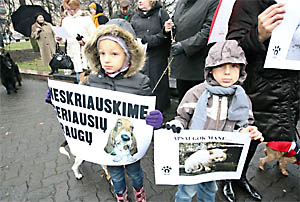
| The Spoilt Suffer Most |
One topic of discussion regarding the current economic crisis is - who is worst affected? Some argue that pensioners brought up in the tough Soviet climate are better able to adapt to the present hardships, others that the 40 - 60 year olds who can’t adapt as quickly to the new way of doing things have been the greatest casualties, not just now but over the last 20 years as well. Deimant suggests it is the unprepared 25 – 40 generation that is suffering most in this economy. Tell us what you think. Deimantė Dokšaitė Some say that pensioners, teachers, social workers, librarians or other civil servants suffer from this economical downturn most. But I think that it is my generation – people who are 25 – 40 years old who suffer from it more than others. A couple of years ago they were living very successful lives. They took loans from the banks and bought cars and flats, and couldn’t imagine a day when their salaries being reduced would ever occur, the prognosis was all just up, up up. They couldn’t imagine that they could lose their jobs, they thought just about the next promotion. Just imagine a young Lithuanian family, parents in their early 30s, they have two children. They took a loan to buy a flat which cost let say half a million litas several years ago, now worth maybe LTL200,000 (and even worse - nobody wants to buy it anyway). Both parents have cars; they took loans to buy them. They used to go on vocation twice a year – in summer to Turkey and during winter perhaps skiing in Italy or Austria. And now one of them has lost their job, and for the other a salary reduction of about 20%. It doesn’t sound cool, does it? But this is exactly what is happening in Lithuania nowadays. But the thing is that a couple years ago everything was about this generation. They were the main consumers, they were also the ones not afraid to take loans, who weren’t scared to spend and didn’t care much about savings. They frequented bars and restaurants, spending their money in all the popular wineries, they were the ones attending the theatre, cinema, concerts, sports events, taking dancing and photography classes, taking trips and trying unusual foods, buying clothes, shoes (more than one pair per season like our parents used to do), the latest computers, dishwashers, cosmetics. And yes, they were the ones who helped to create the real estate bubble. They didn’t live through the tough periods, they were children or teenagers when Lithuania was going through especially difficult times like the Russian blockade, Russian crisis etc. So it wasn’t them who learnt to cope with hardship, it was their parents. They weren’t prepared for this economic crisis, and they never imagined it could be like this. Hopefully this one lesson will be enough to teach them to understand more about responsibility and how to appreciate values other than just money and work. Maybe the Lithuanian proverb saying ‘don’t be happy when you find something, don’t cry then you lose something’ suits this situation perfectly. So perhaps that’s why pensioners and the elder generations can cope better, because they are the ones who expect something like this economical downturn to happen. And generation 25-40 were taken suddenly and without any preparation. |
| Vodka museum opens in Riga |
Riga Nov 24 (LETA-ELTA) - A vodka museum has opened in Riga at 136f Krisjana Barona Street, the newspaper “Vesti Segodna” reports today. The museum was opened by two friends Leonards Jankelovics and Igors Ristolainens. The museum is divided in “thematic corners”, for example, one section is dedicated to “Smirnoff” vodka, another to Putin, yet another to the theme of war. The museum displays bottles and posters with vodka ads, excerpts from newspapers describing the alcoholic drink and vodka labels. The museum includes several hundred displays altogether. |
| International Christmas Charity Bazaar |
The seventh annual International Christmas Charity Bazaar was held in the Rotušė on Sunday 29 November. There were 30 different countries represented at the fair which gave the 2500 guests who attended a good opportunity to buy the Christmas presents and other items they might not be able to get elsewhere. This year they raised LTL150,000 from sales and the lottery, and another LTL50,000 was provided from the main sponsors. Alma Adamkien remains the patron, and was at the opening with her husband Valdas. They bought goods from many of the stalls including origami from the Japanese, a gingerbread house from the Finns and baklava from the Greeks. The lottery was as popular as ever, as was the singing of Christmas carols, and it always proves a great occasion to catch up with friends before the real rush of the festive season gets into full swing. The International Christmas Charity Bazaar is organised by the Vilnius International Women’s Association. |
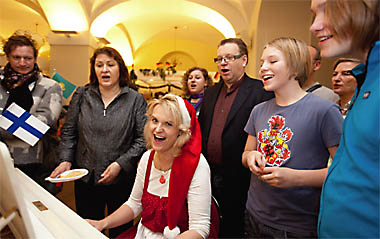
| Ryanair Cabin Crew Strip For Charity |
€110,000 Calendar Proceeds Go To “Kids” Charity Ryanair, launched its 2010 Ryanair Cabin Crew Charity Calendar which the airline hopes will raise €110,000 for the UK charity “KIDS” which provides support to disabled children all over the UK. Ryanair’s CEO Michael O’Leary has already bought the first 100 copies of the 2010 calendar and sent one to ‘anti-fun’ Labour MEP Mary Honeyball who last year wrongly accused Ryanair of “forcing” cabin crew to take part in the calendar. Ryanair’s cabin crew volunteer to take part and this year over 800 of the airline’s 4,000 cabin crew applied for this charity event. This year a Lithuanian stewardess also made the final cut, and Karolina struts her stuff above on the left. |

| A Year to Remember |
They say a week is a long time in politics, so a year must be an eternity. Prime Minister Andrius Kubilius must be feeling an eon has passed since he formed a ruling coalition one year ago on 17 November 2008, and took the reins of the Lithuanian Seimas, a coalition he prophetically named The Coalition of Change. The victory celebrations after last year’s general elections will have to go down as the most short-lived in Lithuanian history, as within two months of its first sitting the members of Seimas were looking out of their windows at a mass protest that eventuated in the deployment of riot police and the use of tear gas and rubber bullets. To be fair there were a lot of circumstances way beyond the control of the Seimas and the government, number one of which was an economy sucked spiralling downward by the worst world economic recession since the Great Depression. Being at the helm of a small nation allows little control on the waves of economic gloom that toss any country around, especially one that did not put any reserves aside in the good years. Then there was the added intrigue of the newly formed National Resurrection Party, the party of celebrities headed by Arūnas Valinskas, which in their first election won 16 seats and an instant invitation to join the ruling coalition. Looking back on the achievements of the current coalition government, you would have to say there is more bad than good news, but let’s go through their litany of change. • They got straight down to business when Valinskas is finally elected Speaker of the Seimas, but only after a controversial second vote on 18 November. • Kubilius is confirmed as Prime Minister on 27 November. • At the end of December the Seimas worked until midnight in putting the finishing touches on tax reforms with little or no public consultation. • December 22 the budget is passed by the Seimas. • January 16 there is a meeting of trades union which end in riots in front of the Seimas; breaking windows, calling out the riot police and extensive use of tear gas and rubber bullets. • May 19 the opposition launches an unsuccessful vote of no-confidence in Finance Minister Algirdas Šemeta, but later he was sent to Brussels to fill the position vacated by President Grybauskaitė. The post of Finance Minister was filled by Ingrida Šimonytė. • In June Valentinas Mazuronis, of the Order and Justice Party, becomes the Opposition Leader. • July 22 the Minister of Social Security and Labour, Rimantas Jonas Dagys, is replaced by Donatas Junkauskas, because he was not validated by President Grybauskaitė. • Mid July the National Resurrection Party is split into two fractions, and on October 15 Arūnas Valinskas is deposed as Speaker of the Seimas. • October 17 Irena Degutienė is elected Speaker of the Seimas. • September 16 preparation for the next budget commences. • September 20 the opposition launches an unsuccessful no-confidence motion against Education and Science Minister Gintaras Steponavičius. IN BETWEEN THESE specific events the government controversially considered adding the Labour Party to the ruling coalition, there was much criticism of energy wasted on unimportant issues, especially under Valinskas’ tenure, the policy on car hire by members of Seimas, and the ill-advised ‘Protection of Minors against the Detrimental Effects of Public Information’ legislation that brought strong international criticism and EU condemnation. While it is usual for politics to be a rough and tumble business, it is speculated by many that this is the least liked government ever. In the 11 years since Vilmorus has been taking polls, their data shows this government the least liked, with the government (trust 11.5%, distrust 59.9%), parliament (trust 4.8%, distrust 76.3%) and political parties (trust 4.1%, distrust 76.7%) taking the bottom three places in a poll of general trust in public institutions. In research conducted by Eurobarometer the popularity of the Lithuanian Seimas is held in equal 25th position with Bulgaria among the EU 27 countries, trailing only behind Latvia. To the credit of the ruling coalition, they learnt a lesson from the unfortunate riots in front of the parliament, which did prompt them to seek greater public input into policy, and without accepting all external advice, they seemed to start working in a more transparent manner. One of the main concerns of the government was the dreaded ‘D’ word – devaluation. While a floating currency along with a much larger population base helped Poland ride out the worst of the economic storm, Lithuania’s problems were compounded by the fact that most bank loans were issued in euros, and a devaluation of 20% – 40% would have meant a double hit on loan repayments, especially considering the already heavy falls in real estate prices. With no reserves the government chose to placate the concerns of the IMF and EU economic gurus, and this meant harsher fiscal measures, most notably through raised taxes and lowered wages, which in turn does little to raise popularity. THE ONLY CONSOLATION Lithuanian’s could draw was that things were still not as bad as in Latvia, with the added expectation that if devaluation was deemed necessary, it would hit our northern neighbours first. While there is still talk of more cuts and hardship to come, some are predicting that as other larger economies seem to be moving out of recession, then Lithuania too may be either at the bottom of the cycle or close to it. The threat of devaluation, though still present, is much subsided since summer and government heads throughout the Baltic are more confidently declaring it no longer an issue. So on the occasion of the Seimas’ first birthday, perhaps they might finally be able to move forward, rather than just paddle frantically in an effort to stay still. This Seimas really has brought to light the full fury of the curse: May you live in interesting times. |

| Vilnius Airport Cheapest in Europe for New Destinations |
Vilnius International Airport (VIA) set new prices to promote new flights from Vilnius. This year VIA has already reduced passenger fees paid by airlines, which stood at LTL40. “As compared to the neighbouring airports, that was a high price to pay. Therefore, now, when airlines count each litas, this price was a serious barrier for new flights”, said Tomas Vaišvila, Director General of VIA. |
| airBaltic Plans New Direct Flights from Vilnius |
airBaltic announced that it is opening five new direct flights from Vilnius Airport. The new flights were made possible through an initiative of the Lithuanian government of lowering |
| Star1 to launch Vilnius-Milan Flights |
Vilnius, Nov 17 (ELTA) - This week Star1 Airlines launches regular flights from Vilnius to Milan, the restoration of a direct link between Lithuania and Italy. |
| Turkey Lifts Visa Requirements for Lithuanian Tourists |
The Government of Turkey lifted the visa requirement for Lithuanian citizens travelling to Turkey as tourists. The new Ambassador of Turkey to Lithuania, Omer Altug, presented the note confirming the Turkish Government’s decision during a meeting with Vygaudas Ušackas, Lithuania’s Minister of Foreign Affairs on 12 November in Vilnius. |
| Five Lithuanians seized by pirates |
 |
Vilnius, Aug 4 (ELTA) - On Tuesday early morning, a ship was attacked near Nigerian coast and five members of its crew were taken as hostages. Their location is not yet known. According to the data available to the Foreign Ministry, the ship Saturnas belonging to Limarko Laivininkystes Kompanija, sailing under a Lithuanian flag, was captured. Five Lithuanian nationals captured by armed attackers were taken as hostages and taken away by a motor boat. Vytautas Lygnugaris, CEO of Limarko Laivininkystes Kompanija, told ELTA that the ship carrying frozen fish was attacked early Tuesday morning. “The ship was berthed and waiting for discharge in the morning. People armed with automatic arms approached the ship by boat. They did not try to get anything from the ship; captured five people who were guarding the ship at that moment and left,” said Lydnugaris. According to the data available to the company head, nobody in the crew was injured during the attack and the rest of the crew is fine. He also claimed that he had no information about the number of attackers. According to Lygnugaris, the crew can defend themselves from the attackers only by releasing a strong water stream in order to wash them away from the board of the ship or by trying to push them away their ladders. “However, when there are more attackers, these measures do not really work,” Lygnugaris explained. Limarko Laivininkystes Kompanija CEO claimed that this is the first time there is an accident with pirates in his experience. “In half an hour Foreign Minister Usackas will be in my office and we will be coordinating our actions further on,” he told ELTA on Tuesday afternoon. According to Rolandas Kacinskas, head of the information and public relations department of the Foreign Ministry, having learned about the accident, the foreign minister suspended his holidays and is currently going to a meeting with the head of Limarko Laivininkystes Kompanija. This is the first case when Lithuania has to independently rescue its nationals from the grips of pirates, however, these captured seamen are not the first Lithuanians being captured by pirates. Pavelas Galijevskis from Klaipeda was captured by Somali pirates this year. He was sailing by Bow Asir tanker belonging to the Norwegian company Salhus Shippuing AS. “This story ended successfully. This man has been rescued,” Kacinskas said. |
| There will be no Disneyland in Vilnius |
Mayor Vilius Navickas, who brought the idea of Disneyland theme park to Vilnius from his official visit to Chicago in the U.S.A. has received negative responses from both Disneyland company and Legoland. Walt Disney Parks and Lego Group investors were proposed to consider the possibility to erect high-class entertainment park in Vilnius with their own finances. It became clear from the responses that the companies are not currently planning to make investments into the Baltic region. “By sending letters to these companies we just checked whether such a possibility existed. We expected such a variant too, however, our provision that a theme park that would be attractive to both Lithuanians and guests from abroad should be erected does not change,” mayor’s advisor Darius Indriunas told the daily Vilniaus Diena. |
| Filipinos think Borat is Lithuanian | |
Vilnius, Jan 14 (ELTA) - Filipinos think that world-famous character Borat is Lithuanian. This conclusion is suggested in an article published in the local daily The Manila Times and US presidential candidate Barack Hussein Obama. “Nobody knew him then. His names were equated to Lithuanian comedian Borat, Iraqi tyrant Hussein, and al-Qaeda terrorist Osama bin Laden,” this is the way the author of the article published on Monday describes the Democratic candidate striving for the post of the US president Obama. |
 |