
Archives |
|
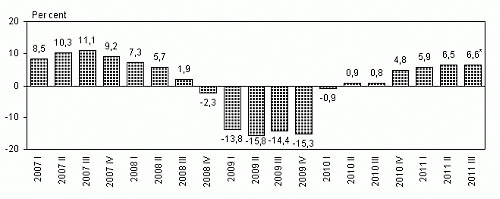
| GDP up 6.6% | 9 November 2011 |
In III quarter 2011, gross domestic product increased by 6.6%
|
|
| The first Lithuanian-Israeli business mission held in Vilnius | 5 October 2011 |
A new stage of economic cooperation between Lithuania and Israel was recently marked by a meeting of the Minister of Economy of Lithuania and the Minister of Industry, Trade and Labour of Israel. A bilateral working group was agreed to be established to help implement specific projects in the field of R&D. At the meeting Rimantas Žylius of Lithuania and Shalom Simhon and other members of Israeli Official and Business Delegations discussed issues relating to bilateral trade and investments as well as cooperation possibilities in the fields of risk capital, R&D and innovation. “It is not only political but also economic aspect to be emphasized in Lithuania’s relations with Israel. The market of Israel is very important for Lithuania, therefore, as soon as February 2012 a commercial attaché of Lithuania will be appointed in Israel. Our companies will have a good chance to evaluate their ability to be interesting to the business community of Israel and learn how to attract investments from Israel as well,” Rimantas Žylius said after the meeting. “It is in my best interest that practical ways of how to foster economic relations between Israel and Lithuania are found. In fact, I will feel most happy when I finally see business contracts signed between both countries as well as other practical work results in place,” said Shalom Simhon, Minister of Industry, Trade and Labour of Israel. Yesterday, the first ever Lithuanian-Israeli Business Mission was arranged in the Ministry of Economy which brought together representatives from more than 15 Israeli companies. During the mission B2B meetings between Lithuanian and Israeli businessmen were held and three memorandums were signed in the field of standardization (product safety), export and industry. Israel’s information technology specialists were among those most interested in business possibilities in Lithuania. The Business Mission attracted Israel and Lithuania’s representatives from other sectors like textile, food industry, irrigation (watering) systems, defence, finance and agriculture. Lithuania’s metal processing companies and plastics manufacturers were interested in potential ordering from Israel. “Cooperation between Lithuania and Israel is a strong incentive for us aiming to continue working in the field of innovation. Minister Shalom Simhon who sees our great potential in this field has proposed to establish a bilateral working group in the period of the coming three month to help the implementation of specific projects in the field of R&D,“ Minister Žylius said. Moreover, Minister Žylius asked Minister Simhon to encourage Israeli risk capital funds to take part in a public tender to be arranged in Lithuania this autumn aimed to select a risk capital fund manager. Besides, Minister Žylius invited the businessmen of Israel to take part in Life Sciences Baltic 2012, an international forum of medicine and physics to be held in Lithuania this autumn. Both Israeli and Lithuanian sides confirmed their high ambitions towards increasing the level of bilateral trade. Despite Israel ranking 42 as export and 48 as import partner of Lithuania, statistics recently show an increase in the trade volumes. |
|
| Foreign companies interested in Lithuanian energy projects | 5 October 2011 |
On 15 September a delegation of one of the biggest Chinese engineering and construction companies, CPECC North China Power Engineering Co Ltd, visited Lithuania's Ministry of Energy. The delegation was led by Chairman of the Board Liu Chaoan. The Chinese delegation had a meeting with ministry representatives. During the meeting the main Lithuanian strategic energy projects were presented by Viceminister of Energy Žygimantas Vaičiūnas. After this presentation representatives of CPECC expressed an interest to propose their tenders for participation in project implementation and both parties agreed on further cooperation. "The fact that companies such as CPECC are interested in projects that we are implementing in Lithuania clearly shows that these projects are definitely visible on the map of world energy projects. "It is important that strategic projects of electricity and gas connections would be implemented in a competitive environment with as many as possible experienced companies participating in the process," viceminister Žygimantas Vaičiūnas said after the meeting. North China Power Engineering is a state company that is engaged in engineering, design and consulting of energy projects and the construction of power plants. The company is implementing projects in China, Belarus, Nigeria, Indonesia and Kazachstan. To the end of 2010, CPECC has implemented 381 Projects of 75,557 MW total capacity in China - this is estimated to be one-tenth of the all countries energy projects. At present the company also dedicates a lot of attention to renewable energy projects. |
|
| Number of rail passengers between Vilnius and Minsk doubles | 4 October 2011 |
People travelling between Vilnius and Minsk now are choosing trains more often. The number of passengers that travelled this summer from Minsk to Vilnius nearly doubled, compared with the corresponding period of 2010. Train travel has become more attractive because from 1 June the travel time from Vilnius to Minsk was reduced from 3 hours 51 minutes to 3 hours. This has been possible because of the close cooperation between Lithuanian and Belorussian Railways. The reduction of travel time was enabled by organisational and technical measures applied in the implementation of the project of high speed trains between Vilnius and Minsk. |
|
| Apartment prices up slightly in Vilnius but remain low elsewhere | 23 August 2011 |
The Ober-Haus Lithuanian apartment price index (OHBI) shows that in June of this year apartment prices in the five major Lithuanian cities (Vilnius, Kaunas, Klaipėda, Šiauliai, and Panevėžys) increased by 0.1%. The same growth as seen in April and May.
In Vilnius, a price rise of 0.5% was recorded in June, however the annual growth of apartment prices compared to the month of May has decreased to 3.6%. In May, the annual growth of apartment prices in the capital was 4.2%. In other cities of Lithuania, negative trends in prices remain. In Kaunas, Klaipėda, and Šiauliai, a fall of 0.2% in prices was recorded. In June, prices fell in Panevėžys by 1.0%. The annual change in apartment prices in other cities is still negative: 3.4% in Kaunas, 2.9% in Klaipėda, 4.4% in Šiauliai, and 2.6% in Panevėžys. From the highest summarised apartment price level which was reached at the end of 2007 to June of this year, the price for apartments dropped 39.1% in Vilnius, 34.5% in Kaunas, 46.1% in Klaipėda, 45.4% in Šiauliai, and 46.3% in Panevėžys. |
|
| Unemployment rate in Lithuania 15.6% | 23 August 2011 |
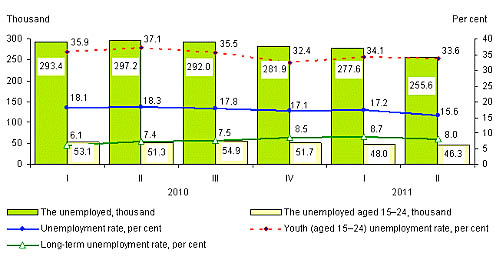
According to the estimates of the Labour Force Survey conducted by Statistics Lithuania, the unemployment rate in Lithuania during II quarter 2011 stood at 15.6%, which is 1.6% less than in I quarter 2011. Over the year the unemployment rate decreased by 2.7%. In II quarter 2011 compared to I quarter, the male unemployment rate decreased by 1.9% and stood at 18.5%, while female unemployment was down 1.2% at 12.7%. In II quarter 2011 the urban unemployment rate was 13% (down 1.2%), while rural unemployment was 21.8% (down 2.6%). The youth (aged 15–24) unemployment rate in II quarter 2011 was 33.6%. Over the quarter youth unemployment rate decreased by 0.5%, over the year by 3.5%. In II quarter 2011, just as in I quarter, each tenth person aged 15–24 was unemployed (9.7 and 10.1% respectively). Unemployment, 2010–2011
According to the estimates of the Labour Force Survey, in II quarter 2011, there were 255,600 unemployed persons, which is 22000 (7.9%) less than in I quarter 2011. Over the year the number of the unemployed dropped by 41,600 (14%). More than half (58.5%) of unemployed had general upper secondary or vocational upper secondary qualifications, while one in seven (14%) had general lower secondary education, and one in eight (12.8%) had completed higher or post-secondary tertiary education. In II quarter 2011, the number of persons working in the country was 1,385,000, or 44,700 (3.3%) more than in I quarter. Over the quarter the most noticeable increase in the number of persons employed was in agriculture, forestry and fishing (up 13,600), trade (up 12,600), industry (up 7,700), and construction (up 6,300); a decrease in the number of persons employed was seen in human health and social work (down 5,200) and accommodation and food service (down 3,100). The employment rate of persons aged 15–64 in II quarter 2011 stood at 60.8%; over the quarter, it grew by 1.7%. The male employment rate was almost equal for male and female: in II quarter 2011, the male (aged 15–64) employment rate was 60.7%, female 60.8%. The youth (aged 15–24) employment rate in II quarter 2011 stood at 19.2%; over the quarter, it dropped by 0.2%. Over the quarter, the employment rate of the elderly (aged 55–64) dropped by 0.2% and stood at 49.7%. Statistical information was prepared based on Labour Force Survey data. The survey is carried out in all EU countries following a common methodology and the concepts of the employed persons and an unemployed person applied by the International Labour Organization, which makes its results comparable across countries. Unemployment in the Baltic States According to the data of the statistical offices of the Baltic States, in II quarter 2011, the highest unemployment rate of the population aged 15–74 was in Latvia (16.2%), the lowest – in Estonia (13.3%); in Lithuania, it stood at 15.6%. Over the quarter, the largest decrease in the unemployment rate – by 1.6% – was recorded in Lithuania; in Estonia, the unemployment rate decreased by 1.1%, in Latvia – by 0.4%. |
|
| Tourism up 12.4% in 2010 | 7 July 2011 |
Statistics Lithuania informs that, based on data from the inbound tourism survey, the number of overnight trips of foreigners in 2010, compared to 2009, increased by 12.4% (from 1.3 million in 2009 to 1.5 million in 2010), the number of same-day trips decreased by 3.5% (from 2.7 million in 2009 to 2.6 million in 2010). Foreign visitors with one or more overnight stays who arrived in Lithuania for personal reasons accounted for 70%, those arriving for business – 30%. The number of personal trips in 2010, against 2009, increased by 22.8%, while that of business decreased by 6.2%. The larger portion of foreign visitors consisted of males who accounted for 66% of all tourists. The main source of information about Lithuania (indicated by 45% of tourists) was friends and relatives. For every third tourist, it was their first visit to Lithuania. More than half of the tourists arrived by road – 58% (in 2009, 60%), by air – 34% (in 2009, 31%), by rail – 5% (in 2009, 6%), by sea – 3% (in 2009, 3%). In 2010, most overnight visitors arrived from Belarus (19%, or 291,500), Russia (15%, or 224,500.), Poland (11%, or 166,000), Germany (11%, or 159,200), and Latvia (10%, or 146,300). In 2010, compared to 2009, the number of trips from Russia increased by 18.5%, from Belarus – 17.9%. The number of trips to Lithuania from EU countries increased by 13% (in 2010, 878,200, in 2009, 777,400), from non-EU member states – by 11.5% (in 2010, 628,700, in 2009, 563,600). Trips from the EU countries accounted for 58.3%. Last year, the average duration of a foreigner’s trip to Lithuania was 4.3 nights (in 2009, 4.5 nights). In 2010, compared to 2009, the number of trips of shorter duration (with 1–3 overnight stays) grew by 13.5%; such trips accounted for 75% of all overnight visits. In 2010, the total number of overnight stays amounted to 6.4 million and, compared to 2009, increased by 6.3%. In 2010 the average expenditure per foreign overnight visitor in Lithuania amounted to LTL1046, which was 4% more than in 2009. The highest expenditure per tourist trip was recorded for tourists from Israel and the United States (about LTL1,700 per trip with 7 overnight stays), the lowest were for tourists from Latvia and Estonia (on average, LTL573 per trip with 3 overnight stays). In 2010 total expenditure incurred during trips with one or more overnight stays amounted to LTL1.6 billion, which is by 17% more than in 2009. Just over half (51%) of foreign tourists indicated that they had stayed in hotels and motels, 36% with relatives and friends. The most popular places visited by foreign tourists were Vilnius – 63%, Kaunas – 25%, Klaipėda – 16%, Trakai – 12%, and Palanga – 8%. Almost all (96%) foreign tourists gave a very good or good assessment of their visit to Lithuania. Foreigners arriving on a same-day trip were for the purpose of shopping (32%) or business (25%). In 2010, same-day visitors in Lithuania spent LTL770.3 million, which is 4.8% less than in 2009. Almost half (46%) of expenditure was on shopping. Average expenditure by a foreigner per same-day trip was LTL300. In 2010, almost half of the same-day visitors arrived from Latvia (987,900 or 38.5%), Poland (621,600 or 24.2%), Belarus (371,500 or 14.5%), Russia (265,600 or 10.3%), and Estonia (191,100 or 7.4%). |
|
| FDI in I quarter 2011 | 7 July 2011 |
Based on provisional data, the FDI flow in Lithuania in I quarter 2011 amounted to LTL800.4 million (3.5% of GDP). Compared to IV quarter 2010, the FDI inflow in Lithuania increased by LTL206.2 million, or 34.7%, while against I quarter 2010 (when outflow of investment was observed) – LTL895 million. An increase in the FDI inflow in Lithuania was determined by an increased reinvestment flow. Over the past four quarters (II quarter 2010–I quarter 2011), the FDI inflow in Lithuania amounted to LTL2.5 billion, or 2.6% of GDP. The flow from other capital (mostly loans from direct investors) accounted for the largest equity of this flow (LTL1.2 billion); reinvestment flow amounted to LTL821 million, while equity capital investment stood at LTL490.3 million. In I quarter 2011, the largest investment came from Sweden (LTL185.9 million), the United Kingdom (LTL182.2 million), the Netherlands (LTL161.5 million), Poland (LTL127.3 million), and Finland (LTL99.9 million). The largest investment was made in financial and insurance activities (LTL290.7 million), wholesale and retail trade; repair of motor vehicles and motorcycles (LTL286.8 million), information and communication (LTL149.9 million), and manufacture of chemicals and chemical products (LTL138.4 million). In I quarter 2011, the Lithuanian Direct Investment (DI) flow abroad was negative (minus LTL28.8 million), i.e. the DI flow abroad was on the decrease. In addition, in I quarter 2010, a decrease in the Lithuanian DI abroad was observed (the negative flow amounted to minus LTL24.1 million), while in IV quarter 2010, the DI abroad increased (the positive flow amounted to LTL397.9 million). Over four quarters (II quarter 2010–I quarter 2011), the Lithuanian DI abroad grew, amounting to LTL329.8 million. The major equity of this flow (LTL254.7 million) consisted of equity capital investment; the flow of reinvestment and other capital abroad amounted to LTL42 million and LTL33.1 million, respectively. In I quarter 2011, Lithuanians invested most in Latvia (LTL44.7 million), the Netherlands (LTL40.5 million) and Estonia (LTL10.9 million), while the fastest outflow of Lithuanian DI was from Cyprus (minus LTL153.3 million). The largest investment abroad by Lithuanian investors was in professional, scientific and technical activities (LTL54.8 million), wholesale and retail trade; repair of motor vehicles and motorcycles (LTL48.9 million), and construction (LTL16.8 million) activities. The largest investment outflow (minus LTL173.4 million) was from water transport. Having estimated the FDI flows in Lithuania and Lithuanian DI flows abroad, the net FDI inflow in I quarter 2011 amounted to LTL829.2 million, or 3.6% of GDP, while in the last four quarters – LTL2.2 billion, or 2.3% of GDP. As of 31 March 2011, the cumulative FDI in Lithuania amounted to LTL36,282.3 million (€10,508 million). Over I quarter 2011, its volume in Lithuania grew by LTL1.2 billion (3.4%). FDI per capita amounted to LTL11,233 (€3,253) on average (as of 31 December 2010, LTL10,817). The growth in the volume of the cumulative FDI was conditioned by the FDI inflow from equity capital and reinvestment. The largest investment was made by Polish – LTL4,216.9 million (11.6% of total FDI), German – LTL4,021.2 million (11.1%), Swedish – LTL4,008.9 million (11%), Danish – LTL3,696.9 million (10.2%), and the Dutch – LTL3,323,8 million (9.2%) investors. The cumulative FDI in Lithuania from EU-27 countries amounted to LTL29,028.4 million (80% of total FDI), from CIS countries – LTL2,568.0 million (7.1%). As of 31 March 2011, the largest investment was made in manufacturing – 27.7%, wholesale and retail trade; repair of motor vehicles and motorcycles – 13.4%, information and communication activities – 12.7%, real estate activities – 11.6%, financial and insurance activities – 11.3% of total FDI. In manufacturing, the largest investment was made in the production of refined petroleum products and chemicals and chemical products – LTL5,509.4 million (54.8% of total FDI in manufacturing), food products, beverages and tobacco products – LTL1,424.9 million (14.2%). As of 31 March 2011, the Lithuanian cumulative DI abroad amounted to LTL5,243.5 million (€1,518.6 million). Over I quarter 2011, it dropped by LTL215.3 million, or 3.9%. The largest investment was made in the Netherlands – LTL1,509.6 million (28.8% of total DI abroad), Latvia – LTL945.4 million (18.0%), Poland – LTL414.4 million (7.9%), Cyprus – LTL407.1 million (7.8%), and Russia – LTL386.7 million (7.4%). The largest investment of Lithuanian enterprises abroad was made in professional, scientific and technical activities – LTL1,615.9 million (30.8% of total DI abroad), real estate activities – LTL929.7 million (17.7%), wholesale and retail trade; repair of motor vehicles and motorcycles – LTL789.5 million (15.1%), manufacturing – LTL649.9 million (12.4%), financial and insurance activities – LTL560.9 million (10.7%). In manufacturing, the largest investment was made in the manufacture of basic pharmaceutical products and pharmaceutical preparations – 39.7%, rubber and plastic products – 16.9%, food products, beverages and tobacco products – 15.3% of total DI in manufacturing abroad. |
|
| World Lithuanian Economic Forum | 29 June 2011 |
During 4 - 5 July, Litexpo will host the third World Lithuanian Economic Forum (WLEF). Working on the premise that there are over a million Lithuanians living outside its borders, WLEF hopes to harness some of the business potential residing outside of the country to help strengthen and develop Lithuanian business, the theme for 2011 is: Competitive future Lithuania: investment in people, knowledge and innovation. With many expatriate Lithuanians working in some of the largest international companies, as well as smaller niche markets, WLEF will host a variety of speakers covering all areas of commerce, and in turn creating an excellent vehicle for networking, the sharing of fresh ideas and creating greater understanding of the concerns of Lithuanian and foreign businesses alike. WLEF goes beyond business and includes scientists and politicians in trying to create a more attractive business environment and in encouraging innovative and enterprising international development. Organised by the Lithuanian Business Confederation | ICC Lithuania with some help from government and business, the focus of this year's event is the creation of a competitive Lithuania, and will feature speakers from all over the world. The opening ceremony will be addressed by President President Dalia Grybauskaitė and Audronius Ažubalis, Minister of Foreign Affairs before the first session begins, entitled: Competitiveness Strategy of Lithuania for the Nearest Decade. Later sessions will include themes such as: New Business and Sponsorship Possibilities: Strategies. Trends. Best Practices; Integrated Sciences, Studies and Business Valleys – Space of Quality Partnership; What is the Determining Factor of Success for Business in Lithuania; Where Does a Successful Career Start; and What Can the World Citizenship Give to Lithuania? Speakers at these sessions will include Ilja Laurs, Founder and CEO of GetJar, Antanas Zabulis, President of Omnitel, Artūras Piliponis, Partner at Ernst&Young, Kęstas Pikūnas, President of World Lithuanian Youth Association, Antanas Guoga, Owner of the betting company Tony Bet, Dr. Daumantas Matulis, The Institute of Biotechnology, Vilnius University, Linas Kleiza, basketball player (TBC) and Marius Jovaiša, author of the photo book "Unseen Lithuania". There will also be a Gala Dinner and after party to keep the networking happening and the B2B fair will be held simultaneously from 16.00 - 18.00 on 4 July. |
|
| Average gross monthly earnings down 2.4 per cent | 25 May 2011 |
Statistics Lithuania has announced that the average gross monthly earnings in the whole economy (less individual enterprises) in I quarter 2011 was LTL2071.6 and, compared to IV quarter 2010, dropped by 2.4%. |
|
| Hotel guests up for I quarter 2011 | 25 May 2011 |
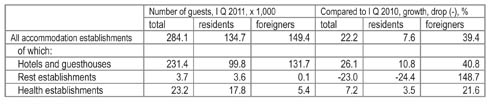
According to provisional data of Statistics Lithuania, in I quarter 2011, accommodation establishments had 22.2% more guests than in the same period of 2010. The number of guests from EU countries increased by 25.1, Lithuanian residents – by 7.6%; the number of quests from non-EU countries increased by 59.1%. The majority of guests were from Russia – 30,800 (in I quarter 2010, 19,000), Belarus – 22,100 (in I quarter 2010, 14,400), Poland – 18,900 (in I quarter 2010, 14,700), Latvia – 10,400 (in I quarter 2010, 9,500), Germany – 9000 (in I quarter 2010, 6,900), Estonia – 6,600 (in I quarter 2010, 4,900), the United Kingdom – 5,200 (in I quarter 2010, 4,300), Finland – 5,200 (in I quarter 2010 – 2,800). In I quarter 2011, the accommodation establishments of Druskininkai received 54,800 guests (15.4% more than in I quarter 2010), Palanga – 16,200 (5.8% more), Neringa – 1,300 (12.4% more). The accommodation establishments of Birštonas municipality received 5,400 guests (9.3% less). Table 1. Number of guests in accommodation establishments
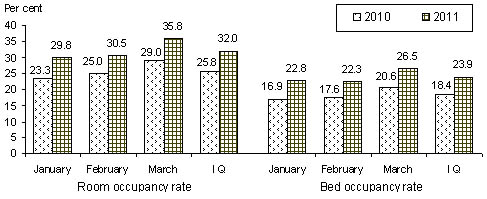
In I quarter 2011, compared to the same period of 2010, Lithuanian hotels and guesthouses accommodated 26.1% more guests; the number of foreigners accommodated increased by 40.8%. In I quarter 2011, the hotel and guesthouse room occupancy rate stood at 32% (in I quarter 2010, 25.8%). In I quarter 2011, Vilnius hotels and guesthouses accommodated 106,000 guests, which is 36.8% more than in the same period of 2010. The number of foreign guests was 83,000, or 43.6% more than in the same period of 2010. In I quarter 2011, the room occupancy rate of Vilnius hotels and guesthouses stood at 39.4% (in I quarter 2010, 32%). Table 2. Distribution of hotels and guesthouses by stars, I quarter 2011
|
|


| Unemployment 17.2% | 23 May 2011 |
According to the estimates of the Labour Force Survey conducted by Statistics Lithuania, the unemployment rate in Lithuania in the first quarter of 2011 was 17.2%, which is 0.1 percentage points higher than in IV quarter 2010. Year on year the unemployment rate dropped by 0.9 percentage points. In I quarter 2011, against IV quarter 2010, the male unemployment rate increased by 1.3 percentage points and was 20.4%, while the female unemployment rate dropped by 1.2% and is now 13.9%. In I quarter 2011, the urban unemployment rate was 14.2%, rural – 24.4%. The youth (ages 15–24) unemployment rate in I quarter 2011 was to 34.1%. Over the quarter the youth unemployment rate grew by 1.7%, while over the year it dropped 1.8%. According to the estimates of Statistics Lithuania, in I quarter 2011 there were 277,600 unemployed, which is 4,300 or 1.5% less than in IV quarter 2010. Over the year the number of unemployed dropped 15,800, or 5.4%. According to the estimates of the Labour Force Survey, more than half (58.1%) of unemployed had either a general upper secondary or vocational upper secondary educational degree, every sixth (15.6%) – higher or post-secondary tertiary educational degree, every ninth (11.4%) – general lower secondary. In I quarter 2011, long-term unemployed persons – i.e. persons looking for a job for one year and longer – accounted for more than half (50.8%) of the unemployed. The number of long-term unemployed in I quarter 2011 was 141,000, or 1,200. (0.9%) more than in IV quarter 2010. Based on the data of Lithuanian Labour Exchange, in I quarter 2011 the number of the registered unemployed was 303,700, which is by 2,300., or 0.8%, less than in IV quarter 2010. In I quarter 2011 the number of persons working in the whole economy was 1,340,000; compared to IV quarter 2010 this number dropped by 26,700. Particularly, there was a decrease in the number of people employed over the quarter in construction – down 17,000, agriculture, forestry and fishing down 6,100, while in transportation and storage as well as in accommodation and food service activities grew by 4,200 each, and other service activities up 4,000. The employment rate of persons aged 15–64 in I quarter 2011 was 59.1%; over the quarter it dropped 0.1%. The male employment rate was lower than the female rate: in I quarter 2011, the male (aged 15–64) employment rate was to 58.8%, female - 59.5%. The youth (aged 15–24) employment rate in I quarter 2011 was 19.4%; over the quarter it dropped by 2%. Over the quarter the employment rate of the elderly (aged 55–64) dropped by 0.4% and was to 49.9%. Note: Statistical information has been prepared based on the Labour Force Survey data. The survey has been carried out by use of a sampling method. In I quarter 2011, 14,600 (0.5%) residents of Lithuania aged 15 and over were interviewed; the survey results were subsequently recalculated for the total population of the country. Unemployment in the EU According to the estimates of the Statistical Office of the European Union (Eurostat), the unemployment rate in the European Union in March 2011, seasonally adjusted, was 9.5%. The highest unemployment rate among EU countries was in Spain – 20.7%, the lowest – 4.2% in the Netherlands. |
|
| Apartment price index positive at last, at least in Vilnius | 19 May 2011 |
The Ober-Haus Lithuanian apartment price index (OHBI) shows that in April of this year apartment prices in the five major Lithuanian cities (Vilnius, Kaunas, Klaipėda, Šiauliai, and Panevėžys) rose by 0.1%. After a break of almost three years the annual price index change is positive and now stands at 0.2%. A slight fall in prices was recorded in April for Kaunas, Klaipėda, and Šiauliai—0.4%, 1.0%, and 1.2% respectively. No changes were recorded in April for Panevėžys. The annual apartment price index in other cities of Lithuania still remains negative: 4.0% in Kaunas, 3.3% in Klaipėda, 2.3% in Šiauliai, and 2.0% in Panevėžys. |
|
| Socially Responsible Companies Awarded | 11 May 2011 |
Thirteen Lithuanian and foreign companies contributing to the creation of social well-being and reduction of negative environmental impact were recognised at the National Responsible Awards. The contest was organised by the United Nations Development Programme in Lithuania in cooperation with the Ministry of Social Security and Labour. President Valdas Adamkus was the patron of the event. This year’s awards attracted even more attention than in the previous years and a total of 83 entries were received from 53 companies. Winners of the “Employer of the Year” and “Debut of the Year” were congratulated by the Minister of Social Security and Labour, who claimed that corporate social responsibility had become more than a matter of fashion as it had been before. Now it is an aspiration and a necessity when creating corporate added value. “The corporate sector is choosing the path of socially responsible business, which is optimistic.” In the previous years, foreign companies constituted the majority of participants in these awards. However, today, a new tendency is emerging. The number of Lithuanian socially responsible companies is increasing. Activities of these companies are not limited to the provision of services, which they were concerned with in the previous years. They gradually turn to manufacture and industry – the fields, which require more effort to introduce and maintain standards of corporate social responsibility,” Donatas Jankauskas said. The National Responsible Business Award is presented to enterprises which mostly contribute to the creation and strengthening of social welfare and reduction of environmental impact in Lithuania. The activities of these enterprises demonstrate their leadership and sincere commitment to operate transparently, fairly treat employees, society and the state. This year’s awards were primarily focused on the environmental theme. Employer of the Year Large Lithuanian companies – Teo LT, AB: For the fostering of employees’ health, consideration of their opinion and results of volunteer work. Small and medium companies – UAB “Alna Software”: For its non-standard work conditions, continuous dialogue with employees and original ideas. Foreign companies – UAB “PricewaterhouseCoopers”: For coherence in labour relations and encouragement of innovative communication culture among employees. Debut of the Year - UAB “Ekonominės konsultacijos ir tyrimai” For company’s open attitude towards employees and the involvement of the latter into the process of strategic decision making. Partner of the Year Large Lithuanian companies – AB “Lifosa”: For its confidence in the municipality and provision of social, cultural and ecological opportunities for the local community. Small and medium enterprises – UAB “ERP”: For original initiatives and attention to the fields abandoned by other companies. Foreign companies – UAB „RIMI Lietuva“: For its coherent commitment to the disabled and its partnership with small farmers. Debut of the Year – AB “LESTO”: For its enthusiastic fostering of responsible consumption and original business initiatives: “Tiek kiek reikia“ (As Many as Necessary), “Operacija 2020” (Operation 2010), “Elektromagija”. Environmental Enterprise of the Year Large Lithuanian companies – Teo LT, AB: For its environmentally friendly investments, engagement of managers, and coherent fostering of environmental virtues across Lithuania. Small and medium enterprises – UAB “PakMarkas”: For its initiative while searching for innovative waste treatment methods and its mature attitude towards corporate environmental impact. Foreign companies – UAB “Švyturys-Utenos alus”: For excellent energy saving and pollution reduction results and involvement of its employees and clients into environmental initiatives. Debut of the year – Private design and publishing company AB “KOPA”: For strategic environmental business solutions. Socially Responsible Enterprise 2010 Large Lithuanian companies – Teo LT, AB: For all-rounded and strategic activities in the field of social responsibility and fostering of responsible business virtues in business community and the public. Small and medium enterprises – UAB “ERP”: For the initiative “Project 12” uniting business, employees, environmental protection and the community. Foreign companies – “Swedbank”, AB: For its mature policy in corporate, social and environmental fields and its corporate policy and practice reflecting the state’s interests. The following companies were also mentioned: The special debut award under the nomination of socially responsible company went to UAB “Verslo žinios”. This newspaper assesses and analyses other companies’ failures and achievements, good and bad work as well as contributes to the development of responsible business ideas. The company also strives to become a responsible employer and contributes to the environment fostering and the strengthening of the state. Director of UAB “TVIRTA” Andrius Mačiulis was awarded for sincere and personal care for each employee as well as for his enthusiasm while tackling wages paid “in envelopes”. |
|
| Bank of Lithuania Board Meeting | 11 May 2011 |
New Medium Term Macroeconomic Projections for Lithuania approved The Board of the Bank of Lithuania approved new Medium Term Macroeconomic Projections of the Bank of Lithuania prepared by the Economics Department. In the near future they will be available on the Bank of Lithuania’s website. Sample coins dedicated to Basketball approved The Board of the Bank of Lithuania approved the sample 50 litas collector (commemorative) gold coin and 1 litas collector (commemorative) circulation coin made of alloy of copper and nickel. Both coins are dedicated to Basketball. The sample coins were minted by UAB Lithuanian Mint. The coin is to be launched in the second quarter of 2011. The graphic designs of the coins were created by Liudas Parulskis, the plaster models by Giedrius Paulauskis. Bjørnar Lund to head AB DnB NORD bank The Bank of Lithuania received a request from AB DnB NORD regarding permission for BjørnarLund to become the Chairman of the Board and Chief Executive Officer (President) of the Bank. The Board of the Bank of Lithuania did not object to this appointment. AB DnB NORD Bank notified the Bank of Lithuania that BjørnarLund has extensive experience from his different previous managerial positions (head of the DnB’s Nordic Desk in Singapore, regional manager of DnB Bank ASA, and the regional manager of the DnB NOR Bank ASA in charge of business banking). He has been the regional manager of DnB NOR Bank ASA in charge of retail banking in Norway since 2009. Will issue a licence of a payment institution The Board of the Bank of Lithuania decided to issue a licence of a payment institution to AB Mažeikių butų ūkis, which grants the right to provide the payment service established in Paragraph 6 of Article 5 of the Republic of Lithuania Law on Payments (money transfers). According to the information provided to the Bank of Lithuania, Mažeikių butųūkis is engaged in the collection of utility and other payments, collection and transfer of fees and payments for heating, water, etc. to the service providers. Moreover, the company provides an additional service of data accumulation and management closely related to the payment service (money transfers), carries out other activities that are not provision of payment services. These include: technical maintenance of blocks of flats and of other buildings, management of the economy of different purpose buildings, renovation and maintenance of the heating economy, installation and maintenance of electrical systems, buildings repair, construction works, etc. |
|
| CPI up 1% in April | 9 May 2011 |
Statistics Lithuania informs that in April 2011, against March, prices for consumer goods and services increased by 1%. The overall change in prices was influenced by an increase in prices for food products and non-alcoholic beverages, clothing and footwear, and transport goods and services. In April 2011, against March, prices for consumer goods grew by 1.3%, prices for services – 0.2%. Food prices are still on an upward trend. The greatest influence to the monthly change in prices for food products and non-alcoholic beverages was made by a 9.5% increase in prices for vegetables and potatoes, 2.2% – both for meat and its products and for bread and cereals, 2.5% – milk and its products, cheese, eggs, 1.8% – fish and its products, as well as by a 2.7% decrease in prices for fruits and berries. Changes in prices for clothing and footwear were influenced by an increase – due to new spring and summer season collections – in prices for clothing – by 3.4%, footwear – 5%. A change in prices for transport goods and services was mostly influenced by a 2.7% increase in prices for petrol, 2.4% – diesel fuel, as well as by a 1.8% drop in prices for liquefied gas for cars. In April 2011, an annual (April 2011, against April 2010) inflation stood at 4.4%. The annual price change was determined by an increase in prices for food products and non-alcoholic beverages, transport goods and services, housing, water, electricity, gas and other fuels group of goods and services, as well as by a decrease in prices for communications goods and services and recreation and culture goods and services. Over the year, prices for consumer goods grew by 5.6%, prices for services – 0.6%. |
|
| Economic Outlook for Lithuania - Lietuvos Bankas | 9 May 2011 |
The development of macroeconomic indicators shows strengthening economic recovery in Lithuania. In addition to rising activity in the main foreign trade partners, the recovery of domestic demand is starting to exert favourable influence on the economy. Real GDP is growing largely due to the increase of the value added created in the manufacturing; however, activities oriented towards domestic demand, such as construction, trade and financial intermediation are also starting to improve. Domestic demand, especially private consumption, is recovering slightly stronger than expected; therefore more favourable economic developments are anticipated: real GDP is expected to grow by 5.6% in 2011 and by 4.8% in 2012. Real private consumption, which declined by more than a fifth during the downturn, is starting to recover. Larger household consumption expenditure already contributed to GDP growth at the end of last year, whereas available information shows that it continues to rise. Private consumption growth has been partly determined by more favourable expectations of households, whereas in the nearest future it will also expand due to a better situation in the labour market. As private consumption is growing more than expected, outlook for this indicator is more favourable over the whole forecast horizon: it will increase by 5.3% and 4.8% in 2011 and 2012 respectively. With the rise of economic activity, the situation in the labour market is improving gradually. Although the unemployment rate was high in 2010, it started to decline in the second half of the year. The number of newly unemployed has been decreasing and the number of vacancies has been growing for some time already. Employment started to increase in some activities, such as information and communication, transport, accommodation and food service, financial and insurance activities. It is expected that with the acceleration of the economic recovery, the situation in the labour market continues to improve; however, it should be noted that labour market efficiency will also have its impact on further labour market developments. The situation will get better, if those in search for a job are capable of meeting market demands, determined to change their qualification and are ready to take on a job in the country where jobs are created. If the labour market is less efficient, the situation may be worse than currently projected. In the context of growing domestic demand, the real import of goods and services is starting to increase slightly faster than exports. Still, export performance is very good. Favourably affected by foreign demand, at the end of the previous year export of goods and services exceeded the highest levels in 2008. Noticeable growth has been observed both in goods produced and services provided by domestic economic entities and in the overall export of Lithuania. The economic development prospects of the key Lithuanian foreign trade partners remain favourable; therefore, export is expected to increase further, albeit at a lower rate. |
|
| TEO to increase Internet speeds | 3 May 2011 |
Starting from 16 May, TEO LT, AB, the largest provider of integrated telecommunication, IT and TV services in Lithuania, will increase the speed of the ZEBRA FTTH Internet up to 300 Mbps, and users will have the possibility to download the information available on Lithuanian and foreign servers at the same speed. |
|
| GDP up 6.9% | 2 May 2011 |
Statistics Lithuania informs that GDP, estimated based on available statistical data and econometric models, in I quarter 2011 amounted to LTL23,121 million at current prices and, compared to I quarter 2010, increased by 6.9%. In I quarter 2011, against the same period in 2010, positive changes in gross value added in all groups of economic activities have been observed. The considerable GDP growth in I quarter has been determined by a low base effect: in I quarter 2010, gross value added was still decreasing in almost all groups of activities, except for industry. |
|
| Retail Trade up 15.8% | 2 May 2011 |
Statistics Lithuania informs that, based on the preliminary results of the survey of trade and catering enterprises, the turnover of retail trade, wholesale and retail trade and repair of motor vehicles and motorcycles enterprises (VAT excluded) in March 2011 amounted to LTL 2483.5 million (in 2010, LTL 2048.5 million) and, against February, increased by 15.8% at constant prices (in March 2010, against February, the turnover had increased by 18.4%). Over the month (March 2011 against February), retail trade turnover, except for trade in motor vehicles and motorcycles, grew 11.7% at constant prices. The turnover of enterprises trading in food products increased by 9.8%, that of enterprises trading in non-food products (motor vehicles excluded) – by 15.6% at constant prices. The turnover of enterprises trading in automotive fuel in March 2011, against February, grew 8.3% at constant prices. The turnover of enterprises engaged in the wholesale and retail trade and repair of motor vehicles and motorcycles in March 2011, against February, grew by 24.9% at constant prices. The turnover of catering and beverage service enterprises (VAT excluded) in March 2011 amounted to LTL 66.1 million (in 2010, LTL 61.5 million) and, against February, grew by 10.7% at constant prices (in March 2010 against February turnover increased 12.2%). The turnover of enterprises engaging in retail trade, wholesale and retail trade and repair of motor vehicles and motorcycles (VAT excluded) in March 2011, against March 2010, grew by 20.5% at constant prices (in March 2010, against the same period in 2009, the turnover had dropped 6.3%). Over a year (March 2011, against the same period in 2010), the turnover of retail trade enterprises, except for those trading in motor vehicles and motorcycles, increased by 4.1% at constant prices. The turnover of enterprises trading in food products dropped by 1.5%, while that of enterprises trading in non-food products (motor vehicles excluded) grew by 8.3% at constant prices. The turnover of enterprises trading in automotive fuel in March 2011, against the same period in 2010, increased by 9% at constant prices. The turnover of enterprises engaged in the wholesale and retail trade and repair of motor vehicles and motorcycles in March 2011, against the same period in 2010, rose by 76.6% at constant prices. The turnover of catering and beverage service enterprises (VAT excluded) in March 2011, against the same period in 2010 grew by 6.8% at constant prices (in March 2010, against the same period in 2009 turnover had dropped 14.1%). The turnover of enterprises engaged in retail trade, except for those trading in motor vehicles and motorcycles, in March 2011, against February, seasonally adjusted, fell by 0.1%, while against March 2010, working day adjusted, it grew by 5.2%. |
|
| Vitas Vasiliauskas starts work | 18 April 2011 |
Vitas Vasiliauskas began his term of office as the Chairman of the Board of the Bank of Lithuania. The decision to appoint Mr Vitas Vasiliauskas as the Chairman of the Board of the Bank of Lithuania, starting 16 April 2011, was taken by the Seimas of the Republic of Lithuania on 24 March this year. The Chairman of the Board of the Bank of Lithuania is appointed for the term of five years. The number of the terms of office is not limited. |
|
| A Step in the Right Direction | 18 April 2011 |
The Government has approved instructions on how business control bodies need to be transformed into organizations which consult with, rather than penalise businesses. The document providing for such procedures was approved by the Government this week and contains further guidance on the next steps that should lead to the reduction of administrative burden on businesses. According to Rimantas Žylius, Minister of Economy of the Republic of Lithuania, the reform process within the business control bodies of Lithuania has already started to gain momentum. “The expectations of the business control bodies’ reform process are very high. Much has already been done. I hope the positive changes will be soon appreciated by business as well. To be confident in their country people must feel that things are improving. Business also has to see progress in the working environment,” the Minister of Economy said. The State Territorial Planning and Construction Inspectorate, State Tax Inspectorate, State Public Health Service, State Food and Veterinary Inspectorate, State Non Food Products Inspectorate, Fire and Rescue Department, State Labour Inspectorate and the State Road Transport Inspectorate have been identified by the Government as priority business control bodies tasked with major changes in their work. The report submitted to the Government also covers those business control bodies which perform their work poorly. The institutions have been obligated by the Government to ensure that the legal acts regulating business supervision come into force on 1 May or 1 November and are announced no later than three months prior to their enactment. The institutions have also been obligated to stick to the principle of not increasing administrative burden, which means that at least one valid requirement has to be abandoned with the introduction of a new one. The institutions will have to perform surveys and inquiries of the supervised business. |
|
| Klaipėda records greatest monthly container turnover in March | 14 April 2011 |
In March 2011 2.94 million tons of maritime cargo was handled by Klaipėda Seaport. This is 13.3% more than in March 2010. One more record was also broken – the largest monthly amount of containers ever handled. In March, 38,611 TEU (Twenty-foot equivalent units) were handled by Klaipėda. According to the types of cargo, the growth of container and ro-ro (roll on roll off) cargo handling was significant. In tems of tonnage as well as in units, the proportions of ro-ro cargo positively indicate tendencies of considerable growth. In March 2011 cargo handling equalled 433.5 tons (an increase of 16.9% or 62,700 tons). Counted by units the amount of the cargo handled was 21724 units, which is 18.4% or by3370 units more than that in March 2010. |
|
| Foreign direct investment in 2010 | 5 April 2011 |
Statistics Lithuania and the Bank of Lithuania publish a joint press release on the foreign direct investment (FDI) in Lithuania and Lithuanian direct investment (DI) abroad. Based on provisional data, the FDI flow in Lithuania in IV quarter 2010 amounted to LTL594.2 million. Compared to III quarter 2010, the FDI flow in Lithuania decreased by LTL905.3 million, or by 60.4%. In IV quarter 2010, a decrease in the FDI inflow was determined by a decrease of investment in share capital and the decrease of the reinvestment. In I and II quarter 2010, the FDI outflow in Lithuania amounted to minus LTL94.6 million and minus LTL358.5 million, respectively, while in III and IV quarter 2010, the inflow amounted to LTL1.5 billion and LTL594.2 million, respectively. In 2010, the FDI flow in Lithuania amounted to LTL1.6 billion and, compared to 2009, grew by LTL1.2 billion, or about four times. This change was determined by a decrease in activity losses of FDI enterprises (mostly monetary financial institutions), i.e. a decrease in negative reinvestment. In 2010, the largest investment came from Russia (LTL548.2 million), Poland (LTL533.9 million), Germany (LTL355 million), the Netherlands (LTL301.4 million), Estonia (LTL267.5 million), and Thailand (LTL216.9 million). The largest investment was made in the manufacture of refined petroleum products and chemicals and chemical products (LTL1 billion), electricity, gas, steam and air conditioning supply (LTL337.5 million), wholesale and retail trade; repair of motor vehicles and motorcycles (LTL209 million), and transportation and storage activities (LTL184.2 million). In 2010, the largest Lithuanian direct investment flow abroad was observed in IV quarter and amounted to LTL397.9 million (i.e. Lithuanian DI abroad was increasing). Lithuanian DI abroad was on the increase in II quarter 2010 as well (its flow amounted to LTL18.6 million). Yet in I and III quarters 2010, Lithuanian DI abroad was decreasing and amounted to minus LTL24.1 million and minus LTL58 million, respectively. In 2010, Lithuanian DI investment flow abroad amounted to LTL334.4 million and, against 2009, dropped by LTL205.8 million, or by 38.1%. This was mostly determined by a decrease in the flow of other capital (loans etc.) of the Lithuanian DI abroad. In 2010, Lithuanian investors invested the most in Cyprus (LTL188.2 million), Bosnia and Herzegovina (LTL118.7 million), and the Netherlands (LTL117.4 million), while the fastest outflow of Lithuanian DI abroad was from Norway (minus LTL96.3 million), Latvia (minus LTL58.9 million), and Russia (minus LTL46.2 million). The largest investment abroad by Lithuanian investors was made to professional, scientific and technical activities (LTL348.6 million), water transport (LTL147 million), and transportation and storage activities (LTL136.4 million). The largest investment outflow was from real estate activities (minus LTL216.2 million) and information and communication activities (minus LTL52.3 million). Having estimated the FDI flows in Lithuania and Lithuanian DI flows abroad, the net FDI inflow in IV quarter 2010 amounted to LTL196.3 million, or 0.8% of GDP, while in 2010 – LTL1.3 billion, or 1.4% of GDP. In 2009, the net FDI outflow from Lithuania has been observed (minus LTL 112.6 million). |
|
| Lithuania joins EU’s new economic pact barring economic populism | 5 April 2011 |
In its meeting attended, among others, by President Dalia Grybauskaitė, the European Council endorsed the Euro Plus Pact, a package of measures aimed at enhancing European competitiveness and strengthening economic coordination. The Pact brings together all eurozone countries and is open to other EU Member States. According to President Grybauskaitė, Lithuania is joining the Pact despite not being a eurozone country, as the country needs to continue responsible budget and fiscal policy. "The European Union must have measures to promote economic development, prevent further crises of this magnitude in Europe, and lay the foundations for long-term stable growth. The Pact will be beneficial to Lithuanian people and the domestic economic growth in the future, as it promotes employment, fosters business growth and, no less importantly, ties hands of those who may want to pass excessively populist decisions. I am glad this kind of Pact was adopted and that six non-eurozone countries, including Lithuania, joined the Pact. On the basis of this Pact, we will have to develop and present to the European Commission a concrete action plan outlining the steps to be followed by Lithuania to meet its commitments under the Pact," the President said. Apart from Lithuania and 17 eurozone countries, five other states - Denmark, Bulgaria, Latvia, Poland and Romania ¬- have also confirmed joining the Pact. |
|
| Unemployment rate 17.8% in 2010 | 21 February 2011 |
In 2010 the unemployment rate stood at 17.8% According to estimates of the Labour Force Survey, conducted by Statistics Lithuania, the unemployment rate in the country in 2010 stood at 17.8%, which is 4.1% higher than in 2009. In 2010, the male unemployment rate was higher than the female rate: the male unemployment rate stood at 21.2%, the female rate at 14.4%. Over the year, the male unemployment rate grew by 4.2%, the female rate by 4%. In 2010, the unemployment rate in urban areas was lower than that in rural areas: the unemployment rate in urban areas stood at 16%, in rural areas 22.4% (in 2009, 12.6% 16.5% respectively). The youth (aged 15–24) unemployment rate in 2010 compared to 2009 grew by 5.9% and stood at 35.1%. In 2010, the youth unemployment rate was twice as high as the total unemployment rate in the country. In 2010, based on the estimates of Statistics Lithuania, the number of unemployed amounted to 291,100 and, compared to 2009, grew by a factor of 1.3. In 2010, each ninth resident of Lithuania aged 15–74 was unemployed (in 2009, each twelfth). In 2010, the long-term unemployed, i.e. persons who have been looking for a job for a year and longer, accounted for 41.4% of the total number of unemployed. In 2010, there were 120,600 long-term unemployed persons in the country. Over the year the number of the long-term unemployed grew 2.3 times. In 2010, based on the data of the Lithuanian Labour Exchange, the average number of the registered unemployed stood at 312,100, which is 1.5 times more than in 2009. Based on the Labour Force Survey estimates, in 2010, there were 1,344,000 persons working in the country; compared to 2009, this figure dropped by 72,200 , or 5.1%. Over the year the largest decrease in the number of employed was observed in construction, where it decreased by 29,300, or 23.9%; the number of persons employed in industry dropped by 22,200 (8.5%), while in professional, scientific and technical, and real estate, there was slight growth of 4,200 and 1,600 (9.3% and 13.5%) respectively. In 2010, the employment rate of the population aged 15–64 stood at 57.8%; over the year, it dropped by 2.3 percentage points. The employment rate of males aged 15–64 was lower than that of females. In 2010, the male employment rate stood at 56.8%, and for females at 58.7%; over the year, it decreased by 2.7 and 2 percentage points respectively. In 2010, the youth (aged 15–24) employment rate stood at 19.2%; over the year, it dropped 2.3 percentage points. In 2010, the employment rate of the elderly (aged 55–64) stood at 48.6%; over the year, it dropped by 3 percentage points. IV QUARTER 2010 UNEMPLOYMENT RATE DECREASED TO 17.1% In the IV quarter 2010, based on the estimates of Statistics Lithuania, the unemployment rate in the country stood at 17.1%, which is 0.7 percentage point less than in III quarter 2010. The male unemployment rate in IV quarter 2010 stood at 19.1%, female 15.1%. In IV quarter 2010, the youth (aged 15–24) unemployment rate stood at 32.4%; compared to III quarter 2010, it dropped by 3.1 percentage points. In IV quarter 2010, the number of the unemployed was 281,900, which is 10,100, or 3.5%, less than III quarter 2010. Based on the Labour Force Survey estimates, in IV quarter 2010, there were 1,367,000 persons working in the country; compared to III quarter 2010, this figure grew by 15,900. Over the quarter, an increase in the number of persons employed was observed in construction (by 8,000), human health and social work (4,800), and transport and storage (3,900). In IV quarter 2010, the employment rate of the population aged 15–64 stood at 59.2%; over the quarter it grew by 0.7%. The employment rate for males aged 15–64 was higher than that of females. In IV quarter 2010, the male employment rate stood at 59.4%, female at 59.1%. In IV quarter 2010, the youth (15–24) employment rate stood at 21.4%; over the quarter, it grew by 1.6 percentage points. In IV quarter 2010, the employment rate of the elderly (55–64) stood at 50.3%; over the quarter, it grew by 2 percentage points. Survey Data Statistical information is based on the Labour Force Survey data. The survey was carried out applying a sampling method. In IV quarter 2010, 14.4 thousand (0.5%) residents of Lithuania aged 15 and over had been interviewed, and the survey results were subsequently recalculated for the total population of the country. Unemployment Throughout The World Based on provisional data of the Statistical Office of the European Union (Eurostat), the unemployment rate in the European Union in 2010 stood at 9.6%. The highest unemployment rate among the EU Member States was recorded in Spain (20.1%), the lowest – in the Netherlands (4.5%). Based on provisional data of Eurostat, in 2010, the unemployment rate in the United States of America stood at 9.6%, in Japan 5.1%. |
|
| Chairman of the Board of Lithuania Bank resigns | 17 February 2011 |
The current Chairman of the Board of the Lithuanian Bank, Reinoldijus Šarkinas has tendered his resignation to be effective 15 April. Šarkinas has reached the end of his five year term, and in fact Seimas had to ratify an extension until 15 April as it was a few months more than the specified five years. The post of Chairman of the Board of the Bank of Lithuania is appointed by the President and confirmed by Seimas. According to Verslo Žinios there are a number of likely candidates for the post. Marius Vismantas seems the most promising. He currently works for the World Bank and from 2009 became Coordinator for World Bank Finance and Enterprise in Ukraine, Maldova and Belarus. Other possible candidates include Ramunė Žabulienė and Darius Petrauskas (both currently Deputy Chairs of the Board of the Bank of Lithuania), Raimondas Kuodis and current Minister of Finance Ingrida Šimonytė |
|
| 2011 starts with a fall in apartment prices – Ober-Haus | 9 February 2011 |
In January the Ober-Haus Lithuanian housing price index (OHBI), which records the prices of apartments in the five largest Lithuanian cities (Vilnius, Kaunas, Klaipėda, Šiauliai and Panėvėžys), showed that their value dropped 0.3%. In December 2010 there was 0.2% growth. After seven consecutive months of rising prices in 2010, in January 2011 Vilnius recorded a 0.4% decrease. Despite the decline in prices in January, the annual price change in the capital has remained positive, up 0.2%. In December 2010 apartment prices in the capital were up 0.1% for the year, but prices in the four other main cities continued to fall. In the first month of 2011 apartment prices fell by 0.1% in Kaunas, 0.7% in Šiauliai and 0.5% in Panėvėžys, while Klaipėda remained unchanged over the last two months. In 2010 apartment prices fell by 8.3% in Kaunas, 3.1% in Šiauliai and 3.1% in Panėvėžys, and 4.9% in Klaipėda. From the peak of housing prices which was recorded in 2007, to January 2010, Vilnius housing prices have dropped 40.0%, 33.2% in Kaunas, 45.4% in Klaipėda, 44.6% in Šiauliai, and 46% in Panėvėžys. |
|
| GDP grew by 1.3%In 2010 | 9 February 2011 |
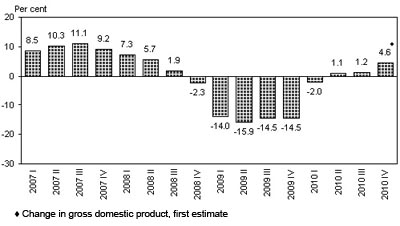
Statistics Lithuania informs that GDP, estimated based on available statistical data and econometric models, in 2010 amounted to LTL 93 939 million at current prices and, compared to 2009, grew by 1.3% (the changes have been estimated using a chain-linked volume of the added value). Changes in gross domestic product
In IV quarter 2010, GDP amounted to LTL24 538 million at current prices and, compared to IV quarter 2009, grew by 4.6%. Such rapid growth in added value was conditioned by particularly good results for industry; it was also, to a considerable extent, influenced by a growth in the added value of transport and storage. In 2010, GDP per capita amounted to LTL28 581 at current prices, in IV quarter 2010 – LTL7466. Seasonally and working day adjusted, GDP was growing throughout all four quarters of 2010 – on average, by 1.1% per quarter. In IV quarter 2010, compared to III quarter of the same year, GDP grew by 1.7% (see the table below). Revised GDP for III quarter 2010 Statistics Lithuania, based on more detailed data for the quarter and having estimated the added value based on a more comprehensive list of economic activities, has revised the second GDP estimate for III quarter 2010. Based on the revised data, in III quarter 2010, GDP amounted to LTL 25 121 million at current prices and, compared to the same quarter of 2009, grew by 1.2%. (The previously published second GDP estimate amounted to LTL 25 027 million, its change – 1.1%.) |
|
| Official reserve assets, January 2011 | 9 February 2011 |
At the end of January 2011, the official reserve assets were LTL16.8 billion (€4.9 billion). In January they decreased by LTL1.1 billion or 6.1%, but increased year on year by LT 282.3 million or 1.7%.
Official reserve assets went down in January mainly as a result of a decrease of LTL1.3 billion in deposits of other MFIs with the Bank of Lithuania, and a decrease of LTL159.8 million in currency in circulation. Negative change in other factors (LTL14.1 million), central government deposits with the Bank of Lithuania (LTL9.8 million), and the Special Drawing Rights (SDRs) allocation value (LTL8.4 million) have also contributed to the narrowing of reserve assets. The decrease in official reserve assets was partly offset by a rise of LTL389.9 million in external liabilities of the Bank of Lithuania. |
|

| EIF announces launch of new risk capital initiative in Lithuania | 3 February 2011 |
The European Investment Fund (EIF) recently announced the launch of the Call for Expression of Interest for a new Seed and Venture Capital Fund Financial Instrument to be implemented in Lithuania under the JEREMIE initiative. The new instrument consists of two funds intended to be managed by one Fund manager selected via open and transparent selection procedure. This new financial instrument is planned to have a target size of €17 million (approx. LTL59 million) financed from the Structural Funds allocated to the JEREMIE Holding fund managed by EIF, and is designed to attract a further amount of private capital. The combined public and private investors’ funds will provide financing for seed and equity investments into micro, small and medium-size Lithuanian companies with high growth potential. Particular attention will be paid to companies at the seed stage of their development as the new instrument will enable the establishment of the first ever State-supported Seed Fund in Lithuania. The selected dedicated professional management team will direct its efforts towards helping develop ideas that turn into start-up businesses. The second part of the new instrument – the Venture Capital Fund could be the second stage for the investments initially made from Seed Fund for further expansion of the investee companies. It will also supplement currently operating risk capital funds established under JEREMIE initiative by expanding the possibilities of SMEs to attract investments which they vitally need for their growth. More information about the Call for Expression of Interest JER-004/5 can be found on EIF official website – http://www.eif.org/what_we_do/jeremie/calls-for-expression-of-interest/2011_Jeremie_Lithuania_004_5/2011_Call_for_EOI_JEREMIE_Lithuania_JER004_5.htm. Currently three risk capital funds worth a total approximate value of €57 million (approx. LTL196 million) have been established under the JEREMIE initiative operate in Lithuania – Business Angels Fund I, “Lithuania SME Fund” managed by BaltCap and LitCapital fund. Business Angels Fund I already announced that three investments into Lithuanian SMEs have been made by attracting together private investors – “business angels” and helping companies to successfully expand their business. The other funds are actively analyzing many potential investment proposals. |
|
| TEO net profit for 2010 - LTL163 million | 3 February 2011 |
The total consolidated revenue of TEO LT, AB Group, the largest provider of integrated telecommunication, IT and TV services in Lithuania, during 2010 amounted to LTL773 million, and net profit for the period amounted to LT 163 million. EBITDA for the year 2010 was LT 310 million, EBITDA margin - 40.1%. |
|
| Additional State aid for renovation of apartment blocks | 3 February 2011 |
The Government recently approved a new version of the Rules on the granting of State aid to renovation (modernisation) of apartment blocks, and has established additional support for owners of apartments and other premises seeking to renovate their old apartment blocks. From now on, compensations will cover not only the 15% of investments in measures for increasing energy efficiency of buildings but also the costs of the preparation of the renovation itself, the engineering supervision of construction works and the management of project implementation. To encourage more active involvement of residents in renovation of old apartment blocks, plans have been introduced to compensate, by 31 December 2013, all costs of owners of apartments and other premises related to the preparation of the renovation project of a building and to the engineering supervision of construction, as well as actual costs for the management of project implementation. From January 2014, compensations will cover 50% of such costs, as has been the case to date. It should be noted that from now on State aid for renovation of apartment blocks will granted to owners of both apartments and other premises in these buildings. Also, State aid will now be available to those owners of apartments and other premises who wish to implement the necessary renovation measures on a smaller scale, reach energy performance of a lower class (D) in the building or implement the modernisation project itself in stages rather than at once. Taking account of the recommendations of the National Audit Office on more effective control of the implementation of apartment block renovation projects, the Housing and Urban Development Agency has been directed to oversee the engineering supervision of construction works in progress. The Agency will have to notify the State Land Use Planning and Construction Inspectorate under the Ministry of Environment of any breaches detected |
|
| Baltic economies recover faster than expected | 3 February 2011 |
The finance ministers of Latvia, Lithuania and Estonia say that economic recovery in all three Baltic states is faster than expected. Further economic growth at large extend will depend on developments in global and EU economies. Finance Ministers of Latvia – Mr. Andris Vilks, Lithuania – Ms. Ingrida Šimonytė and Estonia – Mr. Jürgen Ligi, met today in Riga (the Republic of Latvia) for the annual meeting of Baltic Finance Ministers. The Ministers also discussed fiscal issues - the budget execution, the plans for 2011 and fiscal consolidation measures as well as underlined the importance to continue with the structural reforms. It was concluded that the Baltic States should keep the strong commitment towards the fiscal discipline in future fiscal strategies to ensure the sustainability of public finances within the medium and long term. The Ministers recognized the need for increased cooperation among the Baltic States regarding the tax policy by ensuring regular exchange of information. As Latvia has introduced the financial stability fee, there was also an exchange of views on bank levies. The Ministers agreed that the introduction of levies on financial institutions ensures a fair burden-sharing and sets incentives to contain the systemic risk. Having discussed the importance of successful absorption of the EU funds for the economic growth, the Ministers expressed their interest to commence an exchange of experience among public procurement experts, including EU funds’ experts, of all the three Baltic States on a regular basis. The Ministers also noted that more active use of financial engineering instruments such as credits, loans and venture capital can contribute in an efficient and innovative way for upholding the economic development. The Minister of Finance of Lithuania presented Lithuania’s experience in launching state-owned companies and real estate properties management reform. The Ministers agreed to develop further cooperation in implementing these reforms in the Baltic States. Continuing the good practice to have a regular dialogue among Finance Ministers of the Baltic States, it is planned that the next meeting will take place in Lithuania. |
|
| Credit sits waiting | 4 January 2011 |
Verslo Žinios reports that last year Lithuanian banks managed to lend out less than LTL50 million (€14.47 million ) out of the one billion litas allocated for small and medium businesses. The Economy Ministry acknowledges that it has failed to boost the availability of credit during the economic crisis. Lithuanian banks say they are still committed to lending out all the funds by February 2012, and the Deputy Economy Minister vowed to do so without delay. Shortly into the New Year, the supervisory committee will be called together for a meeting to decide on further actions. |
|
| Lithuanian Apartment Price Index falls 0.1% | 4 January 2011 |
The Ober-Haus Lithuanian apartment price index (OHBI) for November 2010, which records changes in apartment prices in the five main Lithuanian cities (Vilnius, Kaunas, Klaipėda, Šiauliai, and PanevėÏys), decreased by 0.1%. The annual drop in apartment prices in November for Lithuania was 4.0%, and a 1.0% drop compared to October. In November there were different changes in prices in all the main Lithuanian cities were once again recorded. Vilnius retained the top position as apartment prices in the capital grew by 0.4% in November. As in previous months, the greatest impact on the increase in prices was the increased price for new apartments in residential quarters. Apartment prices in the other main Lithuanian cities continued to drop; falling 0.1% in Kaunas, 0.8% in Klaipėda, 1.2% in Panevėžys, and 2.3% in Šiauliai. Comparing prices with the highest recorded apartment prices reached in late 2007, apartment prices in November this year have dropped 40.1% in Vilnius, 33.2% in Kaunas, 45.4% in Klaipėda, 44.2% in Šiauliai, and 45.6% in Panevėžys. |
|
| Retail trade turnover down 3.7% in November 2010 | 4 January 2011 |
Statistics Lithuania informs that, based on preliminary data from the statistical survey on trade and catering enterprises, the turnover of retail trade, wholesale and retail trade and repair of motor vehicles and motorcycles enterprises (VAT excluded) in November 2010 amounted to LTL2218.3 million (in 2009, LTL2006 million) and, compared to October, dropped by 3.7% at constant prices (in November 2009, compared to October, turnover had dropped by 8.5%). Over the month (November 2010, compared to October), the turnover of retail trade enterprises, except for those trading in motor vehicles and motorcycles, dropped by 5.6% at constant prices. The turnover of enterprises trading in food products dropped by 5.2%, those trading in non-food products (motor vehicles excluded) – by 3.4% at constant prices. The turnover of enterprises trading in automotive fuel in November 2010, compared to October, dropped by 10.6% at constant prices. The turnover of enterprises engaging in the wholesale and retail trade and repair of motor vehicles and motorcycles in November 2010, compared to October, grew by 1.5% at constant prices. The turnover of food and beverage service enterprises (VAT excluded) in November amounted to LTL65 million (in 2009, LTL62.3 million) and, compared to October, dropped by 3.1% at constant prices (in November 2009, compared to October, turnover had dropped by 11.2%). The turnover of enterprises engaging in retail trade, wholesale and retail trade and repair of motor vehicles and motorcycles (VAT excluded) in November 2010, compared to November 2009, grew by 11.6% at constant prices (in November 2009, compared to November 2008, turnover had dropped by 25.9%). Over the year (November 2010, compared to November 2009), the turnover of retail trade enterprises, except for those trading in motor vehicles and motorcycles, grew by 4% at constant prices. The turnover of enterprises trading in food products dropped by 0.9%, those trading in non-food products (motor vehicles excluded) – grew by 10.1% at constant prices. The turnover of enterprises trading in automotive fuel in November 2010, compared to November 2009, grew by 2.4% at constant prices. The turnover of enterprises engaging in the wholesale and retail trade and repair of motor vehicles and motorcycles in November 2010, compared to November 2009, grew by 37.9% at constant prices. The turnover of food and beverage service enterprises (VAT excluded) in November 2010, compared to November 2009, grew by 4.8% at constant prices (in November 2009, compared to November 2008, turnover had dropped by 24.9%). The turnover of enterprises engaging in retail trade, except of motor vehicles and motorcycles, in November 2010, compared to October, seasonally adjusted, dropped by 1.9%, while compared to November 2009, working day adjusted, grew by 4%. |
|
| Prime Minister invites leading Israeli high-tech companies to invest in Lithuania | 4 January 2011 |
Continuing his official visit to Israel, Prime Minister Andrius Kubilius, attended a round table discussion with the executives of largest Israeli IT companies. The meeting took place in the premises of the company RAD Data Communications, a telecommunications and database management solutions leader in Israel, uniting 15 companies. The discussion was moderated by Zohar Zisapel, Chairman of the Board of RAD Data Communications. Prime Minister Kubilius and Minister of Economy Dainius Kreivys invited leading Israeli high-tech companies to invest in Lithuania, and presented business conditions and opportunities to potential investors, noting that Lithuania is now doing what Israel had done a decade ago, so their experience is very important and useful for Lithuania. The Prime Minister said that Lithuania is interested in Israel's experience in setting up business incubators for IT start-ups. Micha Harish, President and CEO of Harish Enterprises Ltd., Chairman of the Board of Telecorp Communications, former Israeli Minister of Industry, Trade and Labour, recalled Government’s decision to make a breakthrough in the IT sector back in 1992, and the challenges it entailed. Micha Harish wished the Lithuanian government every success in further hunting for IT investment. Most of the participants at the meeting voiced out their business development interest in Central Europe, including Lithuania, which might be of interest in terms of IT outsourcing, establishing centres of RAD Data Communication, etc. The meeting concluded by signing a letter of intent on cooperation and establishment of a business incubator for IT start-ups in Lithuania between Ori Katz Oz, Chairman of the Board of Granot Ventures and Mark Zbarski, representative of the Lithuanian business and CEO of ERP. |
|
| FDI projects in Lithuania in 2010: a year of great success | 20 December 2010 |
Latest figures by FDImarkets.com investment monitor show that Lithuania attracted 10% more FDI projects in January-November 2010 compared with the same period last year. A total of 31 new investment projects have been launched in 2010 in Lithuania, almost 16 % more capital than last year. It is expected that these projects will create more than 3400 new jobs in the next few years. In comparison, FDImarkets.com tracked 28 FDI projects which created 5300 new jobs in Lithuania in 2009. Following Western Union and Barclays Bank’s success in Lithuania, the newest FDI projects are those of the Indian company Ideal Invent Technologies Pvt Ltd, specializing in information technologies (IT) in the banking sector, as well as the Irish low-cost airline Ryanair. Ideal Invent Technologies is establishing a Scientific Research and Technology Development Centre in Lithuania which will start its operations in Vilnius this year. The company intends to invest nearly €1 million and employ 110 people in the coming 3 years. “We appreciate the inherent potential and competence of local resources,” says Premkumar Bhagwatsaran, Head of Ideal Invent Technologies. After launching its first Central European operations base in Kaunas Airport in May, Ryanair is planning to transfer part of its operations from Marseille, France, to the newly established base in Kaunas. The company intends to invest more than €100 million and employ up to 350 people. The online database tracking crossborder greenfield investment covering all sectors and countries worldwide FDImarkets.com counts 358 FDI projects of a total value of EUR 8 billion and 48325 new jobs in 2003-2010 in Lithuania. |
|
| Tax Changes for 2011 | 15 December 2010 |
The Parliament of Lithuania (Seimas) has adopted the amendments to tax laws provided along with the Law on the State Budget for 2011 that are basically designed for the improvement of business environment or affected by the commitments to the European Union. The following changes fall under the main changes in these laws: the rate of personal income tax applied on income from individual activities is reduced, the validity of the reduced VAT rates is prolonged, the excise duty rates on diesel fuel and tobacco are adjusted in line with the EU commitments. For entry into force of these laws, they should be signed by the President of the Republic of Lithuania. Personal Income Tax Corporate Tax The deadline for the payment of the corporate income tax (the first day after of the 10th month of the next taxation period) not having been changed, itis established that the annual corporate income tax return for the taxation periods commencing in 2010and later should be submitted after the end of the taxation period and before the first day of the 6th months of the next taxation. Excise Duties Such change in the rate would not affect the category of the most popular and more expensive cigarettes, and, as regards the change in the price for cheaper than LTL 7.20 cigarettes, the weighted average retail price per packet might increase only up to 10 cents, however, the changes in prices for specific price categories will depend upon producer and wholesaler pricing decisions. Also, since 2011 excise duty rate for cigars and cigarillos will be increased from LTL 38 to LTL 80 for the kilogram of the product . One of the phases of the transition period for the excise duty on diesel fuel granted to Lithuania by the EU ends this year. Due to commitments to the European Union, since January next year the rate of excise duty on diesel fuel will be increased from LTL 947 to LTL 1,043 per 1,000 litres. Due to this reason, the average retail price per litre of diesel fuel might increase by approximately 12 cents. Since 2011 natural gas, which is used by local (city and suburban transport) regular transport buses as motor fuel, will be exempt from excise duty. Due to this exemption 1 cubic metre of natural gas might become cheaper by approximately 92 cents, while natural gas costs per mileage might decrease by approximately 70 cents. This would predetermine a lower cost of the aforementioned transport services, enable savings of the state and municipal funds (allocated for carriers to compensate for various passenger privileges), thus the losses incurred by carriers would decrease, and the use of fuels less harmful to environment would be promoted. The Parliament reduced excise duty for ethyl alcohol — from LTL 4416 to LTL 3200 per hectolitre of pure ethyl alcohol. VAT Exemptions |
|
| Lithuanian Foreign Trade January–October 2010 | 15 December 2010 |
Statistics Lithuania informs that, based on provisional data obtained from customs declarations and Intrastat reporting data, exports in October 2010 amounted to LTL5.4 billion, imports – LTL 5.7 billion. The Foreign trade deficit of Lithuania was LTL0.3 billion, 15.6% less than in October 2009. Data on trade with EU countries were adjusted after VAT returns had been received. Over the year October 2010 against October 2009, exports and imports increased by 43.5 and 37.6% respectively. Mineral products excluded, exports and imports increased by 36.5 and 31.7% respectively; exports of goods of Lithuanian origin increased by 38.8%, mineral products excluded – by 27%. An increase in exports was influenced by an 82% increase in exports of petroleum products, 68.6% – boilers, machinery and mechanical appliances, 85.6 – fertilisers. An increase in imports was influenced by a 45.4% increase in imports of crude petroleum, 95.5 – ground vehicles. Over the month, October 2010, against September 2010, exports and imports increased by 7.8 and 0.1% respectively. Mineral products excluded, exports and imports increased by 8 and 2.6% respectively; exports of goods of Lithuanian origin increased by 4.8%, mineral products excluded – by 4.2%. An increase in exports was influenced by a 94% increase in exports of fertilisers. In January–October 2010, compared to the same period in 2009, exports and imports grew by 30.2 and 29.9% respectively. Mineral products excluded, exports and imports increased by 25.7 and 22.2% respectively; exports of goods of Lithuanian origin increased by 27.4%, mineral products excluded – 20%. An increase in exports was influenced by a 49.3% increase in exports of petroleum products, 46.2% – ground vehicles, 31.6% – plastics and articles thereof. An increase in imports was influenced by a 45.7% increase in imports of crude petroleum, 61.7% – ground vehicles, 37.1% – electrical equipment and parts thereof. In January–October 2010, the most important partners in exports were Russia (15.3%), Germany (10.2%), Latvia (9.6%) and Poland (7.9%), in imports – Russia (32.6%), Germany (11.1%), Poland (9%) and Latvia (6.1%). In January–October 2010, the largest share in exports fell within mineral products (24%), machinery and mechanical appliances, electrical equipment (10.2%), products of the chemical or allied industries (7.9%), in imports – mineral products (33.1%), machinery and mechanical appliances, electrical equipment (12.1%), products of the chemical or allied industries (11.4%). |
|
| Euro area and EU27 GDP up by 1.0% | 6 October 2010 |
Second estimates for the second quarter of 2010 Euro area (EA16) and EU271 GDP increased by 1.0% during the second quarter of 2010, compared with the previous quarter, according to second estimates from Eurostat, the statistical office of the European Union. In the first quarter of 2010, growth rates were +0.3% in the euro area and +0.4% in the EU27. In comparison with the same quarter of the previous year, seasonally adjusted GDP increased in the second quarter of 2010 by 1.9% in the euro area and by 2.0% in the EU27, after +0.8% and +0.7% rises respectively in the previous quarter. In the second quarter of 2010, Lithuania (+3.2%) recorded the highest growth rate compared with the previous quarter, followed by Germany (+2.2%), Estonia, Finland and Sweden (all +1.9%). Variation in components of GDP In the second quarter of 2010, household final consumption expenditure increased by 0.2% in both the euro area and the EU27 (after +0.2% and +0.3% respectively in the previous quarter). Investments increased by 1.5% in the euro area and by 1.8% in the EU27 (after -0.3% and -0.6%). Exports increased by 4.3% in the euro area and by 4.1% in the EU27 (after +2.5% and +2.2%). Imports increased by 4.0% in the euro area and by 3.8% in the EU27 (after +4.2% and +3.8%). US and Japanese GDP up by 0.4% Among the main partners of the EU, GDP increased by 0.4% in the US in the second quarter of 2010 (+0.9% in the previous quarter). In Japan GDP also increased by 0.4% in the second quarter of 2010 (after +1.2%). |
|
| Foreign direct investment in II quarter 2010 | 6 October 2010 |
Statistics Lithuania and the Bank of Lithuania publish a joint press release on the foreign direct investment (FDI) in Lithuania and Lithuanian direct investment abroad. Based on provisional data, in II quarter 2010 the FDI flow in Lithuania was negative (minus LTL365.5 million), which indicates the outflow of investment. Compared to I quarter 2010, the FDI outflow dropped 3.7 times faster. A year ago, in II quarter 2009, the FDI flow, or investment inflow, in Lithuania amounted to LTL389.5 million. Main Investing Countries
The FDI outflow was determined by the negative flows of reinvestment (minus LTL777.7 million) and share capital (minus LTL86.4 million). The flow of other capital investment was positive and amounted to LTL498.6 million. In II quarter 2010, the largest investment came from Poland (LTL447.6 million), Thailand (LTL61.7 million), Finland (LTL27.4 million), Cyprus (LTL22 million) and Germany (LTL13.1 million); the largest investment was made in the manufacture of coke, refined petroleum products and chemicals and chemical products (LTL531.9 million), wholesale and retail trade; and repair of motor vehicles and motorcycles (LTL27.1 million) and professional, scientific and technical activities (LTL22.7 million). Lithuanian direct investment flow abroad in II quarter 2010 amounted to LTL18.7 million, i.e. has been on the increase. A year ago, the FDI flow abroad also had been increasing and amounted to LTL333.6 million. In I quarter 2010, the FDI flow abroad was negative (minus LTL25.1 million) and showed a decrease in investment abroad. In II quarter 2010, Lithuanian investors invested the most in Belarus (LTL38 million), Bosnia and Herzegovina (LTL29.8 million), Cyprus (LTL26.8 million), the United Kingdom (LTL21.3 million) and Russia (LTL20.3 million), while the fastest outflow of the Lithuanian FDI was observed in the Netherlands (minus LTL105.8 million). Lithuanian investors directed the largest investment to professional, scientific and technical (LTL101.4 million) and financial and insurance (LTL87.3 million) activities. As of 30 June 2010, cumulative FDI in Lithuania amounted LTL32 741.0 million (€9 482.4 million). From the beginning of the year, they decreased by LTL954.9 million (2.8%). FDI per capita amounted to LTL9 946 (€2 881) on average (as of 31 December 2009, LTL10 122). The decrease in cumulative FDI was determined by a negative reinvestment flow which emerged due to dividend payouts to foreign investors. The largest investment was made by Swedish – LTL3 723.6 million (11.4% of total FDI), Polish – LTL3 690.5 million (11.3%), German – LTL3 414.5 million (10.4%), Danish – LTL3 392 million (10.4%) investors. Direct investment from EU-27 countries amounted to LTL25 532 million (78% of total FDI), from CIS countries – LTL2437 million (7.4%). As of 30 June 2010, the largest investment was made in manufacturing – 28.7%, wholesale and retail trade – 13.6, information and communication enterprises – 13.2, financial and insurance enterprises – 11.7, real estate activities enterprises – 10.6% of total FDI. In manufacturing, the largest investment was made in the production of petroleum and chemical products – LTL4900.7 million (52.2% of total FDI in manufacturing), food products, beverages and tobacco products – LTL1311.7 million (14%). From 2010, all statistical information on FDI in a breakdown by economic activity is published according to the national version (EVRK Rev. 2) of the Statistical Classification of Economic Activities in the European Community (NACE Rev. 2). Lithuanian cumulative direct investment abroad at the end of II quarter 2010 amounted to LTL4 653.2 million (€1 347.7 million). From the beginning of the year they dropped by LTL904.2 million, or 16.3%. The largest investment was made in Latvia – LTL936.8 million (20.1% of total direct investment abroad), the Netherlands – LTL902.9 million (19.4%), Russia – LTL514 million (11%), Cyprus – LTL414.2 million (8.9%) and Poland – LTL396.1 million (8.5%). The largest investment of Lithuanian enterprises abroad was made in professional, scientific and technical activities – LTL952.7 million (20.5% of total direct investment abroad), financial and insurance activities – LTL878.5 million (18.9%), wholesale and retail trade – LTL792.1 million (17%), real estate activities – LTL734 million (15.8%), manufacturing – LTL641.2 million (13.8%). In manufacturing, the largest investment was made in the manufacture of basic pharmaceutical products and pharmaceutical preparations – 44.1%, food products, beverages and tobacco products – 17.4% of total direct investment in manufacturing abroad. |
|
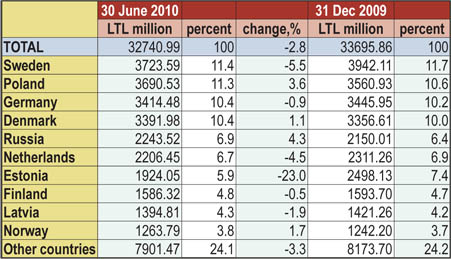
| Estonian Air to launch Vilnius-Milan flights | 6 October 2010 |
Tallinn, Oct 5 (ELTA) - As of December 18 this year, the Estonian airline Estonian Air launches direct flights from Vilnius to Italy's city of Milan, Estonian Air has said in its statement. "Vilnius-Milan is the third direct route that the Estonian airline has added to its schedule this year. The flights will be opened before the ski season, which we believe will help our Lithuanian customers to plan their winter holidays," said Rauno Parras, Estonian Air Vice President Commercia. Estonian Air will operate flights from Vilnius to Milan's Malpensa airport on Saturdays. |
|
| Lithuania to be presented to foreign tourism industries | 6 October 2010 |
Vilnius, Oct 5 (ELTA) - On Wednesday, the 8th tourism business mission Buy Lithuania 2010 will begin in Vilnius at the initiative of the State Tourism Department under the Economy Ministry. The three-day event will be attended by more than 100 foreign tour operators and agents from 14 countries, a double increase in the number of the participants compared to last year. During the business mission, foreign tourism industry representatives will be introduced to 140 tourism businesses offering such services as inbound tourism organization, accommodation, SPA, leisure and other services in Lithuania. In addition to the regular contact trade fair, event participants will set off on three promotional tours in Vilnius, Trakai and Kernave presenting different tourism services. The businessmen will also visit Lithuania's most popular SPA centres and seaside resorts. |
|
| Star1 is a big loss to our economy - Grybauskaitė | 1 October 2010 |
Vilnius, September 30 (ELTA) - According to President Dalia Grybauskaite, the problems of Star1 Airlines are a big loss to our economy. "These are a very painful processes in our aviation; we do not the national carrier, meanwhile all the countries of the world, and especially European countries do have it in one or another form. This is indeed a great loss to our economy, tourism," the head of the state said on Thursday. Dalia Grybauskaite regretted that such processes were taking place and individual agencies failed to perform their jobs. |
|
| Danish investment would be wonderful gift for 20th anniversary of restoration of diplomatic relations - Prime Minister | 1 October 2010 |
On the visit to Denmark, Prime Minister Andrius Kubilius, Minister of Economy Dainius Kreivys and other members of the Lithuanian government delegation, participated in a round-table discussion with representatives of the Confederation of Danish Industries. The meeting was attended by business leaders investing in Lithuania (Carlsberg, Danfoss, Nordisk Wavin, Royal Unibrew and others). The meeting went well in a cordial and warm atmosphere, and the President of the Confederation of Danish Industries, Hans Skov Christensen, recalled a long-term and meaningful cooperation with the Confederation of Lithuanian Industrialists, and the professional guidance and support provided to them. The President noted the steady incline of the Danish-Lithuanian economic relations, investment, export-import volume. The crisis has slowed down these processes in a way, but the President expressed hope that in the near future both parties wouldl be able to enjoy and be proud of the growing mutually beneficial cooperation. Prime Minister Kubilius presented Lithuania’s long-term investment strategy as well as an updated strategy for energy independence, and he underlined mutual interest in continuing economic cooperation. The Prime Minister noted that Denmark was the second (after Iceland) to recognize Lithuania’s independence. “The Danish support to Lithuania was the largest and contributed significantly to our membership aspirations regarding NATO and the EU; Denmark invested heavily in Lithuania. The total Danish assistance was second largest after the EU. A new substantial investment injection from Denmark now would be more than welcome and it would serve a wonderful gift for the occasion of the 20th anniversary of the restoration of the diplomatic relations between our countries ", - said A. Kubilius. The participants of the discussion also focused on the Lithuanian renovation and modernization program of apartment houses and public buildings. Many Danish companies have expressed willingness to actively participate in the renovation process. Besides, the Danish industrialists highly regard Lithuania's energy independence plans. According to the participants, Danish companies would be happy to set a foot in these projects. Danfoss representatives offered their expertise as regards housing and public housing renovation program. Bilateral investment: In the beginning of the second quarter of 2010, foreign direct investment in Lithuania totaled to LTL 33465.4 million, including LTL 3922.2 million of the Danish investment. Denmark ranks 1st Lithuania's direct investment in the second quarter 2010, was LTL 5423.9 million, including LTL 194.8 million in Denmark. In April 2010, the following companies had the highest proportion of direct investment from Denmark: TEO LT, AB, DFDS Lisco, SC Lithuanian Insurance company Kalnapilis-Taurus Group, SC Baltic shipyard. |
|
| SICOR Biotech/TEVA Announce €6.7 Million Expansion Plans | 1 October 2010 |
Lithuania's leading biopharmaceutical manufacturer SICOR Biotech /TEVA is investing EUR 6.7 million in a modular production facility in Lithuania, seeking to double its medicine production volumes and boost high technology exports by 1.5 times. “The new facility will enable our company to satisfy the rapidly increasing production demand in the EU, Swiss and other markets as well as will ease our entrance into US and other countries”, says Professor V.A. Bumelis, Head of Sicor Biotech/TEVA. It is expected that operations of the new plant situated in Santara Valley in the capital city Vilnius will be launched by 2012. |
|
| Changes in retail trade turnover August 2010 | 1 October 2010 |
Over the month, retail trade turnover increased by 4.5% Statistics Lithuania informs that, based on the preliminary results of the survey of trade and catering enterprises, the turnover of retail trade, wholesale and retail trade and repair of motor vehicles and motorcycles enterprises (VAT excluded) in August 2010 amounted to LTL 2270.8 million (in 2009, LTL 2295.0 million) and, against July, increased by 4.5% at constant prices (in August 2009, against July, the turnover at constant prices had remained unchanged). Over a month (August 2010, against July), the retail trade turnover, except for trade in motor vehicles and motorcycles, grew by 3.1% at constant prices. The turnover of enterprises trading in food products dropped by 1.9%, while that of trading in non-food products (motor vehicles excluded) increased by 8.4% at constant prices. The turnover of enterprises trading in automotive fuel in August 2010, against July, grew by 4.2% at constant prices. The turnover of enterprises engaging in the wholesale and retail trade and repair of motor vehicles and motorcycles in August 2010, against July, grew by 9.8% at constant prices. The turnover of food and beverage service enterprises (VAT excluded) in August 2010 amounted to LTL 72.3 million (in 2009 – LTL 82.3 million) and, against July, grew by 5.4% at constant prices (in August 2009, against July, the turnover had dropped by 3.4%) The turnover of enterprises engaging in retail trade, wholesale and retail trade and repair of motor vehicles and motorcycles (VAT excluded) in August 2010, against August 2009, dropped by 2.1% at constant prices (in August 2009, against the same period in 2008, the turnover had dropped by 22.8%). Over a year (in August 2010, against the same period in 2009), the turnover of retail trade enterprises, except for those trading in motor vehicles and motorcycles, dropped by 6.4% at constant prices. The turnover of enterprises trading in food products dropped by 8.5%, those trading in non-food products (motor vehicles excluded) – by 2.7% at constant prices. The turnover of enterprises trading in automotive fuel in August 2010, against the same period in 2009, dropped by 9.4% at constant prices. The turnover of enterprises engaging in the wholesale and retail trade and repair of motor vehicles and motorcycles in August 2010, against the same period in 2009, grew by 17.3% at constant prices. The turnover of food and beverage service enterprises (VAT excluded) in August 2010, against the same period in 2009, dropped by 11.5% at constant prices (in August 2009, against the same period in 2008, the turnover had dropped by 20.5%). The turnover of enterprises engaging in retail trade, except for those trading in motor vehicles and motorcycles, in August 2010, against July, seasonally adjusted, grew by 1.3%, while against August 2009, working day adjusted, it dropped by 6.9%. |
|
| PwC: Estonian economy significantly different from Latvia and Lithuania | 1 October 2010 |
Tallinn, Sept 29 (LETA-ELTA) - The auditing enterprise "PricewaterhouseCoopers" stated in its report that although all Baltic States went through a bursting of the real estate bubble, abrupt economic decline and budget cuts, Estonia's economic situation is currently significantly different from that in Latvia and Lithuania, writes the National Broadcasting. "The economic crisis in Estonia is by some traits similar to what has occurred in Latvia and Lithuania," noted PwC in its report. "The bursting of the bubble on the financial and real estate markets brought an abrupt decline in domestic demand and forced brutal budget cuts on the countries," the document read. "In other aspects, however, the economic situation in Estonia is significantly different from Latvia and Lithuania; the State has been able to maintain full control over its budget and met the terms for acceding to the euro area," remarked "PricewaterhouseCoopers". "The economic growth in Estonia is also recovering faster than in Latvia and Lithuania," added the auditing enterprise. According to the authors of the report, Estonia, along with the Czech Republic, Slovakia, Russia, Poland and Slovenia are among the most solid Central and Eastern European countries. Latvia is considered to be the most vulnerable, followed by Lithuania, Ukraine and Belarus. |
|
| Lithuanian consumer confidence falls in September | 1 October 2010 |
Vilnius, September 29 (ELTA) - Confidence among Lithuanian consumers worsened further in September, Statistics Lithuania said Wednesday. The corresponding index fell to minus 26 during the month from minus 25 in August, the RTT News reports. Compared to last month, consumers were more pessimistic about the personal as well as general economic conditions in the next 12 months. The indicator measuring the households' expectations of their personal financial position fell to minus 13 during the month from minus 12 in August. The indicator assessing consumers' view about the country's economic prospects also declined one percentage point to minus 14 from minus 13. More people than in August thought that there would be a decline in the number of unemployed. However, those expecting an increase in unemployment still outnumbered those expecting a fall. Compared to last month, consumers were more pessimistic about their ability to save over the next 12 months with the index balance falling to minus 45 from minus 41. |
|
| Head of Danske Bank assures prime minister he sees signs of recovery in Lithuanian macroeconomics | 1 October 2010 |
Copenhagen, September 29 (ELTA) - On the second day of its visit in Denmark, the delegation headed by Lithuanian Prime Minister Andrius Kubilius met with Head of Danske Bank A/S Peter Straarup. The president of Danske Bank Group expressed optimism over the indicators of the recovering Lithuanian macroeconomics and stressed the importance of responsible business throughout all areas of economy, as well as the banking sector. Straarup pointed out that any bank in any country was first of all responsible for the depositors' funds entrusted to it and had to treat them respectively. The current macroeconomic situation in Lithuania, economic trends and prospects, possibilities of closer cooperation and increased activity of the banking sector were discussed at the meeting. After the meeting with the leadership of Danske Bank, the delegation headed by the prime minister left for the International Conference "World Climate Solutions 2010 /Green Growth Economies: Leading Examples"; later, Andrius Kubilius will deliver a speech on Lithuania's achievements and investment possibilities. |
|
| Meeting of the Board of the Bank of Lithuania | 1 October 2010 |
1. Under the existing law on credit unions, a general total loan amount to one manager of a credit union and a related person cannot exceed 10% of the credit union’s recalculated capital. As a result, Radviliskis credit union was imposed a fine of 0.1% of its total annual earnings in 2009. The following 10 credit unions have been issued warnings regarding violations of restrictions on credit union lending to management and related persons: 2. The Board of the Bank of Lithuania permitted AB Ukio bankas to register amendments to its Articles of Association related to the rights granted by shares and the competence of the Bank, that were approved during the general meeting of the Shareholders on 26 March 2010. A number of amendments were made to harmonize the Bank’s Articles of Association with the amendments to provisions in the Company Law of the Republic of Lithuania. The shareholders’ meeting approved of amending the Articles of Association by specifying that the head of the Bank administration will have at least one deputy. Also, a revised list of financial services to be provided by the Bank was produced : 3. The Board of the Bank of Lithuania made amendments to the Provisions for the Organisation of Internal Control and Risk Assessment (Management) to ensure effective operation of the internal control system and risk assessment (management) and to guarantee safe and stable activities of these systems. In view of increasing importance of risk factor, changes were made to the wording of prudential requirements concerning concentration risk in the Provisions for the Organisation of Internal Control and Risk Assessment (Management). Some new requirements have been added concerning credit risk management through limiting large exposures with the focus on supplementing the list of criteria for identification of interrelated client groups by stating that any client group will be considered interrelated and considered one client not only in case when the control of the capital share held is identified, but also in case the linkage is based on economic interdependence of clients (such as dependence on the same recourses or the same key customers) or a single major source of financing. |
|
| Baltic region growth forecasts raised by Swedbank | 23 September 2010 |
Brussels, September 21 (Bloomberg-ELTA) - Estonia, Latvia and Lithuanian economies will grow faster than previously forecast as demand for exports increases, according to Swedbank AB, the largest lender in the Baltic countries. The Estonian economy may grow 2.2% , compared with an April estimate of 1.5% , the Stockholm-based bank said in a report on the Baltic Sea region published today. Lithuania's gross domestic product is likely to expand 0.5% , rather than contract 2% , and Latvia's will probably shrink 1.5% , less than the previous forecast of 2.5% . "Estonia's economy has been supported by a strong improvement in the Finnish, Swedish and German economies in the first half of this year," said Maris Lauri, Swedbank's chief economist in Tallinn, at a news conference. "A recovery in Latvia and Lithuania is also supported by exports, while domestic demand will remain weak due to high unemployment and declining incomes." The Baltic region's economies are recovering after shrinking as much as 25% from peak levels in the past two years, the world's worst recessions during the global financial crisis, the International Monetary Fund said this month. Exports and industrial output expanded this year as global trade improved and wage and job cuts helped increase competitiveness. GDP Forecasts Latvia and Lithuania's economies are likely to grow 3% each in 2011, and Estonia may expand 4.5% , helped by declining unemployment and rising consumption, Swedbank said. The unemployment rate will peak this year at 19.5% in Latvia, 17.8% in Estonia and 17% in Lithuania. It will ease to 15.5% in Estonia and Lithuania next year, and to 17.5% in Latvia. The goal of Latvia and Lithuania to follow Estonia into the euro zone in 2014 requires a "decisive" reduction of budget deficits, which limits both governments' options for supporting their economies and raises the risk of reducing growth, according to Swedbank. Inflation will average 2.6% in Estonia and 1% in Lithuania this year, with prices declining 1.2% in Latvia, the bank forecast. In 2011, consumer-price growth will accelerate to 3% in Estonia, 1.5% in Latvia and remain unchanged in Lithuania. |
|
| Lithuania's Q2 current account surplus jumps to 4.8 pct/GDP | 23 September 2010 |
Vilnius, September 20 (ELTA) - Lithuania's current account surplus surged to 4.8 percent of gross domestic product (GDP) in the second quarter, helped by positive current transfers, the news agency Reuters reports. The Baltic state's current account balance, once investors' main concern, has swung rapidly from a wide deficit to a surplus as recession cut demand for imports. In the second quarter, the current account surplus rose to 1.2 billion litas ($455 million) from a revised 190 million litas in the previous quarter. The central bank said in a statement the current account surplus was helped by transfers from European Union funds and private transfers from abroad, giving a total current transfers surplus of 1.6 billion litas. The bank also said it had revised current account data for all quarters of the last year and the whole of 2009. In the second quarter of 2009, the current account was revised to a surplus of 337.7 million litas or 1.4 percent of GDP from a previous estimate of a surplus of 0.9 percent. For the whole of last year, the current account was revised to a surplus of 4.2 of GDP from a previous 3.8 percent estimate, and compared with a deficit of 11.9 percent in 2008. |
|
| New airline to be established in Lithuania | 23 September 2010 |
Vilnius, September 20 (ELTA) - A new airline is to enter the Lithuanian aviation market. It will be established by the company "Baltijas Aviacijas Sistemas" - shareholder of the Latvian aviation company "airBaltic". The name of the new company will be announced in January next year. Transport Minister Eligijus Masiulis and "Baltijas Aviacijas Sistemas" co-owners Kristian Kirchheiner and Bertolt Flick said that at a press conference on Monday. The new generation airline will launch its activities in spring next year. "The Lithuanian Ministry of Transport and Communication supports the company's initiative to launch flights from Lithuania. Its establishment will be beneficial to the whole country. It should help to attract additional investments to Lithuanian economy, guarantee better communications for both national residents and foreign visitors. The Ministry of Transport ensures it will continue to develop the infsratsructure of the country's airports and pave the way for air transport," said Transport Minister Eligijus Masiulis. "In our view, Lithuania is an attractive and potential market, and business environment provides opportunities for rapid development," said Flick. |
|
| Mazeikiu Nafta is for sale, but I will not buy it - Lubys | 23 September 2010 |
Vilnius, September 20 (ELTA) - President of the concern "Achema Group", Chairman of the Confederation of Lithuanian Industrialists Bronislovas Lubys says he is not going to purchase "Mazeikiu nafta", because he does not have money for that. "We are not going to buy the company because we have no money for that. However, I can confirm that "Mazeikiu nafta" is for sale - Poland knows that, Moscow knows that, half of Lithuania knows that, only Andrius Kubilius does not know anything. Having sold the company, Lithuania received 2.5 billion litas, and the company is worth much cheaper in Europe now. We will see in the future who will want to buy such company and who will negotiate for it," Lubys said. According to him, the buyer not only needs to have money, but also to get the opened oil pipeline "Druzba", so that the oil would be supplied through it, rather than indirectly, as it would reduce the company's profitability. Funds will be needed to open the pipeline, but not much," Bronislovas Lubys said. |
|
| Lithuania to build LNG terminal with possible help from Oman | 23 September 2010 |
(lithuaniatribune.lt) The Minister of Energy Arvydas Sekmokas announced that Lithuania is looking into a possibility of building a liquefied natural gas (LNG) terminal without the Latvians and Estonians and without the EU funds. The Minster explained that Lithuania cannot wait any longer. Oman, on the other hand, has expressed its interest in investing in the construction of the LNG terminal in Lithuania. This news broke out during Oman Secretary General of the Foreign Ministry visit in Lithuania on 15 September. Lithuania’s Minister of Energy announced on 14 September that Lithuania is ready to build its own LNG terminal in Klaipeda and invite Latvia and Estonia to buy the terminal’s shares on its completion. Sekmokas, during the press conference stated that during his visit to Brussels he explained to the European Commission the motives behind building the LNG terminal in Lithuania so hasty. ‘I have told them that we are looking to building it by ourselves, even without waiting for EU funding, because funding is possible in the 2014-2020 financing period. We need it sooner. We cannot wait, but we are ready to give some shares to Latvia and Estonia.’ ‘Oman has an extensive experience in the liquefied gas area, and would be ready to share it with us. They are also interested in possibilities to invest,’ delfi.lt portal quoted Mykolas Majauskas, PM’s economic and financial adviser. A delegation of businessmen accompanies the Secretary Genaral Sayyid Badr bin Hamad bin Hamoud al Busaid, official during his visit to Lithuania. Lithuania plans to build a LNG terminal with an annual import capacity of about 3 billion cubic meters. The Baltic country consumes such an amount annually. |
|
| Kubilius expects state companies to add LTL0.5bn to budget next year | 23 September 2010 |
Vilnius, September 17 (ELTA) - The Government expects to collect 0.5 billion litas from state companies. A single holding to manage state assets Visuomis Holding Company, that is planned to be established, will help to achieve such financial effect. According to Prime Minister Andrius Kubilius, it is planned to reduce budget deficit by 2 percent until 5.8 percent of GDP. It is planned to end this year with almost 8 percent deficit. Visuomis will help to collect more revenues to the state budget. "We really do not think that it will be possible to collect 1.5 billion litas next year, because the transformation will not happen overnight, but we will really collect several hundreds of million litas, I mean, up to 0.5 billion litas," Kubilius said on Friday. |
|
| In Vilnius representatives of ten central banks are considering urgent issues of foreign reserve management | 17 September 2010 |
A conference of foreign reserve managers from the Central and East European central banks has begun in Vilnius and will last for two days. In the conference representatives from central banks of Lithuania, as well as Estonia, Latvia, Poland, Check Republic, Malta, Romania, Slovakia, Slovenia, Hungary are sharing investment experience and presenting novelties in their work. Mr Arvydas Kregzde, Director of the Market Operations Department, greeted the conference participants and reminded that such first forum of central bank representatives of the Central and Eastern Europe had taken place thirteen years ago in Vilnius under the initiative of the Bank of Lithuania and afterwards the baton of the organization of such arrangements had been passed on to central banks of other states. ”At that time our level in foreign reserve investment was that of a primary school pupil, we persistently learned this job from more experienced colleagues and such conferences served this purpose. Although we do not differ from other central banks in terms of the style and quality of foreign reserve management today, it is useful to gather together once a year and discuss urgent issues, in particular in cases of investing in the environment of low interest rates and not easy profit”, said Mr Arvydas Kregzde. Experts of the Market Operations Department of the Bank of Lithuania will deliver presentations on how the foreign reserve management policy of the Bank of Lithuania has changed in recent years and will also present the Treasury Risk Management Information System developed by the Bank of Lithuania. Representatives of all other central banks will deliver a presentation each on foreign reserve management. Foreign reserves are reliable liquid foreign assets managed and invested by the Bank of Lithuania. At the time the Bank of Lithuania started to manage foreign reserves, they made up US$300,000. At the end of July this year official reserve assets accounted for LTL 15.9 billion (€4.6 billion). Mr Arvydas Kregzde observed that foreign reserves managed by ten central banks represented at the conference were equal to EUR 208 billion. |
|
| Balance of Payments July 2010 | 17 September 2010 |
In July 2010, the deficit on the current account of the country’s balance of payments amounted to LTL 340.6 million after a surplus of LTL 195.6 million registered on the current account in June. The balance changes were driven by the expansion of foreign trade deficit. According to preliminary estimate, in January-July 2010 the surplus on the current account of the balance of payments made up LTL 162 million, a decrease of LTL 66.7 million compared to January-July 2009. The above data was released by the Statistics Department of the Bank of Lithuania. |
|
| Foreign trade of Lithuania in January–July 2010 | 17 September 2010 |
Statistics Lithuania reports that, based on non-final data obtained from customs declarations and Intrastat reporting data, exports in July 2010 amounted to LTL 4.5 billion, imports – LTL 5.4 billion. Foreign trade deficit of Lithuania amounted to LTL 0.9 billion, which is 2.5 times higher than in July 2009. The deficit increase was determined by a significant increase in imports of crude oil. Data on trade with EU countries were adjusted after VAT returns data had been received. Over a year (July 2010, compared to July 2009) exports and imports increased by 32.5 and 43.7% respectively. Mineral products excluded, exports and imports increased by 29.7 and 28.7% respectively; exports of goods of Lithuanian origin increased by 27.4%, mineral products excluded – 22.4%. The increase in exports was influenced by a 43.7% increase in exports of petroleum products, 34.9% – plastics and articles thereof, 37% – boilers, machinery and mechanical appliances. The increase in imports was influenced by an 84.5% increase in imports of crude oil, 86% – motor vehicles. Over a month (July 2010, compared to June) exports decreased by 2.2%, while imports increased by 8%. Mineral products excluded, exports and imports increased by 2.4 and 3.1% respectively; exports of goods of Lithuanian origin decreased by 5.2%, mineral products excluded – increased by 2.1%. The decrease in exports was influenced by a 15.5% decrease in exports of petroleum products, 29% – motor vehicles. The increase in imports was influenced by a 29.3% increase in imports of crude oil. In January–July 2010, compared to the same period in 2009, exports and imports grew by 25.5 and 27% respectively. Mineral products excluded, exports and imports increased by 20.6 and 17% respectively; exports of goods of Lithuanian origin increased by 23.4%, mineral products excluded – 15.5%. The increase in exports was influenced by a 46.2% increase in exports of petroleum products, 33.1% – plastics and articles thereof, 39.5% – motor vehicles. The increase in imports was influenced by a 52.5% increase in imports of crude oil, 49.7% – motor vehicles, 29.2% – machinery and mechanical appliances, electrical equipment and parts thereof. In January–July 2010, the most important partners in exports were Russia (14.4%), Germany (10.6%), Latvia (9.5%) and Poland (7.2%), in imports – Russia (33.8%), Germany (10.8%), Poland (8.8%) and Latvia (5.8%). In January–July 2010 the largest share in exports fell within mineral products (24.5%), machinery and mechanical appliances, electrical equipment (10%), products of the chemical or allied industries (8.1%), in imports – mineral products (34.2%), products of the chemical or allied industries (11.8%), machinery and mechanical appliances, electrical equipment (11.3%). |
|
| Inflation at 0.8% | 17 September 2010 |
Statistics Lithuania calculates the harmonised index of consumer prices (HICP), which is methodologically harmonised with those of other EU member states, on a monthly basis. The conformity with the price stability criterion, set in the Maastricht Treaty, is assessed taking into consideration the inflation rate calculated based on the said index. Average annual inflation calculated based on the HICP in August 2010 stood at 0.8%, which is by 0.2 percentage point lower than that calculated based on the consumer price index (CPI). |
|
| Unemployment 15.3 % | 17 September 2010 |
On the 1st of August 2010, it was registered 330.6 thousand unemployed in the country and they made up 15.3 % of the country's working age population. This is 0.3 % more than the month before. In July, more young people applied to the local labour exchange offices (11,000 , including 7,700 graduates). During July, 25,700 unemployed applied the local labour exchange offices. Employers registered 17,300 vacancies. |
|
| Lithuania up 6 places in the Global Competitiveness Report | 12 September 2010 |
Vilnius, September 10 (ELTA) - According to the Global Competitiveness Report 2010-2011 released by World Economic Forum, Lithuania has moved six positions up this year now ranking 47th among 139 countries in the world. The level of higher education (25th in the world) as well as IT literacy (33rd) have been scored best, the press service of the Prime Minister reports. "Increasing competitiveness of the country and economic growth make the case for optimism. Much as still remains to be done, it is obvious that we are slowly climbing from the crisis. We will continue to focus on Lithuania's attractiveness to foreign investors, and I am particularly pleased to note that the level of education of the Lithuanian population is highly appreciated on global scale, "- said Prime Minister Andrius Kubilius. Neighbouring Estonia has gone up from33rd to 35th position, while Latvia has come down from 68 to 70 in the same list. Switzerland has remained world's most competitive country, Sweden went up to take the second place, and Singapore has retained its third place. The U.S. has dropped from the second to the fourth this year. Germany went up from the seventh to the fifth place. |
|
| "Moody's" withdraws ratings of "Parex banka" | 12 September 2010 |
Riga, Sept 10 (NOZARE.LV-ELTA) - The international credit rating company "Moody's" has withdrawn all of its ratings of "Parex banka", according to an announcement made by the rating agency. "Parex banka" announced its intention to give up the services provided by "Moody's" a month ago, naming the nature of the bank's future activity as the reason. The bank will now focus on loan restructuring and securing overtaken loans, and as it does not plan to attract new depositors or grant new loans, it no longer considers itself as having any need to be rated. In its own announcement, "Moody's" indicated that it had already declared the possibility of lowering the ratings of "Parex" on August 6 in connection with the bank's recent reorganization and the lack of clarity about its further activity, in particular, the division of assets and liabilities between the new "Citadele banka" and "Parex" and the level of support from the government that the remaining entity is likely to benefit from. "Moody's" based its decision on the belief that it has insufficient or otherwise inadequate information to support the maintenance of the bank's credit rating. Marita Ozolina-Tumanovska, communication and marketing director for "Parex", earlier explained that the bank had carefully reviewed the usefulness of the service provided by "Moody's", and had concluded that these were no longer necessary for the bank. One of the essential aspects of the decision was the wish to reduce the bank's administrative costs. Chris Gwilliam, the chairman of "Parex", emphasized: "Services provided by Moody's International Rating Agency are vital when a company is interested in attracting additional funds or, for example, potential investors. However, we do not plan to carry out such activities, because they are not related with the goals and tasks that 'Parex banka' has set.” As reported, due to heavy financial problems, the government took over the capital shares in ''Parex banka'' on December 5, 2008. As LETA also reported, the division of "Parex banka" was completed at the end of July, and the new bank "Citadele banka" has officially begun its activity, taking over the old bank's "good" assets. |
|
| Lithuania-UK cooperation discussed in London | 12 September 2010 |
London, Sept 10 (ELTA) - During political consultations on 9 September in London, Political Director of the Ministry of Foreign Affairs of Lithuania Eitvydas Bajarunas and Political Director of United Kingdom's Foreign and Commonwealth Office Geoffrey Adams discussed the prospects of bilateral and regional cooperation, European Union and security policy issues, Lithuania's chairmanship of the Organization for Security and Cooperation in Europe (OSCE) in 2011, the press service of the Foreign Ministry reports. Bajarunas expressed satisfaction about the relations between Lithuania and the United Kingdom, that gained dynamics. During the consultations, the parties exchanged their opinions concerning the possible cooperation projects in the fields of economy and energy, and in the EU's Eastern Neighbourhood countries. Bajarunas and G.Adams discussed Lithuania's OSCE chairmanship priorities in 2011, ways to resolve protracted conflicts, expectations for the OSCE summit that will be held on 1-2 December in Astana. Opportunities for a more intensive cooperation between the United Kingdom and the Baltic Sea region countries were also discussed. Bajarunas also met with Brian Fall, UK Special Representative for South Caucasus, and other high officials of the British Foreign and Commonwealth Office who deal with the South Caucasus and Afghanistan issues, international security, international organizations, OSCE and the Council of Europe. On 10 September, political director Bajarunas is meeting with foreign policy analysts from the European Council on Foreign Relations and Chatham House. Coordinator of Lithuania's OSCE Chairmanship, Ambassador Rytis Paulauskas and Ambassador-at-Large Giedrius Cekuolis are also participating in the meetings. |
|
| Passengers in Vilnius Airport up by 10% | 12 September 2010 |
Vilnius, Sept 9 (ELTA) - Over the eight months of this year, Vilnius International Airport (TVOU) served 962,700 passengers, an increase by 10 percent year-on-year. In August this year, 148,200 passengers used the services of the airport, which made a 7-percent growth compared with the same month last year. Over January-August 2010, the number of flights in the TVOU grew by a fifth and the cargo handled at the airport went up by a fourth. In August alone, the number of flights served by the airport rose by 12 percent and the volume of cargo increased by 26 percent year-on-year. Given such results, the TVOU is the second busiest airport in the Baltic States, outpaced by Riga with 3.314 million passengers and followed by Tallinn with 908,801 passengers. |
|
| Lithuanian trade deficit widens in July | 12 September 2010 |
Vilnius, September 9 (ELTA) - Lithuanian trade deficit widened in July from the previous month, RTT News informs. A report by the Statistics Lithuania shows that the trade deficit totaled 915.8 million litas in July, widening from 411.4 million litas deficit in the previous month. A year earlier, the trade deficit amounted to 371.5 million litas. Exports increased 32.5 percent year-on-year to 4.53 billion litas in July from 4.63 billion litas in June. Similarly, imports grew 43.7 percent to 5.45 billion litas from 5.05 billion litas in the previous month. On a monthly basis, exports decreased 2.2 percent in July and imports increased 8 percent. For the first seven months of the year exports and imports increased by 25.5 percent and 27 percent respectively, compared to the same period of the previous year. Thus, the trade deficit amounted to 2.72 billion litas. |
|
| Average annual inflation at 0.8 pct in August | 12 September 2010 |
Vilnius, September 9 (ELTA) - In August this year, the average annual inflation measured by the harmonized index of consumer prices (HICP) reached 0.8 percent in Lithuania and was 0.2 smaller percent than the inflation measured by the consumer price index (CPI). According to the Department of Statistics, the annual inflation (in August 2010 compared with August 2009) stood at 1.8 percent and coincided with the inflation measured by the CPI. A decrease in the prices of consumer goods and services measured by the HICP stood at 0.2, measured by the CPI - to 0.3 pct. |
|
| Lithuania to reunite power grids after 2001 split | 12 September 2010 |
Vilnius, Sept 8 (Reuters-ELTA) - Lithuania's two power grids aim to merge back into a single company after being split nine years ago, the grid companies said on Tuesday. The move is a part of attempts by the government of the Baltic state to raise funds to finance a new nuclear power plant at an estimated cost of 3 billion-5 billion euros (3.8 billion-6.4 billion dollars). RST and VST said their boards had approved the merger, which still has to be voted on at a shareholders' meeting due on Sept 27, and the new company LESTO should start operating from 2011. The total share value of RST and VST was estimated at 1.6 billion litas (590.6 million dollars) and 1.2 billion litas respectively, the companies added. The government holds 98.2 percent of VST and 71.35 percent of RST. Germany's E.ON Ruhrgas [EONR.UL] has 20.28 percent of RST. The merger is expected to save up to 24 million litas and cut administration staff by a fourth. Lithuania split the power grid into two separate companies in 2001 and VST was privatised by local investors. The government bought it back last year. The government controls VST and RST shares via Visagino Atomine Elektrine, a project company for the new nuclear plant. Lithuania wants to build it by 2018-2020 to replace its Soviet-era Ignalina nuclear plant, which was shut at the end of 2009. The country is eager to reduce its energy dependence on Russia, its sole supplier of natural gas. The government expects to pick an investor in the new plant by the end of this year and is eyeing large European utilities. |
|
| Lithuania issues US$750m 7 year bond | 12 September 2010 |
Vilnius, Sept 8 (Reuters-ELTA) - Lithuania sold 750 million dollar of seven-year paper on Tuesday, the second dollar bond this year, the Finance Ministry said on Tuesday. Lithuania, which saw its economy drop 14.8 percent in 2009, avoided seeking international assistance as neighboring Latvia, by tapping international markets to finance its budget deficit. The paper was sold at a yield of 5.249 percent and a coupon of 5.125, the ministry added. Order books for Lithuania's bond had attracted at least 2.25 billion dollars, a fund manager said earlier on Tuesday. The issue follows Lithuania's recent meetings with investors in Europe. Initial talk focused on a euro-denominated bond but there was not sufficient demand, a fund manager said. Lead managers were Barclays, HSBC and RBS. Lithuania raised record 2 billion dollars in 10-year Eurobond at a yield of 7.625 percent and a coupon of 7.375 in February. Lithuania planned to borrow a total 12.8 billion litas (4.73 billion dollars) in 2010, including 6.6 billion litas on foreign markets. The borrowing plan was cut to 11.5 billion litas in mid-summer, while the government managed to raise 7.2 billion litas during the first half of the year, both on domestic and foreign markets, the finance ministry said. That left the borrowing need at 4.3 billion litas, while the new Eurobond issue has covered more than 60 percent of that. Lithuania faces a public sector deficit of 8 percent this year, but pledged to cut it under Maastricht criterion of 3 percent by 2012 to be able to adopt euro in 2014. The public sector debt is expected to reach 36.6 percent of GDP in 2010 |
|
| Zero inflation replaced by deflation | 12 September 2010 |
Vilnius, September 8 (ELTA) - In August, a 3 percent deflation was recorder in Lithuania. In June and July, zero inflation was registered in the country. In august, compared with July, consumer prices decreased by 0.4 percent, the prices of services went up by 0.1 percent. In August, average annual inflation stood at 1 percent, annual inflation - at 1.8 percent. |
|
| Forex up by 8.9 pct in August y-o-y - Bank of Lithuania | 12 September 2010 |
Vilnius, Sept 7 (ELTA) - At the end of August, Lithuania's official reserve assets totalled 16.3 billion litas (4.7 billion euros). Over August, official reserve assets grew by 467.3 million litas (135.28 million euros), an increase of 2.9 percent. Over the year, in August this year, compared with August 2009, the country's official reserve assets went up by 1.3 billion litas (376.34 million euros) or 8.9 percent. The increase in official reserve assets in August was determined by the growth of deposits of other monetary financial institutions with the Bank of Lithuania and an increase in the external liabilities of the Bank of Lithuania, which amounted to 349.5 million litas (101.17 million euros) and 270.4 million litas (78.27 million euros) respectively. A slower growth of the official reserve assets was influenced by the fall of 242 million litas (70.057 million euros) in the central government deposits with the Bank of Lithuania. |
|
| Global Internet Governance Forum to be held in Vilnius | 12 September 2010 |
Vilnius, September 6 (ELTA) - On September 14-17, global Internet Governance Forum (IGF) will be held at Lithuanian Exhibition and Congress Centre Litexpo. The forum in Vilnius is being organized by the United Nations (UN) General Secretariat together with the Lithuanian Ministry of Transport. Not only the UN and the governments, but also representatives of largest Internet companies, non-governmental organizations, and academic communities will attend the forum. This is the most important annual event in the area of global Internet governance; Lithuania has not held such a big event so far. This forum will provide Lithuania with new opportunities to build a knowledge society, to participate in shaping the Internet governance policies on the international level, to establish business contacts, to enhance Lithuania's popularity, to develop tourism. The forum will be attended by representatives of 70 countries of the world; the event will be broadcast live over the Internet. |
|
| FNTT joins EU financial intelligence units | 12 September 2010 |
Vilnius, Sept 3 (ELTA) - The Financial Crime Investigation Service (FNTT) has joined the network of the Financial Intelligence Units (FIU.NET) of the European Union to exchange intelligence information in its everyday work. This network enables EU Financial Intelligence Units to ensure a rapid delivery and check of data about persons, their settlement accounts, assets, financial performance and other information necessary for preventing money laundering and terrorist financing. At the moment, 20 EU FIUs are connected to the network. Financial intelligence units are international specialized state institutions dealing with money laundering and (or) terrorist financing at the national level. |
|
| Romanov allowed to raise its Ukio Bankas share | 12 September 2010 |
Vilnius, Sept 3 (ELTA) - The Competition Council has decided to allow Vladimir Romanov to increase concentration by acquiring a holding of up to 100 percent of Ukio Bankas. The Competition Council found out that the concentration would not create or strengthen the dominant position or limit competition in the corresponding markets related to banking services Before that, the Board of the Bank of Lithuania indicated no objection to an increase in Romanov's qualifying holding of the authorized capital and (or) voting rights to such an extent so that Ukio Bankas would become a private bank. |
|
| Multilateral Carbon Credit Fund signs first projects in Baltics MCCF to purchase carbon credits from wind farms in Estonia and Lithuania | 12 September 2010 |
Luxembourg, Sept 2 (ELTA) - In its first transaction in the Baltics, the EBRD-EIB Multilateral Carbon Credit Fund (MCCF) has agreed to buy carbon credits from a group of wind farms managed by OU Nelja Energia, a renewable energy company, wholly-owned by Fre-energy AS, a leading Estonian investor in renewable energy in Eastern Europe. OU Nelja Energia develops and manages a portfolio of 19 wind farms in Estonia, Lithuania and Latvia, with a planned combined capacity of 330 MW onshore and 700 MW offshore. Under the purchase agreement, the MCCF will acquire carbon credits resulting from six OU Nelja Energia's wind farms projects in Estonia and Lithuania, generated via the Joint Implementation (JI) mechanism under the Kyoto Protocol. Currently one of the six wind farms is operational and the remaining under construction or development. Upon completion, the six wind farms will have a combined capacity of 76 megawatts. The completion of the carbon credit purchase is subject to approvals from the Estonian and Lithuanian governments. This transaction was negotiated by GreenStream Network Plc., which acts as a carbon manager for the MCCF. In June 2009 the EBRD provided a 19 million euro equity investment in Fre-energy, to help support the development of OU Nelja Energia's wind farm projects. |
|
| Lithuanian economy to continue growing this year - Aviva Lietuva experts | 12 September 2010 |
Vilnius, Aug 25 (ELTA) - Over the remaining months of 2010, the Lithuanian economy will continue growing as well as the public confidence in companies offering long-term saving services, the experts of the life insurance and pensions company Aviva Lietuva say. The Aviva Lietuva experts indicate the growing exports as one of the key signs of an economic recovery. In 2009, compared with 2008, the volume of exports dropped by 27 percent, but the exports started growing up as of the second half-year of 2009. "Assessing the growth of exports and 2010 economic growth trends of our main exports partners - Russia, Germany, Poland - we predict that our exports would increase by 24 percent rather than 17 percent as we projected at the beginning of this year, which will lead to an even more rapid economic recovery," Aviva Lietuva Finance Director Arunas Rumskas said. The Aviva Lietuva experts named a decline in credits for businesses and households as one of the key factors affecting the dynamics of GDP. |
|
| Lithuanian economy expands revised 1.3% | 29 August 2010 |
Brussels, August 27 (Bloomberg-ELTA) - The Lithuanian economy expanded a revised 1.3 percent from a year earlier in the second quarter as export growth and manufacturing picked up. The figure compares with a preliminary estimate of 1.1 percent announced July 28 and a 2.8 percent contraction in the first quarter, the Vilnius-based statistics office said today in an e-mailed statement. Gross domestic product increased a seasonally adjusted 3.2 percent from the previous quarter, revised from 2.9 percent. The Baltic nation's economy returned to growth in the period after contracting for six consecutive quarters and suffering a 14.8 percent slump last year. Exports and industrial output expanded with the improving global economy, helping to offset weak domestic demand. "The recovery is largely dependent on export demand, especially this year, with private consumption gaining importance only in 2011," said Annika Lindblad, a Helsinki- based economist at Nordea Markets. "Although we see growth accelerating in the next couple of quarters, GDP will remain below the highs seen in 2008 for several years." Lithuanian Prime Minister Andrius Kubilius pushed through spending cuts to cap the budget deficit, undermining domestic demand. Consumer spending will remain weak in 2010, with consumption shrinking 2.7 percent, the central bank estimates. The International Monetary Fund estimates the economy will grow 2.1 percent for all of 2010, the most optimistic estimate amongst major forecasters. The government expects a 1.6 percent expansion for the year. The yield on Lithuania's 10-year bond rose 0.04 percentage point to 5.6 percent today. Baltic Rebound Lithuania's industrial output, representing about 20 percent of the economy, grew an annual 4.5 percent in the second quarter, compared with a 4 percent drop in the previous three months. Exports grew an annual 37 percent in the April-June period, led by fuel sales from refiner Orlen Lietuva AB. The Baltic economies of Estonia, Latvia and Lithuania are rebounding after suffering the worst recession in the European Union last year as the credit markets froze. The pace of their recoveries is beating economist estimates, prompting analyst at Danske Bank A/S and Capital Economics to upgrade their outlooks for the region. Estonia's economy recorded annual growth of 3.5 percent in the second quarter, the first increase in 2 ? years. Latvia's GDP grew a quarterly 0.1 percent, while the annual contraction slowed to 3 percent from 6 percent. |
|
| Baltic crisis eased but tough road ahead - IMF | 29 August 2010 |
Riga, Aug 26 (Reuters-ELTA) - The economic crisis in the Baltics, which suffered the European Union's worst recessions last year, is easing and the region's growth prospects are looking up, the International Monetary Fund said on Thursday. But the pace of expansion will depend on how quickly the trio of states, which are still feeling the effects of a painful fiscal adjustment, can develop their export sectors and further improve their competitiveness, a senior IMF official said. The Baltics suffered badly in the aftermath of the financial crisis, leaving Nordic banks like Swedbank (SWEDa.ST) and SEB (SEBa.ST) nursing steep losses in the region. "The Baltic countries have turned the corner... have bottomed out," Mark Allen, senior IMF resident representative for Central and Eastern Europe, told a conference. "Growth prospects will depend on how well these countries can shift to a more export-oriented model," he said at the Baltic mergers and acquisitions and private equity forum. The future would be challenging as households were in a difficult position due to unemployment and deleveraging and the corporate sector also faced problems. "There is a further fiscal adjustment going on and there is going to be a shortage of bank capital," Allen said. He said Latvia, Estonia and Lithuania should make sure wages do not rise faster than productivity, that business is not taxed excessively, that public finances are kept tight and that prices do not rise faster at home than abroad. All three nations declined to devalue their currencies in the face of the recession, which would have boosted competitiveness. Instead, they cut wages and spending in austerity packages to achieve the same end. Latvia also had to take a 7.5 billion euro bailout, led by the International Monetary Fund and the European Commission. |
|
| Lithuania expects diversified gas market by 2020 | 29 August 2010 |
Vilnius, August 26 (RIA Novosti-ELTA) - The Lithuanian authorities intend to create a diversified gas market in the country by 2020, which would eliminate Russia's monopoly on gas supplies to the Baltic state, Lithuania's Energy Minister Arvydas Sekmokas says. Speaking during an international energy conference in Vilnius on Thursday, Sekmokas said Lithuanian energy market operator Baltpool had already made proposals to the gas company Lietuvos Dujos, in which Russian energy giant Gazprom owns a 37-percent stake. If Lithuania had a diversified energy market, it would speed up the integration of Lithuania's and Poland's gas transportation networks, he said. Jurgis Vilemas from Lithuania's Laboratory for Complex Energy Research said the integration of the two countries' pipelines was very important for Lithuania as Poland was due to begin to supply gas to some European states within the next 10 years. In April, large shale gas reserves were discovered in Poland. U.S. energy company ConocoPhillips is expected to begin exploration of the reserves in May. |
|
| Lithuania to hire Barclays, HSBC, RBS to plan bond investor meetings | 29 August 2010 |
Vilnius, Aug 25 (Bloomberg-ELTA) - Lithuania hired Barclays Capital, HSBC Holdings Plc and Royal Bank of Scotland Group Plc to arrange meetings with European bond investors, according to two people with knowledge of the sale. The meetings will start on August 30, the people said. |
|
| Lithuanian economy to continue growing this year - Aviva Lietuva | 29 August 2010 |
Vilnius, Aug 25 (ELTA) - Over the remaining months of 2010, the Lithuanian economy will continue growing as well as the public confidence in companies offering long-term saving services, the experts of the life insurance and pensions company Aviva Lietuva say. The Aviva Lietuva experts indicate the growing exports as one of the key signs of an economic recovery. In 2009, compared with 2008, the volume of exports dropped by 27 percent, but the exports started growing up as of the second half-year of 2009. "Assessing the growth of exports and 2010 economic growth trends of our main exports partners - Russia, Germany, Poland - we predict that our exports would increase by 24 percent rather than 17 percent as we projected at the beginning of this year, which will lead to an even more rapid economic recovery," Aviva Lietuva Finance Director Arunas Rumskas said. The Aviva Lietuva experts named a decline in credits for businesses and households as one of the key factors affecting the dynamics of GDP. |
|
| Mazeikiai oil factory is not a strategic company for economy - Grybauskaitė | 25 August 2010 |
Vilnius, August 25 (ELTA) - President Dalia Grybauskaite said she heard a reassurance from Polish President Bronislaw Komorowski that there were no talks about the possible selling of Orlen Lietuva refinery. The head of the state does not give much prominence to the talks on the possible selling and reminds that the company was already sold to the Americans, and the Russians, and now it belongs to the Poles. "The issues related to the profit of the companies like that are quite complex, therefore, there are objective reasons why it is not so easy for Orlen Lietuva to be profitable. It is natural that the company hired consultants to advice on how to optimize the company's performance. So far, there are no talks on the company's sale, and the president assured me of that," Dalia Grybauskaite told journalists on Wednesday. The head of the state said she heard a number of various speculations on the sale of Orlen Lietuva and said that they came from interested parties. "Probably some people would like to buy it cheaper, because the market price is now almost twice lower than PKN Orlen paid. To my mind, a thinking person would not sell the business twice as cheaper than he paid for it," Grybauskaite said. The president does not point out the economic consequences of the potential selling of the company and reminds that its owners changed three times. "This is not a strategic company for the economy, but the person who would import fuel, would pay the same VAT to the Lithuanian budget. It is only strategic for the city in how many people, Lithuanian citizens, it employs and how much they pay into the Lithuanian budget. Such is the impact to Lithuanian economy," Grybauskaite said. |
|
| Vilniaus Vandenys plans investment and increase in cold water price | 25 August 2010 |
Vilnius, Aug 24 (ELTA) - Over the first five months of 2010, Vilniaus Vandenys suffered losses of 2.5 million litas (723,770 euros). In the face of a complicated situation, it is necessary to raise cold water prices to be able to plan new investment, Head of Vilniaus Vandenys Valentinas Miltienis said in a news conference on Tuesday. It is planned to increase the price of cold water up to 50 percent. In this case, a cubic metre of cold water would cost up to 6.33 litas for the residents of Vilnius and Vilnius district, Svencionys and Salcininkai. Presently, a cubic metre of cold water costs 4.22 litas for Vilniaus Vandenys clients. The National Control Commission for Prices and Energy will consider Vilniaus Vandenys' application for raising the price of cold water at the end of summer. The new price will also need the approval of Vilnius city municipal council. |
|
| Star1 Airlines to launch flights to Munich | 25 August 2010 |
Vilnius, Aug 24 (ELTA) - The Lithuanian low cost carrier Star1 Airlines will offer flights from Vilnius to Munich, the capital of Germany's Bavaria, as of November 15. "We expand our regular routes after reducing charter flights in the winter season. The capital of Bavaria, Munich, is an important destination for both businessmen and tourists. The third-largest Germany city is home for such world-famous companies as BMW, Siemens, Linde. Skiing enthusiasts have already started booking hotels for the coming winter season, and there are only a few hours drive to the Alps from Munich," Head of Star1 Airlines Martynas Laivys said. The airline will operate the Munich flight on Mondays and Fridays. Star1 Airlines belongs to the Finnish group of companies Star Team Group which also owns a tour operator Star1 Holidays. In its present flight schedule, Star1 Airlines offers direct flights from Vilnius to London, Dublin, Milan, Edinburgh, Girona (Barcelona), Heralion and Palermo. |
|
| Britain’s Major Electricity Generator Enters Lithuania | 24 August 2010 |
EDF Energy Networks, which is Great Britain's major electricity generator and a branch of the world’s largest utility compan,y EDF based in Paris, entered the Lithuanian market and registered with the Centre of Registers. With headquarters established in Vilnius and Mr Martins Beinarsas leading the company, EDF Energy Networks will join the other 49 companies supplying electricity in Lithuania, according to the National Control Commission for Prices and Energy. EDF Energy Networks uses a number of electricity generation methods: traditional coal-fired and gas-fired power plants, nuclear power stations as well as renewable energy sources. It belongs to the British energy corporation EDF Energy which manufactures, distributes and supplies electricity for the public and businesses, as well as wholesales gas. The company, founded in 2002, employs 20.000 people and has a pool of 5.7 million customers. |
|
| Rimi closing Lithuanian stores | 24 August 2010 |
Vilnius, Aug 20 (ELTA) - A first-half decline in sales across the Baltic countries leads to a probable closing of 24 unprofitable Lithuanian stores, fruitnet.com writes. Rimi has revealed that it is to end operations at 24 unprofitable stores in Lithuania following a fall in sales during the first six months of 2010, a trend seen across much of the Baltic States. The move means that Rimi loses over a third of its store portfolio in the country, although the group's parent company, Swedish retailer Ahold ICA, noted that the decline in sales slowed down through the second quarter of the year. ICA reported on a drop in net sales of 1.6 percent for the first half of the year across its Scandinavian store range to 4.8 billion euros, with operating income coming in at 180 million euros (up 40 percent) and net income amounting to 5.8 million euros, a drop of 88 percent on 2009. President and chief executive officer Kenneth Bengtsson noted that Sweden, Norway and the Baltics had seen falling sales due to a "generally weak food retail market and an increasingly promotional competitive environment". |
|
| Lithuanian Railways transport 14.7% more cargo | 24 August 2010 |
Vilnius, August 20 (ELTA) - Over the first seven months of this year, Lithuanian Railways (Lietuvos Gelezinkeliai) transported 26.7 million tons of cargo, an increase of 14.7 percent year-on-year. According to the Department of Statistics, the international cargo carriage increased by 22.5 percent over the said period and stood at 19.5 million tons; domestic rail carriage fell by 2.2 percent and stood at 7.2 million euros. |
|
| Lithuanian airports serve 1.3m passengers this year | 24 August 2010 |
Vilnius, August 20 (ELTA) - Over the first seven months of this year, Lithuanian airports served 1.3 million passengers, an increase of 22.6 percent year-on-year. The Statistics Lithuania reports that most passengers went to or from United Kingdom (269,200 or 21.1 percent), Germany (147,000 or 11.5 percent), Denmark (122,000 or 9.5 percent), Latvia (106,600 or 8.3 percent) and Ireland (99,700 or 7.8 percent). Most (1.1 million or 86.3 percent) of the passengers chose regular flights. In January-July 2010, the number of passengers taking regular flights went up by 27.8 percent. In January-July 2010, as compared with the same period last year, more passengers went to and from the United Kingdom - 69.6 percent, Germany - 37.4 percent, Denmark - 25.5 percent, Ireland - 8.7 percent, while the number of passengers who went to and from Latvia dropped and stood at 20.3 percent. |
|
| Latvian unemployment falls for first time in two years | 24 August 2010 |
Riga, Aug 19 (LETA-AFP-ELTA) - Unemployment in crisis-hit Latvia fell to 19.4 percent in the second quarter from 20.4 percent in the previous three months, official data showed on Thursday. The number of job-seekers in Latvia stood at 225,800, figures from Latvia's national statistics office showed. "The last time the unemployment rate fell was in the second quarter of 2008," Inga Vanaga, a spokeswoman from the office, told AFP. Since then, unemployment has risen sharply as Latvia found itself locked in the deepest recession in the 27-nation European Union. It peaked at 20.4 percent in the first quarter of this year. Latvia had earned a reputation for breakneck economic growth before its overheated economy went off the rails. It has faced its most serious economic crisis since breaking free from the crumbling Soviet Union in 1991. Its economy contracted 18 percent in 2009. At the end of 2008, Latvia won a 7.5-billion-euro (9.65-billion-dollar) bailout steered from the International Monetary Fund and the EU to avert an economic meltdown. The funds have been paid in tranches, provided Latvia gradually plugs a gaping hole in state coffers by cutting spending and raising taxes. Latvia inched out of recession in the first quarter of this year with 0.3 percent growth compared with the previous three months. Growth of 0.1 percent followed in the second quarter. The country's centre-right coalition government, which is bracing for a general election in October, has said it expects the economy to pick up steam in the second half of the year. It says the boost will come from rising exports thanks to growth in top trading partners such as Russia and Germany. The finance ministry has forecast that the economy will still contract this year by 3.5 percent but then grow 3.3 percent in 2011. |
|
| Board of Bank of Lithuania adopts medium-term macroeconomic projections of bank of Lithuania | 24 August 2010 |
Vilnius, August 19 (ELTA) - On Thursday, the Board of the Bank of Lithuanian adopted medium-term macroeconomic projections of bank of Lithuania. Compared to the previous year the situation in global economy improved. Real sector rebound, particularly in Europe, financial support to Greece and ECB efforts to ensure financial stability positively affected financial markets. However, public finance situation still remains a concern. Thus a wide-scope fiscal consolidation is planned in many EU Member States. Along with dissipating effect of policy stimulus in different countries and slowing Chinese economy it may induce a setback in the global recovery in the coming years. Projections for real GDP of Lithuania stayed unchanged. The growth of 0.5 percent and 3.1 percent is expected for this and the coming year respectively. Forecast for 2010 have not been changed since the data for GDP in the second quarter was broadly in line with the expectations: in the second quarter, annual GDP growth was positive for the first time after one year and a half. As expected, quarterly decline in the first quarter, in large part related to the effects of the closure of Ignalina nuclear power plant, was short-lived. In the second quarter, compared to the first one, GDP grew by nearly 3 percent and confirmed the expectations of more sustainable economic recovery. Although the projections for GDP growth remained the same, forecast for the dynamics of GDP components was changed. In the first quarter of 2010, real domestic investment, particularly investment in construction, fell more than previously expected. Construction should not recover rapidly, therefore, even growing investment into the means of production will not offset the effect of plunging investment into construction on total investment. Thus, decline of real domestic investment in 2010 (15.0 percent) will be considerably stronger compared to the projections in May. As investment will start to increase from the low level (corresponding that of 2002 and 2003), its growth is expected to be double-digit in 2011. Compared to May, projections for private consumption in 2010 were revised upwards. This basically offsets the negative impact of reduced investment projections on domestic demand. According to the revised data of Statistics Lithuania, private consumption expenditure reached its trough at the end of 2009. More positive trends might also be proved by a continued improvement in retail trade in the second quarter of 2010. However, growth of private consumption will be relatively slow: it will be impeded by high unemployment, sluggish wage growth and increased saving of consumers as they became wary of the economic outlook and personal income prospects. In 2011, household expenditure is expected to reach just the level of the second half of 2005. The recovering private consumption will foster import growth within the projection horizon. In the first quarter of 2010, import was already higher than a year ago, and preliminary data of the second quarter indicates further growth. Increasing real import was the main factor behind reduced projections for net export. Projections for real export were unchanged: it developed in line with the expectations and projections for economic growth of the main trading partners have not been revised recently. Compared to May, the unemployment rate is expected to be slightly higher in 2010 (17.9 percent). However, it is anticipated that this indicator has peaked already in the middle of this year. Data of the Labour Exchange for the second quarter confirms these expectations: the number of registered unemployed, which increased in April due to numerous registrations to obtain mandatory health insurance, stabilised in later months. Wages are also expected to stabilise - compensation per employee should stop falling in the coming quarters. However, it will be lower by 5.5 percent on average in 2010 and will increase (by 2.9 percent) only in 2011. Although the economy has reached its turning point, unemployment is expected to decline slowly. This is related to inertia of labour market and to the sectoral allocation of labour force in the period of rapid economic growth - at that time the economy was oriented towards the sector, which satisfied domestic demand needs, i.e. construction and real estate, and this could not ensure a long-term growth. However, restructuring to the tradable sector increases the likelihood of structural unemployment, long-term unemployment disrupts professional skills and motivation of the unemployed and may weaken GDP growth in the long-run. In 2010, consumer prices should increase more than was expected in May: average inflation will stand at 1.0 percent. Over the recent months, food prices increased considerably while prices of market services and industrial goods (which composes the core inflation indicator) almost stopped falling, which indicates that downward pressure of domestic demand on prices has actually eased. As private consumption is recovering more rapidly than was expected in May, these prices, which depend mostly on the domestic demand developments, are unlikely to decrease sharply. Changes in global commodity prices, i.e. those of energy and agricultural products, could lead to different than projected price development. |
|
| Commission authorises support package for Lithuanian financial institutions | 18 August 2010 |
The European Commission has approved under EU state aid rules a Lithuanian package intended to stabilise the markets as a response to the global financial crisis. The package will provide eligible credit institutions with new capital, guarantees on newly issued short and medium term debt, and relieve them of troubled assets under strict conditions. |
|
| Foreign trade of Lithuania in I half-year 2010 | 18 August 2010 |
Statistics Lithuania informs that, based on non-final data obtained from customs declarations and Intrastat reporting data, exports in June 2010 amounted to LTL 4.6 billion, imports – LTL 5 billion. Foreign trade deficit of Lithuania amounted to LTL 0.4 billion, which is by 3.5% higher than in June 2009. Data on trade with EU countries were adjusted after VAT returns data had been received. In June 2010, compared to June 2009, exports and imports increased by 35 and 32% respectively; mineral products excluded, exports increased by 29.9%, imports – by 25.7%; exports of goods of Lithuanian origin increased by 32.2%, mineral products excluded – by 22.8%. The increase in exports was influenced by a 50.6% increase in exports of petroleum oils and oils obtained from bituminous minerals, 64.8% – vehicles other than railway or tramway rolling-stock, 51.5% – boilers, machinery and mechanical appliances. The increase in imports was influenced by a 37.1% increase in imports of crude oil, 60.1% – vehicles other than railway or tramway rolling-stock. In June 2010, compared to May, exports increased by 7.4%, while imports increased by 8.7%; mineral products excluded, exports increased by 3.3%, imports – by 1.6%; exports of goods of Lithuanian origin increased by 9.7%, mineral products excluded – by 4.1%. The increase in exports was influenced by a 19.5% increase in exports of petroleum oils and oils obtained from bituminous minerals, 8.8% – plastics and plastic products, 21.8% – milk and milk products. The increase in imports was influenced by a 34.3% increase in imports of crude oil. In I half-year 2010, compared to the same period in 2009, exports and imports grew by 24.2 and 23.7% respectively; mineral products excluded, exports increased by 19%, imports – by 14.7%; exports of goods of Lithuanian origin increased by 22.5%, mineral products excluded – by 14.1%. The increase in exports was influenced by a 46.7% increase in exports of petroleum oils and oils obtained from bituminous minerals, 42% – vehicles other than railway or tramway rolling-stock, 32.8% – plastics and plastic products. The increase in imports was influenced by a 45.6% increase in imports of crude oil, 43.1% – vehicles other than railway or tramway rolling-stock, 50.3% – organic chemicals. In I half-year 2010, the most important partners in exports were Russia (13.8%), Germany (10.6%), Latvia (9.2%) and Poland (7.1%), in imports – Russia (33.8%), Germany (10.7%), Poland (8.8%) and Latvia (5.8%). In I half-year 2010, the largest share in exports fell within mineral products (24.3%), machinery and mechanical appliances, electrical equipment (9.8%), vehicles, aircrafts, vessels and associated transport equipment (8.5%), in imports – mineral products (33.8%), products of chemical and allied industries (12%), machinery and mechanical appliances, electrical equipment (11.3%). |
|
| July Annual Inflation 0.8% | 18 August 2010 |
Average annual inflation calculated based on the HICP in July 2010 stood at 0.8%, which is by 0.2%age point lower than that calculated based on the consumer price index (CPI). |
|
| Cargo handling in Klaipėda grew 13.2% this year | 18 August 2010 |
During the period of 7 months the freight handling amounts have increased by 13.2% at Klaipėda Seaport. The amounts of bulk cargo have increased almost by third, also grew the amounts of general cargo, particularly the cargo transported by ro-ro vessels, consisting mostly of consumer commodities. This year at Klaipėda Seaport the tendency of growth has stabilised in cargo transportation by ferries (in tons and units as well). In July the total amount of handled ro-ro cargo reached 355.4 thousand tons, which is by 32.3% more than in July last year. |
|
| Annual inflation stood at 1.7% in Lithuania - Eurostat | 18 August 2010 |
Euro area annual inflation was 1.7% in July 2010, up from 1.4% in June. A year earlier the rate was -0.6%. Monthly inflation was -0.3% in July 2010. EU annual inflation was 2.1% in July 2010, up from 1.9% in June. A year earlier the rate was 0.2%. Monthly inflation was -0.2% in July 2010. In July 2010, the lowest annual rates were observed in Ireland (-1.2%), Latvia (-0.7%) and Slovakia (1.0%), while in Lithuania the figure stood at 1.7%. The highest inflation was in Romania (7.1%), Greece (5.5%) and Hungary (3.6%). Compared with June 2010, annual inflation rose in 19 Member States, remained stable in one and fell in six. The lowest 12-month averages up to July 2010 were registered in Ireland (-2.4%), Latvia (1.8%) and Portugal (0.0%), and the highest in Hungary (5.1%), Romania (4.8%) and Poland (3.3%). The main components with the highest annual rates in July 2010 were transport (4.5%), alcohol & tobacco (3.3%) and housing (2.7%), while the lowest annual rates were observed for communications (-0.8%), recreation & culture (-0.3%) and household equipment (0.5%). Concerning the detailed sub-indices, fuels for transport (+0.48%age points), heating oil (+0.17) and tobacco (+0.07) had the largest upward impacts on the headline rate, while telecommunications (-0.09) and cars (-0.07) had the biggest downward impacts. The main components with the highest monthly rates were recreation & culture (1.2%), hotels & restaurants (1.1%) and transport (0.5%), while the lowest were clothing (-9.7%) and household equipment (-0.6%). In particular, package holidays (+0.15%age points) and accommodation services (+0.11) had the largest upward impacts, while garments (-0.51) and footwear (-0.12) had the biggest downward impacts. |
|
| SoDra collects and spends more than planned | 18 August 2010 |
Vilnius, August 16 (ELTA) - According to preliminary data, in July this year, SoDra payments exceeded revenues by 200,100 million litas (57.13 million euros). In July this year, SoDra income totaled 876,600 million litas (33.6 million litas or 4.0 percent more than planned), and benefits - 1.76.7 million litas (44.9 million litas or 4.4 percent more than planned). In July, as planned, SoDra received 29 million litas (8.38 million euros) assignations from the state budget of the Republic of Lithuania and other state financial resources. Within seven months of this year, SoDra received 5.870.7 billion litas revenue, which is 245.1 million litas or 4.4 percent more than planned. In January-July this year, SoDra payments stood at 7 billion 699.8 million litas (199.81 million euros) - 344.2 million litas or 4.7 percent more than planned. According to Sodra, this led to a higher than expected unemployment insurance costs. |
|
| Lithuania's flyLAL rebrands to Small Planet Airlines | 18 August 2010 |
Vilnius, August 16 (ELTA) - Defunct Lithuanian scheduled services airline flyLAL's assets continue to be operated by flyLAL Charters, but the company has decided to rebrand as Small Planet Airlines. It said in conjunction with the new name, it is embarking on a product upgrade to enable it to add more services. It plans to install ergonomic seats from Acro Aircraft Seating on new 737NGs arriving that are replacing its 737 Classics, monthly magazine Air Transport World writes. "The main catalyst for the rebranding was our international growth, CEO Vytautas Kaikaris explained. "The previous brand flyLAL was associated with scheduled flights, business travel and Lithuania, whereas today our business strength is in charter flights in four European countries: Italy, Poland, Estonia and Lithuania." The new brand image and focus on passenger service will be supported by the renovation of the airline's fleet. Its first two 737NGs are scheduled to be delivered in the 2011 summer. In 2009, flyLAL/Small Planet Airlines carried over 500,000 passengers and generated revenue of 46 million euros. It aims to transport 2 million passengers annually by 2012. Owned by Avia Solution Group, the airline provides full charter, ACMI and ad-hoc solutions to tour operators and airlines. |
|
| Lithuanian GDP up by 2.9% in Q2, 1.1% over the year - Eurostat | 18 August 2010 |
GDP increased by 1.0 percent in both the euro area and the EU27. during the second quarter of 2010, compared with the previous quarter, according to flash estimates published by Eurostat, the statistical office of the European Union. In the first quarter of 2010, growth rates were +0.2 percent in both zones. Compared with the same quarter of the previous year, seasonally adjusted GDP increased by 1.7 percent in both the euro area and the EU27 in the second quarter of 2010, after +0.6 percent and +0.5 percent respectively in the previous quarter. During the second quarter of 2010, US GDP increased by 0.6 percent compared with the previous quarter, after +0.9 percent in the first quarter of 2010. US GDP rose by 3.2 percent compared with the same quarter of the previous year (+2.4 percent in the previous quarter). |
|
| In January-May 2010, Lithuania records -1.1 bn trade deficit | 18 August 2010 |
Luxembourg, August 13 (ELTA) - According to Eurostat, the statistical office of the European Union, the first estimate for the euro area trade balance with the rest of the world in June 2010 gave a 2.4 bn euro surplus, compared with +5.2 bn in June 2009. The May 2010 balance was -3.3 bn, compared with +1.9 bn in May 2009. In June 2010 compared with May 2010, seasonally adjusted exports rose by 5.2 percent and imports by 4.3 percent. The first estimate for the June 2010 extra-EU27 trade balance was a 9.6 bn euro deficit, compared with -4.1 bn in June 2009. In May 20102 the balance was -14.8 bn, compared with -7.0 bn in May 2009. In June 2010 compared with May 2010, seasonally adjusted exports rose by 5.8 percent and imports by 5.2 percent. The EU27 deficit increased for energy (-115.6 bn euro in January-May 2010 compared with -93.0 bn in January-May 2009), while the surplus for manufactured goods increased (+63.5 bn compared with +47.6 bn). EU27 trade with all its major partners grew in January-May 2010 compared with January-May 2009, except for imports from the USA (-8 percent). The most notable increases were recorded for exports to Brazil (+51 percent), China (+42 percent) and Turkey (+37 percent), and for imports from Russia (+45 percent) and India (+22 percent). The EU27 trade surplus increased with the USA (+25.0 bn euro in January-May 2010 compared with +12.2 bn in January-May 2009), Switzerland (+6.8 bn compared with +4.8 bn) and Turkey (+5.6 bn compared with +1.9 bn). The EU27 trade deficit increased with China (-57.5 bn compared with -55.7 bn), Russia (-32.0 bn compared with -16.9 bn) and Norway (-15.5 bn compared with -14.6 bn), but decreased with Japan (-8.9 bn compared with -9.2 bn) and South Korea (-4.9 bn compared with -5.7 bn). Concerning the total trade of Member States, the largest surplus was observed in Germany (+60.2 bn euro in January-May 2010), followed by the Netherlands (+17.0 bn) and Ireland (+16.1 bn). The United Kingdom (-42.8 bn) registered the largest deficit, followed by France (-25.6 bn), Spain (-21.3 bn), Italy (-11.2 bn) and Greece (-10.7 bn). |
|
| Capital Economics raises Economic growth outlook for three Baltic States | 18 August 2010 |
Vilnius, August 13 (Bloomberg - ELTA) - The economies of Estonia, Latvia and Lithuania are recovering from the European Union's deepest recessions faster than previously estimated as manufacturing picks up and the financial industry improves, Capital Economics said. Estonian gross domestic product will probably rise 3 percent this year, compared with a previous estimate for a 1 percent contraction, London-based Capita said in an e-mailed note today. Lithuania's economy will register zero growth, compared with a 2 percent contraction forecast earlier, whileLatvian GDP will fall 0.5 percent rather than 3.5 percent. The Baltic economies returned to growth in the second quarter from the previous three months, beating economists' estimates. Exports and industrial output expanded as global trade improved and wage cuts helped increase competitiveness. "We clearly underestimated the pace of the recovery, particularly in industry," said David Oxley, an emerging markets economist at Capital, in the note. "Despite raising our GDP growth forecasts for the Baltic States, we remain a lot less optimistic than the consensus about growth prospects in 2011/12." Next year, all three Baltic states will expand 3 percent, Capital said. Estonia, which will adopt the euro in January, expanded an annual 3.5 percent in the second quarter, the second-fastest pace in the EU behind Sweden. Lithuanian output grew 1.1 percent from a year earlier in the April-June period and Latvia's annual decline slowed to 3 percent from 6 percent. Latvian economic output grew a quarterly 0.1 percent in the second quarter from the previous three months. Oxley estimates quarterly growth was closer to 2 percent and will be revised up later. The EU and the International Monetary Fund estimate Latvia's economy will contract 3.5 percent this year, which will mean the country will have to implement fewer austerity measures in the 2011 budget. |
|
| In June 2010, Lithuanian industrial production up by 3% - Eurostat | 18 August 2010 |
Iin June 2010 compared with May 2010, seasonally adjusted industrial production decreased by 0.1% in the euro area and remained stable in the EU27. In May, production increased by 1.1% and 1.3% respectively. In June 2010 compared with June 2009, industrial production increased by 8.2 percentin the euro area and by 7.7 percent in the EU27. In June 2010 compared with May 2010, production of durable consumer goods dropped by 0.9% in the euro area and by 0.8 percent in the EU27. Intermediate goods decreased by 0.6 percent and 0.4 percent respectively. Non-durable consumer goods fell by 0.1 percent in the euro area, but grew by 0.1 percent in the EU27. Capital goods rose by 0.2 percent and 0.1 percent respectively. Energy increased by 0.3 percent in the euro area, but decreased by 0.4 percent in the EU27. Among the Member States for which data are available, industrial production rose in eleven, fell in eight and remained unchanged in Slovakia. The highest increases were registered in Lithuania (+3.0 percent), Estonia (+2.6 percent), Romania and Finland (both +1.9 percent), and the largest decreases in the Netherlands (-3.1 percent), France (-1.6 percent) and Greece (-0.7 percent). In June 2010 compared with June 2009, production of intermediate goods grew by 11.7 percent in the euro area and by 11.2 percent in the EU27. Capital goods increased by 8.6 percent in both zones. Durable consumer goods rose by 7.6 percent in the euro area and by 9.0 percent in the EU27. Energy gained 6.1 percent and 4.0 percent respectively. Non-durable consumer goods grew by 3.0 percent in the euro area and by 3.3 percent in the EU27. Industrial production rose in all the Member States for which data are available, except Greece (-5.5 percent). The highest increases were registered in Slovakia (+23.9 percent), Estonia (+20.7 percent), Finland (+14.1 percent) and Latvia (+13.3 percent), and the lowest in Spain and the United Kingdom (both +3.0 percent). |
|
| Lithuania's current account surplus drops in June | 18 August 2010 |
Vilnius, August (ELTA) - Lithuania's current account surplus fell to LTL 195.6 million in June from LTL 353.9 in May, data from the Bank of Lithuania showed Wednesday, RTT News reports. During the second quarter, the current account balance posted a surplus of LTL 458.8 million, which is 1.9% of the GDP. For the first half of the year, the surplus amounted to LTL 502.6 million or 1.1% of the GDP, which is an increase of LTL 342.3 million compared to the same period last year. In June, the country's total income balance deficit was LTL 134.9 million and the investment income deficit was LTL 175.1 million. At the same time, current transfers surplus amounted to LTL 431.7 million in June, decreasing by LTL 102.4 million from May. During the month, foreign direct investment accounted for an outflow of LTL 173.7 Million compared to an inflow of LTL 141.1 million in May. According to Statistics Lithuania, exports of goods increased 7.4% month-on-month in June and imports rose 8.7%. The trade deficit amounted to 371.1 million. Exports of services also increased 7.4% on a monthly basis in June and services imports were up 12%. |
|
| This Year Central Government Deficit Has Shrunk | 18 August 2010 |
According to the data by the Ministry of Finance, in June central government deficit (calculated on cash basis) was LTL 584.5 million and represented 0.6% of the projected GDP (LTL 93,759 million). In the 1st half-year of 2010 due to reduced expenditure, central government deficit (calculated on cash basis) was by LTL 645.6 million smaller as compared to the same period in 2009 and made up LTL 4,062.2 million or 4.3% of GDP. In the 1st half-year of 2010 central government revenue amounted to LTL 13,607 million, expenditure made up LTL 16,976.9 million, while transactions in non-financial assets – LTL 692.3 million. In June the major share of revenue was collected from taxes (45.9%) and social contributions (41.7%). The major share, i.e. 46.8%, of total expenditure was designated to social payments (pension, sickness, maternity and unemployment benefits, etc.). Central government covers the State budget, social security funds (“Sodra”, Compulsory Health Insurance Fund and Employment Fund), as well as extrabudgetary funds, i.e. Privatisation Fund, Guarantee Fund, Reserve (Stabilisation) Fund, Ignalina NPP Decommissioning Fund, Rural Credit Guarantee Fund and Savings Restitution Account as well as the State Property Fund and Turto bankas AB. Central government statistical data is published following the IMF’s Special Data Dissemination Standards and IMF’s Government Finance Statistics Manual 2001. |
|
| Order and Justice party to propose to exempting new business-people from taxes | 18 August 2010 |
Vilnius, August 11 (ELTA) - The Seimas Order and Justice political group intends to propose to exempt beginning businessmen and craftsmen living in rural areas from taxes. "We will definitely propose to exempt beginning businessmen from taxes. Tax exemptions should be also applied to craftsmen living in rural areas. We need to ensure favourable conditions for everybody to work and compete successfully. Hopefully we will have support of the colleague members of the Seimas," said Kestas Komskis. On Wednesday, upon the initiative of Kestas Komskis, the most painful problems burdening the activities, development and competitiveness of small and medium business were discussed at the meeting of members of the Order and Justice political group and representatives of Small and Medium Businesses Association. According to Komskis, small businessmen only are able to generate more jobs, thus, raising the country's economy and taking it out of the crisis. "Therefore, it is vital to search for ways to promote small and medium businesses. With the help of my colleagues, I am ready to pursue this goal over the next couple of years," said the Seimas member. |
|
| Labour Exchange to cooperate in preventing illegal employment | 18 August 2010 |
Vilnius, August 11 (ELTA) - Lithuanian Labour Exchange will participate in the informative preventive activities in the field of illegal employment control. Territorial labour exchanges are recommended to cooperate with relevant State Labour Inspectorate territorial divisions in implementing and providing measures aimed at preventing illegal employment and sharing information about companies, constantly registering the same vacancies. There are cases when the people sent by labour exchanges are offered to work without a contract for some time, and later, they do not get the job. Considering the information about illegal employees sent to the State Labour Inspectorate, the decisions on the validity of the status of the unemployed and unemployment insurance payment will be adopted. |
|
| Lithuanian June trade deficit widens | 18 August 2010 |
Vilnius, August 9 (ELTA) - Lithuania's trade deficit widened in June from the previous month, RTT News reports. The trade deficit totaled LTL 371.1 million in June, widening from LTL 290.6 million deficit in the previous month. A year earlier, the trade deficit amounted to LTL 358.7 million. Exports increased 35 percent year-on-year to LTL 4.63 billion in June from LTL 4.31 billion in May. Exports of mineral products increased 29.9 percent, while the domestic produced goods exports climbed 32.2 percent. Similarly, imports grew 32 percent to LTL 4.99 billion from LTL 4.59 billion in the previous month. On a monthly basis, exports increased 7.4 percent in June, but imports decreased 8.7 percent. For the first half of the year, exports and imports increased by 24.2 percent and 23.7 percent, respectively compared to the same period of the previous year. Thus, the trade deficit amounted to LTL 1.42 billion. |
|
| Orlen's Lithuanian refinery may be cut off | 18 August 2010 |
Warsaw, August 9 (ELTA) - Changes at the oil terminal in the Lithuanian port city of Klaipeda threaten to reduce or even cut off oil to a major refinery owned by Poland's state-controlled refiner Orlen, Warsaw Business Journal writes. The port of Klaipeda's oil terminal, which is 70 percent controlled by the Lithuanian government, plans to begin receiving shipments of Venezuelan oil bound for Belarus. Under the plans, as much as 160 tons of oil will be delivered monthly - an amount that would stretch the logistical capabilities of the facility. If Lithuanian authorities do give priority to the Venezuelan oil, then supplies to Orlen's Mazeikiai refinery, located in the interior of Lithuania, could be severely curtailed. The changes might even mean that the oil terminal would find it nearly impossible to fulfill its contractual obligations to the Mazeikiai refinery. The refinery, however, is highly dependant on Klaipeda's port for raw materials. That dependency grew even more important for Orlen when Lithuanian railway company Lietuvos Gelezinkeliai dismantled the direct rail line running to Latvia, thereby depriving Orlen of another potential transshipment route. Alternative transshipment routes through Latvia and Estonia are simply much more expensive. |
|
| Lithuania's July inflation accelerates to 1.9% on fuel, tobacco, alcohol | 18 August 2010 |
Luxembourg, August 9 (Bloomberg - ELTA) - Lithuanian inflation accelerated to the fastest rate in 10 months in July as tobacco, alcohol and fuel prices surged. The inflation rate rose to 1.9 percent compared with 1 percent in June, the Vilnius-based statistics office said in an e-mailed statement today. Consumer prices were unchanged on the month. Prices have increased for four months in a row on an annual basis as rising oil prices pushed up fuel costs. The central bank estimates inflation may be 0.4 percent this year, driven by energy costs. Transport expenses, the third-biggest category in the consumer basket, with an 11.4 percent weighting, rose 6.3 percent from a year earlier, while tobacco and alcohol prices jumped 11.9 percent, the statistics office said. |
|
| Changes in retail trade turnover in June 2010 | 8 August 2010 |
In June retail trade turnover decreased by 0.5% Statistics Lithuania informs that, based on the preliminary results of the survey of trade and catering enterprises, the turnover of retail trade, wholesale and retail trade and repair of motor vehicles and motorcycles enterprises (VAT excluded) in June 2010 amounted to LTL 2142.3 million (in 2009, LTL 2250.5 million) and, against May, decreased by 0.5 per cent at constant prices (in June 2009, against May, the turnover had grown by 0.8 per cent). In June 2010, against May, the retail trade turnover, except for those trading in motor vehicles and motorcycles, dropped by 0.1 per cent at constant prices. The turnover of enterprises trading in food products grew by 1.9 per cent, while that of trading in non-food products (motor vehicles excluded) dropped by 3.4 per cent at constant prices. The turnover of enterprises trading in automotive fuel in June 2010, against May, grew by 2.2 per cent at constant prices. The turnover of enterprises engaging in the wholesale and retail trade and repair of motor vehicles and motorcycles in June 2010, against May, dropped by 2.1 per cent at constant prices. The turnover of catering and beverage service enterprises (VAT excluded) in June 2010 amounted to LTL 64.1 million (in 2009 – 79.2 LTL) and, against May, dropped by 5.6 per cent at constant prices (in June 2009, against May, the turnover had dropped by 3.2 per cent). The turnover of enterprises engaging in retail trade, wholesale and retail trade and repair of motor vehicles and motorcycles (VAT excluded) in January–June 2010 amounted to LTL 11956.0 million (in 2009 – LTL 13145.7 million) and, against the same period in 2009, dropped by 9.9 per cent at constant prices (in January–June 2009, against the same period in 2008, the turnover had dropped by 28.8 per cent). In January–June 2010, against the same period in 2009, the turnover of retail trade enterprises, except for those trading in motor vehicles and motorcycles, dropped by 12.3 per cent at constant prices. The turnover of enterprises trading in food products dropped by 12.7 per cent, those trading in non-food products (motor vehicles excluded) – by 10.7 per cent at constant prices. The turnover of enterprises engaging in the wholesale and retail trade and repair of motor vehicles and motorcycles in January–June 2010, against the same period in 2009, grew by 0.5 per cent at constant prices. The turnover of catering and beverage service enterprises (VAT excluded) in January–June 2010 amounted to LTL 367.7 million (in 2009, LTL 457.0 million) and, against the same period in 2009, dropped by 19.1 per cent at constant prices (in January–June 2009, against the same period in 2008, the turnover had dropped by 19 per cent). The turnover of enterprises engaging in retail trade, except of motor vehicles and motorcycles, in June 2010, against May, seasonally adjusted, grew by 1 per cent, while against June 2009, working day adjusted, dropped by 8.7 per cent. |
|
| Changes in construction input prices | 8 August 2010 |
In June 2010, compared to May, construction input prices grew by 0.4 per cent Statistics Lithuania informs that construction input prices in June 2010, compared to May, grew by 0.4 per cent. In June 2010, compared to May, the overall change in construction input prices was mostly influenced by a 1.3 per cent increase in wages and salaries and overheads. It was also influenced by a 0.1 per cent decrease in hourly labour costs of the operation of construction machines and mechanisms. Prices for building materials and products in June remained almost unchanged. The change in prices for building materials and products was mostly influenced by a 1.2 per cent increase in prices for metallic articles, 0.5 per cent – windows and doors, as well as by a 1.3 per cent decrease in prices for plumbing materials, 0.5 per cent – basic building materials, 0.4 per cent – various kinds of concrete and mortar. Over the year (June 2010, compared to June 2009), construction input prices dropped by 3.9 per cent. The annual price drop was conditioned by a decrease, over twelve months, in prices for building materials and products (by 3.8 per cent) and wages and salaries and overheads (by 4.1 per cent). |
|
| Changes in prices for industrial production in July 2010 | 8 August 2010 |
Statistics Lithuania informs that in July 2010, compared to June, prices for total industrial production sold dropped by 1.8 per cent. The overall price change was mostly influenced by a 6.3 per cent decrease in prices for refined petroleum products, 1.6 per cent – metallic products, except for machinery and equipment, as well as by a 2.2 per cent increase in prices for rubber and plastic products, 1.7 per cent – wood and wood products (except furniture), 0.2 per cent – food products. Refined petroleum products excluded, prices for total industrial production sold remained unchanged. Prices for products sold on the domestic market over a month dropped by 0.2 per cent. It was mostly influenced by a 3.1 per cent decrease in prices for refined petroleum products, 1.7 per cent – chemicals and chemical products, 0.9 per cent – furniture, as well as by a 4.4 per cent increase in prices for rubber and plastic products, 3.1 per cent – wood and wood products (except furniture), 1.3 per cent – other non-metallic mineral products. Prices for food products grew by 0.2 per cent: for bread and fresh pastry goods – by 3 per cent, sugar – 2.7 per cent, prepared meals and dishes – 1.3 per cent, meat – 1.1 per cent, while condiments and seasonings went down in price by 3.7 per cent, fruit, berries and vegetables juice – 2.9 per cent, prepared and preserved fruits and vegetables – 2.3 per cent. Refined petroleum products excluded, prices for total industrial production sold on the domestic market grew by 0.2 per cent. Prices for exported products in July 2010, compared to June, dropped by 3.2 per cent. The overall price change was mostly influenced by a 7.3 per cent decrease in prices for refined petroleum products, 3.8 per cent – other metallic products, except for machinery and equipment, as well as by a 0.3 per cent increase in prices for chemicals and chemical products and for food products, 1 per cent – motor vehicles, trailers and semi-trailers. Refined petroleum products excluded, prices for exported products dropped by 0.2 per cent. Over a year (July 2010, compared to July 2009) prices for total industrial production sold grew by 9.8 per cent, refined petroleum products excluded – 5 per cent. The largest price rise was observed for crude oil – 34.5 per cent, refined petroleum products – 26.1 per cent, base metals – 24.8 per cent, while electrical equipment went down in price by 12.1 per cent, tobacco products – by 8.2 per cent. Prices for products sold on the domestic market over a year grew by 5.6 per cent. The largest price rise was observed for crude oil – 32.8 per cent, refined petroleum product – 28.3 per cent, while electrical equipment went down in price by 27 per cent, motor vehicles, trailers and semi-trailers – 13.2 per cent. Prices for exported products over a year grew by 14.1 per cent. Prices for base metals and crude oil increased by 37.1 and 35.8 per cent respectively, while prices for beverages and other non-metallic mineral products decreased by 20.6 and 13.3 per cent respectively. |
|
| Kaunas airport serves more passengers in July | 8 August 2010 |
Kaunas, Aug 6 (ELTA) - In July this year, the volume of passengers in Kaunas airport grew by over 100 percent for the third month in a row, the airport said in its statement. Over the said month, Kaunas airport served the largest amount of transit cargo (471.5 tonnes) this year. Over January-July this year, the airport handled 2,473 tonnes of cargo, a 17-percent growth, compared with the entire past year. In July, the airport served 92,097 passengers. In January-July this year, the number of passengers who used the services of Kaunas airport rose by 66 percent year-on-year. The most popular holiday destinations for Lithuanians include Milan, Barcelona and Paris, while Lithuania is chosen mostly by Finnish and German travelers after the airline Ryanair increased the number of direct routes and launched base flights in May. The number of the Finns and Germans travelling to Lithuania went up by 90 percent over the past few months. |
|
| Poland may allow PKN Orlen to sell Lithuanian business, Parkiet reports | 8 August 2010 |
Warsaw, August 5 (Bloomberg - ELTA) - Poland may allow state-controlled PKN Orlen SA, the country's biggest refiner, to sell Orlen Lietuva, its Lithuanian unit, Deputy Treasury Minister Mikolaj Budzanowski told Parkiet. Further actions and "ownership decisions" must be considered and the priority is to return Lietuva to profit, the newspaper cited Budzanowski as saying. Lithuania won't be able to rebuild a stretch of railway, to shorten Orlen Lietuva's fuel transport routes to Latvia, by September, as the Polish government had hoped, Parkiet added. |
|
| Belarus to import Venezuela oil via Lithuania | 8 August 2010 |
Moscow, August 5 (ELTA) - Belarus is testing new routes for its oil imports from Venezuela, eyeing shipments via Lithuanian ports, as Minsk seeks to diversify crude deliveries due to strained relations with Russia, its main energy supplier, news agency Reuters reports. "We are discussing with Belarussians possibility of importing crude via Klaipeda. At the moment we are discussing one tanker as a trial. It would be (delivered to Klaipeda) in the beginning of September or late in August," Klaipedos Nafta general manager Rokas Masiulis told Reuters. "We are also discussing long-term shipments, up to 2.0 million tonnes per year," he added. |
|
| EU Clears Lithuanian Banking Aid Package | 8 August 2010 |
Brussels, August 5 (ELTA) - On Thursday, the European Commission approved a Lithuanian banking aid package intended to stabilize the markets as a response to the global financial crisis, the Wall Street Journal writes. The package will provide eligible credit institutions with new capital, guarantees on newly issued short- and medium-term debt, and relieve them of troubled assets under strict conditions, the commission said. The commission was able to clear the aid measures as they are available to all credit institutions, remain limited in time and scope, and ask for a market-oriented remuneration. Lithuania has also promised to inform the commission about the restructuring plans for banks which rely on the support measures. "The Lithuanian scheme will strengthen confidence in the markets and provide support in a period of uncertainty, while at the same time establishing safeguards to limit distortions of competition," Competition Commissioner Joaquin Almunia said. |
|
| "Aviva Lithuania" profit up by 67 pct in first half of 2010 | 8 August 2010 |
Vilnius, August 5 (ELTA) - Over the first six months of this year, the profit of joint stock limited life insurance and pension company "Aviva Lithuania" amounted to 9.8 million litas (2.83 euros), an increase of 67 percent, as compared to the same period last year, when the company's profit stood at 5.9 million litas (1.70 euros). "Such increase in profit was mainly influenced by increased revenues indicating a further growth in customers' confidence in our company. Our ability to work without increasing costs has also influenced the achievement of such results," says "Aviva Lithuania" Director General Asta Ungulaitiene. "Aviva Lithuania" income from the life insurance activities grew by 9.3 percent - from 37.65 to 41.16 million litas - in the first half of this year as compared to the same period last year. The number of "Aviva Lithuania" customers stands at more than 200,000. |
|
| Unemployment stands at 15.3 pct in July | 8 August 2010 |
Vilnius, Aug 5 (ELTA) - On August 1, there were 330,600 jobseekers or 15.3 percent of the population of working age registered with the country's territorial labour exchanges, an increase 0.3 percent month-on-month. According to the data compiled by the Lithuanian Labour Exchange, in July, more young people (a total of 11,600) addressed labour exchanges. In July, labour exchanges registered 25,700 unemployed people, an increase of 5.5 percent, compared with June. Over July, 16,000 people were employed; 17,300 vacancies were recorded. The highest unemployment rates were recorded in Vilnius district (20.8 percent), Mazeikiai district (20.6 percent), Alytus district and Salcininkai district (20.4 percent each), Zarasai and Ignalina districts (20.1 percent each), Kelme district (20.0 percent). The lowest unemployment rates were observed in the municipalities of Neringa (4 percent), Birstonas (10.8 percent), Pakruojis (11.6 percent), Kedainiai (12.5 percent), Palanga (12.6 percent), Kazlu Ruda (13 percent). Among the major cities, Panevezys has the highest number of unemployed residents (17.2 percent), while the fewest unemployed people live in Siauliai (13 percent). |
|
| Klaipedos Nafta earns 8.9m litas in revenues in July | 8 August 2010 |
Klaipeda, Aug 5 (ELTA) - In July this year, the company Klaipedos Nafta loaded 629,300 tonnes of oil products. Since the beginning of this year, Klaipedos Nafta loaded a total of 4.692 million tonnes. Over the period, the company's preliminary revenues stood at 8.9 million litas (2.57 milion euros). According to preliminary data, Klaipedos Nafta has received revenues of 72.9 million litas (21.103 million euros) since January 1. Last year, Klaipedos Nafta loaded 7.66 million tonnes of oil products, an increase of 7 percent from the projections for the annual projected capacity of the terminal. In 2009, the company earned revenues of 116.3 million litas (33.66 million euros) from sales, a growth of 17 percent from the projections. The company gained a pre-audited pre-tax profit of 42.6 million litas (12.33 million euros). |
|
| Finance Minister Simonyte predicts 8 pct budget deficit for 2010 | 8 August 2010 |
Vilnius, Aug 5 (ELTA) - Finance Minister Ingrida Simonyte predicts that this year the deficit of the state budget will account for about 8 percent of gross domestic product (GDP) instead of the previously projected 9.5 percent. According to Simonyte, these projections for the state budget deficit are similar to the ones presented at the beginning of this year. The finance minister noted that such results were determined by the reduced spending in the public sector and the better than expected implementation of the plan for revenues. "(...) This year we can expect that our deficit will not account for 9.5 percent as it was anticipated in autumn last year, but about 8 percent of GDP. This means that we will have to borrow less this year and spend less for interest in the future," the finance minister, who presently acts as the prime minister, said on the Ziniu Radijas on Thursday Morning. Simonyte said that it was not only possible, but also vital to reduce the budget deficit to meet the Maastricht criterion of 3 percent of GDP by 2012. The minister emphasised that it was being done because of the increasing Lithuanian debt rather than for entering euro area. "If we did not cut the deficit and we did not take these measures, soon we would have to pay our debt in interest of over 3 billion litas (868.44 million euros). Can we allow ourselves to pay the part of 13 billion litas (3.76 billion euros) that we collect in taxes and cut spending for other sectors? I think not," said Simonyte. |
|
| Head of Lietuvos Pastas changes | 8 August 2010 |
At a sitting on Monday, the board of directors of the state-owned company Lietuvos Pastas (Lithuanian Post) dismissed the company's acting Director General Aidas Ignatavicius by mutual agreement. As of Tuesday, the company's chief financial officer Lina Minderiene will act as the head of Lietuvos Pastas. Ignatavicius left his office upon his will. In the short run, a competition for the vacancy will be announced. |
|
| SEB bank lends "Visagino energija" LTL8.63 million | 8 August 2010 |
Visaginas, August 2 (ELTA) - SEB bank provided public company "Visagino energija" that supplies the territory of Visaginas municipality with electricity, heating and cold water and provides waste management services, a loan of 8.63 million litas (2.5 million euros). The funds will be used to finance the reconstruction of Visaginas municipality water infrastructure. The total value of the project stands at 31.4 million litas. More than half of this amount was provided by the European Union Cohesion Fund. More than 6 million litas was allocated to the implementation of the project from the state budget. |
|
| In June, unemployment stood at 17.3 pct in Lithuania - Eurostat | 8 August 2010 |
Luxembourg, July 30 (ELTA) - According to Eurostat, the statistical office of the European Union, the euro area seasonally-adjusted unemployment rate was 10.0 percent in June 2010, unchanged compared with May. It was 9.5 percent in June 2009. The EU27 unemployment rate was 9.6 percent in June 2010, unchanged compared with May. It was 9.0 percent in June 2009. Eurostat estimates that 23.062 million men and women in the EU27, of whom 15.771 million were in the euro area, were unemployed in June 2010. Compared with May 2010, the number of persons unemployed decreased by 32 000 in the EU27, while it increased by 6 000 in the euro area. Compared with June 2009, unemployment rose by 1.466 million in the EU27, and by 0.788 million in the euro area. Among the Member States, the lowest unemployment rates were recorded in Austria (3.9 percent) and the Netherlands (4.4 percent), and the highest rates in Spain (20.0 percent), Latvia (20.0 percent in the first quarter of 2010), and Estonia (19.0 percent in the first quarter of 2010). Compared with a year ago, four Member States recorded a fall in the unemployment rate, one remained stable and twenty-two showed an increase. The largest falls were observed in Austria (5.1 percent to 3.9 percent), Malta (7.2 percent to 6.5 percent) and Germany (7.7 percent to 7.0 percent) . The highest increases were registered in Estonia (11.0 percent to 19.0 percent between the first quarters of 2009 and 2010) and Latvia (13.4 percent to 20.0 percent between the first quarters of 2009 and 2010). Between June 2009 and June 2010, the unemployment rate for males rose from 9.3 percent to 9.8 percent in the euro area and from 9.1 percent to 9.7 percent in the EU27. The female unemployment rate increased from 9.7 percent to 10.2 percent in the euro area and from 8.9 percent to 9.5 percent in the EU27. In June 2010, the youth unemployment rate (under-25s) was 19.6 percent in the euro area and 20.3 percent in the EU27. In June 2009 it was 19.5 percent and 19.6 percent respectively. The lowest rate was observed in the Netherlands (8.1 percent), and the highest rates in Spain (40.3 percent), Estonia (39.8 percent in the first quarter of 2010) and Latvia (39.5 percent in the first quarter of 2010). In the USA, the unemployment rate was 9.5 percent in June 2010. In Japan it was 5.2 percent in May 2010. |
|
| Roshen to invest 8m in Lithuania caramel plant upgrade | 8 August 2010 |
Kiev, Klaipeda, July 39 (ELTA) - Ukrainian confectionery group, the Roshen Confectionary Corporation, has announced that is planning to invest 8 million euros in the modernization of its caramel production facility in Lithuania, confectionerynews.com reports. The company said the funds will be used to install new caramel production lines, with an output of 1,290 tonnes of products per month expected as a result of updating the Klaipeda factory, which it bought in 2006. Roshen said the work would begin at the end of 2010, with ¬3.3m to be invested in the initial phase, and resulting products expected to be on the European market in March 2011. The confectionery group, which has four factories in Ukraine, a facility in Russia as well as the plant in Lithuania, is also building a second confectionery plant in Russia, with construction expected to start towards the end of this year. Roshen hopes to increase its share of the Russian confectionery market from the current three per cent to five per cent. Earlier this week, the company, which produces around 25 per cent of all Ukrainian confectionery and has over 10,000 employees, announced a 35 per cent increase in sales for the first half of the year, compared to the same period in 2009. The manufacturer of a range of sweets, chocolate, sugar candies, cookies, waffles, fruit jellies and cakes said that sales totalled US$ 425m during the first six months of 2010. Roshen said that output in the period reached 184,000 tonnes, an increase of 12 per cent on the same period in 2009. Industry analysts said that the confectionery group, appears to be rebounding strongly from what was a very challenging 2009 for Ukraine when the economy was severely hit by external shocks and exacerbated by domestic vulnerabilities. According to Leatherhead Food International, Central and Eastern European chocolate sales rose 9.1 per cent annually between 2004 and 2008, making it the fastest growing chocolate market in the world, in contrast to the rate of increase of annual sales of chocolate in Western Europe - 2.2 per cent in dollar terms between 2004 and 2008. And Leatherhead researcher, Chris Brockman, recently told this publication that he sees scope for acquisition opportunities within the Central and Eastern European markets, including the Baltics, citing a lot of second tier domestic confectionery firms in that geography which could provide growth opportunities for some of the multinationals. |
|
| Monetary aggregates in June almost reach level of Q3 in 2008 | 8 August 2010 |
Vilnius, July 29 (ELTA) - In June 2010, M3 broad monetary aggregate grew by 158.9 million litas (45.99 million euros) reaching the highest level since September 2008. Net external assets, i.e. external assets minus external liabilities, of other monetary financial institutions (MFIs) contracted by 114.9 million litas (33.26 million euros) over the month, the Bank of Lithuania reports. In June, other MFIs' lending to residents, excluding MFIs, increased by 134.6 million litas (38.96 million euros) , while euro lending accounted for 69.8 percent of total lending at the end of the month. All three monetary aggregates went up over the year respectively as follows: M1 increased by 14.4 percent, while M2 and M3 grew by 7.7 percent. At the end of June, M1 made up 24.4 billion litas (7.06 billion euros), M2 stood at 44.6 billion litas (12.91 billion euros), and M3 reached 45.2 billion litas (13.08 billion euros), very close to the record heights observed in the third quarter of 2008. An increase of 346 million litas (100.157 million euros) in one night deposits and a hike of 141.8 million litas (41.04 million euros) in currency in circulation contributed to the growth of M3 in June. However, a slump of 241 million litas (69.76 million euros) in deposits with agreed maturity of up to 2 years, a decline of 34.1 million litas (9.87 million euros) in repo transactions, a fall of 30.7 million litas (8.88 million euros) in debt securities with the maturity of up to 2 years, and a decrease of 23 million litas (6.65 million euros) in deposits redeemable at notice of 3 months contained the growth of M3. In June, net external assets of MFIs went down by 114.9 million litas still remaining in negative territory: at the end of the month net external assets equaled -1.6 billion litas (463.16 million euros). The decrease of net external assets was determined by a decrease of 226 million litas (65.42 million euros) in net external assets of the Bank of Lithuania. Since the end of 2008, external assets of other MFIs, by contrast to external liabilities, have been constantly growing. In June 2010, external assets rose by 803.3 million litas (232.53 million euros): loans to non-resident MFIs (banks) grew by 469.7 million litas (135.96 million euros) and to non-MFIs (non-banks) grew by 130.1 million litas (37.66 million euros), while securities other than shares issued by non-resident MFIs and non- MFIs (non-banks) increased respectively by 138.6 million litas (40.12 million euros) and 62.4 million litas (18.06 million euros). External liabilities of other MFIs, which were decreasing significantly since September 2009, jumped by 692.2 million litas (200.37 million euros) in June 2010: deposits of non-resident MFIs (banks) climbed by 324 million litas (93.78), and deposits of non-MFIs (non-banks) went up by and 368.3 million litas (106.6 million euros). |
|
| Gross domestic product first estimate, II quarter 2010 and revised I quarter 2010 estimate | 8 August 2010 |
In II quarter 2010, compared to II quarter 2009, gross domestic product increased by 1.1 per cent In II quarter 2010 positive changes in the value added created by industrial and services enterprises compensated for the decrease in the added value in the construction sector. The increase in the value added generated by transport, industrial and wholesale enterprises determined positive changes in GDP. In I quarter 2010, GDP amounted to LTL 44814.3 million, i.e. by 0.9 per cent less than in I quarter 2009 (the changes have been estimated using a chain-linked volume of added value). |
|
| Bite Lietuva profit up by 4.7% in H1 | 8 August 2010 |
Vilnius, July 28 (ELTA) - Over the first six months of this year, the telecommunications company Bite Lietuva gained a profit of 80.1 million litas (23.18 million euros) before interest, taxes, depreciation and amortization (EBITDA), an increase by 4.7 percent year-on-year. Over January-June 2010, the number of Bite users increased by almost 10 percent. According to the company's statement, 1.037 million residents use Bite's services. "The growth of the number of our clients is the most important evaluation of our work. According to the recent survey, Bite's clients are most satisfied with their operator, they appreciate our services, their quality and price," said Fred Hrenchuk, Bite Group board chairman and CEO. Over the second quarter of this year, Bite Lietuva reached revenues of 129 million litas (37.34 million euros), an increase of 7.1 percent on a quarterly basis. |
|
| Recession expected to end in next quarter - Swedbank analyst | 8 August 2010 |
Vilnius, July 28 (ELTA) - A growth of gross domestic product (GDP) in the second quarter of this year marks the beginning if a long-term process. The economic curve starts rising upwards and a recovery has begun, yet it will be a slow and long one, chief analyst at Swedbank Lina Vrubliauskiene says. On Wednesday, the Statistics Lithuania reported that gross domestic product (GDP) measured by the available statistical data and econometric models stood at 24.286 billion litas (7.03 billion euros) at current prices in the second quarter of 2010, an increase by 1.1 percent as compared with the same period last year. According to Vrubliauskiene, over the two years of the economic downturn, Lithuania's GDP fell down by 18 percent from its 2008 peak. This means that the economy went back to the level of 2004-2005. The analyst said that it could take some five years to reach the pre-crisis level. "We see that so far exports have been the lifeblood of the Lithuanian economy. The growth of exports stands at double digits. It boosts the confidence in a business recovery. Thanks to the exports, Lithuania's trade, the industry and transport sectors show recoveries. The economic growth of the key foreign trade partners of Lithuania seems sustainable, thus, our industrial, commercial and transport sectors may expect further good results," Vrubliauskiene said. However, the analyst stresses that the Lithuanian economy continues suffering from too low domestic consumption. The main cause of this decline concerns an increase in energy prices and the high unemployment which leads to the residents' doubts about their financial stability. The Swedbank analyst predicts the unemployment rate to remain high next year as well. According to her, the unemployment may reach some 15.5 percent in 2011. Vrubliauskiene highlighted the notable lack of investment. Although foreign markets are recovering, yet companies, especially those which are not guaranteed about their export opportunities, refuse long-term development projects and investment in technology. Efforts are put to make the best out of the given opportunities, especially when the majority of the Lithuanian businesses have been very flexible to adapt to changes in the economic situation and optimise their activities. "Thus, an economic upturn has started in Lithuania, but talks about the official end of the recession could be possible only in the next quarter. We think that the economy will grow by 0.5 percent in 2010 and some 3 percent in 2011," Vrubliauskiene said. |
|
| Lithuania records largest decrease in EU retail trade in June y-o-y | 4 August 2010 |
Luxembourg, Aug 4 (ELTA) - In June this year, compared with the month before, the volume of retail trade increased by 1 percent in Lithuania. On an annual basis, Lithuania's volume of retail trade plunged by 8.7 percent, making the largest decrease among the European Union member states, Eurostat, the statistical office of the European Union, reports. In June 2010, compared with May 2010, the volume of retail trade1 remained stable in the euro area (EA16) and increased by 0.1 percent in the EU27. In May retail trade rose by 0.4 percent and 0.6 percent respectively. In June 2010, compared with June 2009, the retail sales index gained 0.4 percent in the euro area and 0.5 percent in the EU27. In June 2010, compared with May 2010, "Food, drinks and tobacco" fell by 0.7 percent in the euro area and by 0.3 percent in the EU27. The non food sector rose by 0.3 percent and 0.5 percent respectively. Among the Member States for which data are available, total retail trade increased in eleven, remained stable in two and declined in six. The highest increases were observed in Romania (+3.1 percent), Slovakia (+2.6 percent), Belgium and Poland (both +1.6 percent), and the largest decreases in Malta (-1.6 percent), France (-1.3 percent) and Portugal (-1.1 percent). In June 2010, compared with June 2009, "Food, drinks and tobacco" rose by 0.1 percent in the euro area, but fell by 0.2 percent in the EU27. The non food sector gained 1.4 percent and 2.1 percent respectively. Among the Member States for which data are available, total retail trade increased in twelve and declined in seven. The highest increases were observed in Romania (+4.3 percent), Belgium (+4.1 percent) and Finland (+3.0 percent).The largest decreases were observed in Lithuania (-8.7 percent), Bulgaria (-6.8 percent) and Estonia (-4.1 percent). |
|
| Banks set records in deposits | 4 August 2010 |
Klaipeda, Aug 4 (ELTA) - People have not rejoiced at the improvement in their living conditions yet, but the statistics show that we certainly face no lack of money as the amounts of deposits in banks have beaten the records of all time. According to the Bank of Lithuania, in the Q2 this year, the amount of deposits jumped to 43 billion litas (12.44 billion euros), the largest sum ever kept in the Lithuanian banking sector, the daily Vakaru Ekspresas writes. Individuals have entrusted 25 billion litas (7.236 billion euros) to banks, and the remaining sum belongs to private companies and financial institutions. Over the past year, the amount of deposits and letters of credit increased by 12.3 percent, resident deposits went up by 6.1 percent. In the Q2, natural persons grew their savings both in the litas and foreign currencies more or less equally. Financial analysts ascribe such a drive of economizing, despite small deposit rates, particularly to psychology, i.e. the fear of not a secure tomorrow. According to economists, such a saving has both its own advantages and disadvantages. "Surveys show that people do not expect an improvement so far, they still anticipate deterioration. It is normal to economize in this case, but it is not good for speeding an economic recovery as the capital is accumulated but it is not spent for consumption. The domestic market remains weak," said Gitanas Nauseda, adviser to the SEB Bank president. "The government also contributes to such economizing by its statements about new taxes and cutbacks in social benefits. People hear all this and draw certain conclusions, and then everything has a negative impact on the state itself." Chief DnB Nord bank analyst Rimantas Rudzkis also says that an increase in deposits does not mean an economic recovery. A part of money went into various investment projects; a growth in stock prices was attractive. Now the investment in various securities and real estate has fallen and deposits have increased, Rudzkis says. Independent financial expert Vaidas Vysniauskas notes that in some sense such a saving acts as a brake on the economy. Exports have started growing, but those who are oriented to the domestic markets still see no signs of a recovery. "It is logical that a large amount of money should lead to low interest on loans, unless the European Central Bank does something with the euro and the litas goes cheaper, but it is very unlikely. There is money, banks do not know where to put them as there is a lack of normal and low-risky projects. With a more sustainable recovery, money will be used again and there will be a lack of them, then interest rates will rise again, but this will not be the case for the coming year probably," Vysniauskas said. |
|
| Klaipeda port grows its cargo load | 4 August 2010 |
Klaipeda, Aug 3 (ELTA) - Over the past seven months of 2010, the port of Klaipeda loaded a total of 17.42 million tonnes of cargo, an increase of 13.2 percent year-on-year. According to Klaipeda State Seaport Authority, the port loaded 2.402 million tonnes of cargo in July and 2.465 million tonnes of cargo in June. The heads of Klaipeda State Seaport Authority predict that this year the port of Klaipeda will load 30 million tonnes of cargo, an increase of 2 million tonnes from projections. |
|
| Lithuania Has One of Europe's Lowest Taxes | 4 August 2010 |
Lithuania has one of the lowest tax ratios in Europe, according to Eurostat‘s report Taxation Trends in the European Union 2010 edition. 'Lithuania exhibits the fifth lowest total tax burden (including social contributions) in the EU (30.3% of GDP against an EU-27 average of 37%) reports Eurostat. In 2008, Lithuania had the second lowest tax rate on capital (12.4 %) just after Estonia (10.7 %), with the EU-27 average being 26.1 %. Taxes on consumption and labour being 17.5 % and 33 % in Lithuania were also lower than the EU-27 averages of 21.5 % and 34.2 % respectively. Lithuania‘s personal income tax rate was also the second lowest in the EU-27, being 15 %, after 10 % in Bulgaria, and compared to the EU-27 average of 37.5 % in 2010. It is as well one of the major drops (-18 %) over the period from 2000 to 2010. What is more, in Lithuania the tax on corporate income is 15% for 2010, being the fourth lowest in the EU-27 and far from the EU average of 23.2%. |
|
| Lietuvos Gelezinkeliai traffic control centre to cost almost LTL74m | 20 July 2010 |
Vilnius, July 20 (ELTA) - Lietuvos Gelezinkeliai (Lithuanian Railways) will have a new traffic control centre. On Tuesday, CEO of Lietuvos Gelezinkeliai Stasys Dailydka and international director of the company Indra Sistemas S.A (Spain) Jose Miguel Rubio Sanchez signed a contract work for the establishment of the traffic control centre. The traffic control centre is the major part of the entire railway infrastructure that ensures a reliable and safe railway traffic operation, its management and the stable control of telecommunications, signal and power supply systems of the entire Lithuanian railway network. The value of the contract stands at 73.9 million litas (21.39 million euros). The European Union (EU) structural funds will allocate 62.8 million litas (18.18 million euros) of the sum to the project. The new traffic control centre will satisfy all the requirements for the EU's railways, ensure good communication among its member states and technical interoperability between national networks and the Trans-European Transport Network (TEN-T). |
|
| Utenos Trikotazas grows sales for a few quarters in a row | 20 July 2010 |
Utena, July 20 (ELTA) - Utenos Trikotazas, one of the largest textile company in Lithuania, reached sales of 15.7 million litas (4.6 million euros) in the Q2 of 2010, a decrease by 5.7 percent. The company also reports having gained revenues of 30.1 million litas (8.7 million euros) in the H1 of this year, a fall of 11 percent year-on-year. Over April-June 2010, consolidated group sales stood at 18.2 million litas (5.3 million euros), a fall of 4.8 percent year-on-year. In the H1 of 2010, Utenos Trikotazas' consolidated group sales amounted to 35.2 million litas (10.2 million euros), which made decreases by 4.8 percent and 10.7 percent as compared with the revenues of the same periods last year. In the second quarter of 2010, the company's sales grew by 9 percent and group sales went up by 6 percent compared with the first quarter of this year. Sales have been growing for a several quarters in a row, though they remain lower compared to the last year. While no significant recovery in the consumption of ready-made apparel is evident in Europe or Lithuania, Utenos Trikotazas states that it works with both the existing and new customers actively and welcomes their increasing activity, which allows the company to expect a consistent growth of its sales for the second half of this year as well. |
|
| Omnitel revenue grows 9% in Q2 | 20 July 2010 |
Vilnius, July 20 (ELTA) - Over the second quarter of this year, the communications company Omnitel earned revenues of LTL150.6 million (€43.59 million), an increase of 9% on a quarterly basis. The growth of revenues over April, May and June was largely influenced by an increasing consumption of services and a significant growth of the sales of laptop computers and mobile phones. In Q2 and the H1 of 2010, Omnitel retained a stable EBITDA (earnings before interest, taxes, depreciation and amortization) margin of 31.5% and 33.7% respectively. In Q2 of this year, compared with Q2 of 2009, Omnitel's revenues fell by 21%. Over the first six months of 2010, Omnitel's revenues totalled LTL288.9 million (€83.635 million), compared with LTL371.6 million (€107.57 million) of the same period last year. |
|
| TEO gains net profit of LTL83.6m in H1 | 20 July 2010 |
Vilnius, July 19 (ELTA) - The group of companies of TEO LT, the largest provider of integrated telecommunication, IT and TV services in Lithuania, reached revenues of 387 million litas (110.47 million euros) and a net profit of 83.6 million litas (23.86 million euros) in the first six months of this year. The company's EBITDA for January-June 2010 stood at 159.6 million litas (45.56 million euros), the EBITDA margin accounted for 41.2 percent. Last year, TEO's H1 revenues totaled 408.9 million litas (116.72 million euros) and its net profit amounted to 91.9 million litas (26.23 million euros). In January-June 2009, the company's EBITDA stood at 190 million litas (54.23 million euros); the EBITDA margin comprised 46.5 percent. Over the Q2 of 2010, TEO LT gained revenues of 195 million litas (55.66 million euros), an increase of 1.6 percent. Over the first six months of this year, the company allocated 51 million litas (14.56 million euros) for investment. |
|
| Balance Sheet of The Bank of Lithuania, June 2010 | 20 July 2010 |
In June 2010, external assets and external liabilities of the Bank of Lithuania decreased by LTL672.4 million and LTL 446.3 million respectively. Both indicators amounted respectively Currency in circulation went up by LT 132.5 million to LT 8.2 billion at the end of the Central government deposits shrank by LTL 508.0 million to LT 2.7 billion at the end of June 2010. Deposits of other monetary financial institutions went up by LTL 93.1 million to LTL 2.4 billion at the end of the month. Capital and reserves increased by LTL18.0 million to LTL 1.8 billion at the end of June. |
|
| Central Government Revenue in May | 20 July 2010 |
According to the data by the Ministry of Finance, in May central government revenue was LTL 2,138.2 million, expenditure – LTL 2,901.9 million, while transactions in non-financial assets – LTL 79.1 million. In May central government deficit (calculated on cash basis) amounted to LTL 842.8 million and represented 0.9% of the projected GDP for 2010 (LTL 93,759 million). In May the major share of revenue was collected from taxes (44.8%) and social contributions (43.3%). The major share – 49.5% of total expenditure – was designated to social payments (pension, sickness, maternity and unemployment benefits, etc.). Central government covers the State budget, social security funds (“Sodra”, Compulsory Health Insurance Fund and Employment Fund), as well as extrabudgetary funds, i.e. Privatisation Fund, Guarantee Fund, Reserve (Stabilisation) Fund, Ignalina NPP Decommissioning Fund, Rural Credit Guarantee Fund and Savings Restitution Account as well as the State Property Fund and Turto bankas AB. Central government statistical data is published following the IMF’s Special Data Dissemination Standards and IMF’s Government Finance Statistics Manual 2001. |
|
| Central Government Debt in May | 20 July 2010 |
According to the data by the Ministry of Finance, in end-May central government debt was LTL 31,685.2 million or 33.8% of the projected GDP for 2010 (LTL 93,759 million). During May central government domestic debt decreased by LTL 31.4 million and it made up LTL 6,852.6 million (21.6% of total central government debt).Central government foreign debt increased by LTL 423.1 million and amounted to LTL 24,832.6 million (78.4% of total central government debt). Central government was indebted to domestic financial sector LTL 5,636.5 million, foreign financial institutions – LTL 21,980.7 million, international organisations – LTL 2,851.9 million, other creditors (households and non-profit institutions) – LTL 863.2 million, non-financial sector – LTL 352.9 million. Total long-term central government debt made up LTL 30,303.3 million (95.6% of total debt), short-term debt – LTL 1,381.9 million (4.4% of total debt). After hedge transactions (having estimated the current and the agreed during the hedge transactions U.S. dollar exchange difference) in end-May central government debt was actually lower by LTL 1,207.4 million than that in accounting records, and made up LTL 30,477.8 million, while its structure by currency was as follows: in euros – 92.4%, in litas – 7.6%. |
|
| 0.1% monthly inflation predicted for July | 17 July 2010 |
Vilnius, July 16 (ELTA) - The Department of Statistics forecasts that the inflation measured by the harmonized index of consumer prices (HICP) will reach 0.1 percent in July, compared with June. The monthly inflation is expected to stand at 1.8 percent, and the average annual inflation rate is predicted to amount to 0.8 percent. The inflation rate predicted for July will be most likely influenced by the rising prices for housing, water, electricity, gas and other kinds of fuel because of an increase in gas prices. The overall price growth will slow down because of a decrease in the prices of ready-made apparel and footwear due to summer sales. |
|
| Lithuania’s Foreign Minister Invited Honorary Consuls to Help Promote Lithuanian Export and Attract Foreign Investments | 17 July 2010 |
Lithuania’s honorary consuls are expected to contribute consolidated efforts to achieving today’s key tasks of Lithuania’s economic diplomacy – the promotion of Lithuanian exports and attraction of foreign direct investments. During the opening of the 4th Convention of Lithuania’s Honorary Consuls on 14 July in Vilnius, Lithuania’s Minister of Foreign Affairs Audronius Ažubalis invited the participants of the convention to share information about foreign markets with Lithuanian exporters and to acquaint potential investors with business environment in Lithuania. “We would appreciate if you could share the information on market access particularities and trade barriers of your respective country with diplomatic representations or the Ministry, as well as use your influence and intermediation to help Lithuanian exporters to make necessary contacts in local official and business circles and to solve arising problems on the spot,” the Minister said. According to him, an active cooperation of honorary consuls and the authorities of Lithuania will help to achieve two strategic goals set by the national Government: to become the Northern Europe Service Hub by 2015 and Northern Europe Innovation Centre by 2020. “Your assistance in embassy’s political and economical activities, organization of visits of Lithuanian officials and business delegations is needed very much,” the Minister said. Over a hundred consuls from about 60 countries are taking part in the convention on 14-16 July. Participants of the convention will meet with representatives from the Lithuanian Business Confederation|ICC Lithuania, Lithuanian Confederation of Industrialists, Lithuanian Business Employers’ Confederation, and other associated business organizations. They will visit Šiauliai, Alytus, Prienai and Tauragė regions, where they will meet local entrepreneurs and learn about the most progressive companies, export and investment possibilities of those regions. Currently, Lithuania has 166 honorary consuls in 74 countries. The largest number – sixteen Lithuanian honorary consuls – work in the U.S.A., nine in Italy, and six in each of those countries: Germany, Sweden, Denmark and Poland. Conventions of Lithuanian Honorary Consuls are held in Vilnius every three years. The first convention was held in autumn of 2001, the second - in the summer of 2004 and the third in the summer of 2007. |
|
| Port of Klaipeda gradually regains its leading position | 17 July 2010 |
Klaipeda, July 15 (ELTA) - The seaport of Klaipeda returns to the top among the sea ports of the Baltic States step by step. In January-June this year, the flows of cargo and passengers grew rapidly at the port, thus, record indicators are expected at the end of this year. Over the first six months of 2010, the cargo loaded at the seaport of Klaipeda went up by 14.5 percent. During this period, a total of 15.012 million tones of sea cargo were handled at the port, the Klaipeda State Seaport Authority reports. By its turnover of cargo, Klaipeda continues to be ahead of the neighbouring ports of Riga and Ventspils. In the H1 of 2010, the port of Klaipeda was overtaken only by the port of Tallinn, the ports of St Petersburg and Primorsk. |
|
| Baltic ministers shared experience of dealing with social consequences of economic crisis | 17 July 2010 |
Vilnius, July 15 (ELTA) - On Thursday, Social Minister Donatas Jankauskas, Latvia's Minister for Welfare Uldis Augulis and Estonian Social Minister Hannu Pevkur met to discuss measures taken to tackle the social consequences for labour markets and social insurance systems that were caused by the economic crisis. At the meeting, the Baltic ministers discussed the challenges their countries had to meet at the start of the crisis and what measures were taken to root out the problems. Moreover, the positions of the Baltic States were discussed before the coming sitting of the European Union's ministerial council for employment and social affairs. The meeting also concentrated on problems related to youth employment. Deputy Social Minister Audra Mikalauskaite presented the proposals drawn up by the Social Ministry for reduction of unemployment and the reform of Lithuanian labour exchanges that was taking place. The Estonian and Latvian delegations covered the programmes and measures for solving the problems brought by the crisis. The three Baltic ministers discussed changes in social insurance and pension systems and related reforms. At the second part of their meeting on Friday, the ministers will devote most attention to the plans and measures of the EU 2020 strategy. |
|
| Over 2,500 flats sold in Vilnius in H1 | 17 July 2010 |
Vilnius, July 15 (ELTA) - According to preliminary data of the Centre of Registers, in the first six months of, over 2,500 flats were sold in Vilnius. Real estate developers directly sold or reserved about 670 new flats, an increase of 47 percent year-on-year. In the completed construction projects, the supply of new flats dropped by 33 percent in Vilnius. According to Eika market analyst Tomas Ziaugra, the supply of flats in the most attractive projects was declining rapidly, therefore, clients would have limited choice in the nearest future. |
|
| Gapsys calls Government to increase VAT tax threshold | 17 July 2010 |
Vilnius, July 14 (ELTA) - Leader of the Seimas opposition, Elder of the Labour Party political group Vytautas Gapsys calls the Government to appeal to the European Commission for increase of the value added tax (VAT) threshold, from which the persons involved in economic activities would have to pay this tax. The parliamentarian proposes to learn from Latvia, which was given a permission of the European Commission to increase this threshold to 172,000 litas (50,000 euros). The Commission pointed out that such measures would promote the development of small and medium businesses in Lithuania. In April, the Labour Party political group registered a similar amendment to the Law on Value Added Tax, however, according to the group, the ruling majority has been delaying its adoption. Upon the adoption of such amendment, more money will be collected to the state budget through other taxes, because the newly established small and medium companies, that will not pay VAT, will have to pay other taxes, which would increase the state budget. "Having facilitated the development conditions for small and medium business, the budget revenue would increase. With so many small businesses going bankrupt, we have to take measures - the said amendment would be one of them. Latvians understood that small and medium business are the economy's drive - why the Lithuanian Government does not want to realize that?" Vytautas Gapsys asks rhetorically. |
|
| In June SoDra revenues nearly LTL100 mil higher than planned | 17 July 2010 |
Vilnius, July 14 (ELTA) - According to preliminary data, in June 2010, SoDra budget revenue stood at 969.4 million litas (280.71 euros), that is, 96.8 million litas (28.03 euros) or 11.1 percent higher than it was planned. In June, as planned, SoDra received 29 million litas (8.38 million euros) assignations from the state budget and other state financial resources. In June, monthly benefits stood at 1.129.3 billion litas (327.02 euros), that is 75.9 million litas or 7.2 percent more than planned. In June this year, monthly benefits exceeded revenues by 159.9 million litas (46.30 euros). Over the first six months this year, SoDra revenues stood at 4.994.1 billion litas, which is 211.5 million litas or 4.4 percent higher than it was planned. |
|
| Lithuanian current account deficit replaced by surplus in May | 17 July 2010 |
Vilnius, July 13 (ELTA) - In May 2010, the surplus of the country's current account totaled 353.9 million litas (102.456 million euros), compared to the current account deficit of 90.7 million litas (26.258 million euros) in April. Such results were mostly determined by a drop in the trade gap, the Bank of Lithuania reports. The Department of Statistics reports that in January-May this year, the current account surplus stood at 307.1 million litas (88.906 million euros). In May 2009, the current account deficit reached 88.9 million litas (25.736 million euros), and it totaled 124.4 million litas (36.014 million euros) over January-May 2009. |
|
| Inflation 0.9% in June | 17 July 2010 |
Annual inflation calculated based on the harmonised index of consumer prices in June stood at 0.9%. Statistics Lithuania calculates the harmonised index of consumer prices (HICP), which is methodologically harmonised with those of other EU member states, on a monthly basis. The conformity with the price stability criterion, set in the Maastricht Treaty, is assessed taking into consideration the inflation rate calculated based on the said index. |
|
| Earnings in 2009 down 7.2% | 11 July 2010 |
Statistics Lithuania informs that real earnings in the whole economy (individual enterprises included) in 2009 dropped by 7.2 per cent in comparison to 2008, in the public sector – by 5.1 per cent, in the private sector – 9.4 per cent. The decrease in average monthly earnings in 2009 was conditioned by a decrease in the volume of work and a deteriorated economic situation. Average gross monthly earnings in the whole economy in 2009 amounted to LTL 2056 and, compared to the previous year, decreased by 4.4 per cent; in the public sector – to LTL 2285.6 and, compared to 2008, decreased by 2.1 per cent; in the private sector – to LTL 1915.5 and decreased by 6.9 per cent per year. The decrease of earnings in the public sector in 2009 was conditioned by a reduced basic rate applied to monthly wages of politicians, judges, public officials and civil servants, reduced coefficients of basic salaries, bonuses for qualification, basic monthly wage, bonuses and premiums paid to the employees of budgetary institutions and organizations and decreased irregular payments. Most noticeably, average gross monthly earnings in the whole economy in 2009, compared to the previous year, decreased in construction (23.4%), mining and quarrying (11.9%), public administration and defence, compulsory social security (9.5%), of which legislative and executive activities of central administration institutions (10.6% or LTL 460) and in enterprises of real estate activities (8.6%). The most noticeable decrease was observed in counties of Telšiai (6.8%), Alytus (6.3%), Marijampolė and Šiauliai (5%) and in the municipalities of Jonava region (14.6%) and Plungė region (10.7%). Average net monthly earnings in the whole economy in 2009 amounted to LTL 1602, in the public sector – LTL 1769.6 and in the private sector – LTL 1499.4. Average net monthly earnings in 2009, compared to 2008, decreased by 3 per cent in the whole economy, 0.8 per cent in the public sector, 5.3 per cent in the private sector. A slower decrease in net earnings has been affected by a reduced tax on individual income (from 24 to 15%) since 1 January 2009. Average number of employees in the whole economy in 2009 amounted to 1154.5 thousand, in private sector – 737, in public sector – 417.5 thousand and, compared to 2008, decreased in the whole economy by 11.3 per cent, in private sector – by 15.6 per cent, in public sector – by 2.6 per cent. The number of employees decreased mostly in relation to unfavourable economic conditions, bankruptcy of enterprises and reorganization. |
|
| Lithuania's economy may expand 2.1% this year - IMF | 11 July 2010 |
Washington, July 8 (Bloomberg-ELTA) - The Lithuanian economy, which suffered the European Union's second-deepest contraction last year, will return to growth in 2010 as exports rebound, the International Monetary Fund said. The Baltic country's economy, which probably shrank by a fifth from peak to trough during the global crisis, may expand 2.1 percent this year, the Washington-based fund said in a report today. "Lithuania is now benefiting from the global recovery," the IMF said. "Recent data are encouraging with signs that an economic recovery is starting to take hold." The government, which pushed through austerity measures equivalent to about 10 percent of gross domestic product, was able to use lower borrowing costs to avoid turning to the IMF for a loan. Real gross domestic product may return to pre-crisis levels only in 2014 to 2015, the IMF said. "The Lithuanian economy faces important challenges of high fiscal deficits and rapidly growing public debt as well as a high stock of non-performing bank loans," the IMF said in the report. Some Lithuanian banks "are not as well provisioned and capitalized, and also face pressure on interest rate margins," the IMF said. "Directors considered it important that banks be subjected to forward-looking stress tests to ensure viability." |
|
| Kedys' supporters demanded cleaning of prosecutors' office from prosecutors | 11 July 2010 |
Vilnius, July 8 (ELTA) - Supporters of Drasius Kedys have held a protest campaign near the Prosecutor General's Office to demand explanation from Prosecutor General Darius Valys about the investigation into the pedophilia case. A group of ten people gathered near the Prosecutor General's Office on Thursday. They held a theatricalised protest campaign and demanded a meeting with the prosecutor general. Pedagogue Marius Kuprevicius was the most active among the protesters who complained that Valys had promised to go to Garliava but had not done that so far. Therefore, according to them, they were forced to arrive to the building of the Prosecutor General's Office on Thursday. Protesters held posters with the words "When will you clean the prosecutors' office from Jancevicius, Kliunka, Jasaitis, Sileika, Petrauskas?", "Why is Betingis still a prosecutor?", "Who did kill Kedys?", "When will allegations be brought against Stankunaite?", "Will you investigate the pedophilia case finally?", "The PSD is a pedophile security department." The protesters wore purple strips tied around their arms. The protesters violated the order of public gatherings by not keeping the permitted distance and hiding their faces. They wanted to hand in a broom with the surnames of the prosecutors who had investigated the so-called Kaunas pedophilia case to the prosecutor general. The people waited for over an hour at the Prosecutor General's Office and were not received by the prosecutor general or any other prosecutor. Despite that, spokeswoman for the Prosecutor General's Office Jurgita Barzdziuviene told ELTA that Valys would meet several protesters on Thursday. The supporters of Kedys handed in a document to the prosecutor general asking to answer over ten questions related to the pedophilia case. |
|
| Dailydka to continue heading Lietuvos Gelezinkeliai | 11 July 2010 |
Vilnius, July 8 (ELTA) - Stasys Dailydka will continue heading Lietuvos Gelezinkeliai (the Lithuanian Railways) until the expiry of the powers of the board, the board of directors decided on Thursday. For the recent six months, the CEO has worked under a fixed-term employment contract. Dailydka has headed Lietuvos Gelezinkeliai since 2006. The new board of the company was appointed at the beginning of this year. |
|
| Official international reserves down by 4.3% in June | 11 July 2010 |
Vilnius, July 8 (ELTA) - In the end of June this year, official international reserves stood at LTL15.9 billion litas (€4.6 billion). According to Department of Statistics of the Lithuanian Bank, the official international reserves decreased by LTL717.3 million, or 4.3%, in June. |
|
| Number of passengers at Vilnius Airport continues increasing | 11 July 2010 |
Vilnius, July 7 (ELTA) - Over six months this year, Vilnius International Airport (TVOU) served 667,000 passengers, an increase of 11 percent as compared to the same period last year. In June (149,000) this year, the number of passengers grew by 16 percent, as compared with June 2009. Over a period of six months this year, the number of flights operated at TVOU increased by 23 percent (13,300), the volume of cargoes - up to 2,400 tons. In the first six months this year, the most popular destinations were Copenhagen, Riga, Prague, London, Dublin, Frankfurt, Helsinki, Warsaw, Moscow and Vienna. |
|
| Lithuanian GDP down by 3.9% in Q1 of 2010, down by 2.6% over the year | 11 July 2010 |
Luxembourg, July 7 (ELTA) - According to Eurostat, the statistical office of the European Union, euro area and EU27 GDP both increased by 0.2% during the first quarter of 2010, compared with the previous quarter, according to second estimates from. In the fourth quarter of 2009, growth rates were +0.1% in the euro area and +0.2 percent in the EU27. In comparison with the same quarter of the previous year, seasonally adjusted GDP rose in the first quarter of 2010 by 0.6 percent in the euro area and by 0.5 percent in the EU27, after -2.1 percent and -2.3 percent respectively in the previous quarter. In the first quarter of 2010, among Member States for which seasonally adjusted GDP data are available, Ireland (+2.7 percent) recorded the highest growth rate compared with the previous quarter, followed by Sweden (+1.4 percent) andPortugal (+1.1 percent). In the first quarter of 2010, household final consumption expenditure decreased by 0.1 percent in both the euro area and the EU27 (after +0.2 percent in both zones in the previous quarter). Investments fell by 1.2 percent in the euro area and by 1.3 percent in the EU27 (after -1.2 percent and -1.5 percent respectively). Exports increased by 2.1 percent in the euro area and by 2.0 percent in the EU27 (after +1.8 percent and +1.9 percent). Imports rose by 3.8 percent in the euro area and by 3.4 percent in the EU27 (after +1.2 percent and +1.6 percent). Among the main partners of the EU, GDP increased by 0.7 percent in the US in the first quarter of 2010 (+1.4 percent in the previous quarter). In Japan GDP grew by 1.2 percent in the first quarter of 2010 (+1.1 percent in the previous quarter). Compared with the first quarter of 2009, GDP rose by 2.4 percent in the US (+0.1 percent in the previous quarter) and by 4.2 percent in Japan (-1.4 percent in the previous quarter). |
|
| Greece's woes may give pause to euro zone candidates - The New York Times | 11 July 2010 |
Riga, July 2 (LETA-NEW YORK TIMES-ELTA) - The tiny Baltic states have pursued closer integration with Europe with enormous zeal. But the price of monetary union may be giving them pause, "The New York Times" writes. Economists and ordinary citizens alike are watching the protests rumbling through the streets of Athens and the slow response to Greece's problems coming out of Brussels. "Countries like Estonia and Latvia were once desperate to get in," said Alf Vanags, director of the Baltic International Center for Economic Policy Studies in Riga. "The euro is not looking so attractive now." Latvia has been on track to adopt the euro in 2014, as has Lithuania, with Estonia joining the European common currency in 2011. These governments have reason to fear that, like Athens, they will be caught in a vise: unable to pay for expensive social programs demanded by citizens while staying within the euro zone's debt limits. Enthusiastic for years about adopting the euro, Latvia had undertaken painful austerity measures. Even as the global economy contracted, the government slashed spending. The program included cuts of 50 percent or more in the salaries of public-sector employees and a 40 percent reduction in hospital budgets. The result, many economists say, has been deepening unemployment and the worst recession of any country in the 27-nation European Union. Latvia's gross domestic product has declined by an estimated 24 percent since the recession began - a steeper drop than America's during the Great Depression. To keep a faltering country's economy in line with the euro "is a tall and very unpleasant order," Mr. Vanags said. One of the constraints of joining the euro zone would be that Latvia would be unable to devalue its currency by printing more money. The current members of the euro zone that are weaker, like Spain and Portugal, are feeling such constraints now. Despite some negative effects, devaluations have helped many countries over the years, giving a lift to their economies by making foreign goods more expensive and domestic goods more attractive. Latvia has already taken some steps that limit its ability to bolster its economy. Since 2004, the Latvian central bank has pegged its currency, the lat, to the euro, to prepare for adhering to the common currency. Andris Liepins, deputy minister of economy in Latvia, said in an interview that Latvia remained committed to a currency peg and to adopting the euro. "Greece's problems are temporary," he said. "Greece needs the same reforms as Latvia." The austerity programs imposed by the I.M.F., Mr. Liepins said, would help Latvia's economy restructure over the long term, by cutting health care outlays and encouraging companies to become more efficient. Devaluing the currency would help only in the short term, he said. It would also push more homeowners to default on their mortgages, which are often denominated in foreign currencies. "We would lose competitiveness as an economy," he said. The policies should be judged three or four years from now, he said, when policies like encouraging outsourcing has made companies more competitive while creating opportunity for new small business. Latvia's economy contracted an extraordinary 18 percent in 2009, according to preliminary figures. If the number holds, it would mark the sharpest contraction in the world, though it followed what was widely regarded as an unsustainable burst of growth just before the global crisis. Casting about for ways to raise cash during the crisis, the Latvian government grasped at times at unconventional methods. The economy began growing slowly in the fourth quarter of last year. Rating agencies also noted an improved outlook on the country's creditworthiness. Still, the government's reliance on layoffs and deep wage cuts has not been popular. But the response has been more measured in the Baltic countries so far than in Greece, struggling with public employee strikes and protests. Slava Ushakovs, who had a small business, sympathizes with the employees of the Greek government. When his business failed in the recession, Ushakovs took a job chipping ice from city sidewalks under a government work program. When he slipped and broke a rib, his already meager pay was docked for the days that he had missed. So now he comes to work injured. "I just wrapped it," Ushakovs said, lifting his sweater and gingerly touching bandages. The work program, designed by the World Bank and partly financed by the European Union, pays Ushakov LVL 100 a month. Still, the jobs are coveted, in a sign of the depth of troubles in Europe’s most recession-plagued economy. "I am still working every day," UshakovS said. He added that these days in Latvia, "if you want to buy a chicken, you have to think pretty highly of yourself." |
|
| Real estate transactions in Estonia grew by 25 pct in Q2 | 11 July 2010 |
Tallinn, July 2 (LETA-ELTA) - In the second quarter of 2010, the Estonian real estate market experienced the biggest increase since the year 2006 as the accession to the euro area was approved and the economic outlook is also better, writes Aripaev Online, citing Bloomberg. In the year-on-year comparison, the number of transactions involving real estate and land sales grew by 25 per cent (to 8,108) - the biggest growth since the first quarter of 2006. The value of the transactions carried out grew by 12 per cent to 372 million kroons. The collapse of the real estate market in 2008, after the boom, lowered housing prices by half and decreased the volume of investments into commercial real estate by 97 per cent in 2009. |
|
| Lithuanian Foreign Trade 2009 | 7 July 2010 |
Statistics Lithuania reports that, based on final data obtained from customs declarations and Intrastat reporting data, exports in 2009 amounted to LTL 40.7 billion, imports – LTL 45.3 billion. Foreign trade deficit of Lithuania amounted to LTL 4.6 billion, which is by 73.8 per cent less than in 2008. Data on trade with EU countries were adjusted after VAT returns data had been received. In 2009, compared to 2008, exports and imports decreased by 26.6 and 37.9 per cent respectively; mineral products excluded, exports and imports decreased by 23.3 and 37.5 per cent respectively. Exports of goods of Lithuanian origin dropped by 27.1, mineral products excluded – by 21.6 per cent. An impact on the decrease in exports was made by a 37 per cent decrease in exports of petroleum oils and oils obtained from bituminous minerals, 48.4 per cent – fertilisers, 38.9 per cent – motor vehicles, 35.1 per cent – electrical machinery and equipment. The decrease in imports was influenced by a 37.6 per cent decrease in imports of crude oil, 66.4 per cent – motor vehicles, 39.8 per cent – boilers, machinery and mechanical appliances. In 2009, the most important partners in exports were Russia (13.2 per cent), Latvia (10.1 per cent), Germany (9.7 per cent), Poland (7.2 per cent), in imports – Russia (29.9 per cent), Germany (11.3 per cent), Poland (10 per cent), Latvia (6.4 per cent). In 2009, the largest share in exports fell within mineral products (21.5 per cent), machinery and mechanical appliances, electrical equipment (10 per cent), products of the chemical or allied industries (9.1 per cent), in imports – mineral products (29 per cent), machinery and mechanical appliances, electrical equipment (13.2 per cent), products of the chemical or allied industries (12.3 per cent). |
|
| FDI in I quarter 2010 | 7 July 2010 |
Based on provisional data, the FDI flow in Lithuania in I quarter 2010 amounted to minus LTL 39.3 million, which shows the outflow of investment. Compared to IV quarter 2009, the FDI outflow dropped by 90.1 per cent. In I quarter 2009, the FDI flow in Lithuania amounted to LTL 971.5 million, which shows the inflow. In the total FDI flow, investment in share capital amounted to LTL 100.3 million, reinvestment – minus LTL 371 million, other capital investment (mostly loans from a direct investor) – LTL 230.9 million. In I quarter 2010, the largest investment came from Denmark (LTL 224.5 million), France (LTL 111.3 million), Malta (LTL 109.8 million), Russia (LTL 74 million), Cyprus (LTL 65.8 million), and Germany (LTL 43.1 million), while the largest FDI inflows were in water transport (LTL 246.1 million), electricity, gas, steam and air conditioning supply (LTL 186.8 million), information and communication (LTL 94.4 million), real estate (LTL 60 million), and wholesale and retail trade (LTL 44 million) activities. The flow of Lithuanian FDI abroad was negative (minus LTL 30 million), which shows a decrease in investment abroad. In IV quarter 2009, the FDI flow abroad was also negative (minus LTL 158.8 million). In I quarter 2010, Lithuanian investors invested the most in Bosnia and Herzegovina (LTL 50.4 million), Cyprus (LTL 16.4 million), and Ukraine (LTL 5.5 million); the largest decrease in the flow of Lithuanian FDI was observed in Latvia (LTL 77.8 million). The largest investment flows abroad were in financial and insurance (LTL 52.2 million) and professional, scientific and technical (LTL 13.7 million) activities. As of 1 April 2010, cumulative FDI in Lithuania amounted to LTL 33 465.4 million (EUR 9 692 million). From the beginning of the year, their volume in Lithuania grew by LTL 184.4 million (0.6 per cent). FDI per capita amounted to LTL 10 073 (EUR 2 917) (as of 1 January 2010, LTL 9997). The increase in share capital, which was due to the increase in share prices, conditioned the growth in the volume of cumulative FDI. The largest investment was made by Danish – LTL 3922.2 million (11.7 per cent of total FDI), Swedish – LTL 3779.5 million (11.3 per cent), and German – LTL 3350.7 million (10 per cent) investors. Direct investment from EU-27 countries amounted to LTL 26 227 million (78.4 per cent of total FDI), from CIS countries – LTL 2435.7 million (7.3 per cent). As of 31 March 2010, the largest investment was made in manufacturing (25.9 per cent of total FDI), information and communication (13.7 per cent), wholesale and retail trade (13.3 per cent), financial and insurance (12.8 per cent), and real estate (11.3 per cent) activities. In manufacturing, the largest investment was made in the manufacture of petroleum and chemical products – LTL 4148.2 million (47.9 per cent of total FDI in manufacturing), food products, beverages and tobacco products – LTL 1410.5 million (16.3 per cent). From 2010, statistical information on FDI in a breakdown by economic activity is published according to the national version (EVRK Rev. 2) of the Statistical Classification of Economic Activities in the European Community (NACE Rev. 2). At the end of I quarter 2010, cumulative direct investment abroad amounted to LTL 5423.9 million (EUR 1570.9 million). Over I quarter, they dropped by LTL 133.6 million, or 2.4 per cent. The largest direct investment – LTL 1165.7 million (21.5 per cent of total direct investment abroad) – was made in the Netherlands, while direct investment in Latvia amounted to LTL 962.5 billion (17.7 per cent), Russia – LTL 507.6 million (9.4 per cent), Poland – LTL 419.2 million (7.7 per cent). The largest direct investment of Lithuanian enterprises abroad was made in real estate activities – LTL 1386.8 million (25.6 per cent of total direct investment abroad), while direct investment in financial and insurance activities amounted to LTL 874.2 million (16.1 per cent), professional, scientific and technical activities – LTL 849.3 million (15.7 per cent), wholesale and retail trade – LTL 805.4 million (14.8 per cent), manufacturing – LTL 640.6 million (11.8 per cent). In manufacturing, the largest investment was made in the manufacture of basic pharmaceutical products and pharmaceutical preparations – 45.2 per cent, food products, beverages and tobacco products – 13.8 cent of total direct investment in manufacturing abroad. |
|
| Intergovernmental Lithuanian-Russian Commission convened in Moscow | 7 July 2010 |
Vilnius, July 1 (ELTA) - On June 29-30, the Intergovernmental Lithuanian-Russian Commission for Trade, Economic, Scientific, Technical, Humanitarian and Cultural Cooperation convened in Moscow, informs Ministry of Foreign Affairs. During the session, bilateral cooperation in the areas of trade, economy, investments, business development, energy, tourism, regional cooperation, transport, also finances, cultural relations, demarcation of the Lithuanian-Russian state border and other issues were discussed. The session focused on the drafting of the texts of bilateral agreements on metrology, standardization and the evaluation of conformity, state border plenipotentiaries, fight against organized crime, prevention of extreme situations, Panemunë bridge construction and on other issues. This was already the 7th session of the Intergovernmental Lithuanian-Russian Commission. Lithuania plans to host the next session of the Commission in 2011. |
|
| Baltic trio shows how fiscal medicine tastes - The Financial Times | 7 July 2010 |
London, June 30 (ELTA) - As debate rages within the Group of 20 nations over how quickly countries, especially those in Europe, should consolidate their bloated budgets, the Baltic region has emerged as a laboratory for the harsh fiscal medicine being prescribed by deficit-laden governments across the continent, The Financial Times writes. While the big squeeze is only just beginning in countries such as Greece, Spain and the UK, Estonia, Latvia and Lithuania are already deep into the age of austerity. Estonia led the way with cuts equivalent to 9.3 per cent of gross domestic product in 2010, followed by Lithuania with 7.3 per cent and Latvia 6 per cent. By comparison, the UK is planning to take five years to make savings worth 8 per cent of GDP. To fiscal hawks, the Baltic trio is a model for the rest of Europe - a role the region’s policymakers are happy to embrace. “My advice would be very simple: start fiscal consolidation as soon as possible,” Andrius Kubilius, prime minister of Lithuania, told The Financial Times. “Don’t wait until the situation becomes more difficult.” Yet, for those who worry that excessive austerity risks undermining recovery, the Baltic experience is a cautionary tale. Neil Shearing, economist at Capital Economics in London, said the real lesson from the region was that, “aggressive fiscal consolidation at a time when the private sector is also retrenching is likely to lead to much weaker levels of activity and a surge in unemployment”. Much like Spain, Ireland and the UK, the Baltic states were badly hit by the bursting of a credit bubble in 2008 that sent their economies into freefall and their budget deficits soaring. While others cushioned the impact with stimulus spending, the Baltic trio plunged straight into austerity. As a result, they suffered the deepest recessions in the European Union last year, with Latvia’s economy shrinking by 18 per cent. The region has since stabilised but, for many ordinary people it still feels like a depression. Wages have plummeted while unemployment has rocketed, with more than a fifth of the Latvian labour force out of work. The Baltic governments have a strong motivation for making cuts. All three are preparing to enter the eurozone, whose rules require new members to have deficits no greater than 3 per cent of GDP. Estonia has achieved the goal and is set to join next January. Latvia and Lithuania plan to enter in 2014. All three Baltic currencies are pegged to the euro in preparation for entry, depriving them of the help a floating exchange rate can provide in restoring competitiveness. Instead, they are forcing through a so-called internal devaluation in prices and wages. This makes the Baltic experience more relevant to countries inside the eurozone than those outside, such as the UK. |
|
| Lithuania’s foreign trade deficit down by 73.8% in 2009 y-o-y | 7 July 2010 |
Vilnius, June 30 (ELTA) - Last year, Lithuania’s foreign trade deficit totalled 4.6 billion litas (1.33 billion euros), a decrease of 73.8 percent year-on-year. According to preliminary data of customs declarations and Intrastate reports, last year, Lithuania’s exports stood at 40.7 billion litas (11.78 billion euros) and its imports reached 45.3 billion litas (13.114 billion euros). The Department of Statistics reported that in 2009, compared with 2008, the country’s exports and imports dropped by 26.6 percent and 37.9 percent respectively. In 2009, Lithuania’s main exports partners were Russia (13.2 percent), Latvia (10.1 percent), Germany (9.7 percent), Poland (7.2 percent) and the main imports partners were Russia (29.9 percent), Germany (11.3 percent), Poland (10 percent) and Latvia (6.4 percent). |
|
| Significant democratic progress made only by Lithuania among new EU states - Freedom House | 7 July 2010 |
London, June 30 (ELTA) - According to Nations in Transit, Freedom House’s annual report on democracy and human rights situation in 2009, an improvement in democratic situation was observed only in Lithuania among the ten new European Union member states. Freedom House assesses countries according to seven criteria: electoral processes, civil society, independent media, national democratic governance, local democratic governance, judicial framework and independence and corruption. The ratings are based on a scale of 1 to 7, with 1 representing the highest level of democratic progress and 7 the lowest. The ratings for all categories reflect the consensus of Freedom House, the Nations in Transit advisers, and the report authors. Nations in Transit is an independent assessment with a methodology rooted in the Universal Declaration of Human Rights. It measures trans-Atlantic-agreed standards of democratic governance. Nations in Transit, Freedom House’s annual assessment of democratization, examines democratic performance in 29 countries from the Baltics to Central Europe to Central Asia According to the report, Lithuania scored 1.75 points for electoral processes, civil society, independent media, judicial framework and independence. The country was given 2.75 points for national democratic governance, 2.50 points for local democratic governance and 3.50 points for corruption. Among the ten new EU member states only Lithuania recorded an improvement in its democratic situation. Six countries observed deterioration and the remaining ones saw no changes in their democratic situations. The report showed that Russia made the slowest democratic progress over the ten past years. Freedom House pointed out a worrying trend related to slow democratic reforms and an inclination to authoritarianism. Such conclusions could be applied to as many as 14 out of 29 countries that were ranked. |
|
| Lithuania among most stable and promising countries - The Failed States Index 2010 | 7 July 2010 |
Vilnius, June 29 (ELTA) - Lithuania is among the most stable and promising world countries, capturing one of the highest positions among the new EU member states. Such were the results of the annual report The Failed States Index 2010 which ranked 177 countries according to their stability and prospects. Lithuania was ranked 145, the press service of the Prime Minister reports. The Nordic countries were evaluated as the most stable countries (Norway, 177th; Finland 176th; Sweden, 175th). Great Britain captured 161st place, France was ranked 159th, Germany was given the 157th position, the U.S. was ranked as 158th. The said report ranked 177 countries according to 12 social, economic, political and military indicators. Common characteristics of a failing state include a central government so weak or ineffective that it has little practical control over much of its territory; non-provision of public services; widespread corruption and criminality; refugees and involuntary movement of populations; and sharp economic decline. In this year’s index, Lithuania outpaced the new EU member states: Slovakia (143rd), Poland (142nd), Hungary (141st), Estonia (140th), Latvia (136th), Romania (128th), and Bulgaria (126th). According to the report, the most failed states included African states mostly - Somalia was ranked first, followed by Sudan, Zimbabwe, Congo, the Central African Republic and Guinea. The top ten of the failed states ended with Afghanistan, Iraq and Pakistan. The Failed States Index has been compiled each year by the U.S. research and educational organization “Fund for Peace” since 2005. The index is published in the magazine “Foreign Policy”. |
|
| Half of Lithuanians think that economic situation will worsen - survey | 28 June 2010 |
Vilnius, June 28 (ELTA) - In May, a half (50 percent) of the Lithuanian residents thought that the economic situation would worsen in the country over the coming twelve months. Among those polled, only one (10 percent) out of ten respondents expressed their hope that the economic situation would improve, slightly over a third (36 percent) of the respondents predicted that the situation would remain unchanged, while 4 percent said having no opinion on this issue. According to a survey conducted by the market research and public opinion company Baltijos Tyrimai on May 26-31 as commissioned by the news agency ELTA, the Lithuanian residents became more optimistic over the past six months. The number of the residents who believed that the economic situation would remain the same over the coming year went up by 6 percent. The survey observed a decrease of 9 percent in the number of the residents who thought that the economic situation would deteriorate over the coming twelve months. |
|
| The crisis has bypassed the container train Viking | 28 June 2010 |
The train "Viking", shuttling between the ports of Klaipeda, Odessa and Ilyichevsk, hasn‘t felt the crisis. Last year, the train transported 16 percent more goods than before. Total 39.517 thousand TEUs of containers. "Viking" cargo volumes increase every year: from 15 thousand TEUs in 2003 to 40 thousand TEUs in 2007. Since its establishment in the beginning of 2003, "Viking" has already transported 153.899 thousand TEUs of containers. The fact that the container train "Viking" is a successful project of the North and South countries was discussed in the International Transport Week "Inter Transport" in Odessa. Last year, "Viking" shipments reached pre-crisis levels. Freight forwarders involved in the Forum in Odessa assessed this fact as good "Viking" prospects. The operators of the train "Viking" in Lithuania are: "LG Expedition" department in the company "Lithuanian Railways"; in Belarus, it is the Belarusian republican freight forwarding company "Belintertrans"; in Ukraine, it is the Ukrainian State Transport Service Centre "Liski". |
|
| Why Lithuania Still Wants in to Euro | 28 June 2010 |
New York, June 23 (ELTA) - The euro zone may be in crisis, but it is a club that continues to attract new members, informs The Wall Street Journal. Estonia will become the 17th nation to adopt the euro as its currency in January, and the other Baltic states want to follow as soon as they can bring their budget deficits into line with the entry criteria. Speaking ahead of a pitch in London to potential investors Tuesday, Lithuanian Prime Minister Andrius Kubilius said his government intends to make further big cuts to its budget deficit to secure membership of the currency area in 2014. Little more than a decade after its foundation, the euro zone faces a major test of its coherence. The failure of its systems for monitoring and controlling build-ups in government debt have forced member governments to provide 10 billion euro (12.3 billion dollars) in loans to Greece, helped by the International Monetary Fund. On top of that, euro-zone policy makers acknowledge that the existence of a shared currency has led to the emergence of big divergences in competitiveness, with Greece, Spain, Portugal and others losing ground against Germany, largely because wages in those countries have grown more rapidly than productivity. Yet for Mr. Kubilius there simply isn't an alternative to joining the euro zone for a small European nation in an increasingly integrated global economy. In his view, Lithuania doesn't have the freedom of choice open to larger countries around the Baltic Sea-such as Sweden and Denmark-which have chosen to stay out of the currency area. "It's an instrument that will allow us to feel a little more safe in the global financial system," he said. Lithuania has long pegged its currency to the euro, so in Mr. Kubilius's view, Lithuania "almost has the euro, without the benefits," such as a say in forming euro-zone policy and cheaper access to bond-market financing. Outside the currency area, Lithuania has suffered greatly form the financial crisis and the global economic recession. Its economy contracted by 15% last year, partly the result of the bursting of a property bubble, while the unemployment rate hit 13%. The economy continued to shrink in the first quarter of this year, and the European Commission doesn't expect growth to resume until next year. With tax revenues collapsing, the budget deficit soared to 8.9% of gross domestic product last year. Mr. Kubilius' center-right government responded by slashing public-sector wages, cutting social-welfare benefits and raising the sales tax. Mr. Kubilius estimates that without those measures the deficit would be 12% of GDP higher. But further measures are required to cut another 5% of GDP from the deficit in order to bring it below 3% of GDP in 2012, meeting the criterion for joining the euro zone. It is Mr. Kubilius's second period as prime minister, his first having been in 1999, when Lithuania was suffering from the fallout from Russia's financial crisis. He now styles himself "the crisis prime minister," and is confident his government can achieve its fiscal aims. "I don't see any major problems to achieve this goal, if nothing very bad will happen in Europe," he said. In many ways, the course that Lithuania has chosen in response to the crisis is one that now seems inevitable for some of the euro zone's weaker members. In deciding to maintain its peg to the euro, Lithuania chose not to devalue its way back to competitiveness. Instead, it has undergone what Mr. Kubilius terms "an internal devaluation" - essentially a reduction in wages. In the first quarter of this year, wages were down 9.7% from the same period in 2009, by some margin the largest drop in the 27-member European Union. Economists increasingly believe that workers in Greece, Ireland and other euro-zone members that have big fiscal and economic problems will have to undergo similar pain. Those measures haven't made Mr. Kubilius popular, but so far the street protests have been less dramatic than in Greece, a development the prime minister puts down to Lithuania's difficult 20th-century history, which has familiarized its population with tough times. "The people have not become accustomed to a luxury life," he said. "We have a large number of former deportees and political prisoners. In their view, this is not a crisis. Being sent to Siberia is a crisis." Lithuania is now placing its hopes for a better future in an educated work force and becoming a hub for high-technology services for the Baltic region. It also aims to attract large amounts of foreign investment. Mr. Kubilius said his government will go about that in the same way he campaigned for election. "We are going to canvass door to door," he said. |
|
| Lithuanian Government Talks to 66 Potential Investors | 28 June 2010 |
The Lithuanian Government is in talks with 66 foreign companies that are considering investing in the Baltic country. “I hope quite a few of them will decide to invest in Lithuania,” Minister of Economy Dainius Kreivys said at a briefing ahead of a Government meeting with advisers such as Ernst & Young, Microsoft Corp. and Nordea AB on attracting foreign direct investment to the country, organized by Invest Lithuania in Vilnius last week. “Lithuania is very well positioned to take advantage of the next wave of investment,” said Marc Lhermitte, an associate at Ernst & Young and a member of an advisory committee to the Government to help attract investment. “The Government “is really up to its task” of doubling foreign direct investment in five years if it continues improvements in infrastructure, education and property legal framework. We think that double is probably a minimum,” Lhermitte said. “It will do more certainly from what we hear from investors. The word is good.” “Lithuania’s geographical position helps market itself as a hub between the west and the east”, Microsoft Chairman for Europe Jan Muehlfeit said. “Lithuania can play the bridge between the EU, Russia and maybe even Asia”. Lithuania has secured foreign investment projects this year from Barclays PLC, Western Union Co., IBM Corp., Moog Medical Devices and Systemair AB. |
|
| Klaipėda has highest cargo turnover in May | 25 June 2010 |
In January-May this year the ports of the Baltic States handled 53,135 mln. tons of marine cargo – 6,0 % more, than in the corresponding period last year. The share of Latvian ports was 48,1% of the total cargo turnover in the Baltic States, Estonian ports – 28,3% and Lithuania – 23,6%. The number of containers handled during the reporting period amounted to 114801 TEU – 9.3% more, compared with corresponding period in 2009. Klaipėda maintains its position as the largest container port among the Baltic States, and its handling figures both for ro-ro units and containers are the highest since the beginning of the year. (ro-ro: roll on roll off vehicle ferries) |
|
| Transport sector grows by 14 .8% | 25 June 2010 |
Vilnius, June 22 (ELTA) - Over the first quarter of this year, the Lithuanian transport sector increased its exports of services by 14.8%. According to the Transport Ministry, transport operators earnedLTL 1.44 billion (€416.87 million ) from the exports of services, all other branches of economy gained LTL779.9 million (€225.7 million) from the export of services. In total, Lithuanian companies received LTL2.23 billion (€645.57 million) for the exports of services over the first quarter of this year. |
|
| Lithuanian companies returned to profit as decline slowed | 25 June 2010 |
Vilnius, June 17 (Bloomberg-ELTA) - Lithuanian businesses returned to profit in the first quarter as the Baltic nation's economic decline slowed. Total gross profit amounted to LTL703.6 million (€250 million dollars), compared with a net loss of LTL3.1 billion in the final three months of 2009, the Department of Statistics said in a statement on its website on Thursday. Revenue fell an annual 4.6% it said. Earnings at Lithuanian companies have resumed growth as exports recover and industrial output expands. The country's annual economic decline eased to 2.8% in the first quarter from 12.1% in the previous period. The share of companies that made a profit rose to 45% from 43.7% in the prior three months, the office said. |
|
| Most favorable climate for microenterprises in Baltics is Lithuania | 25 June 2010 |
Riga, June 16 (NOZARE.LV-ELTA) - The most favorable climate for microenterprises in the Baltic States is in Lithuania, while in Latvia preparations are just being made for recognizing such companies, and in Estonia this has not even been considered yet. These were the conclusions drawn by research carried out by the law firm "BDO Zelmenis&Liberte" on the business environment for microenterprises in the Baltic States, as published in today's "Dienas Bizness". Although there has long been talk of stimulating small businesses and microenterprises, it is only in 2010 that this has resulted in concrete action, according to the research. "At present the best conditions for microenterprise exist in Lithuania, where this year a law has already come into force which allows a five percent income tax to be applied, while in Estonia, where income tax on retained earnings is not even applied, there are no separate regulations for small businesses," says lawyer Jeva Slavska in the report. Slavska notes that while the initial proposals for a special income tax rate for microenterprises in Latvia suggested a level of 20 percent of turnover, this was later reduced to 12 percent by Saeima deputies, and there are now proposals to reduce it further to 9 percent. Several experts surveyed by the newspaper suggested that the tax rate could be set even lower, at around five or 7.5 percent, which would serve as a stimulus for people to register their own microenterprise and help to reduce the unemployment problem. |
|
| In May SoDra benefits exceeded revenues by LTL246.3 mill | 17 June 2010 |
Vilnius, June 15 (ELTA) - According to preliminary data, in May 2010, SoDra budget revenue stood at 845.9 million litas (244.88 million euros), which is 12 million litas (3.47 million euros) or 1.4 percent more than planned and 70.2 million litas (20.32 million euros) or 7.7 percent less as compared with the same period last year. In May, as planned, SoDra received 29 million litas (8.38 million euros) assignations from the state budget and other state financial resources. In May 2010, monthly benefits stood at 1.920,2 billion litas, which is 42.7 million litas or 4.1 percent more than planned. As compared to the same period last year, the benefits were 101.1 million litas or 8.5 percent smaller. In May this year, monthly benefits exceeded revenues by 246.3 million litas (71.30 million euros). Over five months this year, SoDra received 4.24,7 billion litas revenues, which is 114.7 million litas or 2.9 percent more than planned. |
|
| The EU is interested in trade relations with the east - Ažubalis | 17 June 2010 |
The European Union is economically interested to reach an agreement on stable and global rules-based trade relations with its neighbours in the East as soon as possible, Lithuania’s Minister of Foreign Affairs Audronius Ažubalis said during the meeting with Péter Balás, Deputy Director General of the European Commission’s Directorate-General for Trade in Vilnius on 11 May. The goal of this meeting was to discuss important issues of the European Union’s (EU) trade policy. Special attention was dedicated to the EU’s trade relations with Russia and Ukraine, projects of the Eastern Partnership initiative and an appropriate use of EU’s instruments of trade protection. During the conversation the Minister stressed that during negotiations with Russia on the new Partnership and Cooperation Agreement, the European Commission must persistently aim at having Russia’s clear commitments in the area of foreign trade, in compliance with the rules that are set out by the World Trade Organization, as it is especially important for the economy of the European Union. In Minister A.Ažubalis’s opinion, during the negotiations with Ukraine on free trade the EU has to aim to make an ambitious agreement and, at the same time, the EU has to be prepared to demonstrate flexibility, especially regarding the opening of the agricultural produce market. It is important to conclude this agreement as soon as possible and in this way to support European integration aspirations of Ukraine. When discussing the EU’s Eastern Partnership programme, the Minister said that Lithuania aimed to use the projects that were based on this initiative to have the EU open talks with Georgia on Deep and Comprehensive Free Trade Agreement as soon as possible. According to Minister A.Ažubalis, instruments of trade protection must remain an important means of ensuring fair trade. |
|
| Western Union is yet another result of consistent effort | 17 June 2010 |
Prime Minister Andrius Kubilius welcomed the choice of Western Union, the international financial services company and leader of innovations, to invest in Lithuania and stressed that this move was yet more proof that consistent efforts by the Government to attract global high-tech leaders to Lithuania yields excellent results. “I am glad that more and more innovation and high-tech leaders, of all the countries around the world, choose Lithuania as the best place to establish their advanced service centres. This shows that we are able to win in the global competition for talent and attraction of high technologies, as well as provide the best environment for investment”, said Prime Minister Kubilius. “Investments like this will not only lead to the creation of new jobs in Lithuania and increase in export of the Lithuanian services, but they will also stimulate Lithuania to make a breakthrough moving towards the high value-added economy. I know that a number of well-known companies are going to follow the footsteps of Barclays, IBM, Fermento and now Western Union”, said Prime Minister Kubilius. The services centre in Vilnius is going to be the fourth international centre of Western Union. Western Union has more than 6,000 employees, and its turnover was US$5.1 billion in 2009. Moog Medical, the US manufacturer of medical devices, launched production, services and R&D of medical devices in Lithuania. The leading ventilation company, Sweden’s Systemair plans to open a new ventilation equipment manufacturing plant in Ukmergė, and Spain’s Gruppo Sopena plans to open an aluminium parts plant in Alytus industrial park. |
|
| Lithuanian Foreign trade January – April 2010 | 17 June 2010 |
Statistics Lithuania reports that, based on non-final data obtained from customs declarations and Intrastat reporting data, exports in April 2010 amounted to LTL 4.1 billion, imports – LTL 4.9 billion. The foreign trade deficit of Lithuania amounted to LTL 0.8 billion, which is 2.6 times more than in April 2009. Data on trade with EU countries was adjusted after VAT returns data had been received. In April 2010, compared to April 2009, exports and imports increased by 36.2 and 46.9% respectively; mineral products excluded, exports and imports increased by 22.5%. Exports of goods of Lithuanian origin grew by 37.2, mineral products excluded – by 15.8%. The increase in exports was influenced by a 2.3-fold increase in exports of petroleum oils and oils obtained from bituminous minerals, a 47.7% increase in exports of motor vehicles, 24.3% – plastics and plastic products. The increase in imports was influenced by a 2.8-fold increase in imports of crude oil and a 66.2% increase in imports of motor vehicles. In April 2010, compared to March 2010, exports and imports increased by 7.6 and 8.6% respectively; mineral products excluded, exports increased by 2.9%, while imports decreased by 4.3%. Exports of goods of Lithuanian origin grew by 12.2%; mineral products excluded, exports of goods of Lithuanian origin grew by 6%. The increase in exports was influenced by a 28.4% increase in exports of petroleum oils and oils obtained from bituminous minerals, 41.7% – fertilisers. The increase in imports was influenced by a 2.1-fold increase in imports of crude oil. In January–April 2010, the most important partners in exports were Russia (13.3%), Germany (11.1%), Latvia (9.2%), Poland (7.9%), in imports – Russia (35.5%), Germany (10.4%), Poland (8.7%), Latvia (5.4%). In January–April 2010, the largest share in exports fell within mineral products (22.5%), machinery and mechanical appliances, electrical equipment (9.4%), vehicles, aircraft, vessels and associated transport equipment (8.9%), in imports – mineral products (35.1%), products of the chemical or allied industries (12.1%), machinery and mechanical appliances, electrical equipment (11%). |
|

| Summer season increases passenger flows | 17 June 2010 |
Vilnius, June 3 (ELTA) - In the five months this year, Vilnius International Airport (TVOU) served 517,170 passengers, an increase of 10% as compared with the same period last year. Comparing the results of April and May this year, passenger flow increased by 37% in May. Over a period of five months, the number of flights increased by 23% (10,868) and the amount of cargo transported grew to 2,052 tons. “The beginning of summer season, the variety of scheduled and charter flights attract considerable number of passengers travelling via Vilnius airport,” says TVOU CEO Tomas Vaišvila. According to him, Vilnius captured the second place, after Riga (1.621 million passengers), among the airports of the Baltic States, whereas Tallinn remained in the third place (495,257 passengers). This year Copenhagen, Riga, London, Frankfurt, Prague, Dublin, Helsinki, Warsaw, Moscow and Vienna remain the most popular destinations. Vilnius International Airport expects to serve about 2 million passengers this year. |
|
| Lithuania to sell euro-denominated domestic debt from July | 14 June 2010 |
Vilnius, June 14 (Bloomberg-ELTA) - Lithuania plans to begin sales of euro-denominated bonds in domestic auctions from next month to diversify borrowing opportunities. The notes, which will be auctioned at NASDAQ-OMX Vilnius, are expected to hold maturities of more than one year, the Finance Ministry said in an e-mailed statement on Monday. |
|
| Zero inflation predicted for June | 14 June 2010 |
Vilnius, June 14 (ELTA) - The Department of Statistics forecasts that inflation measured by the harmonized index of consumer prices will stand at 0.0 percent in June, as compared with May. According to the Department, annual inflation will reach 0.8 percent, while average annual inflation will stand at 0.9 percent in June. The inflation rate predicted for June will be slightly influenced by rising transport prices as well as the prices for foodstuffs and non-alcoholic beverages. The overall price growth will be stopped by declining prices of stationery and office supplies and a decrease in the prices of ready-made apparel and footwear. |
|
| Andrius Kubilius to Lecture in London | 14 June 2010 |
Andrius Kubilius, Prime Minister of the Republic of Lithuania, is to give a public lecture at the London School of Economics. As well as his duties in politics, Kubilius is interested in political science, history and the knowledge economy. He is Chairman of the Policy Committee of the Knowledge Economy Forum, and has been a Member of the international Advisory Board of the Baltic Development Forum since 2001. The lecture is free and open to all, however a ticket is required and can be requested from: http://www2.lse.ac.uk/publicEvents/events/2010/20100622t1830vLSE.aspx |
|
| Top 10 Richest Lithuanians | 12 June 2010 |
Veidas magazine recently published their list of the richest people in Lithuania. The richest person is Bronislovas Lubys (LTL1.2 billion), a major shareholder of Achemos grup?. Next on the list, in order of wealth are: Nerijus Numavičius (LTL1.1 billion, Vilniaus prekyb?), Darius Mockus (LTL1 billion. MG Baltic), Augustinas and Artūras Rakauskas (LTL726 million, Senukai), Žilvinas Marcinkevičius (LTL648 million, Vilniaus prekyb?), Dainus Dundulis (LTL600 million, Rivon?), Vidmantas Kučinskas (LTL525 million, Arvi ir ko), Arūnas Martinkevičius (LTL504 million, SBA), Ramūnas Karbauskis (LTL486 million, Agrokoncernas) and Nerijus Dagilis (LTL323 million, Hermis Capital). |
|
| The EU is interested in trade relations with the east - Ažubalis | 11 June 2010 |
The European Union is economically interested to reach an agreement on stable and global rules-based trade relations with its neighbours in the East as soon as possible, Lithuania’s Minister of Foreign Affairs Audronius Ažubalis said during the meeting with Péter Balás, Deputy Director General of the European Commission’s Directorate-General for Trade in Vilnius on 11 May. |
|
| Lithuanian “GetJar"- among TOP-100 Most Promising IT Companies | 11 June 2010 |
The Lithuanian and world's largest cross-platform app store based in Lithuania, the US and the UK, “GetJar", has been recognized as one of TOP-100 most promising IT companies in Europe, in the list of companies with maximum business and development potential, annually compiled and issued by an international innovation media group "Red Herring". "This is an important assessment witnessing that our business strategy is right, and we have ample opportunities for further development - said "GetJar” founder and CEO Ilja Laurs. – “GetJar” is the first Lithuanian company, entering this prestigious list.” According to the company leader, "GetJar” grows very rapidly - company’s website’s users download around 30 mobile applications for phones and games in 1 second. In a couple of weeks the total number of downloaded applications is expected to reach 1 billion. “We see “GetJar” as an exceptionally state-of-the-art, dynamic and innovative business enterprise with a great potential” – says Alex Vieux, Executive Director of “Red Herring”. "Red Herring’s" TOP-100 is composed mainly of companies from Great Britain (19), France (13), Germany (12), Finland (10), Sweden (10), and Israel (8). Nominating the most promising European IT company, "Red Herring" editors take into account company’s financial performance, technology innovation, management quality, business strategy, market penetration and others. |
|
| Lithuania Leading in Broadband and Digital TV | 11 June 2010 |
The 15th Progress Report on the Single European Electronic Communications Market – 2009 prepared by the European Commission places Lithuania among EU’s leading countries in terms of the development of broadband infrastructure, mobile communications as well as digital television. Lithuania is ranked 3rd leading among EU-27 in the development of fibre and wireless broadband connections, outpacing Denmark, Norway, Sweden, the Netherlands, Luxembourg and Germany. In 2009 up to 64% of broadband lines in Lithuania were provided using a non-DSL technology in January 2010, largely above the EU average of 21%. And with the completion of the publicly funded rural fibre network project (called RAIN), access to broadband will be available to 98% of the Lithuanian population. Digital terrestrial television (DTTV) network covers 92% of the territory of Lithuania, and it is in service for 95% of the population. In terms of the development of the DTTV network, Lithuania stands in one line with France, the UK and Slovakia. |
|
| State Budget collects more income than planned in May | 11 June 2010 |
Vilnius, June 11 (ELTA) - Over May this year, the state budget received 1.657 billion litas (0.479 billion euros), while the projected revenues stood at 1.223 billion litas (0.354 billion euros). According to the Finance Ministry, the state budget collected most revenues from value-added tax (VAT). Over May, revenues from VAT amounted to 585.6 million litas (169.52 million litas) compared with the expected 518.6 billion litas (150.13 billion euros). Over the said month, revenues of 256 million litas (74.10 million euros) were received from excise duty as compared to the predicted 280 million litas (81.05 million euros). In May, 71.6 million litas (20.72 million litas) were received from income tax as compared to the planned 76.8 million litas (22.23 million euros). Over a period of five months this year, the state budget collected 8.382.2 billion litas together with the funds of the European Union and other countries (the EU funds stood at 2.489.6 billion litas). Over the five months of 2010, the state budget received 5.892.6 billion litas as compared to the planned 5.489.4 billion litas. In 2010, the state budget deficit stands at 4.930 billion litas. All additional income is used to reduce the budget deficit, states the report of the Finance Ministry. |
|
| Hourly labour costs down by 10.3 pct in Q1 y-o-y | 11 June 2010 |
Vilnius, June 10 (ELTA) - In the first quarter of this year, compared with the first quarter of 2009, hourly labour costs in industrial, construction and services companies, including sole proprietorships, went down by 10.3%. In business companies, hourly labour costs dropped by 10.8%, the Department of Statistics reports. |
|
| Do not miss your best chance - Kubilius to Swedish investors | 11 June 2010 |
Stockholm/Vilnius, June 9 (ELTA) - Prime Minister Andrius Kubilius, currently on a visit to Sweden, has called on the country's businessmen to invest in Lithuania. The prime minister and the Government's delegation started their visit to Sweden on Wednesday. Kubilius and Economy Minister Dainius Kreivys met with the heads of well-known Swedish investment companies, economy experts and presented new investment opportunities in Lithuania and suggested the Swedes "not to miss your best chance." During his meeting with Swedbank's president and board chairman Michael Wolf, Kubilius exchanged views on the economic and financial situation in the Baltic States and Lithuania. According to the prime minister's press service, the Swedbank president noted that the Scandinavian banks saw the light at the end of the tunnel and concrete signs of a recovery in the financial markets. According to Wolf, now is the right time for a search for new business investment. During a working lunch with key leaders of Swedish investment companies which have already invested in or plan to invest in Lithuania soon, Kubilius spoke about the Government guarantees for foreign investment protection and recalled that Barclays, IBM, Western Union and other world-renowned international companies had started working in Lithuania. The prime minister wished Swedish investors "not to miss their best opportunity of investing in Lithuania now." |
|
| May Inflation 1.1% | 11 June 2010 |
Statistics Lithuania calculates the harmonised index of consumer prices (HICP), which is methodologically harmonised with those of other EU member states, on a monthly basis. The conformity with the price stability criterion, set in the Maastricht Treaty, is assessed taking into consideration the inflation rate calculated based on the said index. Average annual inflation calculated based on the HICP in May 2010 stood at 1.1 per cent, which is by 0.3 percentage point less than that calculated based on the consumer price index (CPI). Average annual rates of change in prices for consumer goods and services calculated based on the HICP
Annual inflation (May 2010, against May 2009) stood at 0.5 per cent, and was by 0.2 percentage point lower than that calculated based on the CPI. In May 2010, against April, the increase in prices for consumer goods and services calculated based on the HICP made 0.2 per cent, and tallied with that calculated based on the CPI. DIFFERENCES BETWEEN THE HICP AND CPI The main differences between the HICP and CPI are as follows: Purpose. The HICP is the instrument for measuring inflation in the EU and making international comparisons, as well as for the compilation of the European Index of Consumer Prices (covering 27 EU Member States), Monetary Union Index of Consumer Prices (covering 16 countries: Ireland, Austria, Belgium, Greece, Spain, Italy, Cyprus, Luxembourg, Malta, the Netherlands, France, Portugal, Slovenia, Slovakia, Finland, Germany) and the European Economic Area Index of Consumer Prices (covering 27 EU member states, Iceland and Norway). The CPI is used to measure the inflation rate in the country. It is the key instrument for indexation. Coverage. The HICP covers consumption expenditure incurred by the residents of the country, institutional households, non-residents and visitors from abroad within the economic territory of the country. The CPI covers consumption expenditure met only by the residents of the country (exclusive of institutional households) within the economic territory of the country. The HICP does not cover expenditure of households on games of chance and financial intermediation services, while the CPI does cover them. Weights. Due to a different coverage of consumption expenditure, weighting systems used for the HICP and CPI calculation differ. This is the primary factor leading to differences in index values. Classification. For the calculation of the CPI, the Classification of Individual Consumption by Purpose (COICOP) is used. The COICOP/HICP classification has been adjusted for the calculation of the HICP. Concepts Inflation – a decrease in the purchasing power of a currency unit, which manifests itself in a long-term growth in the general average price level. Annual inflation shows the relative change in the average price level in the reporting month and the corresponding month of the previous year. Average annual inflation shows the relative change in the average price level in last twelve months and the corresponding previous twelve months. |
|
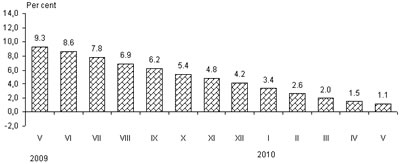
| Lithuanian Foreign trade January–April 2010 | 11 June 2010 |
Statistics Lithuania reports that, based on non-final data obtained from customs declarations and Intrastat reporting data, exports in April 2010 amounted to LTL 4.1 billion, imports – LTL 4.9 billion. Foreign trade deficit of Lithuania amounted to LTL 0.8 billion, which is 2.6 times more than in April 2009. Data on trade with EU countries was adjusted after VAT returns data had been received. In April 2010, compared to April 2009, exports and imports increased by 36.2 and 46.9% respectively; mineral products excluded, exports and imports increased by 22.5%. Exports of goods of Lithuanian origin grew by 37.2, mineral products excluded – by 15.8%. The increase in exports was influenced by a 2.3-fold increase in exports of petroleum oils and oils obtained from bituminous minerals, a 47.7% increase in exports of motor vehicles, 24.3% – plastics and plastic products. The increase in imports was influenced by a 2.8-fold increase in imports of crude oil and a 66.2% increase in imports of motor vehicles. In April 2010, compared to March 2010, exports and imports increased by 7.6 and 8.6% respectively; mineral products excluded, exports increased by 2.9%, while imports decreased by 4.3%. Exports of goods of Lithuanian origin grew by 12.2%; mineral products excluded, exports of goods of Lithuanian origin grew by 6%. The increase in exports was influenced by a 28.4% increase in exports of petroleum oils and oils obtained from bituminous minerals, 41.7% – fertilisers. The increase in imports was influenced by a 2.1-fold increase in imports of crude oil. In January–April 2010, compared to the same period in 2009, exports and imports grew by 17.2 and 21.8% respectively; mineral products excluded, exports increased by 12.7, imports – by 8.1%. Exports of goods of Lithuanian origin grew by 16.7%; mineral products excluded, exports of goods of Lithuanian origin grew by 10%. An impact on the increase in exports was made by a 37.9% increase in exports of petroleum oils and oils obtained from bituminous minerals, 36.6% – plastics and plastic products, a 3.2-fold increase in exports of ships, boats and floating structures, and a 27.2% increase in exports of motor vehicles. The increase in imports was influenced by a 71.8% increase in imports of crude oil, 30.2% – motor vehicles, 59.2% – organic chemicals. In January–April 2010, the most important partners in exports were Russia (13.3%), Germany (11.1%), Latvia (9.2%), Poland (7.9%), in imports – Russia (35.5%), Germany (10.4%), Poland (8.7%), Latvia (5.4%). In January–April 2010, the largest share in exports fell within mineral products (22.5%), machinery and mechanical appliances, electrical equipment (9.4%), vehicles, aircraft, vessels and associated transport equipment (8.9%), in imports – mineral products (35.1%), products of the chemical or allied industries (12.1%), machinery and mechanical appliances, electrical equipment (11%). |
|
| Belgian Etex Group Opens a Plant in Lithuania | 7 June 2010 |
The Belgian industrial group, specialising in the manufacture and marketing of high quality building materials and systems, Etex Group opened its new fiber cement roofing sheets of wavy plant in Lithuania, the only of its kind in the Baltic States. With over 110 employees, the company aims to produce about 7 million square meters of wavy plates in its eco-friendly factory building which required an investment of over 70 million for its state of the art building with modern technology and latest quality standards. The capacity of the new plant will be 2-3 times higher than the entire production of fiber cement sheets in the past, says the newly established Eternit Baltic’s Director Gediminas Vaitkevicius. The company expects to export the fiber cement sheets to Latvia, Estonia, Poland, Germany, Romania, Russia and other European countries. |
|
| Maxima Group sells Baltservis shares | 7 June 2010 |
Vilnius, June 4 (ELTA) - Maxima Group (UAB Maxima Grupe) sold 90 percent of its Baltservis shares to Baltservis Director Saulius Rugys. According to the report of Maxima Group, the transaction was carried out in order to focus only on the direct activities of Maxima in the future. Registered in 2007, Maxima Group is an operational financial holding company governing the retail business in Lithuania, Latvia, Estonia and Bulgaria and consisting of 425 trade centers: Maxima X, Maxima XX, Maxima XXX, T-Market and Ermitazas, out of which 216 trade centers are located in Lithuania, 127 in Latvia, 52 in Estonia and 30 in Bulgaria. The number of employees in the companies managed by the Maxima Group in all the above-mentioned countries stands at more than 23,500. |
|
| "Swedbank" to merge Baltic banks with the parent company | 7 June 2010 |
Tallinn, June 4 (LETA-ELTA) - On the basis of a recent analysis, "Swedbank" is considering it wise to merge in near future its subsidiary banks in the Baltic States with the parent company, writes Estonia's National Broadcasting. "From the point of view of capital management, the most reasonable solution in business terms is to merge the Baltic subsidiaries directly with the parent company "Swedbank" AB," explained "Swedbank" head of Baltic banking Hakan Berg. He also announced that the board of directors of the "Swedbank Group" that is representing the shareholders will make a definitive decision on the issue in late summer this year. Currently, "Swedbank" banks in Latvia and in Lithuania are the subsidiaries of the Estonia-based subsidiary. Since May 25, the new chairman of the supervisory board of "Swedbank" is Hakan Berg, the head of the Baltic division of the "Swedbank". CEO of "Swedbank" is the managing director of the bank's Estonian subsidiary Priit Perens. "The Baltic banking division is still a strategic business area for the Swedbank Group; the objective of the change is to release the group's managing director from having to lead the subsidiary's management and subsidiary organs, which is the substance of the everyday work for me as the head of the Baltic division," explained Hakan Berg. |
|
| SEB plans to expand operations unit in Lithuania | 4 June 2010 |
SEB group plans to expand Skandinaviska Enskilda Banken AB Vilnius Branch, established in Lithuania, by creating new units of Operations, IT and other business support units engaged in providing services to the SEB Group and its clients outside Lithuania. SEB Group’s plans are described in a letter of intent signed with the Lithuanian Economy Ministry in Vilnius on Tuesday. By expanding Skandinaviska Enskilda Banken AB Vilnius Branch in Lithuania, SEB plans to create 30 new full-time working places during 2010 for providing operations, IT and other business support services. SEB plans to create up to 150 full-time jobs to employ high quality specialists until the end of 2012 in SEB’s Vilnius Branch. For the establishment of new working places in the Branch it is planned to grant a direct state subsidy of LTL 175 thousand. „SEB has always stressed that the Baltic countries are home markets for SEB. SEB continues to look for long-term development opportunities in Lithuania. Therefore, two years ago SEB decided to develop not only banking services provided to Lithuania‘s customers, but also to transfer some of business support functions from Sweden to Lithuania“, – says Martin Johansson, Head of SEB Baltic Division. “This investment shows that Lithuania is attractive not only to set up IT service centers, but also to expand the operations of financial services”, - says Deputy Minister of Economy Arnoldas Burkovskis. In order to strengthen the integration of operations across the SEB Group and to use the available knowledge, expertise and competence SEB established an operations centre in Vilnius (Skandinaviska Enskilda Banken AB, Vilnius Branch) in 2008. The Branch took over the functions of the account management operations centre in Stockholm. |
|
| Summer season increases passenger flows | 3 June 2010 |
Vilnius, June 3 (ELTA) - In the five months this year, Vilnius International Airport (TVOU) served 517,17 passengers, an increase of 10 percent as compared with the same period last year. In April (134,000), the number of passengers increased by 19 percent as compared with the same month last year. Comparing the results of April and May this year, the passengers flow increased by 37 percent in May. Over a period of five months, the number of flights increased by 23 percent (10,868) and the amount of cargo transported grew to 2,052 tons. "The beginning of summer season, the variety of scheduled and charter flights attract considerable number of passengers travelling via Vilnius airport," says TVOU CEO Tomas Vaisvila. According to him, Vilnius captured the second place, after Riga (1.621 million passengers), among the airports of the Baltic States, whereas Tallinn remained in the third place (495,257 passengers). This year Copenhagen, Riga, London, Frankfurt, Prague, Dublin, Helsinki, Warsaw, Moscow and Vienna remain the most popular destinations. Vilnius International Airport expects to serve about 2 million passengers this year. |
|
| Retail trade turnover for April 2010 | 3 June 2010 |
Statistics Lithuania informs that, based on the preliminary results from the survey of trade and catering enterprises, the turnover of retail trade, wholesale and retail trade and repair of motor vehicles and motorcycles enterprises (VAT excluded) in April 2010 amounted to LTL2092.0 million (in 2009, LTL2285.3 million) and, against March, grew by 1.7% at constant prices (in April 2009, against March, turnover had grown by 5.9%). In April 2010, against March, the turnover of retail trade enterprises, except for those trading in motor vehicles and motorcycles, grew by 1.6% at constant prices. The turnover of enterprises trading in food products dropped by 2.2%, those trading in non-food products (motor vehicles excluded) – grew by 4% at constant prices. The turnover of enterprises trading in automotive fuel in April 2010, against March, grew by 5.8% at constant prices. The turnover of enterprises engaging in the wholesale and retail trade and repair of motor vehicles and motorcycles in April 2010, against March, grew by 1.9% at constant prices, The turnover of food and beverage service enterprises (VAT excluded) in April 2010 amounted to LTL 61.3 million (in 2009, LTL 76.1 million) and, against March, dropped by 0.3% at constant prices (in April 2009, against March, turnover had grown by 5.4%). The turnover of enterprises engaging in retail trade, wholesale and retail trade and repair of motor vehicles and motorcycles (VAT excluded) in January–April 2010 amounted to LTL 7682.3 million (in 2009, LTL 8654.3 million) and, against the same period in 2009, dropped by 11.9% at constant prices (in January–April 2009, against the same period in 2008, turnover had dropped by 29.7%). In January–April 2010, against the same period in 2009, the turnover of retail trade enterprises, except for those trading in motor vehicles and motorcycles, dropped by 13.7% at constant prices. The turnover of enterprises trading in food products dropped by 13.8%, those trading in non-food products (motor vehicles excluded) – by 12.2% at constant prices. The turnover of enterprises trading in automotive fuel in January–April 2010, against the same period in 2009, dropped by 16.3% at constant prices. The turnover of enterprises engaging in the wholesale and retail trade and repair of motor vehicles and motorcycles in January–April 2010, against the same period in 2009, dropped by 4.5% at constant prices. The turnover of food and beverage service enterprises (VAT excluded) in January–April 2010 amounted to LTL 235.5 million (in 2009, LTL 296.0 million) and, against the same period in 2009, dropped by 20% at constant prices (in January–April 2009, against the same period in 2008, turnover had dropped by 19.9%). The turnover of enterprises engaging in retail trade, except of motor vehicles and motorcycles, in April 2010, against March, seasonally adjusted, dropped by 1.5%, while against April 2009, working day adjusted, by 11.7%. |
|
| Thermo Fisher Scientific Signs Agreement to Acquire Fermentas | 3 June 2010 |
WALTHAM, Mass. (May 26, 2010) – Thermo Fisher Scientific Inc. (NYSE: TMO), the world leader in serving science, announced today that it has signed a definitive agreement to acquire Fermentas – a manufacturer and global distributor of enzymes, reagents and kits for molecular and cellular biology research – for $260 million in cash, subject to a post-closing adjustment. With principal operations in Vilnius, Lithuania, Fermentas has approximately 500 employees and had full-year revenues of approximately $57 million Canadian dollars in 2009 (USD $53 million). Fermentas provides a broad range of high-quality molecular and cellular biology research tools, including reagents for nucleic-acid and protein purification; restriction and modifying enzymes; molecular weight markers and other life science research and diagnostic tools. The company also offers a variety of products for polymerase chain reaction (PCR), reverse transcription PCR (RT-PCR) and quantitative real-time PCR (qRT-PCR), which will strengthen Thermo Fisher’s existing PCR portfolio. “With Fermentas, we are better-positioned to meet the demands of molecular and cell biologists for complete workflows that can accelerate their research and improve results,” said Marc N. Casper, president and chief executive officer of Thermo Fisher Scientific. “The addition of Fermentas, our recent acquisition of Finnzymes and the launch of our new Solaris qPCR assays create a unique combination of products and expertise that enables us to strengthen our depth of capabilities in the high-growth PCR market, including research and PCR-based testing.” Dr. Viktoras Butkus, chairman and chief executive officer of Fermentas, said, “We are extremely pleased with the organization we have created at Fermentas and are proud of our consistent track record of delivering high-quality molecular biology products with compelling value for our customers. Thermo Fisher Scientific is the global leader in the life sciences industry, and joining such a highly respected company will create many attractive opportunities for our customers and employees.” Fermentas will be integrated into Thermo Fisher Scientific’s Analytical Technologies Segment. The transaction, which is subject to applicable regulatory approvals, is expected to close during the third quarter of 2010. The company does not expect this transaction to have a material impact on its 2010 financial results. |
|
| Western Union is yet another result of consistent effort | 1 June 2010 |
Prime Minister Andrius Kubilius welcomed the choice of Western Union, the international financial services company and leader of innovations, to invest in Lithuania and stressed that this move was yet another proof that consistent efforts by the Government to attract global high-tech leaders to Lithuania yield excellent results. “I am glad that more and more innovation and high-tech leaders, of all the countries around the world, choose Lithuania as the best place to establish their advanced service centres. This shows that we are able to win in the global competition for talent and attraction of high technologies, as well as to provide the best environment for investment", said Prime Minister Kubilius. According to the Prime Minister, this was yet another result of our consistent and intense efforts in trying to attract the world-class high-tech companies to invest in Lithuania. “Investments like this will not only lead to the creation of new jobs in Lithuania and increase in export of the Lithuanian services, but they will also stimulate Lithuania to make a breakthrough moving towards the high value-added economy. I know that a number of well-known companies are going to follow the footsteps of Barclays, IBM, Fermento and now Western Union", said Prime Minister Kubilius. Western Union has more than 410,000 agent locations in over 200 countries and territories around the world. The services centre in Vilnius is going to be the fourth international centre of Western Union. Western Union has more than 6,000 employees, and its turnover amounted to USD 5.1 billion in 2009. In March 2010 the global foreign direct investment monitor database FDiMarkets.com announced that 28 foreign investors entered the Lithuanian market in 2009; they invested over LTL 3.5 billion (EUR 1 billion) and created 5,300 new jobs. The UK’s Barclays Group has established a global information technologies centre in Vilnius. One of the global leaders in advanced technologies IBM and the Lithuanian Government have recently signed a Protocol of Intent on the establishment of a joint research centre in Lithuania. Moog Medical, the US manufacturer of medical devices, launched production, services and R&D of medical devices in Lithuania. The leading ventilation company, Sweden’s Systemair plans to open a new ventilation equipment manufacturing plant in Ukmergė, and Spain’s Gruppo Sopena plans to open an aluminium parts plant in Alytus industrial park. |
|
| Liquefied gas terminal to compete with Russian gas - Grybauskaite | 1 June 2010 |
Vilnius, June 1 (ELTA) - A liquefied gas terminal in Lithuania will create competition with Russian gas, President Dalia Grybauskaite said after opening the Baltic Development Forum in Vilnius on Tuesday. According to the head of state, Lithuania will build a liquefied gas terminal. "It provides strong competition with Russian gas as we can import gas via the liquefied gas terminal from all over the world," Grybauskaite said. During her speech in the opening of the Baltic Development Forum, the president said that gas prices in Lithuania were higher than in other European Union countries since Lithuania had no single gas market. According to Grybauskaite, this problem will be solved. "We are talking to the European Commission and I have already received confirmation from President of the European Commission Jose Manuel Barroso that a gas link with Poland will be funded by the EU. We are also speaking about shale," Grybauskaite said. The president also noted that not only alternatives to gas, but also to other energy resources were important to Lithuania. "We need any energy alternatives, not only the ones related to gas," Grybauskaite said. |
|
| Euro area unemployment rate at 10.1% | 1 June 2010 |
The euro area1 (EA16) seasonally-adjusted2 unemployment rate3 was 10.1% in April 2010, compared with 10.0% in March4. It was 9.2% in April 2009. The EU271 unemployment rate was 9.7% in April 2010, unchanged compared with March4. It was 8.7% in April 2009. Eurostat estimates that 23.311 million men and women in the EU27, of whom 15.860 million were in the euro area, were unemployed in April 2010. Compared with March 2010, the number of persons unemployed increased by 25 000 in both the EU27 and the euro area. Compared with April 2009, unemployment went up by 2.400 million in the EU27 and by 1.275 million in the euro area. These figures are published by Eurostat, the statistical office of the European Union. Among the Member States, the lowest unemployment rates were recorded in the Netherlands (4.1%) and Austria (4.9%), and the highest rates in Latvia (22.5%), Spain (19.7%) and Estonia (19.0% in the first quarter of 2010). Compared with a year ago, one Member State recorded a fall in the unemployment rate and twenty-six an increase. The fall was observed in Germany (7.6% to 7.1%), and the smallest increases in Luxembourg (5.3% to 5.4%) and Malta (6.9% to 7.0%). The highest increases were registered in Estonia (11.0% to 19.0% between the first quarters of 2009 and 2010), Latvia (15.4% to 22.5%) and Lithuania (11.2% to 17.4% between the first quarters of 2009 and 2010). Between April 2009 and April 2010, the unemployment rate for males rose from 9.0% to 10.0% in the euro area and from 8.7% to 9.8% in the EU27. The female unemployment rate increased from 9.5% to 10.2% in the euro area and from 8.7% to 9.5% in the EU27. In April 2010, the youth unemployment rate (under-25s) was 20.0% in the euro area and 20.6% in the EU27. In April 2009 it was 19.3% and 19.2% respectively. The lowest rate was observed in the Netherlands (8.0%), and the highest rates in Latvia (44.6% in the first quarter of 2010), Spain (40.3%) and Estonia (39.8% in the first quarter of 2010). In the USA, the unemployment rate was 9.9% in April 2010. In Japan it was 5.0% in March 2010. |
|
| Cooperation among academia, business and politics is a key to prosperity of the Baltic Sea Region | 1 June 2010 |
"Energy, the sea, innovation, and competitiveness - these are the key words that best describe the peculiarities and challenges of the Baltic Sea region and define directions for close cooperation," President of the Republic of Lithuania Dalia Grybauskaitė said at the Baltic Development Forum Summit which is hosted by Lithuania for the first time and which brings together over 500 influential businesspeople, politicians and academics to discuss the current economic situation, the potential for improvement, the EU's Baltic Sea Region policy, and prospects of cooperation. The Baltic Development Forum which is also called the Baltic Davos and which runs this year under the title "European Challenges - Regional Solutions: An Agenda for Jobs, Investments and Sustainable Growth" is attended by prime ministers of the Baltic countries, Norway and Finland, ministers of foreign affairs of Lithuania and Denmark, Minister of Economy and Energy of Sweden, President of the European Commission Jose Manuel Barroso, Deputy Director of the World Trade Organisation Rufus H. Yerxa, senior managers of large energy, consulting and other companies of the Baltic Sea countries, associated business structures, international financial institutions, analysts from research institutions, and many others. |
|
| Budget deficit should be cut by 5% in two years - Kubilius | 1 June 2010 |
Vilnius, May 31 (ELTA) - Prime Minister Andrius Kubilius has voiced his intentions of reducing the budget deficit by about 5 percent and says that financial consolidation measures should be announced as soon as possible. "Over the coming two years, we must consolidate the deficit by another 5 percent of gross domestic product. (...) I see a challenge here, we must announce further consolidation as soon as possible," Kubilius said after the Government's meeting on Monday. On Monday, the prime minister and Finance Minister Ingrida Simonyte met with President Dalia Grybauskaite. As reported, the meeting focused on European issues mainly. "In mid-June, the president will take part in the European Council. There are many important changes in Europe. What is more, President of the European Commission Jose Manuel Barroso is coming on a visit," Kubilius said. |
|
| Mazeikiai oil refinery should be sold - Gazeta Wyborcza | 1 June 2010 |
Warsaw, May 31 (ELTA) - PKN Orlen bought the oil refinery Mazeikiu Nafta to destroy the plans of Russia. Today the Lithuanian plant brings profit to a good friend of Vladimir Putin, while the Polish oil concern has big financial difficulties. Such are the consequences of the failure of a political attempt to diminish Russia's influence, an influential Polish daily, Gazeta Wyborcza, writes. Orlen Lietuva receives a large part of oil from the Russian port of Primorsk with Gunvor as the largest oil operator. Gunvor was set up in 1997 by Gennady Timchenko who is closely related to the incumbent prime minister of Russia, the newspaper writes. The Mazeikiai plant increased its revenues in the Q1 of this year, compared with the same quarter of last year. However, the total losses of the oil refinery amounted to 30 million U.S. dollars and were higher than last year. According to experts, even if Orlen Lietuva will ever gain a profit, business profitability will still be less than the average of PKN Orlen, which means that the Mazeikiai oil refinery drags the Polish concern down. The only sensible solution is to admit a mistake and sell the oil refinery, Gazeta Wyborcza states. According to the Polish daily, the problem is that there are few companies willing to buy with the exception of Russian companies. Some of the sources told the Polish newspaper that "the Lithuanians have nothing against the return of Russians to Mazeikiai, although they will not say this openly." |
|
| Weekly unemployment rate remains unchanged | 31 May 2010 |
Vilnius, May 28 (ELTA) - On Thursday, there were 326,400 (15 percent of the residents of working age) unemployed registered with labour exchanges in Lithuania. The unemployment rate remained the same as last week. Over the past week (May 24-27), territorial labour exchanges registered almost 5,000 jobseekers, one of the lowest rates per week this year. Over a day, labour exchanges registered 922 jobseekers on the average (1,071 jobseekers last week). During the past seven days, labour exchanges helped almost 4,000 jobseekers get employment. On May 21-27, employers registered 2,436 vacancies. Almost 1,200 jobseekers were sent to active labour market policy measures. |
|
| Star1 Airlines launches flights to Dublin | 31 May 2010 |
Vilnius, May 28 (ELTA) - The Lithuanian low cost carrier Star1 Airlines will launch direct flights from Vilnius to Dublin this Saturday. In summer, the airline will operate flights to Dublin on Tuesdays, Thursdays and Saturdays. "There is a big community of Lithuanians in Ireland, especially in Dublin, which finds this route very necessary and convenient. We see that there are a lot of people interested in this route, thus we will continue these flights in winter as well," CEO of Star1 Airlines Martynas Laivys said. The flight from Vilnius to Dublin lasts about 3 hours. Star1 Airlines belongs to the group of companies Star Team Group which also owns a tour operator Star1 Holidays. In its summer flight schedule Star1 Airlines offers flights to London, Dublin, Milan, Edinburgh, Girona, (Barcelona), Heralion, Ibiza and Palermo. |
|
| Gross domestic product - Revised I quarter 2010 estimate | 31 May 2010 |
According to the revised data, in I quarter 2010, GDP at current prices amounted to LTL 20863.1 million and, against the same period in 2009, dropped by 2.8 per cent, while against IV quarter 2009 – by 12.7 per cent (the changes have been estimated using the chain-linked volume of indicators). (The previously published first GDP estimate for I quarter 2010 amounted to LTL 20648.6 million and, against the same period in 2009, dropped by 2.9 per cent, while against the previous quarter – by 12.9 per cent). The revised results for industry, transport and domestic trade conditioned a slightly smaller decrease in GDP than the previously announced; however, the general trend remained unchanged. In I quarter 2010, the hugest drop in the value added was observed in construction (by 32.2 per cent). In other activities, a slower decrease in the value added was observed: in financial intermediation, real estate and other business services – by 3.4, agriculture, forestry and fishing – 1.5, public administration and defence, education, health care and social work activities – 1.4, trade, transport and communication – 1.1 per cent. The slowest decrease in the value added was observed in industry (by 0.4 per cent). The drop in GDP was to a certain extent buffered by positive changes in the energy and transport sectors. In January–March 2010, against the same period in 2009, final consumption expenditure dropped by 7.5 per cent. Household final consumption expenditure dropped by 10 per cent; the rate of decrease in general government final consumption expenditure was slower (-0.2 per cent). A further decrease in gross fixed capital formation was observed; against the same period in 2009, it dropped by 30.2 per cent, which was conditioned by a further decrease in investment in buildings and civil engineering works. In I quarter 2010, against the same period in 2009, with the recovery in manufacturing in the country, exports of goods and services grew by 2.8, imports – by 5.7 per cent. |
|
| Thermo Fisher to buy Fermentas for 260$ m. | 31 May 2010 |
Burlington, Ontario, May 28 (ELTA) - Thermo Fisher Scientific Inc. (TMO) has agreed to buy biology research materials maker Fermentas International Inc. for 260$ million, informs The Wall Street Journal. Thermo Fisher sells big-ticket products such as mass spectrometers--used to identify chemical compositions--that are more discretionary during hard times, but its diverse field of offerings has cushioned results. It has made a number of acquisitions over the past year and saw profit improve recently. Ontario-based Fermentas makes enzymes, reagents and other materials for molecular and cellular biology research. Its 2009 revenue was about 54$ million. The company will be integrated into Thermo Fisher's analytical technologies segment, which saw its latest-quarter profit jump 34 percent as sales increased. The deal is expected to close in the third quarter and is not expected to impact 2010 results. Thermo Fisher shares were up 1.8 percent at $51.82 in early trading, roughly in line with the broader market. The stock is up 37 percent the past year. |
|
| Lotos takes over Lithuanian oil producers | 31 May 2010 |
Warsaw, May 28 (ELTA) - Lotos Group, one of Poland's largest refinery companies, has taken over Lithuanian oil producers Geonafta, reports Polish business daily Puls Biznesu. After concerns raised by the Lotos advisory board, the takeover was given the green light, and will result in the group's oil production increasing by 30 percent. Petrobaltic, a Lotos subsidiary which will control the Lithuanian firm, is expected to rubberstamp the deal over the weekend. Miller and Lents, an oil and gas consultancy, has confirmed that Geonafta's reserves reach up to 9.2 million barrels of oil, guaranteeing production of 800,000 tons annually until 2018. |
|
| Latvia is most fragile Baltic State - Reuters | 31 May 2010 |
RIGA, May 27 (LETA-Reuters-ELTA) - Of the three recession-hit Baltic states, the political situation in Latvia is the most fragile as it faces a parliamentary election in October, according to a commentary on political risks in the Baltic States by the "Reuters" agency. However, Estonia and Lithuania are also working with minority governments, which could complicate the taking of unpopular but necessary decisions. "Reuters" recognized the most serious risk to Latvia as being October's elections, which will most likely lead to another multi-party coalition government. As polls are showing the highest support for Harmony Center and Prime Minister Valdis Dombrovskis' Unity alliance, the question arises as to whether these two forces could agree to work together in a new government, writes "Reuters". There is also a question over a possible softening of Latvia's adherence to the IMF program by a new government, which could cause doubts on financial markets about the sustainability of the economy and renew the risk of a devaluation of the lat. Estonia's main challenges are linked to the introduction of the euro, which will increase support for the ruling parties ahead of the elections set for March 2011. Nevertheless, some instability inside the ruling coalition is expected as the country nears the March elections, with the junior coalition partner, Pro Patria and Respublica Union, trying to emerge from the leading Reform Party's shadow, according to "Reuters". The main challenge for the election victors will be staying within euro zone limits and staying on the path of fiscal austerity. The threat of instability is also present for Lithuania, as Prime Minister Andrius Kubilius' minority government is dependent on a small group of independent deputies, with the possibility that another party could also leave the government. A major test for the government will come in December, when parliament has to vote on a budget for 2011. Before that, the Seimas will have to approve yet another set of fiscal consolidation measures. If the government's weak position leads to fiscal slippage and problems financing its budget deficit, then speculation against the currency could mount and local market interest rates rise. This could also spread worries to the other two Baltic states, according to "Reuters". |
|
| President is against motor vehicles and property taxes | 31 May 2010 |
Vilnius, May 26 (ELTA) - President Dalia Grybauskaite does not approve of tax increase and call the Government to reduce the "shadow". The head of the state supports the proposal of the International Monetary Fund experts to continue cutting costs and to broaden the tax base. "Lithuania really needs to cut costs and broaden the tax base, but this is exactly why a year ago I did not recommend Lithuania to borrow from IMF in order for the country to decide upon the measures of reducing its budget deficit. First of all, it is necessary to pull the economy out of the shadow, not increase taxes. That is the first task of the Government," the president told the journalists on Wednesday. Asked about the motor vehicles and property taxes, the head of the state said that "they would not justify today". |
|
| On hearing of new taxes, people panic - Deputy Seimas Speaker | 31 May 2010 |
Vilnius, May 26 (ELTA) - The Government's talks about the property and the "green" motor vehicle taxes raise chaos in the society, because on hearing about any new taxes, people get into panic, says Deputy Seimas Speaker, Member of the Labour Party Virginija Baltraitiene. "Some taxes are necessary. I am not saying anything; we could consider the property tax, however, what it should be? Is it possible to impose a tax on the property, when a person has one home only? What concerns other taxes, I am of different opinion. The Government did not carry out any studies on what and how many taxes were needed, and what effects would the effects of tax increases," Baltraitiene said on Ziniu Radijas on Wednesday. According to her, the tax increase does not mean that more money will be collected into the state budget. Virginija Baltraitiene is convinced that the Government should reduce taxes to some people and defer their tax payments in order to save as many jobs as possible. |
|
| A more integrated EU will save euro - Grybauskaite | 31 May 2010 |
Vilnius, May 25 (ELTA) - To be able to properly manage the current eurozone crisis and tackle more global challenges, the EU needs to be united and more deeply integrated, Lithuanian President Dalia Grybauskaite has told EurActiv in the presidential palace in Vilnius. "Having a common currency and no mechanism strict enough to control and push member states to behave responsibly is a mistake," the Lithuanian president said, referring to EU member states' persistent failure to respect the Stability and Growth Pact. "In 2005, member states themselves laundered this pact. It became a rubber pact where you can inflow as much as possible flexibility without responsibility," she added. Grybauskaite, who has also served as her country's finance minister and vice-minister of foreign affairs, became president of Lithuania in July 2009, after having held the position of European commissioner for financial programming and budget in the first Barroso Commission. "If one country is allowed to misbehave, to bluff with information, to avoid paying its full share to the European budget, to make uncoordinated moves in economic policy, the system collapses," she said, claiming that the euro debacle was an accident waiting to happen and was accelerated by the global crisis, which exposed the weaknesses and bottlenecks of the European fiscal and monetary situation. The president explained that the rescue package adopted by EU leaders earlier this month to prevent the euro from collapsing under the weight of debt accumulated in countries such as Greece, Spain or Portugal is just a means of buying time. According to Grybauskaite, if Europe fails to act, "the investment of the rescue package will be lost and misused" as the crisis is not just a Greek problem, but a problem for the entire euro zone and the EU as a whole, because ultimately its resolution lies in fiscal policies and how they are controlled and harmonised. "A currency without a common monetary and fiscal policy is an artificial design," she said. "And if you don't coordinate, you cannot speak with one voice, and cannot decide in one shot." Outlining her long-term vision for the European Union, the former commissioner, who worked extensively on preparations for the EU budget review, argued that the 'Europe 2020' blueprint, which was launched in March as a follow-up to the Lisbon Strategy, "is not a solution for all problems". "It is clear that you cannot solve citizens' everyday lives with that kind of strategy," she said. "Any strategy needs to be open to change and adapt to reality, because life is changing fast and our documents ought too," she added, stressing that the European Commission has not fully learned the lessons of the Lisbon Strategy's failure. Europe 2020 has fewer indicators and it is more structured, argues the former commissioner, but the control mechanism for member states' commitment and ownership is still weak. "This is really all we need no matter what we write in the document." Responding to a question on whether creating a European monetary fund or a European credit rating agency are sound proposals, President Grybauskaite smiled and said that although there is a desperate need to manage situations regionally, regional institutions can only partly respond to the problem. "Financial markets are more integrated than governments are [&]. Some policies have outgrown the European dress," she continued. "Global markets are already a 'federation' and even more than that - they are so much united that we governments in different regions are running after them," she said, arguing instead for reform of international institutions. European instruments, however, could help the bloc itself to be more coordinated. Indeed, in the coming years Europe needs to be integrated not only as regards the single market of goods and services, but also in the field of energy infrastructure, Grybauskaite argued. "We do not need to change the EU treaty to have a political agreement on a common energy policy or foreign policy. It only takes the Council and governments to agree - a gentlemen's agreement," she said, expressing regret that economic integration and the single market were still far from being completed. Crises have always been perceived as opportunities for change and progress, especially in the European Union, which has developed through political and economic turmoil. But it is not yet clear whether the EU will take this crisis as a lesson, the Lithuanian president cautioned. "The understanding is coming, but it is not shaping institutions yet." She refuted suggestions that this is down to a lack of leadership at national level. "What we need is real European leadership. Do we go into deeper integration or we grow more like a club of friends?" she wondered, hinting at the fact that the Delors, Mitterand or Kohl of the 21st century was yet to come forward. |
|
| Unemployment in I quarter 2010 was 18.1% | 26 May 2010 |
Statistics Lithuania informs that, according to the Labour Force Survey data, the unemployment rate in the country in I quarter 2010 was 18.1% , which is by 2.5% more than in IV quarter 2009. In I quarter 2010, against I quarter 2009, the unemployment rate grew 1.5 times. The male unemployment rate in I quarter 2010 was 23.2%, female 13.1% . A higher male unemployment rate was conditioned by a rapid decrease in the number of persons employed in construction and industrial enterprises. In I quarter 2010, the urban unemployment rate was 16.6%, rural 21.8% . The youth (aged 15–24) unemployment rate in I quarter 2010 increased to 35.9% . Over the quarter, the youth unemployment rate grew by 6.8%, over the year almost 1.5 times. In I quarter 2010, according to the estimates of Statistics Lithuania, the number of the unemployed was 293,400, which is by 38,200 more than in IV quarter 2009. Over a year, the number of the unemployed grew 1.5 times (by 99,500). In I quarter 2010, the number of the long-term unemployed, i.e. persons looking for a job for one year and longer, increased to 99,600. In IV quarter 2009, this figure stood at 71,700, a year ago – 38,100. In I quarter 2010, according to the data of the Lithuanian Labour Exchange, the average number of the registered unemployed was 298,000. A noticeable increase in the number of the unemployed registered at the labour exchange was observed at the end of the March, which was due to the obligation for the unemployed who are not registered at the labour exchange to pay compulsory health insurance contributions, set in the Law on Health Insurance of the Republic of Lithuania. With the increase in unemployment, the number of employed persons decreased. In I quarter 2010, the number of employed persons in the whole economy was 1,328,000, which is 55.4% (4%) less than in IV quarter 2009. The most marked decrease in the number of employed persons over the quarter was observed in construction – 11,800, and industry – 10,300. In I quarter 2010, against I quarter 2009, the number of employed persons dropped by 104,700, or 7.3% . Over the year the number of persons employed in construction dropped by 36.5%, in industry 12.4% . With the decrease in the number of employed persons, the employment rate declined as well. In I quarter 2010, the employment rate of the population aged 15–64 was 56.8%. Over the quarter it dropped by 1.9%, while over the year by 4.2%. The male employment rate was 54.%5, female 58.9% . In I quarter 2010, according to the data of statistical offices of the Baltic States, the lowest unemployment rate was in Lithuania (18.1% ), the highest – in Latvia (20.4% ), while Estonia stood at 19.8% . Over a year, the unemployment rate in Lithuania and Latvia grew 1.5, in Estonia – 1.7 times. |
|
| Lithuania's competitiveness down - IMD | 21 May 2010 |
Zurich, May 21 (ELTA) - A survey on competitiveness of countries carried out by the International Institute for Management Development (IMD) shows that Lithuania has dropped to the 43rd position from the 31st in the ranking of 58 countries. Estonia rose to the 34th position from the previous 35th, whereas Latvia was not included in the list. Poland climbed to the 32nd position from the 44th; Russia fell to the 51st place from the 49th. The ranking was based on 327 criteria, starting with GDP per capita and economic growth and ending with exports, level of computerization or even prices of mobile phone services. The criteria of the ranking also included many other factors such as the level of corruption, state's support for education, attitude to globalization, and management as well as supervisory bodies. The top ten of the world's most competitive countries includes Singapore, Hong Kong, the U.S., Switzerland, Australia, Sweden, Canada, Taiwan, Norway and Malaysia. The list was ended by Venezuela, Ukraine and Croatia. |
|
| Come to Belarus - Lukashenko to Lithuanian businessmen | 22 May 2010 |
Minsk/Vilnius, May 20 (ELTA) - Improvement of trade and economic relations with Lithuania is in Belarus' interest, says Alexander Lukashenko, president of the neighbouring country. The Belarusian leader voiced such a position in a meeting with Lithuanian businessmen and promised to assist them in their investment in Belarus. On Thursday, a delegation of twelve Lithuanian businessmen met with Lukashenko to present the directions of the Lithuanian business' investment in Belarus, opportunities for the development of projects as well as the problems related to the development of business in the neighbouring country. "Belarus and Lithuania have a great potential for cooperation in many areas. We are glad at the coming of the Lithuanian investment in the Belarusian economy. It is most important that we have joint promising projects, which will unite us in a common goal," the Belarusian president said. Lukashenko also noted that he was ready to take supportive decisions with regard to every project proposed by Lithuanian businessmen to cut through the red tape. "If you are interested in Belarus, come here and let's start working," Lukashenko told the Lithuanian businessmen at the meeting held on his own initiative. On May 21, Friday, the 4th Lithuanian-Belarusian Economic Forum will open in Minsk starts. The forum is the annual meeting of the Lithuanian and Belarusian businessmen with the heads of the institutions responsible for business development. Last year, the forum took place in Vilnius. It was attended by Lukashenko. This year, the forum will be opened by the economy ministers of the two countries - Dainius Kreivys and Nikolai Snopkov. The reports in the forum will be delivered by the head of the Lithuanian-Belarusian Business Council, President of the UBIG group Vladimir Romanov, President of the Lithuanian Industrialists' Confederation and Achema Grupe Bronislovas Lubys, the ambassadors of the two countries. During the forum, the Lithuanian-Belarusian intergovernmental commission will hold a sitting headed by the Lithuanian and Belarusian economy ministers. |
|
| Estonia in the euro? Why? - CNN Money | 22 May 2010 |
Tallinn, May 20 (LETA-CNN/Fortune) - Despite the turmoil in the eurozone, there's a bit of a love fest going on across the Atlantic. Estonia has worked hard and behaved well, and it's now time for the little country to adopt the euro. And the euro, right now, just wants to be wanted. The European Commission announced last week that it supports Estonia's bid for the euro. The European Central Bank will need to approve to finalize the deal. If all goes well, Estonia will join the eurozone at the beginning of 2011. That'll probably happen, even though the central bank has expressed some concern over potential inflation problems in the country. They can't really say no: Estonia has done right by all the financial requirements of the Maastricht Treaty, which established the European Union in 1992. To meet the Maastricht mandates, the Estonian government sliced the national budget, and cut civil service by about 20%, battling their way back from a huge recession. They've been eyeing a spot in Europe's premier financial league for a while, and now, it looks like they're going to earn the promotion. Members of the eurozone are glad that anyone still wants to join the team. "Estonia is too small for the EU to gain anything but the symbolic," says economist Barry Eichengreen from the University of California, Berkeley. "But, in terms of symbolism, a vote of confidence in the euro is timely, even when it comes from a country as small and distinctive as Estonia." The euro could use a vote of confidence right now. The eurozone is taking a big financial hit, trying to bail Greece out of bankruptcy caused by too much government spending. Spain and Portugal are hurting. Germany, which has carried the currency, is trying to maintain some discipline by banning naked short-selling on government bonds. Unfortunately, Estonia doesn't really have the manpower to offer much financial clout. The country only has 1.3 million people, and a GDP of 27.7 billion US dollars. It doesn't stack up next to a power player like Germany, which has a GDP of 2.9 trillion dollars, and is still growing, or even floundering Greece, at 330 billion dollars. But Estonia has gotten a global pat on the head for admirable financial policies for some time. It's ranked 16th in the world on the Wall Street Journal's 2010 Index of Economic Freedom, and 7th in its region. "I think Estonia brings that voice of fiscal conservatism to the table, which always makes everybody squirm, but that's a healthy thing," says Jeremy Hildreth, a former economist who works on branding for different countries, and worked on the branding for Estonia. "It's a great time for smart little Estonia to pop up on to the scene." Estonia's been waiting for its breakout for quite some time. Things were looking good from 2004-2006, when Estonia's growth numbers were in the double digits. But the country isn't entirely immune to global pressures. When the property bubble burst in 2007, Estonia spun into a recession. Estonian prime minister Andrus Ansip's term started in 2007. He banked his campaign on getting the country on the euro. "A year ago, there didn't seem to be any light at the end of the tunnel with the recession, then the euro became that [light]," says Andres Kasekamp, the director of the Estonian Foreign Policy Institute in Tallinn. Estonia will reap the rewards from switching to the euro on several levels. Their current currency, the kroon, is already pegged to the euro, but without any of the many benefits, large and small, of being in the eurozone. The currency switch would most likely boost foreign investment and tourism. Something as simple as removing the fee for exchanging money could effect the economy, says Oliver Loode, a marketing director at Consumetric, an Estonian tourism and marketing consultancy agency. "It just basically groups Estonia as a tourism destination more with Scandinavia than it does with the Baltic countries." See you on the flip side, Latvia. That's a big psychological shift, Kasekamp says. And there are others. "Joining the eurozone is sort of this seal of being first class Europeans, not second class like the typical eastern European." "It's something that they've earned from scratch, whereas other countries had to fudge numbers," says Hildreth. And Estonians are proud of that distinction, according to Kasekamp, who says that Estonians "have zero sympathy for the Greeks." "A year ago had anyone said that Estonia joining [the euro] would be welcomed as a boost, it would have seemed to be a great exaggeration, but thanks to the Greek crisis, that's the case." |
|
| Star1 Airlines launches flights to Girona airport | 22 May 2010 |
Vilnius, May 21 (ELTA) - As of May 23, the Lithuanian low cost carrier Star1 Airlines launches direct flights from Vilnius to Spain's Girona airport which is located 90 kilometres from Barcelona. The airline will operate the flights to Girona, which were very popular last summer, twice a week, on Thursdays and Sundays. Star1 Airlines belongs to the group of companies Star Team Group which also owns a tour operator Star1 Holidays. In its summer flight schedule Star1 Airlines offers flights to London, Dublin, Milan, Edinburgh, Girona, (Barcelona), Heralion, Ibiza and Palermo. Star1 Airlines CEO Martynas Laivys said that last summer the airline carried 5,700 passengers on the route Vilnius-Girona-Vilnius, which proved to be one of the most popular routes in the season. "In summer season Barcelona becomes one of the largest attraction points for tourists from Europe and all over the world. No wonder we feel high interest from travellers in this destination. This year the timing of flights to Girona is extremely favourable for longer weekend trips - after departing from Vilnius on Thursday morning tourists shall have 3.5 days for their stay at the Catalonian capital and be back to Vilnius Sunday afternoon," Laivys said. The flights are expected to be chosen by around 7,000 travellers during this summer season. The flight to Girona will take 3 hours and 15 minutes. |
|
| Lithuanian economic outlook improved at Danske Bank | 18 May 2010 |
Vilnius, May 18 (Bloomberg-ELTA) - The Lithuanian and Estonian economies may contract less than previously estimated this year on rebounding industrial production, Danske Bank A/S said. The Danske estimates are the most pessimistic for the region. The governments of the two countries expect 1.6% growth in Lithuania and 1% expansion in Estonia. Lithuania's industrial output grew in March for the first time in 17 months, while Estonia's output rose at the fastest pace in more than 3 years as recovering sales to export markets increased demand. |
|
| Upgrade of runway at Vilnius Airport completed | 18 May 2010 |
The installation of a category II system of signalling lights for precision approach and landing at Vilnius International Airport (VIA) has been completed and the system has been acknowledged as suitable for use. On implementation of the procedures of this category, flight safety will be enhanced and the duration of aircraft idle time due to poor weather conditions will be reduced. Until recently, the airport had a category I precision approach and landing system. This means that the height when aircraft captains took the decision to land or terminate the approach to land at the airport was 60 meters and the horizontal runway visibility was 550 metres. With the category II system, the decision-taking height is reduced to 30 meters, and horizontal visibility is reduced to 350 metres. ‘On implementation of these higher category installations, it will be easier for aircraft captains to land at the airport when there is poor visibility, and as a result aircraft idle time due to bad weather conditions will decrease. All this enhances flight safety and makes the airport more attractive,’ Darius Okunevičius, director of the Infrastructure Department of VIA, said. Mr Okunevičius stated that technical work for the implementation of category II installations has been completed, and procedures for the legalisation of the installations have been initiated. Those procedures could take several months. Experts from the International Civil Aviation Organisation (ICAO) will also have to present their conclusions regarding the compliance of the installations at the airport with category II requirements. Siemens UAB, which won a public tender to become contractor of this work, has supplemented the current signalling system of Vilnius Airport with approach and landing area lights; approximately 250 additional lights were installed. The value of the runway work project is LTL 4.86 million. Runways at airports can be equipped according to three different categories of precision approach and landing systems. |
|
| Euro area annual inflation up to 1.5% | 18 May 2010 |
Euro area annual inflation was 1.5% in April 2010, up from 1.4% in March. A year earlier the rate was 0.6%. Monthly inflation was 0.5% in April 2010. EU annual inflation was 2.0% in April 2010, up from 1.9% in March. A year earlier the rate was 1.3%. Monthly inflation was 0.4% in April 2010. These figures come from Eurostat, the statistical office of the European Union. Inflation in the EU Member States In April 2010, the lowest annual rates were observed in Latvia (-2.8%), Ireland (-2.5%) and Lithuania (0.2%), and the highest in Hungary (5.7%), Greece (4.7%) and Romania (4.2%). Compared with March 2010, annual inflation fell in six Member States, remained stable in three and rose in seventeen. The lowest 12-month averages up to April 2010 were registered in Ireland (-2.5%), Portugal (-0.7%), Estonia and Latvia (both -0.6%). Lithuania stood at 1.5%, while the highest were in Hungary (5.0%), Romania (4.9%) and Poland (3.8%). Euro area The main components with the highest annual rates in April 2010 were transport (5.9%) and alcohol & tobacco (4.2%) while the lowest annual rates were observed for recreation & culture (1.0%), communications (-0.6%) and food (-0.2%). Concerning the detailed sub-indices, fuels for transport (+0.75% age points), heating oil (+0.21) and tobacco (+0.11) had the largest upward impacts on the headline rate, while gas (-0.14) and package holidays (-0.11) had the biggest downward impacts. The main components with the highest monthly rates were clothing (3.2%), transport (0.8%) and housing (0.6%), while the lowest were recreation & culture (-1.1%), communications (-0.2%) and education (-0.1%). In particular, garments (+0.14 percentage points) and fuels for transport (+0.10) had the largest upward impacts, while package holidays (-0.11) had the biggest downward impact. |
|
| Olialia Cola advertising among most innovative worldwide | 18 May 2010 |
Vilnius, May 17 (ELTA) - The advertising campaign of the soft drink Olialia Cola is the first Lithuanian advertising campaign which has been included into a hundred of the most innovative world advertising campaigns by Cream, the only online subscription intelligence service that indexes and analyses the world's media and marketing innovations for global advertisers, agencies and media vendors. Based in London UK, Cream's editorial team uses 250 spotters from around the world that feed into Cream's library of over 2,500 case studies from more than 100 countries. The content is underpinned with innovation news, analysis, 10 in-depth reports over the year, plus the shortlisted and winning entries from The Festival of Media Awards. The book No Apples: 100 Other Top Innovators discusses the advertising campaign of Olialia Cola and the products with the drink'si taste, cream dessert and sweets. Besides Olialia, the book presents many well-known brands: Intel, Financial Times, Virgin Galactic, Philips, Ikea, Amazon, Nike, Google, Red Bull, Pedigree, Kodak, BBC, Volkswagen, Guinness, Pepsi, Adidas. "We analyze thousands of media, marketing and business solutions and we see that an innovative and creative approach is the most valuable in advertising. Such companies are most successful in practice. We have noticed Olialia and their soft drink Olialia Cola for the original approach to the positioning of a non-alcoholic beverage. We have been surprised at the number of markets that Olialia has entered so far," Editor of Cream Olivia Solon said. According to Giedre Pukiene, the Olialia brand manager, the evaluation of Cream is the most important and the most pleasing one, considering the fact that no Lithuanian company succeeded in achieving such global recognition and interest before Olialia. The manager said that in the short run Olialia would launch four or five food products and had plans of entering the non-food sector. "Our long term goal is to select the best products, to produce an integrated package of the brand name and products and to offer it as a franchise in the neighbouring markets," Pukiene said. Presently, Olialia Group includes the project Olialia girls and the model agency Olialia Models, the band Olialia Pupytes, the parties Olialia Party, the Olialia beauty clinic, the discount programme Maestro Olialia, the soft drink Olialia Cola, the Olialia Cola ice cream, the cream dessert and sweets, Olialia pizzeria, the transport vehicles for rent Olialia Limo and Olialia Party Bus, and the annual calendar of the daily Vakaro Zinios. |
|
| Central Government Debt in March | 17 May 2010 |
According to the data by the Ministry of Finance, the end-March central government debt was LTL31,291.8 million or 33.4 % of the projected GDP for 2010 (LTL93 819 million). During March central government foreign debt decreased by LTL 324.2 million and made up LTL23, 807.4 million (76.1% of total central government debt). Central government domestic debt increased by LTL150.7 million and accounted for LTL7, 484.4 million (23.9% of total central government debt). Central government was indebted to foreign financial institutions LTL20,952.5 million, domestic financial sector – LTL6, 023 million, international organisations – LTL2,854.9 million, other creditors (households and non-profit institutions) – LTL1,017.8 million, non-financial sector – LTL443.6 million. Total long-term central government debt made up LTL29,733 million (95 % of total debt), short-term – LTL1, 558.7 million (5 % of total debt). |
|
| Central Government Revenue in March | 17 May 2010 |
According to the data of the Ministry of Finance, in March central government revenue was LTL2,196.1 million, expenditure – LTL2,818.2 million, while transactions in non-financial assets – LTL168.5 million. In March central government deficit (calculated on cash basis) made up LTL 790.6 million and accounted for 0.8% of the projected GDP for 2010 (LTL93,819 million). Three-month central government revenue amounted to LTL6,506.4 million, expenditure made up LTL8,159.7 million, while transactions in non-financial assets – LTL446.4 million. Three-month central government deficit (calculated on cash basis) was LTL2,099.7 million or represented 2.2% of GDP: State budget – LTL1,192.2 million, extrabudgetary funds – LTL110.3 million and social security funds – LTL797.2 million. In March the major share of revenue was collected from taxes (46.6%) and social contributions (39%). The major share of expenditure was designated to social payments (49.4% of total expenditure). Central government covers the State budget, social security funds (“Sodra”, Compulsory Health Insurance Fund and Employment Fund), as well as extrabudgetary funds, i.e. Privatisation Fund, Guarantee Fund, Reserve (Stabilisation) Fund, Ignalina NPP Decommissioning Fund, Rural Credit Guarantee Fund and Savings Restitution Account as well as State Property Fund and AB Turto bankas. Central government statistical data is published following the IMF’s Special Data Dissemination Standards and IMF’s Government Finance Statistics Manual 2001. |
|
| Estonia is ready to help out Greece | 17 May 2010 |
Tallinn, May 13 (LETA-ELTA) - Estonian prime minister Andrus Ansip said at the government's Thursday press conference that the Estonian government is in principle ready to help out the indebted Greece and buy Greek government bonds, if need be, Äripäev Online reports. "Solitary in the European Union is reality," said Ansip. "Yes, we are ready to acquire Greek government bonds if we participate in the wider support package," he said. Those who say that Estonia should not help Greece are wrong, Ansip said, adding that you never know when Estonia might need the help of other states. Ansip stated that the likelihood that the guarantees that the EU crisis measure in support of the euro entail would actually be used is rather small. "This instrument is certainly necessary," said Ansip, stressing that this is not irretrievable aid, it has to be paid back and it brings a reasonable interest rate. |
|
| Monthly inflation of 0.1% predicted for May | 17 May 2010 |
Vilnius, May 17 (ELTA) - Calculated in proportion to the harmonized index of consumer prices (HICP), the inflation should reach 0.1% in May, as compared to April. The Department of Statistics forecasts that in May, the annual inflation will stand at 0.4, the average annual inflation will reach 1.1%. |
|
| East Europe threatened by west's debt, euro crisis - EBRD | 17 May 2010 |
London, May 17 (Bloomberg-ELTA) - The Greek debt crisis, which is threatening to bring down the decade-old euro, may spoil east Europe's nascent recovery, the European Bank for Reconstruction and Development (EBRD) said. The EBRD, a London-based development bank that helps former communist states in eastern Europe and central Asia transform their economies, said May 15 that the 30 countries it invests in may expand a combined 3.7% this year. The struggle to contain the debt crisis in western Europe may ruin that forecast, especially on the Balkan peninsula, the EBRD said. "We have the Greek crisis, and it poses a risk in particular to southeastern Europe," EBRD Chief Economist Erik Berglof said during the bank's annual meeting in Zagreb, Croatia. "But there is a broader risk for the region. Clearly this is something we are very concerned about." The former communist countries in Europe and the former Soviet republics in central Asia are recovering from the deepest recession since switching to free-market policies two decades ago. Challenges include adjusting to a slower pace of growth as the European Union, the largest export market for most of the region, grapples with mounting fiscal problems, the EBRD said. The euro has fallen 3.9% to 1.2358 million dollars in the past seven days. It traded for 1.2311 million dollars at 9:14 a.m. Central European Time. German Chancellor Angela Merkel said May 14 that Europe is in a "very, very serious situation," even after a rescue package for the region's most indebted nations. The Spanish newspaper El Pais reported the same day that French President Nicolas Sarkozy threatened to withdraw his country from the euro. Finance Minister Christine Lagarde and other government officials denied the report. EU Monetary Affairs Commission Olli Rehn told participants at the Zagreb conference that "it is important that markets read our package and see that we are serious about our defence of the euro area." Yesterday, Greek Prime Minister George Papandreou said his country may take legal action against US investment banks that might have contributed to the country's debt crisis. The euro region's tensions may affect eastern Europe through "a disruption of capital markets" as well as "a decrease in import demand from countries like Germany or France," EBRD President Thomas Mirow said at the close of the annual meeting. "There are potential risks that can be channeled through the subsidiaries of Greek banks. Up until now we haven't seen this materializing. We have to watch and encourage policy makers to bear this risk in mind." The EBRD raised its forecast for Russian economic growth this year to 4.4% from 3.9% . It also boosted the outlooks for Turkey, Poland, Hungary, and Ukraine, while lowering expectations for Romania and Bulgaria. "The outlook remains very uncertain because of a shift in risks from the domestic to the external," Berglof said. "External risks have risen dramatically." While the EBRD now expects most countries where it operates to rebound, the recovery will be protracted, it said. Growth rates will remain below pre-crisis levels and former drivers of expansion, such as investment from abroad and consumer spending, will remain subdued. The region grew at an average pace of 5% annually before 2008. The EBRD's shareholders increased the bank's resources for the next five years. They approved raising the bank's capital by 50% to €30 billion, enabling it to invest about €52 billion until 2015. That's more than the bank's combined investments since its 1991 inception. The capital increase will open the way to investments of €9 billion in each of the next two years and €8.5 billion in the succeeding three years. The bank this year will spend €8 billion on loans and company stakes. Funding reached €1.76 billion in the first quarter, 60% more than in the same period last year, the bank has said. The bank also announced a plan to limit foreign-currency loans by east Europe banks, after they brought some countries to verge of default during the global credit crisis. Underdeveloped financial markets, low saving rates and high local interest rates contributed to a surge in foreign currency loans during the boom years, the EBRD said. East European banks struggled to refinance foreign-currency mortgages, car and consumer loans because their parents in Austria, Italy, Germany and Sweden reduced funding during the credit crisis. The EBRD helped limit the impact of the financial crisis, which hit Europe's emerging markets hardest, by persuading western banks to remain in the region and providing them with funds to lend. The bank's 63 shareholders also pledged to support an EBRD program designed to help countries with excessive reliance on raw-material exports, such as Russia, or few manufactured goods, such as central Europe, to diversify their economies. |
|
| European Commission recommends accepting Estonia to euro zone | 12 May 2010 |
Tallinn, May 12 (LETA-ELTA) - The European Commission recommended in its convergence report revealed on Wednesday to accept Estonia to the European common currency, the euro zone from 2011, Estonian press reports. The Commission writes in its report that Estonia excels above others clearly and the state's government and people have made major efforts in the name of the euro, Postimees Online reports. The Commission said that they have evaluated Estonia's sustainability, using qualitative methods that go further than the ordinary quantitative rules. There is no doubt that Estonia will manage to cope well in the Euro area, states the report. The recommendation of the European Commission is the first formal step of accepting Estonia to the euro zone, National Broadcasting reports. Next, on June 8, the euro zone states Euro-group and EU finance ministers council Ecofin will give the evaluation to fulfilling the criteria. On June 18, the European Council will discuss the proposal of Ecofin. On July 6, Ecofin will confirm Estonia's transition to the euro and the exchange rate. |
|
| Estonia's admission to euro zone a good sign to our region - Kubilius | 12 May 2010 |
Vilnius, May 12 (ELTA) - Prime Minister Andrius Kubilius says that the official proposal of the European Commission for Estonia to join the euro zone as of January 1 next year is a great appreciation of Estonia's efforts and a good sign to our entire region. "Estonia's success once again proves that the purposeful and responsible policy gives positive results. I am sure such evaluation of our neighbours will strengthen Lithuania's determination in pursuing its goals. I would like to point out that the euro itself is not the goal. Lithuania's goal of becoming a member of euro zone is an effective means to ensure financial order, discipline and life according to the sources available," said Kubilius. Lithuanian Prime Minister Andrius Kubilius sincerely congratulates Estonia with this achievement and hopes that the European Council will approve of the decision of the European Commission. |
|
| Orlen Reports Profit on Higher Crude Price | 18 May 2010 |
Warsaw, May 13 (Bloomberg-ELTA) - PKN Orlen SA, Poland's largest oil refiner, managing Orlen Lietuva (former Mazeikiu Nafta), reported net income of 593.1 million zloty in the first quarter, compared with a loss of 1.09 billion zloty a year earlier. The mean estimate of eight analysts surveyed by Bloomberg called for a profit of 503.4 million zloty. The figure was boosted by an increase in the value of oil in PKN's tanks as crude prices rose in the quarter, and by a profit on financial operations. |
|
| East Europe's main challenge is guiding capital flows - IMF | 12 May 2010 |
London, May 11 (LETA-BLOOMBERG-ELTA) - Emerging Europe's biggest challenge after the financial crisis is to steer capital flows and avoid a resurgence of the imbalances that precipitated economic slumps across the region, the International Monetary Fund (IMF) said. The key policy challenge will be attracting and harnessing healthy capital inflows to restore economic growth, the Washington-based fund said in a report released Tuesday. For countries that are already seeing a resumption of inflows, responsive macroeconomic policies will be critical to stemming an excessive surge. For countries with pegged exchange rates, the best response to inflows in excess of those driven by structural factors is to tighten fiscal policy, the IMF said. For countries without pegged exchange rates, the most effective response could be to let the currency appreciate. Emerging economies inside the European Union will on average grow 1.4% this year after contracting 3% in 2009, the IMF estimates. Growth will be led by Poland, where output will expand 2.7 percent. The biggest contraction will be in Latvia, where the economy will shrink 4% in 2010, the IMF said. Russia's economic output will expand 4% following last year's 7.9% decline, it estimates. |
|
| Klaipėda Seaport Duties Sharply Reduced | 12 May 2010 |
Seeking to improve conditions for the port’s loyal old as well as new customers - cruise, ro-ro, ro-pax and ro-ro liner, as well as container tramp vessels - the changes to regulations on application of the Klaipėda State Seaport dues were initiated. According to the new regulations:
The above reductions were approved by the Government of Lithuania and are in force since March, 2010, thus providing more favourable conditions for ships calling the port of Klaipėda. |
|
| Prime Minister Andrius Kubilius Delivered a Lecture in the Massachusetts Institute of Technology (MIT) | 12 May 2010 |
Lithuania is an investment-attractive, dynamic, inventive, creative and goal-driven country with educated people who are open to change and ready for challenge – such was the key idea that pervaded the Prime Minister’s lecture in the MIT. In the today’s lecture, the Prime Minister presented his arguments why Lithuania would be the best country to invest in and to expect that investments would pay off. In his opinion, investment in Lithuania pays off because of the country’s low production costs, highly developed infrastructure facilities, geographically convenient location between Western and Nordic Europe and the East as well as its due to its tremendous potential and willpower to grow. The lecture hall was packed to capacity; some people even could be seen standing and attentively listening to the Prime Minister’s speech about Lithuania, its achievements, problems, ways and solutions to problems. His talk elicited a lively audience response. The question was raised what kind of advice the Prime Minister could give to Greece. “Greece has no other choice. You can’t count on miracles as miracles do not happen. The Greek Government should focus on the reduction of public expenditure and saving, that is to do the same thing as Lithuania did”, the Prime Minister said. Both teaching staff and students who were present in the lecture hall responded lively and appreciatively to Kubilius’ fine sense of humour when he expressed his regrets about Big Z (Žydrūnas Ilgauskas) playing for the Cleveland Cavaliers and not for Boston Celtics as both teams are facing each other in the NBA second-round playoff series, with the current result, unfortunately, being not in Boston’s favour. Also, today Prime Minister A. Kubilius met with MIT President Susan Hockfield. The interlocutors discussed opportunities for cooperation with Vilnius University, especially in the fields of nanotechnology, biotechnology and others; the conversation touched on a wide range of options presented by the development of five integrated science, studies and business centres (valleys) in Lithuania. Dainius Kreivys, Lithuanian Minister of Economy, Juras Banys, Pro-rector for Research of Vilnius University, Professor Artūras Žukauskas, Director of the Institute of Materials Science and Applied Research at Vilnius University, and Saulius Klimašauskas, Head of Laboratory of the Institute of Biotechnology, were also present at the meeting. The US News and World Report ranks MIT fourth in America’s Best Colleges 2010 and ninth in the World’s Best Universities. Historically, physics and engineering was the forte of MIT; however, over the recent decades biotechnologies, IT, economics and management have gained considerable attention as well. 73 present and former members of the MIT community have won the Nobel Prize. The Prime Minister also met with Ted Kelly, CEO of Liberty Mutual Group. A. Kubilius’s visit to MIT is a follow-up to his visit to the USA in February, when the Prime Minister met with influential high-tech company CEOs in the Silicon Valley and New York and explored opportunities to attract investments to the high-tech sector in Lithuania. Prime Minister Kubilius has started his five working days’ working visit to the United States. The major objective of the visit is further search for investments, but the Prime Minister is also scheduled to meet with high-ranking state officials, such as United States Secretary of State Hillary Clinton. |
|
| Lithuanian Central Bank sees slower economic growth next year | 12 May 2010 |
Luxembourg, May 6 (Bloomberg-ELTA) - Lithuania's central bank lowered its forecast for economic growth next year because of weak domestic demand and "tensions" in financial markets stemming from the Greek fiscal crisis. Output will probably expand 3.1% in 2011, compared with a Feb. 11 forecast of 3.4 percent, the Vilnius-based Lietuvos Bankas said by e-mail today. Gross domestic product will rise 0.5% this year, it said, reiterating its previous prediction. The Baltic nation's recovery was hampered in the first quarter by a harsh winter and the closure of its only nuclear power plant, which pushed up energy costs for households and industry. The government is hoping for an export-driven recovery as domestic demand remains weak. Overseas sales are growing faster than it expected and may reach pre-crisis levels this year, Finance Minister Ingrida Simonyte said on April 16. "The projection of GDP growth in 2010 was not changed," though "downside risks to this scenario have emerged recently," the bank said. "Economic activity might be more subdued due to lower-than-expected private consumption and tensions in financial markets related to the stance of public finances in Greece and some other countries." The European Commission said yesterday Lithuania will probably shrink 0.6% this year, less than a previously forecast 3.9% decline. Sweden's SEB Bank AB predicts 1% growth this year and Denmark's largest lender, Danske Bank A/S, forecasts a 2.2% contraction. Output fell a seasonally adjusted 4.1% in the first quarter from the previous period after expansion of 1.3% in the last three months of 2009. The Finance Ministry said on April 28 it expects 1.6% growth this year. Exports grew 6.3% through the first two months of this year, driven by exports of fuels from AB Orlen Lietuva, plastics and wood. Still, falling wages, growing unemployment and government austerity measures are curbing consumer demand, with retail sales falling an annual 12.9% in the first quarter. Domestic demand is expected to remain weak in 2010 across the Baltic region, Swedbank AB, the largest lender in the region, said on April 22. Consumer prices may rise 0.4% this year before accelerating to a 1.7% rate in 2011, the bank said. |
|
| Latest GDP Figures | 29 April 2010 | |||||||||||||||||||||||||||||||||||||||||||||||||||||||||||||||||||||||||||||||||||||||||||||||||||||||||||||||||
FIRST GDP ESTIMATE FOR I QUARTER 2010 AND REVISED RESULT FOR IV QUARTER 2009 IN I QUARTER 2010, AGAINST I QUARTER 2009, GROSS DOMESTIC PRODUCT DROPPED BY 2.9% Statistics Lithuania reports that gross domestic product, estimated based on available statistical data and econometric models, in I quarter 2010 amounted to LTL 20 648.6 million at current prices and, against I quarter 2009, dropped by 2.9% (see Fig. 1), while against IV quarter 2009 – by 12.9% (the changes have been estimated using a chain-linked volume of the value added). In I quarter 2010, the largest decrease in the gross value added was observed in construction; the decrease was absorbed by positive changes in indicators of transport and storage enterprises. The change in the value added created in agriculture was close to the decrease in the value added in the whole economy. The smallest decrease in the value added in I quarter 2010 was observed in industry. Fig 1. Changes in GDP, against the respective period of the previous year Fig 2. Changes in GDP In I quarter 2010, per capita GDP amounted to LTL 6202.6 at current prices, which is by 2.6% less than in the respective quarter of 2009 (price change adjusted). In I quarter 2010, against I quarter 2009, seasonally and working day adjusted, GDP decreased by 2.8%, while against IV quarter 2009 – by 4.1% (see Fig. 2). REVISED GROSSES DOMESTIC PRODUCT FOR IV QUARTER 2009 Statistics Lithuania, based on more detailed data for the quarter and having estimated the value added based on a more detailed list of economic activities, has revised the second GDP estimate for IV quarter 2009. According to the revised data, in IV quarter 2009, GDP amounted to LTL 23 464.2 million at current prices and, against the respective quarter of 2008, dropped by 12.1%. (The previously published second GDP estimate amounted to LTL 23 801.4 million, its decrease –12.8%.) Revised data is available on the website (in predefined tables) and in the Database of Indicators of Statistics Lithuania. GDP estimates
? Provisional data |
||||||||||||||||||||||||||||||||||||||||||||||||||||||||||||||||||||||||||||||||||||||||||||||||||||||||||||||||||


| Changes in retail trade turnover in March 2010 | 28 April | |||||||||||||||||||||||||||||||||||||||||||||||||||||||||||||||||||||||||||||||||||||||||||||||||
Statistics Lithuania informs that, based on the preliminary results from the survey of trade and catering enterprises, the turnover of retail trade, wholesale and retail trade and repair of motor vehicles and motorcycles enterprises (VAT excluded) in March 2010 amounted to LTL 2036.7 million (in 2009, LTL 2183.1 million) and, against February, grew by 18 per cent at constant prices (in March 2009, against February, turnover had grown by 7.2 per cent). In March 2010, against February, the turnover of retail trade enterprises, except for those trading in motor vehicles and motorcycles, grew by 14.4 per cent at constant prices. The turnover of enterprises trading in food products grew by 14.4 per cent, those trading in non-food products (motor vehicles excluded) – by 14.7 per cent at constant prices. The turnover of enterprises trading in automotive fuel in March 2010, against February, grew by 13.8 per cent at constant prices. The turnover of enterprises engaging in wholesale and retail trade and repair of motor vehicles and motorcycles in March 2010, against February, grew by 32.2 per cent at constant prices. The turnover of food and beverage service enterprises (VAT excluded) in March 2010 amounted to LTL 61.4 million (in 2009, LTL 72.2 million) and, against February, grew by 11.8 per cent at constant prices (in March 2009, against February, turnover had grown by 3.8 per cent). The turnover of enterprises engaging in retail trade, wholesale and retail trade and repair of motor vehicles and motorcycles (VAT excluded) in January–March 2010 amounted to LTL 5572.8 million (in 2009, LTL 6369.0 million) and, against the same period in 2009, dropped by 12.9 per cent at constant prices (in January–March 2009, against the same period in 2008, turnover had dropped by 29.9 per cent). In January–March 2010, against the same period in 2009, the turnover of retail trade enterprises, except for those trading in motor vehicles and motorcycles, dropped by 14.5 per cent at constant prices. The turnover of enterprises trading in food products dropped by 13.8 per cent, those trading in non-food products (motor vehicles excluded) – by 14.7 per cent at constant prices. The turnover of enterprises trading in automotive fuel in January–March 2010, against the same period in 2009, dropped by 15.6 per cent at constant prices. The turnover of enterprises engaging in wholesale and retail trade and repair of motor vehicles and motorcycles in January–March 2010, against the same period in 2009, dropped by 6.4 per cent at constant prices. The turnover of food and beverage service enterprises (VAT excluded) in January–March 2010 amounted to LTL 174.0 million (in 2009, LTL 219.9 million) and, against the same period in 2009, dropped by 20.6 per cent at constant prices (in January–March 2009, against the same period in 2008, turnover had dropped by 20.3 per cent). The turnover of enterprises engaging in retail trade, except of motor vehicles and motorcycles, in March 2010, against February, seasonally adjusted, grew by 4.6 per cent, while against March 2009, working day adjusted, dropped by 10.6 per cent. Table 1. Changes in turnover (VAT excluded)
The next press release is due on 28 May 2010. |
||||||||||||||||||||||||||||||||||||||||||||||||||||||||||||||||||||||||||||||||||||||||||||||||||
| Lithuanian economy returns to decline on power plant | 28 April 2010 |
Vilnius, April 28 (Bloomberg-ELTA) - Lithuania's economy, which exited the European Union's second-worst recession last year, contracted in the first quarter from the previous three months after the closure of the country's only nuclear power plant. Output fell a seasonally adjusted 4.1%, compared with a revised 1.3% expansion in the previous quarter, the Vilnius-based statistics office said by email on Wednesday. Gross domestic product shrank an annual 2.9% after a revised 12.1% decline. The median estimate of seven economists in a Bloomberg survey was for a 4.5% annual drop. The recovery of the Baltic nation's economy, which exited its economic recession in the third quarter of last year, is more protracted, weighed on by the closure of the Ignalina nuclear power plant in December, which is pushing up costs for both industry and consumers. "The effect of Ignalina is evident: higher costs for heating and electricity had a negative effect on consumer demand," said Jekaterina Rojaka, chief economist at the DnB Nord Bankas in Vilnius. "The economy is clambering upwards from the bottom, but the return will take time, a sudden rebound won't happen" as "fragile domestic demand" remains. The yield on Lithuania's 10-year dollar bond rose 0.18 percentage points to 6.49% on Wednesday. The annual contraction was deeper than the projected 2% drop for the first quarter because of an "unusually cold and snowy winter," the Finance Ministry said in an emailed statement. The ministry said it was sticking to its 2010 growth forecast of 1.6% and that output may expand an annual 4% in the second quarter. Producer prices surged 7.3% in the first quarter, driven by an increase in electricity costs after Lithuania ceased production at its Soviet-built nuclear plant. "We are still more pessimistic in our forecasts on GDP than the Ministry of Finance and the central bank," Violeta Klyviene, an economist with Danske Bank A/S in Vilnius, said in a note to investors. "However, on the key issues of economic outlook this year, there are no major differences. The general opinion is that this year's Lithuanian GDP should be significantly better than 2009, but whether we will have a positive growth rate is still not clear." Falling wages, growing unemployment and government austerity measures are hampering consumer demand in the Baltic region. Lithuanian retail sales fell an annual 16% in February. Domestic demand is expected to remain weak in 2010 across the Baltic region as rising unemployment and wage cuts hamper consumption, Swedbank AB, the largest lender in the region, said on 22 April. Lithuanian Prime Minister Andrius Kubilius's measures helped cap the public deficit at 8.9% of GDP, without having to resort to a bailout. Without wage cuts, tax increases and other spending cuts, the deficit might have swelled to 17.5%, he said on 15 April. Exports are growing faster than the government's earlier expectation and they may reach "pre-crisis" levels this year, Finance Minister Ingrida Simonyte said in an interview on 16 April. Foreign sales grew 6.3% through the first two months this year, driven by export of fuels from AB Orlen Lietuva, plastics and wood. Industrial output, representing about 20% of the economy, shrank an annual 4% in the first quarter, improving from an 8.3% drop in the fourth. Industries posted their first annual increase in 17 months in March. The industrial confidence index rose in the first three months to minus 11 in March from minus 32 in December on an expected increase in export opportunities, the statistics office said on 31 March. |
|
| Orlen Lietuva fuel prices higher in Lithuania than Latvia and Estonia | 28 April 2010 |
Vilnius, Apr 28 (ELTA) - The oil refinery Orlen Lietuva sells fuel in Lithuania at higher prices than in Latvia and Estonia. According to the Competition Council, this is the case because Orlen Lietuva faces no competition on the Lithuanian market. In its report to the Government the Competition Council stated that "there are restrictions on fuel imports in Lithuania because of the provisions on state reserves, thus Orlen Lietuva gives its own ‘peculiar’ pricing of fuel." According to the data, Orlen Lietuva sets its prices according to Platts quotations that are published in European Marketscan rather than by summing up its costs of production. Orlen Lietuva prices are not based on separate component prices of costs. The formula of Platts is an important component element of Orlen Lietuva prices, however, the Competition Council has information that Orlen Lietuva adds higher rates to the formula in Lithuania than in neighbouring countries. The Competition Council stated that in 2009 a litre of petrol was cheaper by 0.076 litas and diesel fuel by 0.055 litas on Latvia's wholesale market than Lithuania's because of the different rates. In 2002-2004, the petrol market share of Orlen Lietuva amounted to 99% in Lithuania. The oil refinery's diesel fuel market share accounted for 85.4-97.1% in the country. The Competition Council noted that the situation remained unchanged. Meanwhile, Orlen Lietuva holds a market share of 57.1-74.2% of the petrol market and 19.7-26.7% of the diesel fuel market. In Estonia, the oil refinery has a market share of about 70% of the petrol market and 28-37% of the diesel fuel market. After the meeting with the Government on Wednesday, Chairman of the Competition Council Jonas Rasimas said that the pricing system of Orlen Lietuva aroused serious suspicions of the Council. The Government plans to allow importers to have larger fuel reserves in other European Union (EU) countries to increase competition on the wholesale fuel market. At present importers are allowed to keep up to 10% of fuel reserves in other EU countries. According to Energy Minister Arvydas Sekmokas, other EU countries permit an average of about 26% of fuel reserves abroad. The prime minister noted that Lithuania should follow the example of Western countries and move to electric cars. "We could achieve a considerable improvement if we agreed on following the trends in the Western world and replacing petrol by electricity in transportation in the coming decade," Kubilius stated. |
|
| European Innovation Scoreboard 2009: Lithuania among Moderate Innovators | 28 April 2010 |
In the ninth edition of the European Innovation Scoreboard (EIS), which provides a comparative assessment of the innovation performance of EU-27 Member States, Lithuania has showed a significant improvement climbing from the group of Catching-up countries to the group of Moderate innovators. Lithuania is among the group of Moderate innovators 2009, with an innovation performance below the EU-27 average, however, with a rate of improvement above that of the EU-27. Lithuania’s strengths are in Human resources, Finance and support and Linkages & entrepreneurship. Over the past five years Human resources, Finance and support and Throughputs have been the main drivers of the improvement in Lithuania’s innovation performance, in particular as a result of strong growth in S&E and SSH doctorate graduates (14.8%), Private credit (21.5%), EPO patents (15.5%) and Community trademarks (26.8%). Denmark, Finland, Germany, Sweden and the UK are the Innovation leaders, with innovation performance well above that the EU-27 average and all other countries. Austria, Belgium, Cyprus, Estonia, France, Ireland, Luxembourg, Slovenia and the Netherlands are the Innovation followers, with innovation performance below those of the Innovation leaders but close to or above that of the EU-27 average. |
|
| Economic situation at least not worsened - survey | 28 April 2010 |
Vilnius, Apr 26 (ELTA) - In March, three quarters (75%) of Lithuanian residents thought that the economic situation worsened over the several past months. Among those polled, only 2% of the respondents said that the economic situation improved, while 22% of the respondents noted that the situation remained unchanged. According to a survey conducted by the market research and public opinion company Baltijos Tyrimai on March 20-31 as commissioned by the news agency ELTA, over the month, the evaluation of the economic situation remained the same. A year ago, the residents were more pessimistic about the economic development. Over the year, the number of the respondents who said that the economic situation was worsening dropped by 6%. There was a 13% increase in the number of the residents who believed that the economic situation remained stable for the two past months. In March 2009, only one out of ten respondents stated that the economic situation remained unchanged, while even nine of ten respondents said that the situation deteriorated. In the same survey, the respondents gave similar opinions about their own financial situation. The majority (69%) of the respondents stated that their household financial situation worsened, while 2% of the respondents said that they witnessed an improvement in their income over the two past months. The remaining respondents (28%, compared with 24% in February) said that their financial situation remained unchanged. A year ago, in March 2009, 80% of the respondents stated that their financial situation deteriorated over the past two months. |
|
| Baltic Development Forum 2010 | 28 April 2010 |
At the beginning of the summer this year, Vilnius will become the capital of the Baltic Sea region. On 1-2 June 2010, the city will host the Baltic Sea States Summit and the Baltic Development Forum (BDF) Summit. Heads of Government from 11 countries (Denmark, Estonia, Finland, Germany, Iceland, Latvia, Lithuania, Norway, Poland, Russia and Sweden), delegations of the European Commission and the Baltic Sea Parliamentary Conference are invited to attend the Baltic Sea States Summit. This event will be the pinnacle of Lithuania’s Presidency of the Council of the Baltic Sea States. The 12th annual BDF Summit will take place in Vilnius for the first time under the slogan “European challenges – Regional solutions: An Agenda for Jobs, Investments and Sustainable Growth”. High-ranking government officials, representatives of the academic community and business from the Baltic Sea States are invited to attend the event. The upcoming event will be held in the premises of the Lithuanian Exhibition and Convention Centre LITEXPO. The Summit’s networking village will be a venue for presentations, discussions, meetings and other events. For more information on BDF Summit visit www.bdforum.org |
|
| Socially responsible enterprises awarded | 28 April 2010 |
On 7 April, the National Responsible Business Awards ceremony was held in Vilnius University for the third year. Enterprises were awarded for the contribution to the creation of welfare and reduction of negative environmental impact. The National Responsible Business Award is presented to enterprises which mostly contribute to the creation and strengthening of social welfare and reduction of environmental impact in Lithuania. The activities of these enterprises demonstrate leadership and a sincere commitment to operate in a transparent manner, fairly treat employees, society and the state, assess the environmental impact of businesses and reduce the negative consequences of this impact. This year, the awards focused on the enterprises that tried to respond to the challenges of the economic crisis. Socially responsible business awards have been gaining more popularity each year; this year, 40 companies submitted 69 applications. Last year, the figures were much more modest: 22 companies submitted 50 applications. The patron of the Awards, Speaker of the Seimas of the Republic of Lithuania Irena Degutienė, Minister of Social Security and Labour Donatas Jankauskas, Minister of Environment Gediminas Kazlauskas and Vice Minister of Economy Rimantas Žylius congratulated the winners. Winners of the “Employer of the Year”: · Large Lithuanian companies – UAB Klaipėda Stevedoring Company “Bega”: for responding to the challenges of the crisis through job creation, retention of additional guarantees and the level of wages; · Foreign companies – UAB “PricewaterhouseCoopers”: for the ability to prepare for the crisis, quickly respond to challenges and the employees’ initiative; · Small and medium enterprises – UAB “PakMarkas”: for good industrial working conditions and non-formalised approach to individuals. Winners of the “Partner of the Year”: · Large Lithuanian companies – Alma Littera group of companies: for the promotion of creativeness of the young generation and successful educational initiatives; · Foreign companies – UAB “Mars Lietuva”: for a successful dialogue with society and the development of humanity in young people; · Small and medium enterprises – A. Astrauskas’s company “Pirmas žingsnis”: for a consistently developed partnership with the local community. Winners of the “Environmental Enterprise of the Year”: · Large Lithuanian companies – UAB “Fermentas”: for the involvement of employees in the environmental activities of the company; · Foreign companies – UAB “Coca-Cola HBC Lietuva”: for the environmental programme and efforts in introducing eco-friendly technologies; · Small and medium enterprises – UAB “ATEA”: for the reorganisation of business processes in compliance with the environmental principles. Winners of the “Socially Responsible Enterprise 2009”: · Large Lithuanian companies – Teo LT, AB: for comprehensive leadership, publicity in achieving the goals of social responsibility, and consistency during the crisis; · Foreign companies – UAB “Omnitel”: for a variety of new initiatives and their significance for the state and socially excluded groups; · Small and medium enterprises – UAB “Renerga”: for the development of sustainable business, education of young people and efforts in developing green energy. |
|
| SEB Bank Group Lithuania Result | 28 April 2010 |
SEB Lithuania performance over Q1 2010: According to preliminary data, unaudited net loss sustained over the first quarter of the year 2010 by SEB Bank is LTL 59,4 million (€17,2 million) and that by SEB Bank Group is LTL 80,3 million (€23,3 million). The result has been calculated in accordance with the requirements set by relevant acts of the Bank of Lithuania as well as legal acts of the Republic of Lithuania. Over the first quarter of the year 2009, unaudited net profit earned by the Bank totalled LTL 26.6 million (EUR 7.7 million) and that by the group – LTL 16.2 million (€4.7 million). The result of the fist quarter of the year 2010 of the Bank includes sale profit resulting from transfer of shares of the Bank’s subsidiary companies SEB Gyvybės Draudimas and Litectus to the SEB Group. The result of the fist quarter of the year 2010 of the SEB Bank Group includes the result of Litectus in January and February; the result of SEB Gyvybės Draudimas is not included. Comment by Raimondas Kvedaras, President of SEB Bank: In the first quarter of 2010, condition of Lithuania’s economy improved only negligibly. Financial situation of households and businesses kept deteriorating due to rising unemployment and declining income, what demanded making more of specific provisions by the bank group. Although the banking market and operating conditions remain difficult, during the first quarter of 2010 SEB Group Lithuania stabilised it’s income, we have reduced operating costs significantly and the pace of increasing provisions for loans has slowed down more than twice. Further in 2010, business environment will gradually become friendlier but banking industry will not face an evident recovery. However, it is expected, that domestic demand will become more buoyant only in 2011 due to stronger export performance, and consequently credit market will not get livelier in 2010. |
|
| Reduced VAT proposed for periodic press | 28 April 2010 |
Vilnius, Apr 26 (ELTA) - It is proposed to apply the reduced value-added tax (VAT) rate on periodic press starting from July 1 this year. Members of the Seimas Vaidotas Bacevicius, Pranas Zeimys, Petras Austrevicius and Audrius Endzinas registered this amendment to the Law on Value-Added Tax at the Secretariat of the Seimas Sittings. According to them, having reduced VAT rate from 21 to 9%, the costs of periodic press would decrease, the prices of newspapers and magazines would go down. Member of the Homeland Union - Lithuanian Christian Democrats political party Bacevicius noted that due to the higher VAT rate periodic press became more expensive and thus less available in those regions, where the press has a very important educational and cognitive function. It is proposed to start applying the reduced VAT rate starting from July 1 this year. |
|
| Greece Must Copy Baltic Debt Crisis Model, Finance Chiefs Say | 28 April 2010 |
April 23 (Bloomberg-ELTA) - Greece must deploy budget cuts on the same scale as the Baltics to survive its debt crisis and sacrifice economic growth to restore fiscal health, Latvia's central bank governor and Lithuania's finance minister said. The Baltic nations, whose fixed exchange rates last year forced them to execute the European Union's toughest austerity packages to protect their finances, suffered the 27-member bloc's deepest recessions. Latvia's economic output slumped an annual 19% in the third quarter, Lithuania's contracted 19.5% the previous quarter, while Estonian output dropped 16.1% in the same period. All three had their ratings outlooks raised last month at Moody's Investors Service. Greece this week began talks with International Monetary Fund and euro-region officials on activating a 45 billion-euro ($60 billion) emergency loan as the government struggles to meet soaring debt costs. The yield on Greek two-year bonds yesterday jumped above 10%, more than double the rate on Latvia's 2014 note. Latvia cut public spending by 10% of gross domestic product last year after receiving a 7.5 billion-euro EU and IMF-led loan in 2008. "The Greek situation is similar to Latvia's in that there is no other choice but to downsize expenditures," Latvian central bank Governor Ilmars Rimsevics said in an interview last week. "We are very pleased that Latvia is more and more mentioned as a template because a year ago people were thinking we are going to fail. Today things are more or less out of the woods." Greece is more likely to default than all the EU's emerging members, credit default swaps show. The cost of insuring against Greek default jumped to an all-time high yesterday and Greek 10- year yields rose to the highest since at least 1998. Credit-default swaps tied to Greece's government bonds climbed 158 basis points to a record 644 yesterday, according to CMA DataVision prices, after the European Union's Luxembourg- based statistics office said its budget deficit may have exceeded 14% of GDP last year. Latvia's 5-year credit default swaps were at 328 basis points yesterday, compared with a high of about 1,200 basis points in March 2009. Five-year Lithuanian CDS were at 219 basis points. Even after spending cuts, Latvia's deficit widened to 9% of GDP last year, the EU said yesterday, as the economy shrank 18%. The Riga-based government has pledged more spending cuts in the next two years to comply with the euro- adoption limit of 3%. Prime Minister Valdis Dombrovskis's government targets the currency switch for 2014. Lithuanian Prime Minister Andrius Kubilius's measures helped cap the public deficit at 8.9% of GDP, without having to resort to a bailout. Without wage cuts, tax increases and other spending cuts, the deficit might have swelled to 17.5%, he said on April 15. "If a country can't raise money at favorable terms to finance the deficit, the country must reduce the deficit; this is something we know a lot about," said Finance Minister Ingrida Simonyte in an interview last week. "Baltic countries had to clean up their houses very quickly in order to get back on track," while "Greece was able to raise money in international markets last year at rates I would envy." Even so, Prime Minister George Papandreou's government, faced with street protests and strikes against budget cuts, has failed to convince investors Greece can shore up its debt. Even if Greece triggers the EU-IMF loan, the government can't afford to delay austerity measures, Rimsevics said. Euro No Solution Swedish central bank Governor Stefan Ingves, who said last week that Greece's bailout may follow the path set out by Latvia, added that while the EU and IMF would be involved in the financing, "in the end the country itself will have to deal with its fiscal problems." "It should be a Greek program, the Greeks should be designing, constructing and communicating it," said Rimsevics. "The key question is the speed and the clarity of the measures and that the market believes in these measures. The more dragged out in time, the less effective they are." The Greek example also shows that the euro isn't the safe haven it was once perceived to be by the EU's emerging members. "The countries can learn that euro is not a solution, it's always the fiscal policy, the home policies that are the solution," Simonyte said. "You can't spend a lot of money and hope there will be somebody who will clean up your unsustainable deficit." |
|
| Lithuania creates an innovative Green Investment Scheme | 28 April 2010 |
Tuesday, April 6th Lithuanian minister of Environment has signed legislation establishing the green investment scheme (GIS). Lithuanian GIS is rather innovative in the market as it is based on the revolving fund framework, where money from any carbon trade that is under the government’s disposition is spent in the form of subsidies, soft loans and capital investment in climate change projects, thus ensuring the sustainability of the program. Lithuania has a surplus of 50 million assigned amount units (AAUs) which it is willing to sell. In order to be eligible for international trade, Lithuania started to build its GIS when the new government came into power at the end of 2008. It is estimated that there is a 9 billion assigned amount units surplus in the market and the demand is calculated as being around 2 billion. The competition from buyers, mainly Japanese firms, is fierce and the country was trying to create what the minister of Environment Gediminas Kazlauskas calls a sustainable and self- replenishing GIS. Lithuania rejected the straight forward idea of short term financial instrument which relies solemnly on the revenues from surplus AAUs trade, as seen in majority GIS in the market. “It took us longer as we have done a lot of research and considered many options for the scheme. We were aiming to create a sustainable framework that would serve in disbursing money generated from any Kyoto units trade now and in the future as well as revenues from auctioning of the EUAs from 2013” – says one of the architects of the Green Investment Scheme in Lithuania, adviser to the minister Laura Dzelzyte. According to Lithuanian GIS, at least 40% of the revenue from carbon trade must go to energy efficiency, 40% to renewable energy and the rest to other climate change projects. The money is distributed through subsidies, soft loans and capital investment ensuring fiscal returns to the program and self-replenishment. The system also puts a requirement for guaranteed CO2 reductions for every euro spent on financed projects. Lithuania is advocating international carbon trade regulation to ensure the transparency of the carbon dealing. “We built our GIS as a carbon trading tool to finance Lithuania’s long term climate change strategy that would underpin the way to green and sustainable economy. "Carbon trade is a very important source of finance for the environmental projects especially in the face of economic downturn and we do not wish to see the market being discredited because of unfair or opaque dealings of other market players,” says Mr Kazlauskas. |
|
| World Bank: Lithuania Will Lead the Recovery in 2010 | 28 April 2010 |
The World Bank’s new “EU-10 Regular Economic Report” says that Lithuania will show the largest improvement in economy growth in the Baltic States’ region as well as will lead the recovery in 2010 in one line with Poland, Slovakia, Romania and the Czech Republic among the EU-10 Member States. According to countries’ government projections, Lithuania’s economy will grow by 1.6%, while Latvia’s and Estonia’s GDPs are expected to contract by 4% and 0.1%, respectively. The World Bank says that the pace of the recovery will also differ across the EU-10 region, reflecting different initial conditions, external shocks, and policy responses. Lithuania, Poland, Slovakia, Romania, and the Czech Republic are expected to lead the recovery in 2010. Only in 2011 will all EU-10 countries experience growth. |
|
| Smallest monthly decrease in apartment prices in past 1.5 years | 28 April 2010 |
The Ober-Haus Lithuanian apartment price index (OHBI) for March of this year shows that in the five major Lithuanian cities (Vilnius, Kaunas, Klaipėda, Šiauliai, and Panevėžys) apartment prices decreased 0.6% (in February 2010, a monthly decrease of 1.4% was recorded). This is the smallest monthly change in prices since August 2008. The annual change in apartment prices continued its rapid decline. Over the past 12 months, apartment prices dropped 19.9% (in February 2010, the annual decrease in prices was 23.2%). From the highest summarised apartment price level, which was reached in December 2007, until March of this year, apartment prices in the five major Lithuanian cities dropped 39.7%. |
|
| Office vacancy rate drops for second consecutive quarter | 28 April 2010 |
In 2009, the commercial sector suffered the greatest shake-up in the entire history of the existence of modern commercial premises in Lithuania, i.e. since 1999. Even though the situation in the commercial property market remains tense, the results for Q1 2010 look promising and allow us to assert that the largest problems in this sector are already in the past. The sector of modern office premises, which saw a sharp drop in 2009, finally reached its bottom for a price point. In Q1 2010, office rent went down slightly only in Klaipėda (around 5%) and in Vilnius and Kaunas remained the same as those at the end of 2009. It should be noted, however, that some owners of successfully operating business centres are already trying to raise prices. Such attempts are usually observed in the buildings with few vacancies. In Vilnius today A class offices are being offered for 9.3–13.0 €/m2 and Class B are being offered for 5.8–8.1 €/m2. In Kaunas and Klaipėda, the price level of modern offices is nearly the same: the asking price is 5.2–10.4 €/m2 for rent of A class offices and 2.9–5.2 €/m2 for rent of B Class offices. Because during the past quarter no new business centres have been opened in Lithuania and successful companies or companies newly established in Lithuania (e.g., the IT centre of Barclays Bank in Vilnius) are taking an opportunity to rent modern premises for attractive prices, the vacancy rate of office premises in the major cities of Lithuania continues to decrease. For instance, in Vilnius and Kaunas this indicator went down the second consecutive quarter. The highest vacancy rate of 16.6% is in B class office buildings, which account for nearly 2/3 of the entire modern office market in Vilnius. This indicator in A class office buildings is lower—13.0%. The total vacancy rate of modern offices in Q1 2010 went down from 14.9% to 13.4% in Kaunas and from 16.8% to 14.1% in Klaipėda. The total area of vacant premises in these cities was 10,000 m2 and 8,600 m2 respectively. |
|
| Lithuanian deficit among largest in EU in 2009 - Eurostat | 28 April 2010 |
Luxembourg, Apr 22 (ELTA) - According to Eurostat, statistical office of the European Union, Lithuania's government deficit grew by 8.9% in 2009, which made one of the largest increases among the European Union member states. In 2009, the government deficit and government debt of both the euro area (EA16) and the EU27 increased compared with 2008, while GDP fell. In the euro area the government deficit to GDP ratio increased from 2.0% in 2008 to 6.3% in 2009, and in the EU27 from 2.3% to 6.8%. In the euro area the government debt to GDP ratio increased from 69.4% at the end of 2008 to 78.7% at the end of 2009, and in the EU27 from 61.6% to 73.6%. In 2009 the largest government deficits in percentage of GDP were recorded by Ireland (-14.3%), Greece (-13.6%) the United Kingdom (-11.5%), Spain (-11.2%), Portugal (-9.4%), Latvia (-9.0%), Lithuania (-8.9%), Romania (-8.3%), France (-7.5%) and Poland (-7.1%). No Member State registered a government surplus in 2009. The lowest deficits were recorded by Sweden (-0.5%), Luxembourg (-0.7%) and Estonia (-1.7%). In all, 25 Member States recorded a worsening in their government balance relative to GDP in 2009 compared with 2008, and two (Estonia and Malta) an improvement. At the end of 2009, the lowest ratios of government debt to GDP were recorded in Estonia (7.2%), Luxembourg (14.5%), Bulgaria (14.8%), Romania (23.7%), Lithuania (29.3%) and the Czech Republic (35.4%). Twelve Member States had government debt ratios higher than 60% of GDP in 2009: Italy (115.8%), Greece (115.1%), Belgium (96.7%), Hungary (78.3%), France (77.6%), Portugal (76.8%), Germany (73.2%), Malta (69.1%), the United Kingdom (68.1%), Austria (66.5%), Ireland (64.0%) and the Netherlands (60.9%). In 2009, government expenditure in the euro area was equivalent to 50.7% of GDP and government revenue to 44.4%. The figures for the EU27 were 50.7% and 44.0% respectively. In both zones, the government expenditure ratio increased between 2008 and 2009, while the government revenue ratio decreased. |
|
| Lithuanian economy up 3% in 2011 - Swedbank | 28 April 2010 |
Stockholm, Apr 22 (Bloomberg-ELTA) - Swedbank AB, the largest lender in the Baltic region, predicts a 3% economic growth in Lithuania in 2011, but only after a 2% fall this year. Latvia's economy, mired in the European Union's deepest recession, may shrink 2.5% this year, compared with a January outlook for a 3% drop, according to the Stockholm-based bank's updated forecasts released today. Swedbank kept its forecasts unchanged for Estonian gross domestic product to grow 1.5% this year and Lithuanian GDP to fall 2%. The three Baltic governments are pushing though deflation and wage cuts to restore competitiveness after a credit-fuelled boom led to an economic crisis. Domestic demand is expected to remain weak in 2010 across the Baltic region as rising unemployment and wage cuts hamper consumption, Swedbank said. |
|
| Pensions to be compensated when economy recovers - Razma | 28 April 2010 |
Vilnius, Apr 21 (ELTA) - The Government should draw up a pension compensation mechanism and present it to the Seimas by July 1 this year. It might be that the mechanism will be approved not by the decision of the Government, but by the law passed at the Parliament. The conclusions of the Constitutional Court regarding the reduction of pensions, other social benefits and salaries for civil servants, were commented upon too broadly, said Elder of the Seimas' group of the Homeland Union-Lithuanian Christian Democrats Jurgis Razma. "After reading it calmly, it seems that this interpretation has no dramatic consequences, while yesterday it was described in such a way that it seemed that this additional reduction of pensions due to working pensioners had to be recalled straightaway. Meanwhile, it appears that the Constitutional Court does not allow linking the additional reduction to the very fact of employment. But we reviewed our decisions calmly, and we concluded that the reduction was linked to higher income of working pensioners rather than the fact of employment or unemployment [&],"Razma said. According to him, Prime Minister Andrius Kubilius promised to form a competent working group to examine the decision of the Constitutional Court and submit its proposals. This might take a few weeks. The elder of the Seimas' group of the Homeland Union-Lithuanian Christian Democrats stated that the Government would draw up the pension compensation mechanism by July 1 this year. |
|
| Reval hotels to be managed by Rezidor | 28 April 2010 |
Riga, April 20 (NOZARE.LV-ELTA) - "Rezidor Hotel Group" are to manage ten "Reval" hotels in the Baltic States and Russia, "Linstow" CEO Per Mortensen told a press conference today. As a result, "Reval" hotels will change their brands to either "Radisson Blu" or "Park Inn", while "Linstow" will remain as the owner, said Mortensen, adding that "Reval" owner "Linstow" has concluded this long-term management agreement due to its wish to focus on its main operations as a real estate developer and investor. "Rezidor Hotel Group" is a hotel management company which runs around 300 hotels worldwide, with a total of 61,000 rooms in 47 countries. The head office of "Rezidor Hotel Group" is located in Brussels. "Reval Hotels" is a hotel network in the Baltic States consisting of ten full-service, high-class hotels, eight of which are located in the Baltic States' capitals: three in the Estonian capital Tallinn, three in the Latvian capital Riga, and two in the Lithuanian capital Vilnius, with another located in the Lithuanian city of Kaunas. "Reval Hotel Sonya" is the first hotel to be opened by the company in the Russian city of St. Petersburg. "Reval Hotels" belongs to the Norwegian real estate company "Linstow", which is owned by "Awilhelmsen", the co-owner of "Royal Caribbean Cruise Lines". |
|
| Foreign direct investment up 5% in Lithuania in 2009 | 14 April 2010 |
Statistics Lithuania informs that, based on provisional data, foreign direct investment (FDI) in Lithuania as of 1 January 2010 amounted to LTL 33.28 billion, which is 5.3% more than as of 1 January 2009 (LTL 31.59 billion). FDI per capita amounted to LTL 9997 (as of 1 January 2009, LTL 9431). The largest investment was from the Swedes – LTL3.93 billion (11.8% of total FDI), Polish – LTL3.49 billion (10.5%), Danes – LTL3.47 billion (10.4%), German – LTL3.45 billion (10.4%), Dutch – LTL2.27 billion (6.8%), Estonians – LTL2.16 billion (6.5%), Russia – LTL2.15 billion (6.5%), and Finnish – LTL1.58 billion (4.7%) investors. Direct investment from EU-27 countries amounted to LTL26.2 billion (78.7% of total FDI), from CIS countries – LTL2.33 billion (7%). As of 1 January 2010, direct investment of Lithuanian enterprises abroad amounted to LTL5.56 billion, which is by 13.9% more than as of 1 January 2009 (LTL 4.48 billion). The largest direct investment of Lithuanian enterprises – LTL 1.16 billion (20.9% of total direct investment abroad) – was made in the Netherlands, while direct investment in Latvia amounted to LTL 1.06 billion (19%), Russia – LTL 0.53 billion (9.5 per cent), Poland – LTL 0.43 billion (7.7%), Ukraine – LTL 0.38 billion (6.9%). Direct investment of Lithuanian enterprises in EU-27 countries amounted to LTL 4.2 billion (75.5 per cent of total direct investment abroad), in CIS countries – LTL 1.1 billion (19.8%). The largest direct investment of Lithuanian enterprises abroad was made in real estate, renting and business activities – LTL 2.3 billion (41.4% of total direct investment abroad), while direct investment in wholesale and retail trade amounted to LTL 0.94 billion (16.9%), financial intermediation – LTL 0.79 billion (14.3%), manufacturing – LTL 0.71 billion (12.7%), transport, storage and communication – LTL 0.47 billion (8.5%). In manufacturing, the largest investment was made in the manufacture of chemical products (45.8% of total direct investment in manufacturing abroad) and food products, beverages and tobacco (21.5%). |
|
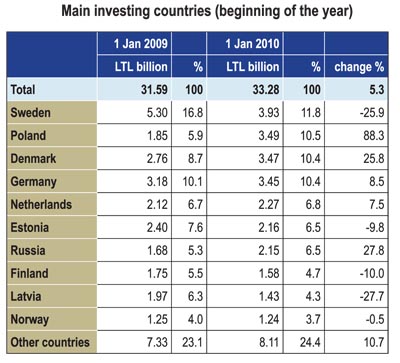
| Budget gathers LTL75.6 mill more than expected | 14 April 2010 |
Vilnius, Apr 13 (ELTA) - Over March this year, the state budget received 1.153 billion litas (€333.8 million), an increase of 75.6 million litas (€21.88 million) from the projected revenues, the Finance Ministry reports. The state budget collected most revenues from value added tax (VAT). Over March, revenues from VAT amounted to 513.4 million litas (€148.633 million) compared with the expected 411 million litas (€118.98 million). Over the said month, revenues of 139 million litas (€40.24 million) were received from income tax as compared to the predicted 130.2 million litas (37.69 million euros). In March 267.4 million litas (€77.41 million) were received from excise duties as compared with the planned revenues of 307.3 million litas (€88.965 million). In March, the state budget collected 1.443 billion litas (€417.76 million) together with the funds of the European Union and other countries. The approved draft budget for 2010 is expected to collect revenues of 21.27 billion litas (€6.157 billion). |
|
| Wages down 8.7% in 2009 | 14 April 2010 |
Statistics Lithuania informs that the average gross monthly earnings in the whole economy (less individual enterprises) in IV quarter 2009 was LTL2118.3 and compared to III quarter 2009 decreased by 1.1%. In IV quarter 2009, average gross earnings in the public sector was LTL2208.9, and against III quarter 2009 decreased by 2.8%; in the private sector – LTL2052.3, and against III quarter 2009 remained almost unchanged from LTL 2051.6. The most notable decrease in average gross monthly earnings in the whole economy in IV quarter 2009, against III quarter 2009, was seen in education (4.3%) and public administration and defence; compulsory social insurance activity (4.1%), of which legislative and executive activities of central administrative institutions was 5.2% (LTL198). Over a year, average gross monthly earnings (IV quarter 2009, against IV quarter 2008) decreased: in the whole economy by 8.7%, in the public sector by 10.4%, in the private sector by 8%. The largest decrease was in construction (20.8%) and public administration and defence; compulsory social insurance activity (18.1%), of which compulsory (state) social insurance activity by 26.6%, real estate operations by 11.8%. IV quarter 2009, the average number of employees was further decreasing (part of employees was on unpaid leave, worked for shorter working time period than that set by law). The average number of employees, against III quarter 2009, decreased in the whole economy by 3.2%, against IV quarter 2008 – by 12.4%, while the number of employees in full-time units decreased by 4.6 and 15% respectively. Average net monthly earnings in the whole economy (less individual enterprises) in IV quarter 2009 was LTL1647.5, in the public sector LTL1713.6, in the private sector LTL1599.3. In IV quarter 2009, against III quarter 2009, average net monthly earnings decreased: in the whole economy by 1%, in the public sector 2.6%, while in the private sector they remained unchanged. Against IV quarter 2008, they decreased: in the whole economy by 7.1%, in the public sector by 8.8%, in the private sector by 6.4%. |
|
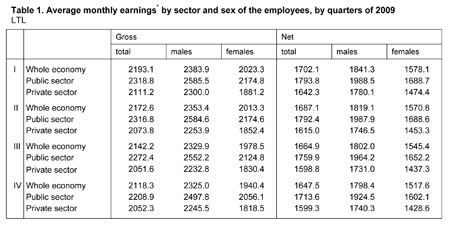
| Balance of Payments narrows in February | 14 April 2010 |
In February 2010, the Current Account Balance on the Balance of Payments of Lithuania recorded a deficit of LTL 36 million. Compared to January (when the deficit on the current account balance was LTL133.2 million), the deficit decreased by LTL97.2 million. In February, the deficit decrease was driven largely by a decline in the foreign trade balance deficit. The deficit on the current account balance for January-February this year totalled LTL169.3 million. In February 2009, the current account balance was in surplus of LTL82.4 million, while in January-February it posted a deficit of LTL187.8 million. |
|
| Moody’s improves rating outlook for Lithuania and Latvia | 14 April 2010 |
Vilnius, Mar 31 (Bloomberg-ELTA) - Latvia and Lithuania, which underwent the European Union’s steepest contractions last year, had the outlooks on their credit ratings raised by Moody’s Investors Service as their economies recover faster than anticipated. The outlook on Lithuania’s Baa1 rating, the third-lowest investment grade, was lifted to stable from negative, Moody’s said in a statement today. The outlook on Latvia’s Baa3 rating was also raised to stable from negative, it said. Ratings companies are lifting outlooks for the region on signs of stabilization. Standard and Poor’s and Fitch Ratings raised their outlooks for the Baltic states of Estonia, Latvia and Lithuania to stable from negative in the past two months on recovery signs and government steps to curb budget deficits. “The Lithuanian economy has stabilized more quickly than previously anticipated, and also faster than the other Baltic countries,” said Kenneth Orchard, a London-based analyst with Moody’s, in the statement. The recession “apparently” ended as early as the third quarter of last year and “this development is expected to have a modestly positive impact on government financial strength through slightly lower budget deficits and less rapid increase in debt.” In Latvia “the worst of the recession has passed, and the fledgling recovery should support the government’s financial strength and the banking sector,” Orchard said. “The prospect of a disorderly currency devaluation is now highly unlikely.” The yield on Lithuania’s 10-year bond maturing in 2020 fell 0.01% to 6.11%. The NASDAQ OMX Riga stock index dropped 1.76% to 321.19 at 11:42 a.m. and the Vilnius NASDAQ OMX stock index fell 0.19% to 311.73. The cost of protecting Lithuanian debt with credit-default swaps rose 2.3 basis points to 225.7 yesterday. Latvia’s rose 2.46 basis points to 368.6, according to CMA DataVision. Latvia turned to a group led by the European Commission and the International Monetary Fund for a 7.5 billion-euro ($10.08 billion) loan in 2008 after taking over its second-biggest bank. The economy contracted 16.9% in the fourth quarter. Lithuanian Prime Minister Andrius Kubilius cut budget spending and increased taxes to save about 9% of GDP last year. Lithuanian real wages fell 7.3% in 2009 from the previous year, the statistics office said on 28 Jan. The Finance Ministry estimates consumer prices may fall 1% this year, after rising 4.2% in 2009. The government’s plans to reduce the deficit below 3% of GDP by 2012 “may be overly ambitious,” Moody’s said. Optimism about an economic recovery in Lithuania is growing after GDP grew for two consecutive quarters from the previous three-month period. The improving economic situation in western European markets is boosting confidence about an export-led recovery. The economy grew a seasonally adjusted 0.5% in the fourth quarter after rising 1% in the previous three months, the statistics office said. In the year, output shrank 12.8%, it said. |
|
| Banks only repossess homes in exceptional cases | 14 April 2010 |
(alfa.lt) The governor of the Bank of Lithuania Reinoldijus Šarkinas said in Seimas on Friday that there were only a few cases when homes were taken away from bank clients. One bank explained: “two people were evicted from their homes due to their bad loans. One case is when the client was imprisoned, another – when a divorcing couple didn’t share their commitments. Another 578 clients were allowed to restructure their loans, to postpone the payments,” Sarkinas said, refusing to name the bank that provided the information. “When restructuring the loan, the bank postpones the term of it, allows the client to suspend payments for a while – it depends on banks,” said Šarkinas, aiming to prove that banks are not depriving their clients of their last shelter. Šarkinas said in parliament in March that banks have not taken a single home from a client and that they have promised not to, if the client is not avoiding his or her commitments malignantly.
|
|

| Airline News | 14 April 2010 |
VNumber of Vilnius Airport passengers up 24% Vilnius, Apr 2 (ELTA) - In March, Vilnius International Airport (TVOU) served 112,700 passengers, an increase of 24% year-on-year. In the first quarter of this year, the volume of passengers at the airport grew by 10% compared with the same period last year. Over Q1 of 2010, compared with Q1 of 2009, the number of flights operating to and from Vilnius Airport rocketed by 20%. The freight volumes at the airport went up 25% annually. “The market is recovering, and this makes an impact on the airport’s results. At the beginning of 2010, new flights to Milan, Berlin, Munich, Paris, Amsterdam, and Rome were launched. The number of flights to Copenhagen has increased. With the summer flight schedule now there are new destinations - Hamburg, Edinburgh, Heraklion, Ibiza, Palermo,” TVOU CEO Tomas Vaisvila said. According to Vaisvila, another wave of new flights is expected in May. There will be more flights to Kiev, Copenhagen, Oslo, Dublin; flights to Girona will be resumed, and new flights to Heraklion, Ibiza and Palermo in the summer. In the first three months this year, the most popular destinations were Copenhagen, Riga, Prague, London, Dublin, Frankfurt, Helsinki, Warsaw, Moscow and Vienna. Vilnius Airport plans to serve 2 million passengers this year. New summer season – new destinations from Vilnius Lithuanian airline company Star1 Airlines has launched a new destination from Vilnius to Edinburg (Scotland). In May the company will start direct flights to Dublin and will renew summer-season flights to Gerona (Spain). The airBaltic company is starting this season with a new flight from Vilnius to Hamburg (Germany); also the company has added flights from Vilnius to Dublin, London (Gatwick) and Tallinn, and since May – to Oslo. The summer season will have more frequent flights from Vilnius. Staring with May, Scandinavian Airlines will fly to Copenhagen three times per week. The company Aerosvit will operate flights to Kiev every day. LOT Polish Airiness will fly to Warsaw twice a day on a daily basis. airBaltic has increased the frequency of flights to Paris and Berlin from 3 to four times per week. Lufthansa has traditionally increased summer flights to Frankfurt – twice per week. Norwegian Air Shuttle will fly to Oslo 3 times per week, and Star1 Airlines from April will operate flights to London six times per week. At present 15 airline companies are operating flights to and from Vilnius to 24 directions. |
|
| Swedbank to issue three times more housing loans than last year | 14 April 2010 |
Vilnius, Apr 8 (ELTA) - In the light of the improving situation in global financial markets and Lithuanian economy starting recovering slowly after the deep recession of 2009, the credit market in the country starts growing again, note Swedbank’s specialists. According to the bank’s press release, the number of housing loans in January-February 2010 increased by almost three times as compared to the same period last year. “In absolute terms this growth is not that high, since in the beginning of 2009 the real estate market was almost stagnant, however, the trend is already visible,” says Head of Swedbank Financing Department Jūratė Gumuliauskienė. According to the bank’s press release, in March, Swedbank started applying more favorable loans’ terms. From now on, the customer who are buying or building housing will have to invest less of their own money, as the bank will finance up to 80 percent of the housing’s value. In 2009, the share financed by the bank stood at up to 70%. “We note that the customers act much more responsibly when taking a loan - they borrow only when they are sure about the stability of their job or financial prospects, they consult more with the bank,” said Gumuliauskienė. The average size of the housing loan stands at around 155,000 litas. Most often, standard flats in new construction homes are bought, and the average loan terms stands at 25 years. |
|
| PKN Orlen to decide on Lithuanian unit in April | 14 April 2010 |
Warsaw, Apr 6 (Bloomberg-ELTA) - PKN Orlen SA, the state-controlled company that is Poland’s largest oil refiner, will decide in April whether to sell its Lithuanian unit, Dziennik Gazeta Prawna reported, without saying where it got the information. The decision by Orlen, which in 2006 bought the refinery now called Orlen Lietuva, depends on talks with Lithuania’s government to help it improve fuel transport after pipeline delivery cuts that year increased the cost of supplies, the newspaper said. PKN wants Lithuania’s railroads to reduce transportation rates, which are higher than the European average, according to Chief Executive Officer Jacek Krawiec. The company also asked the government to rebuild a 19 kilometre track section dismantled in 2008 that would cut the distance to neighbouring Latvia by 80 kilometres, the newspaper said. The company isn’t seeking “special treatment” in Lithuania, Deputy Treasury Minister Mikolaj Budzanowski told the newspaper, adding that Orlen is “discriminated against” in many areas, hurting results. |
|
| Consumer Goods and Services up 0.3% in March | 14 April 2010 |
VStatistics Lithuania informs that prices for consumer goods and services in March 2010, against February, grew by 0.3%. In March 2010, against February, the overall price change was mostly influenced by a 0.7% increase in prices for transport goods and services, and alcoholic beverages and tobacco, 1.1% – clothing and footwear, 0.3% – food products and non-alcoholic beverages, 0.4% – housing, water, electricity, gas and other fuel group of goods and services, as well as by a 0.7% decrease in prices for communication goods and services. Prices for consumer goods over the period in question grew by 0.4%, while those for consumer services remained almost unchanged. The change in prices for the transport group of goods and services was conditioned by a 1.7% increase in prices for petrol, 2.1% – diesel. Liquefied gas for cars went down in price by 0.7%, technical servicing and repair of cars – 0.4%. The price change for clothing and footwear was influenced by an increase – due to the appearance of new spring collections – in prices for clothing (by 1.2%) and footwear (by 0.9%). The price rise for alcoholic beverages and tobacco products was conditioned by a 1.9% increase in prices for beer, 1.2% – wine and wine products. The price change for the housing, water, electricity, gas and other fuels group of goods and services was mostly influenced by a 0.8% increase in prices for hot water and centralised heat supply, 0.9% – materials for the maintenance and repair of the dwelling, 1.1% – solid fuel. As regards other goods and services which conditioned the overall change in consumer prices, the following could be mentioned: a 2.2% increase in prices for package holidays, 2.1% – cosmetics, as well as a 0.9% decrease in prices for furniture, 2% – second-hand cars, 3.5% – vehicle insurance. |
|
| Lithuanian Foreign Trade in 2009 | ||||||||||||||||||||||||||||||||||||||||||||||||||||||||||||||||||||||||||||||||||||||||||||||||||||||||||||||||||||||||||||||||||||||||||||||||||||||||||||||||||||||||||||
Statistics Lithuania reports that, based on non-final data obtained from customs declarations and Intrastat reporting data, exports in December 2009 amounted to LTL3.7 billion, and imports LTL3.8 billion. The foreign trade deficit of Lithuania was LTL0.1 billion, which is 90% less than in the same period of 2008. In December 2009, against November 2009, exports increased by 2.2%, imports decreased by 5.2%; mineral products excluded, exports increased by 2.1%, imports decreased by 1.8%. Exports of goods of Lithuanian origin increased by 2.6%. In 2009, exports amounted to LTL40.7 billion, imports LTL45.1 billion, and the foreign trade deficit amounted to LTL4.4 billion, which is 74.8% less than in 2008. Exports and imports decreased by 26.6% and 38.2% respectively; mineral products excluded, exports decreased by 23.3%, while imports by 38%. Exports of goods of Lithuanian origin decreased by 27.2%, mineral products excluded by 21.9%. In 2009 the most important export partners were Russia (13.2%), Latvia (10%), Germany (9.7%), Poland (7.2%); for imports Russia (30.1%), Germany (11.2%), Poland (10%) and Latvia (6.4%). Key foreign trade partners, 2009
|
||||||||||||||||||||||||||||||||||||||||||||||||||||||||||||||||||||||||||||||||||||||||||||||||||||||||||||||||||||||||||||||||||||||||||||||||||||||||||||||||||||||||||||
| US Economy Chiefs: Kubilius applying appropriate saving policy |
The Lithuanian Government’s measures aimed at cutting the budget deficit were necessary and yielded positive results, said the United States economy and finances chiefs during their meetings with Prime Minister Andrius Kubilius in Washington. The Prime Minister met with Chairman of the United States Federal Reserve, Ben Bernanke, at the headquarters of the Federal Reserve (FED). Later the Prime Minister met with Director of the White House’s National Economic Council, Lawrence Summers, an influential adviser to President Barack Obama. Afterwards Kubilius met with US Secretary of the Treasury Timothy F. Geithner. The Minister of Finance Ingrida Šimonytė and the Prime Minister’s delegation also attended the meetings. Chairman of the FED Bernanke and Kubilius discussed the global economy and shared thoughts on management strategy. Bernanke welcomed the stringent saving measures that helped the Lithuanian Government manage the crisis, as a result of which the country can now expect economic recovery. At the same time he regretted that not all EU member states pursued similarly consistent budgetary policy, and he considered that economic recovery of the entire European Union will be delayed compared to the Asian and the US economies. According to Bernanke, the global economy is to recover at different speeds. He said that the biggest challenge for the US economy is unemployment, which remains high, although some of the major economic indicators show recovery. During the meeting with the Lithuanian Prime Minister, President Obama’s economic advisor Larry Summers projected that the global economic recovery would hardly be homogeneous. In his view the European Union's economic curve will be L-shaped, while that of the US, U-shaped; the Asian economy, however, will be fastest to recover and most likely will take the V shape. T. F Geithner also noted that Lithuania and the other Baltic States had no choice but to take the course of austerity. "This was a difficult, but also brave, responsible and just step by the Lithuanian Government. I admire what your Government did over the last year," said the US Treasury Secretary to the Prime Minister Kubilius. He also noted that some other EU countries showed a lack of commitment as regards to tighter fiscal policy; therefore, the EU economy, unlike the Baltic States, is deemed to recover later. |
| IMF: steps taken by Lithuanian authorities bolstered country’s credibility with international investors |
During his visit to the US, Prime Minister Andrius Kubilius met with John Lipsky, First Deputy Managing Director of the International Monetary Fund (IMF), to review recent economic developments and discuss the prospects for Lithuania’s economy. Lipsky welcomed the adjustment effort already underway, including the substantial fiscal adjustment taken in 2009 and the additional steps taken to reduce spending in the 2010 budget. "In a very difficult environment, the Lithuanian authorities have taken decisive steps that have limited the impact of the international financial crisis and bolstered the country’s credibility with international investors,” Lipsky said at the end of the meeting. Given Lithuania’s goal to adopt the euro in 2014 and reduce the deficit accordingly, Lipsky added that advancing the ongoing adjustment through a permanent reform of the social security system and new measures to enhance revenues will be fundamental. Kubilius thanked the IMF for the long-term constructive co-operation and consultations. The Prime Minister pointed out that the drastic response to the crisis was absolutely necessary. Andrius Kubilius said that Lithuania's economic outlook began to improve at the end of 2009, while 2010 is expected to show growth. The Prime Minister assured that the Lithuanian authorities would continue to implement all measures necessary to ensure sustainable economic recovery. In 2010, special attention will be given to structural reforms and measures aimed at bolstering economic growth and employment with due consideration to the most vulnerable groups of society. |
| European Parliament approves support for Lithuanian workers |
Strasbourg, Mar 9 (ELTA) - Over 1,280 people who have lost jobs in Lithuanian construction companies and the refrigerator manufacturing industry will benefit from the European Globalisation Adjustment Fund (EGF). This decision was adopted by the European Parliament (EP) on Tuesday. The support from the Globalisation Adjustment Fund was also allocated to the former workers of the German Karmann car company. To finance the EGF support, money will be transferred from the European Social Fund's budget. |
| Income will not increase for another 3 years |
Vilnius, Mar 9 (ELTA) - The alternative Government programme, presented on Tuesday, states that there is a need to fight against the crisis by investing in the creation of new jobs, the promotion of business and consumption, and ensuring social guarantees. Currently, the political parties that presented the alternative programme have 53 mandates in the Seimas. |
| Money allocated to IAE closure spent, but nothing done - Ciuksys |
Visaginas, mar 9 (ELTA) - One billion euros was allocated to the closure of the Ignalina Nuclear Power Plant, however, nothing was done. The new IAE Head Osvaldas Ciuksys will only be able to show the EU auditors the poured concrete. "2013 is the real date, however, the end of constructions might be postponed even longer. Some works should have been started this autumn, however they were not," said Ciuksys. |
| Lithuania's rating outlook raised by Fitch on fiscal policy |
March 8 (Bloomberg-ELTA) - Lithuania, which suffered the European Union's second-worst recession, had the outlook on its credit rating raised by Fitch Ratings after the government implemented an austerity program to curb the budget deficit. Lithuania raised its forecast for the economy this year on 1 Feb, predicting a 1.6% expansion, compared with a previous forecast of a 4.3% contraction. |
| Survey of Lithuanian Economy |
The latest – 25th – survey of the Lithuanian economy was conducted in January 2010. Its results demonstrate more optimism than five months ago, as compared to the previous survey of September 2009. Nonetheless, the optimism is modest and participants expect that the Lithuanian economy will continue to contract and the rate of unemployment will rise in 2010. Major Findings: Market participants are more optimistic now than they were in September 2009. However, the optimism is very modest. Market participants predict that the Lithuanian economy will continue to contract in 2010, with unemployment on the rise. The country’s economy will continue to contract insignificantly in 2010 – GDP will decline by 1%. Market participants polled by LFMI think that Lithuania’s GDP went down by 14.5% in 2009. While evaluating the forecasts of GDP growth and corporate financial indicators in relative terms, it is important to consider the base effect. The Lithuanian economy shrank by nearly 15% in 2009, and a 1% drop in GDP in 2010 has been projected keeping in view the markedly contracted GDP base in 2009. Therefore, GDP will go down very negligibly in 2010 compared to the year before, but the volume of GDP will be much smaller than that before the economic crisis. Equally, although company financial indicators are projected to improve in 2010 in relative terms, the improvement in absolute terms (in Litas of profit, in Litas of invested capital and the like) will be very negligible since relative indicators are calculated from a diminished base of return on equity, income or profit. Market participants think that the situation in the Lithuanian labour market will deteriorate further. According to the survey unemployment stood at 15.2% last year and will rise to 17.1% in 2010 (in September 2009 the LFMI respondents projected that unemployment would be 15.3% in 2010). Experts polled by LFMI think that 35% of the unemployed were unable to find jobs in 2009 as a result of factors not related with economic decline. Fifteen percent, or 40,000 jobless people could have found jobs last year if the minimum wage had been slashed and labour regulations loosened. The survey predicts exports will continue to grow at a higher rate compared to imports. Market participants forecast imports will grow by nearly 2% in 2010 and exports will edge up by 5.3%. A negative GDP forecast and the projected five-percent export growth indicate that market participants anticipate a faster recovery of foreign markets compared to the Lithuanian market and see exports as the course for the recuperation of the Lithuanian economy. The LFMI survey shows that illicit activity remains an acute problem of the Lithuanian economy. According the survey the share of the shadow economy in GDP accounted for 23% in 2009. The share of the shadow economy is expected to increase in 2010, accounting for about 27% of GDP. The LFMI respondents reported that 37% of businesses were involved in illicit activity in 2009, and a total of 42% of the Lithuanian enterprise will go off the books in 2010. The rapidly expanding shadow economy can be related to both the worsening economic situation and an improper economic policy which lacks necessary reforms. The regulatory burden on companies increased in 2009. Market participants think that the regulatory burden increased by nearly one-tenth (about 8%) last year. The growing tax burden is among the causes of the swelling shadow economy. As the LFMI survey shows, the tax burden was as much as 37% of GDP in 2009. Market participants believe that the tax burden will continue to grow, constituting 38% of GDP in 2010. Household finances will deteriorate in 2010 compared to 2009. According to the survey, average personal earnings will decline, household savings will decrease in line with falling household income and households will spend less money on consumer durables. The LFMI survey shows average net earnings amounted to about LTL1,620 per month in 2009, a nearly 10% slide compared to 2008. Market participants believe that average net earnings will continue to drop, by 6.5%, to LTL1,514 Litas per month in 2010. According to the survey, the year 2010 will be more auspicious to companies than the previous year. Market participants believe that the profit margin and the return on equity averaged 2% and 4% respectively in 2009. They expect that both the profit margin and the return on equity will increase and average 3% and 5.2% in 2010. According to the LFMI survey, the price of borrowing will go down in 2010 compared to 2009. Market participants think that interest on loans in litas was between 8.5 and 9% in 2009. |
| Total nights spent in EU hotels fell by 5% in 2009 |
In 2009, nearly 1.5 billion nights were spent in hotels and similar establishments in the EU27, a decrease of 5.1% compared with 2008, after an annual change of -0.2% in 2008 and +3.5% in 2007. The number of hotel nights spent by residents in their own country in 2009 fell by 1.6% and hotel nights spent by non-residents fell by 9.1%. The decline in the number of hotel nights in the EU27, which began in the middle of 2008, slowed down during 2009. The number of hotel nights fell at an annual rate of 8.0% in January-April 2009 (compared with the same period of the previous year), of 4.1% in May-August and of 3.6% in September-December. These estimates, which include nights spent whether for business or leisure, come from a publication from Eurostat, the statistical office of the European Union. Change in number of hotel nights varied in 2009 from -23.3% in Latvia to +0.1% in Sweden Amongst the Member States, the highest numbers of nights spent in hotels in 2009 were recorded in Spain (251 million nights (mn), -6.5% compared with 2008), Italy (238 mn, -4.3%), Germany (216 mn, -1.4%), France (191 mn, -5.6%) and the United Kingdom (170 mn, -1.7%). These five countries accounted for more than 70% of the total number of hotel nights in the EU27. The number of nights spent in hotels in 2009 fell in all Member States, except Sweden (+0.1%). The largest decreases were recorded in Latvia (-23.3%), Lithuania (-20.4%), Cyprus (-19.7%) and Slovakia (-18.1%), and the smallest in Germany (-1.4%), the United Kingdom (-1.7%), Slovenia (-2.1%) and Austria (-2.9%). |
| Ryanair is expanding and considers flights from Vilnius |
The Minister of Transport and Communications, Eligijus Masiulis and the Manager of the Ryanair, Michael O‘Leary, announced an agreement on the base of which the first Ryanair depot will be established in the Middle Europe. Ryanair is also increasing the number of direct flights from Kaunas, and in general 18 European airports will be accessible from Kaunas. Ryanair is also considering plans to begin flights from Vilnius and Palanga. The new aviation depot in Kaunas will be the first Ryanair depot in the region of Middle Europe (Poland, Lithuania, Latvia, and Estonia), and the 40th in the world. Ryanair is planning to build an airplane hangar in Kaunas, and 120 flights per week are planned by Ryanair from this depot. |
| Orlen Delays Asset Sales as Earnings Ease Pressure |
Brussels, Feb 25 (Bloomberg-ELTA) - PKN Orlen SA, Poland's largest oil refiner, said better than expected fourth quarter earnings and lower debt helped it fulfil loan agreements, relieving the pressure to sell assets. Earnings before interest and taxes, or Ebit, of 333.7 million zloty compared with a 4.33 billion-zloty loss a year earlier, which was mainly caused by falling oil prices and impairment charges on Lithuanian refining assets, the Plock, Poland-based company said. That compares with the 319.5 million- zloty median estimate of 10 analysts surveyed by Bloomberg. Earnings were boosted by a 112 million-zloty profit from selling carbon-dioxide emission rights and 163 million zloty from an increase in value of oil stored in the company's tanks as crude prices rose, the company said in the statement. Orlen's net debt decreased 18% to 10.3 billion zloty at the end of 2009 from a year earlier, helping the company meet requirements set by banks in loan agreements and easing the pressure to sell chemical unit Anwil SA and a stake in Poland's largest mobile phone company Polkomtel SA. "The sales have been pushed back in time somewhat, but Orlen can't avoid selling the stakes, because the issue of debt covenants may return in the middle of the year," Monika Kalwasinska, an analyst at PKO Bank Polski SA in Warsaw, said by phone. "Everything will depend on conditions on the oil and currency markets,” she said. |
| Lithuanians slightly more optimistic about economic situation in February |
Vilnius, Feb 25 (ELTA) - In February this year, Lithuanian residents are more optimistic about economic prospects: fewer residents predict deterioration of the economic situation and a high increase in unemployment. The number of people predicting deterioration of their household financial situation and people not hoping to save money over the next 12 month decreased. The Department of Statistics reports that in February 2010, the consumer sentiment index stood at -40, an increase of 5 percentage points as compared to January, and 10 percentage points as compared to December. In February, 2% of the population said that their household financial situation has improved over the past year, 70% indicated that the situation has deteriorated, while 29% of the population felt that their household's financial situation did not change during the year (in January. - 3, 63 and 34%). In assessing the changes of their family financial situation over the next 12 months, 9% of the population indicated that it expected improvement, 46% expected deterioration (in January - 9 and 55% respectively). 41% felt that their household financial situation will remain unchanged over the next year. When evaluating the economic situation in the country, 88% of respondents said that it deteriorated over the past year, 1% indicated that the situation has improved, and 11% of the respondents said that the economy had been stable over the past 12 months (in January - 89, 1, and 9% respectively). In February, 14% of the respondents expected the economic situation in the country to slightly improve over the nearest 12 months, 50% indicated that things would get worse. Among those polled, 32% were confident that the general economic situation in the country would remain stable (in January - 13, 58 and 26% respectively). Among those polled 84% predicted an increase in jobseekers, compared to 88% in January. |
| Average monthly earnings down 8.7% |
Vilnius, Feb 24 (ELTA) - In Lithuania, average monthly gross earnings dropped by 8.7% overall, 10.4% in the public sector and 8% in the private sector over the past year (Q4 of 2009 compared with Q4 of 2008). The Department of Statistics reported on Wednesday that monthly earnings mostly decreased in the construction sector (20.8%) and public administration and defence services, compulsory social security services (18.1% each). |
| Implementation of Rail Baltica to start in early summer - Telicka |
Vilnius, Feb 23 (ELTA) - Finance from European Union funds will be allocated to the international Rail Baltica project and construction work is due to begin as early as this summer, Pavel Telicka, Rail Baltica project co-ordinator appointed by the European Commission, said at a meeting with Transport Minister Eligijus Masiulis on Tuesday. In the brief news conference Minister Masiulis said that he discussed with Telicka the specific steps in the reconstruction of the railway line from the Lithuanian and Polish state border to the Kaunas logistics centre. The project is scheduled to be completed by 2013. It was decided to reconstruct the existing railway line from Poland to Kaunas rather than build a new Rail Baltica line. In this way the costs will be almost halved - the line will cost about LTL800 million (€231.6 million) instead of LTL2 billion (€579 million). However the train speeds will not be very high in this section - only about 90 kph - but it is said to be sufficient for freight trains. |
| Fortum to build waste energy plant in Lithuania |
Helsinki, Feb 23 (ELTA) - Fortum Corp will build the first waste energy plant in the Baltic states, in a €140 million deal with Lithuania's Klaipedos Energija, The Associated Press cited the Finnish utility on Tuesday. The combined heat and electricity power station will be situated in the Lithuanian port city of Klaipeda and is expected to be online by January 2013. It will use municipal and industrial waste and biomass as fuel. The plant's heat output will be 50 megawatts and it will produce 20 megawatts of electricity. Fortum, the Nordic region's second largest power company with operations in the Nordic countries, Russia and the Baltic states, is 51% owned by the Finnish government. It employs 11,500 people. |
| airBaltic to operate flights from Lithuania to Riga 12 times a day |
Vilnius, Feb 23 (ELTA) - As of the beginning of its summer flight season, the Latvian airline airBaltic will operate flights from Lithuania to Latvia 12 times a day. At the end of March an additional day route from Kaunas and Palanga airports and one route from Vilnius will be presented. In the new season airBaltic planes will fly three times a day from Kaunas and Palanga airports and in Vilnius airport the airline will offer six routes a day. At present, airBaltic operates direct flights to Amsterdam, Berlin, Copenhagen, Munich, Paris, Riga, and Rome. As of 4 March direct flights to London will be launched. In the coming summer season, the airline will offer flights to Dublin, Hamburg, Manchester, Oslo and Tallinn. |
| Lithuanian unemployment rate reaches 15.6 pct in fourth quarter |
Luxembourg, Feb 23 (Bloomberg-ELTA) - Lithuania's unemployment rate rose in the fourth quarter to the highest in at least six years as the economy struggled through its worst recession in two decades, a labour-force survey showed. The jobless rate rose to 15.6% from 13.8% in the previous three months, the Vilnius-based statistics office said in a statement today. The rate was 7.9% in the same period last year. Unemployment is rising after the Baltic state's economy contracted 13% in the fourth quarter. Weakening domestic demand and the stalled construction industry are prompting businesses to cut jobs. For all of 2009, the unemployment rate rose to 13.7% from 5.8% in 2008, the statistics office said. |
| Seimas Committee to evaluate activities of Bank of Lithuania |
Vilnius, February 22 (ELTA) - The Seimas Committee on Budget and Finance intends to carry out a parliamentary investigation to evaluate the activities of Bank of Lithuania over the period of 2004-2009. Chairman of the Seimas Committee on Budget and Finance Kestutis Glaveckas proposed to investigate the activities of the Bank of Lithuania. His initiative has been supported by the Seimas and members of the Seimas committee, thus, the investigation should be launched soon. Chairman of the Board of the Bank of Lithuania Reinoldijus Sarkinas welcomed the intention to investigate the activities of the institution he heads. He said he is ready to co-operate with the Seimas Committee on Budget and Finance. "We will provide any information requested," assured Sarkinas. He abstained from more detailed comments. According to Glaveckas, the main objective of the investigation is the implementation of parliamentary control. It is intended to hear the annual activities report of the Bank of Lithuania for the period of 2004-2009, to find out whether the regulation of commercial banks was successful. Representatives of the Bank will be asked to tell what measures were taken to combat the economic bubbles, and what proposals were submitted to the Government. Having examined the information received, members of the Seimas Committee on Budget and Finance shall decide where the Bank of Lithuania carried out its duties properly, and having formulated the conclusions, they shall provide suggestions on how to improve the activities of this institution. According to Deputy Chairman of the Seimas Committee on Budget and Finance Vitas Matuzas, such parliamentary investigation is necessary. He hopes that the investigation will help to answer the question whether the Bank of Lithuania has made every effort to avoid the current difficult economic situation. |
| Lithuania to be part of the US temporary worker visa program |
On 22 January 2010, Secretary of Homeland Security Janet Napolitano designated Lithuania as one of 11 new countries whose citizens are eligible to participate in the H2-A and H2-B non-immigrant visa programs. These programs allow U.S. employers to bring foreign nationals to the US to fill temporary or seasonal jobs for which American workers are not available. Before applying for a temporary worker visa at a US Embassy, applicants must obtain an approved petition from the Department of Homeland Security (DHS). The petition must be submitted by the applicant’s prospective employer to DHS no earlier than 6 months before the proposed employment start date.For more information about the H2-A or H2-B visas please visit the US Embassy website at: http://vilnius.usembassy.gov/non-immigrant_visas.html under “Information for Temporary Workers” link. |
| Five companies tender for new nuclear power plant |
• Photo: Kęstutis Jankauskas (ELTA) Vilnius, Feb 1 (ELTA) - The Lithuanian Ministry of Energy has chosen five potential strategic investors that could participate in the building of the new nuclear power plant. According to Minister Arvydas Sekmokas, 25 energy companies expressed an interest in the project. In April all five selected companies are to submit non-binding proposals for participation in the building of the new nuclear power plant. It is planned that by the middle of summer only two companies will remain, and finally, one strategic investor will be chosen. Sekmokas did not reveal which five companies were selected after the first round because of confidentiality agreements. The key criteria for a strategic investors was experience in the nuclear sector, the execution of big energy projects and financial requirements. According to Sekmokas what technology will be used in the Visaginas plant will only become clear after the investor is chosen. It is planned that the strategic investor will be offered 51 percent of the nuclear power plant shares. The new nuclear power plant will cost €3-5 billion. |
| E-commerce accounted for 12% of turnover in EU27 in 2008 |
In January 2009, 93% of enterprises with ten or more employees had access to the internet in the EU27 and 82% had a broadband internet connection. Among other uses, internet access ena-bles enterprises to buy and sell products electronically: in the EU27 in 2008, 12% of turnover was generated from e-com-merce, according to Eurostat.Almost all enterprises in Finland, Denmark, Austria and Slovakia have internet access In January 2009, the highest proportion of enterprises with internet access in the EU27 were recorded in Finland (100%), Denmark, Austria and Slovakia (98%) and Germany (97%). The percentage was less than 90% in only six Member States: Romania (72%), Bulgaria (83%), Latvia and Hungary (87%), Cyprus (88%) and Greece (89%). The proportion of enterprises with a broadband connection in January 2009 was above 90% in Finland (94%), Spain and Malta (93%) and France (92%). Only in Romania (40%), Lithuania (57%) and Poland (58%) did less than 60% of enterprises have a broadband connection. |
| Economics by Numbers |
|
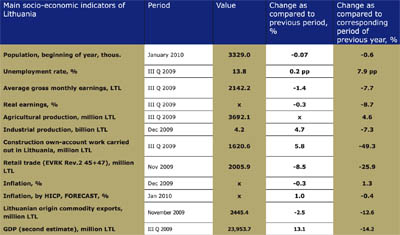
| On the job front |
How well-equipped are European companies to meet the challenges of global competition and the recent recession? The 2009 European Company Survey provides some clues. Eurofound an EU research agency based in Dublin, surveyed 27,000 public and private-sector employers across the 27 EU countries and Croatia, Turkey and the former Yugoslav Republic of Macedonia. The main results are not due out until March. But the first findings show many companies use hiring, pay and work policies that are flexible - that is to boost their ability to respond to changes in the business climate. Labour market flexibility is a key element of the EU’s strategy for making Europe more dynamic and competitive. About two out of three companies use freelancers or other forms of temporary help, and more than half employ at least one person on a fixed-term contract. Part-time work has also become more widespread. Two-thirds of the companies questioned offer part-time work but part-timers in highly skilled positions are still uncommon. Just over a third of employers offer performance-related pay, while just 14% of the private firms surveyed have profit-sharing schemes. Flexibility cuts both ways. About 56% of European companies now let employees vary their work hours to suit personal schedules - up from 48% five years ago. |
| Moog’s Research and Technology Development Centre to be Established in Lithuania |
The U.S. company Moog Medical Devices, which owns the Lithuanian company Viltechmeda, will invest an-other €4 M in Lithuania to establish its major European scientific research and technology development centre in the nearest future. Moog Medical Devices will employ 50 Lithuanian professionals in the new establishment based in the science and business valley Santara located in the capital city. The centre will focus on the development of medical technologies and innovations. Moog Medical Devices, a part of the international Moog Inc group, acquired a 100% holding of the Lithuanian com-pany Viltechmeda for €15 M in January 2009. |
| Ūkio bankas issues fixed-rate bond issue in euro |
From 22 January to 19 February of this year Ūkio bankas will offer medium-term (369 days) bonds in euro with the fixed annual return of 5%. The nominal value of one bond is EUR 100. The accrued interest will be paid at maturity on 24 February 2011. Ūkio bankas bonds will be available from all the bank’s branches and units, as well as from the electronic banking system Eta bankas. |
| Swedbank economic predictions |
According to the forecasts of Swedbank analysts, the economic recession in Lithuania is to be over in the second half of 2010; however, the rate of recovery will depend on the situation in export markets and on the government’s ability to manage the growing debt and reduce taxes. Although in the second half of the year the economy is expected to grow, the country’s GDP this year will balance at the level of 2009. In 2010, the unem-ployment rate will reach its peak; while exporters will recover gradually, busi-ness oriented to domestic consumption will continue to experience the burden of the crisis. In 2011, the country’s GDP is expected to grow by a modest 3%. These forecasts are given in the most recent macroeconomic overview of Sweden and Baltic states prepared by Swedbank. |
| Three Lithuanian Success Stories |
Some of the most innovative projects of the European Union Structural Funds will be presented during the RegioStars 2010 Awards in Brussels. Lithuania is represented by three success stories: Computer literacy training by Association Langas į ateitį, social integration in the restaurant Mano Guru and website www.esparama.lt The RegioStars awards are given for the most successful EU-funded projects which are being implemented by applying the best ideas, progressive and innovative methods. These awards are made by the European Commission. 87 projects from 27 EU Member States were nominated for RegioStars 2010 Awards. The RegioStars Jury chose 24 finalists, who presented their projects 27 January. “Computer Literacy Basics for Lithuanian E-citizens” implemented by “Langas į ateitį”, the work rehabilitation project initiated by Public Institution Social Assistance Projects implemented along with a popular salad bar Mano Guru in Vilnius, and EU structural assistance website www.esparama.lt were established during the 2004–2006 financing period and have not only reached their goals and met the criteria established by the RegioStars Jury, but also are unique due to their wide scope, continuity, popularisation of partnership ideas and created value added. The project designed for modern social rehabilitation being implemented in salad restaurant Mano Guru in Vilnius has been nominated for RegioStars 2010 Award category “City Star: the integration of migrants or marginalised groups in urban areas”. The oasis of healthy food opened in Vilnius five years ago distinguishes itself not only for its healthy food , but also for its staff. Some of the staff of Mano Guru have successfully overcame dependence and undergo work rehabilitation – the integrated rehabilitation method is highly popular abroad, but only recently introduced in Lithuania. In 2009 Mano Guru was voted the most hospitable café in Vilnius. In the Information and Communication category the project implemented by Langas į ateitį has been selected. In the name of one goal to provide fundamentals of computer literacy to economically active residents of Lithuania – it developed partnerships between the government and the leaders of Lithuanian telecommunications, banking and internet business. During the project implementation computer literacy fundamentals were provided to 50,400 adults. In RegioStars 2010 Information and Communication category “Websites offering quality information and showing the European added-value” the EU structural assistance website www.esparama.lt has been nominated, which is administered by the Ministry of Finance and 14 other EU assistance administering institutions. This website is the basic source of information on EU structural assistance to Lithuania updated on daily basis. One more project which will participate in the presentation by the finalists is INTERREG project “Establishment of Multi-centres in Marijampolė and Olshteen” being implemented by Lithuania together with Poland, which aims at instalment of computer rooms and e-libraries in public libraries of the aforementioned towns. The basic operator of this project is the public library of Olshteen in Poland and the partner of the project is public library of Petras Kriaučiūnas in Marijampolė. The Awards Ceremony will take place in May 2010 in Brussels. |
| First Solar Cell Factory Opens in Vilnius |
The first solar cell production line was opened in Vilnius on 26 January. Modernios E-technologijos (MET) and Precizika Metrology (PM) invested €2.9 million into the project. Dainius Kreivys, the Minister of Economy, participated in the opening of the production line and expressed his hope that this was the birth of the totally new sector in Lithuania’s economy, which could grow into a significant industry and would become a pillar of growth. “It is estimated that the clean-tech sector is creating seven times more of added value than traditional industries. I hope that this investment will become a great example of how high technology is becoming an every day reality in Lithuania’s industry,” said Mr. Kreivys during the opening ceremony of the factory. According to Precizika Metrology CEO Algimantas Barakauskas, it is estimated that the line should generate about €5.8 million in the annual revenue, even though the 2010 revenue might reach €2.9 million. |
| Airline News |
New Flights from Star1 From 28 March 2010, Star1 will offer direct flights from Vilnius to Edinburgh on Thursdays and Sundays, and from 7 May on Fridays and Sundays. Star1 will also be adding a direct Girona flight in May, on Thursdays and Sundays, and will resume its Dublin – Vilnius service on Tuesdays, Thursdays and Saturdays from 29 May. airBaltic and Reval Hotels Join Forces in Co-branding airBaltic and Reval Hotels have announced extended co-operation. The companies will join forces under the “Reval Hotels, Member of airBaltic Hotels” brand, in order to differentiate and better promote their services and high standards. This kind of co-branding exercise is the first of its scale in the region, and leverages business for both companies in the Baltic region, Russia, Scandinavia and Western European markets. Customers of both companies will have an opportunity to experience seamless and high quality travel service. Both companies will reciprocally market each others services. Star1 Holidays reaches turnover of 24m litas in H1 Vilnius, Jan 19 (ELTA) - Star1 Holidays, the new tour operator which entered Lithuania’s tourism market in the middle of last year, served over 15,000 clients in its first six months of activities in Lithuania. The company reached a turnover of LTL24 million (€6.9528 million). According to Star1 Holidays communications head Jurate Rupšienė, the most popular resort in 2009 was Turkey which accounted for 43% of Star1 Holidays destinations. Greece was next at 21%, 20% travelled to Egypt and the remainder chose resorts in Spain, Bulgaria and Tunis. Presently, the company has about 30% market share in Lithuania. Number of passengers served by Lithuanian airports down this year Vilnius, Jan 22 (ELTA) - In 2009, the number of passengers arriving and departing from Lithuania’s airports was 1.9 million, a decrease of 26.8% year on year. According to the Department of Statistics, the majority of passengers were from the United Kingdom (17.1%), Latvia (12.6%), Germany (9.9%), Ireland (8.5%) and Denmark (8.9%). Compared to 2008, the number of passengers going to and from Latvia increased almost three fold due to changed flight scheduling. The number of passengers going to and from the United Kingdom decreased by 10.2%, Denmark by 25%, Germany - 28.7%, Ireland - 32.8%. In 2009, Lithuanian airlines transported a total of 675,000 passengers, a decrease of 41.9% year on year. airBaltic to Launch Four New Routes from Vilnius airBaltic will launch new flights from Vilnius to Dublin, Hamburg, Manchester, and Oslo, thus offering already 13 direct flight routes from Vilnius. airBaltic will start direct flights to Dublin on March 29, to Hamburg on March 30, and to Manchester on March 31. The airline will operate the first flight to Oslo on May 17. Tero Taskila, Chief Commercial Officer of airBaltic: “After profitable year 2009 and with a positive outlook for 2010, airBaltic is expanding the network of direct routes from Vilnius to strengthen our position in Lithuania.” |
| New Loans to Help Lithuanian SMEs |
EIF and Šiauliu Bankas signed an agreement under which Šiauliu Bankas will provide loans worth €40 million (over LTL138 million to) Small and Medium sized Enterprises (SMEs) in Lithuania. Šiauliu Bankas will manage the newly created Funded Risk Sharing product under the JEREMIE initiative, designed to stimulate lending from banks to SMEs over a two year period. The EIF will provide €20 million to Šiauliu Bankas, which will be matched by an equal amount from the bank, therefore totalling €40 million. This transaction enables Šiauliu Bankas to accelerate lending to Lithuanian SMEs during the current economic recession. Richard Pelly, Chief Executive of the European Investment Fund stated: “This agreement is very good news for Lithuanian SMEs and will enable increased lending to this important sector of the economy. “Šiauliu Bankas was chosen to implement this initiative following a detailed selection process. It is the only local bank in Lithuania to be selected for this purpose which reflects the strength of its management and its ability to provide enhanced access to finance for SMEs. Šiauliu bankas will begin lending to Lithuanian enterprises in the first quarter of 2010 with an expectation that the full amount will be lent within a two year period. About JEREMIE JEREMIE (Joint European Resources for Micro to Medium Enterprises) is a joint initiative launched by the European Commission (DG Regional Policy) and the European Investment Bank group to improve access to finance for SMEs in the EU within the Structural Funds framework for the period 2007 - 2013. |
| Eastern Europe is the wrong label - The Economist |
London, Jan 29 (LETA-ELTA) - The economic downturn has made it harder to speak sensibly of a region called “Eastern Europe”, The Economist wrote. It was never a very coherent idea and it is becoming a damaging one, the article says. “Eastern Europe” is a geographical oddity that includes the Czech Republic (in the middle of the continent) but not Greece or Cyprus (supposedly “western” Europe but in the far south-east). It makes little sense historically either: it includes countries (like Ukraine) that were under the heel of the Soviet empire for decades and those (Albania, say) that only brushed it. Some of those countries had harsh planned economies; others had their own version of “goulash communism” (Hungary) or “self-managed socialism” (Yugoslavia). The nearly 30 states that once, either under their own names or as part of somewhere else, bore the label “communist” now have more differences than similarities. Yet calling them “Eastern Europe” suggests not only a common fate under totalitarian rule, but a host of ills that go with it: a troubled history then; bad government and economic misery now. The economic downturn has shown how misleading this is. Worries about “contagion” from the banking crisis in Latvia raised risk premiums in otherwise solid economies such as Poland and the Czech Republic - a nonsense based on outsiders’ perceptions of other outsiders’ fears. Ten “eastern” countries that joined the EU are in so bad a mess. They include hotshots and slow-coaches, places that feel thoroughly modern and those where the air still bears a rancid tang from past misrule. Slovenia and the Czech Republic, for example, have overhauled living standards in Portugal, the poorest country in the “western” camp. Neither was badly hit by the economic downturn. Together with Slovakia, Slovenia has joined the euro, which Sweden, Denmark and Britain have not. Estonia - at least in outsiders’ eyes - is one of the least corrupt countries in Europe, easily beating founder members of the EU such as Italy. Ten countries that joined in the big enlargement of 2004 and in the later expansion of 2007. They are a mixed bunch, ranging from model EU citizens such as Estonia (recently smitten by a property bust, but all set to gain permission this year to join the euro) to Romania and Bulgaria, which have become bywords in Brussels for corruption and organised crime respectively. Eight of them (Romania and Bulgaria are the exceptions) have already joined Europe’s Schengen passport-less travel zone. Most (Poland is a big, rankling exception) also have visa-free travel to America. Four countries - Poland and the three Baltic states - worry a lot about Russian revisionism (or revanchism). Hungary, the Czech Republic and Slovakia are concerned too, but more about energy and economic security than military sabre-rattling. Yet elsewhere, in the former Yugoslavia for example, such fears seem mystifying and even paranoid. The new and future members also share capital-thirstiness. All need lots of outside money (from the EU’s coffers, from the capital markets and from foreign bank-lending) to modernise their economies to the standards of the rest of the continent. But the usefulness of the “new member state” category is clearly declining as the years go by. Oxford University still has a “New College” which was a good label in 1379 to distinguish it from existing bits of the university. It seems a bit quaint now. Poles, Czechs, Estonians and others hope that they will drop the “new” label rather sooner, so that they can be judged on their merits rather than on their past. |
| Record cargo loaded at Klaipėda in December |
Klaipėda, Dec 31 (ELTA) - According to estimates, the second best result of cargo loaded at Klaipėda seaport in the history of the port was achieved in 2009 - 27.7 million tonnes of sea cargo. According to the communication report of the Klaipėda State Seaport Authority, the volume of cargo at the seaport loaded since May exceeded expected results as well as the results of 2008. The amount of cargo loaded in 2009 was higher by 4.1% than in the strategic plan of activities of the Klaipėda State Seaport Authority for 2009-2011. A record volume of cargo was loaded at Klaipėda in December 2009. Even before the end of the month, 2.62 million tonnes of sea cargo were loaded, an increase of a fifth (20.4%) compared to December 2008. |
| EU Budget 2010: investing to restore jobs and growth |
The 2010 EU budget will see jobs and the economy top spending. Over €64bn (or 45%) of the €141bn of EU funds will go on measures linked to research, education and innovation. Research funding will grow by nearly 12% (€7.5bn) and energy and transport by more than 10% (€2bn). Financing for strategic energy projects, broadband in rural areas and cash to help rural communities cope with new challenges in agriculture will also provide a welcome boost to Europe’s economy with the final €2.4bn of the €5bn European economic recovery plan being secured for 2010. Agricultural spending will continue to be stable next year at nearly €44bn with over €14bn (+2.6%) to promote rural development and additional emergency aid of €300m to help milk producers. The biggest increase in EU spending in 2010 will be for projects to fight crime, terrorism and manage migration flows, with this area growing by 16.2% on 2009 to almost €1bn. Speaking in the European Parliament after the vote on the 2010 EU budget, Algirdas Šemeta, EU Commissioner for Financial Programming and Budget said: “The 2010 budget is a recovery budget. It’s about getting ready for better times, maintaining jobs, stimulating growth”. Speaking to the media Commissioner Šemeta added: “Despite the difficult economic situation, the 2010 budget guarantees the financial resources to keep EU programmes on track and focused on areas linked to recovery. The fastest growing areas are the ones most geared to an upturn like innovation, research or the financing of energy links, where spending is increasing faster than the budget itself .” Boosting the integration of the EU-12 into cohesion policy Cohesion funding will grow in 2010 with €49.4bn going directly to the EU-27, a 2% rise compared to 2009. The trend to phase-in funding for the Member States that joined the EU in 2004 and 2007 (EU-12) will continue and, for the first time ever, these countries will receive the biggest share of the EU’s Cohesion and Structural Funds (52%). The European Social Fund will account for €10.8bn in 2010 to support people and businesses helping 9 million companies and citizens through training and education programmes. |
| Lithuanian economic sentiment declines on austerity measures |
Vilnius, Dec 31 (Bloomberg-ELTA) - Lithuania’s economic sentiment fell in December for a third month, a survey showed, after lawmakers approved further austerity measures for next year. The confidence index, which measures expectations for manufacturing, construction, retail and service industries as well as gauging consumer sentiment, fell to -33 from -31 in November, the Department of Statistics said on its website on Thursday. The rate was -36 in December 2008. Lithuania is coping with the worst recession since the early 1990s when the country gained independence from the Soviet Union and switched to a market economy from a central planning system. The government has introduced spending cuts equivalent to about 8% of estimated gross domestic product this year, stifling demand for goods and services. The industrial confidence index fell to -32 from -31 in November, while the services confidence index dropped to -13 from -8 in the previous month, the statistics office said. Retail confidence worsened to -42 in December from -35 in the previous month. Consumer confidence rose to -50 from -51 in November. |
| Lithuanians no Scrooges over Christmas |
According to figures from Maxima, the Christmas and New Year food sales for this year were 10% down on last year, but this was not as much as most Lithuanians themselves had forecast. There was an increase in sales of products used for cooking at home, and presents tended to be more practical. Shoppers treated themselves to products like fresh fruit, vegetables, sweets and sparkling wine. “Comparing this year’s festive season to last, our takings were down 14%, but this was still a better result than expected. Even though people were planning to save more over the holidays, it seems once they got around to shopping they couldn’t help treating themselves and their loved ones. There was also an increase in sales of special products of which a percentage of the sale price goes to the disadvantaged in our society,” said Saulius Jonaitis, Maxima LT Marketing and Sales Director. The sale of eggs rose 14% in the holiday season, while margarine, mayonnaise, chocolate and other sweets sold at the same rate as last year. The sale of fresh fish was down 10% and fresh meat was down 8%, nuts down 30%, prepared cakes and sweets down 27%, marinated and preserved products down 20%. Over New Year the sale of fresh fruit and vegetables rose 20%, while the sale of processed meat for platters and baked dishes rose by a factor of ten. Cheaper presents were most popular; items like household goods, cooking implements, hair care products and cosmetics were big sellers. The sale of lottery tickets rose 9% before Christmas and 23% before New Year. The sale of books rose 20%. Alcohol sales were down 16% and Maxima said they noted that there were higher sales of wines and less of strong spirits. Leading up to New Year there was a 6% increase in the sale of cheaper sparkling wine. |
| Airline News |
Star1 adds another London flight Star1 will add an extra flight from London in April, meaning there will soon be direct flights between Vilnius and London every day of the week excluding Sundays. Kaunas Airport Growth Continues In 2009, Kaunas International Airport handled 456,700 passengers, an increase of 11.34% over 2008, the largest ever number of passengers to use the airport. The most popular destination was London with 220,000 passengers flying to London’s Standsted and Luton airports. December was the busiest month with 41,565 passengers, which was 42.8% more than last year. Kaunas International Airport now offers eight direct flights to eight European cities, and indirect flights to 60 cities. Aer Lingus expected to cut Vilnius flights Less than a year after establishing a base at England’s Gatwick Airport, Aer Lingus is cutting back the number of aircraft based there from three to five. The reduced capacity means flights to Vilnius are expected to be cut from the end of March 2010. Flick admits Vilnius Airport is now competing with Riga Riga, Dec 28 (NOZARE.LV-ELTA) - Vilnius Airport is actively working to attract airlines and is reducing tariffs to make them more competitive against other airports, including Riga, President and co-owner of airBaltic, Bertolt Flick told LETA. airBaltic is also planning to begin direct flights from Vilnius to London’s Gatwick, as well as adding another flight to Paris. SAS resumes flights to Vilnius On Monday 11 January SAS resumed its direct flights between Vilnius and Copenhagen. A new CRJ900 NextGen jet has been assigned the route and it will make two trips a day, or 14 flights each week. SAS continue their service from Palanga.
KLM & Estonian Air join forces Starting from 12 February 2010, Estonian Air and KLM Royal Dutch Airlines will start code share cooperation on Estonian Air flights on Amsterdam-Vilnius-Amsterdam route. Estonian Air will serve the route as a through flight to/from Tallinn with six weekly frequencies on Mondays, Tuesdays, Wednesdays, Thursdays, Fridays and Sundays. |

| Lithuanian Innovation Rewarded |
GetJar, the world’s largest cross-platform app store based in Lithuania, the US and the UK, was announced the winner of the prestigious Mobile Excellence Award for Best Mobile Service. The Mobile Excellence Awards is the industry’s leading and most influential awards program and honours innovation, creativity and excellence in mobile entertainment. This year, GetJar was selected for its innovative premium advertising system, Pay-Per-Download (PPD) that allows developers and brand owners to bid for premium visibility and drive downloads for their apps on the GetJar mobile app store. Additionally, GetJar is closing in on the billion download mark, making it the second largest app store in the world. “It’s a tremendous honour to be recognized as a leading mobile app store and we share the credit with our developers and partners,” said GetJar CEO, Ilja Laurs. Ilja Laurs, founder and CEO of GetJar Networks, was listed one of the 40 most influential leaders in the world’s mobile communication industry in 2009. He is the first Lithuanian included on the list published by the Informa Telecoms & Media. GetJar is also the recipient of the 2009 Meffy Award for Best Direct to Customer Service. |

| FDI up 3.3% in October |
Statistics Lithuania informs that, based on provisional data, foreign direct investment (FDI) in Lithuania as of 1 October 2009 amounted to LTL34.2 billion, which is 3.3% more than 1 July 2009 (LTL33.1 billion) and by 0.7% more than 1 October 2008 (LTL34.0 billion). FDI per capita amounted to LTL10,259 (as of 1 October 2008, LTL10,134). The largest investors were Swedish – LTL4.18 billion (12.2% of total FDI), German – LTL3.61 billion (10.6%), Danish – LTL3.6 billion (10.5%), Polish – LTL3.42 billion (10%), Russian – LTL2.31 billion (6.8%) and Estonian – LTL2.29 billion (6.7%). Over III quarter 2009, FDI from Russia, Denmark and Germany increased most (34.6, 18.9 and 11.2% respectively), while FDI from Sweden decreased by 15.4%. Direct investment from EU-27 countries amounted to LTL27.0 billion (78.9% of total FDI), from CIS countries – LTL2.52 billion (7.4%). As of 1 October 2009, the largest investment was made in manufacturing – 26.6%, real estate, renting and business activities – 15.1%, transport, storage and communication – 14.7%, financial intermediation – 14.3%, wholesale and retail trade – 13% of total FDI. In III quarter 2009, the largest increase was observed for direct investment in mining and quarrying (52.2%) and electricity, gas and water supply (25.6%). In manufacturing, the largest investment was made in the manufacture of petroleum and chemical products – LTL4.73 billion (51.9% of total investment in manufacturing), food products, beverages and tobacco – LTL1.58 billion (17.3%). |
| Lithuania 22nd best country to live in |
According to the International Living 2010 Quality of Life Index, the quality of life in Lithuania is one of the highest among the new EU-12 members and ranks higher than Sweden, Great Britain and Greece. Lithuania is 22 in the Index, with an overall final score of 73 points, while France, Australia, Switzerland, Germany and New Zealand make up the top 5. Estonia, Poland and Latvia are ranked No. 32, 35 and 40, respectively. Lithuania scored highest in the categories of citizens’ civil and political rights as well as safety (100 points), living environment in terms of population density and environmental pollution (81 points), as well as climate (79 points, same as Greece, Spain and Costa Rica). Cost of living in Lithuania (63 points) is also very competitive comparing to most of other countries. |
| Lithuania records highest GDP growth in EU in Q3 of 2009 |
Luxembourg, Jan 7 (ELTA) - In the third quarter of 2009, Lithuania’s gross domestic product (GDP) increased by 6.1% compared with the previous quarter. In the Q3 of 2009, compared with the Q3 of 2008, the country’s GDP slumped by 14.2%, according to the second estimates from Eurostat, the Statistical Office of the European Communities. Euro area (EA16) GDP increased by 0.4% and EU27 GDP by 0.3% during the third quarter of 2009, compared with the previous quarter. In the second quarter of 2009, growth rates were -0.1% in the euro area and -0.3% in the EU27. In comparison with the same quarter of the previous year, seasonally adjusted GDP declined in the third quarter of 2009 by 4.0% in the euro area and by 4.3% in the EU27, after -4.8% and -5.0% respectively in the previous quarter. In the third quarter of 2009, among Member States for which seasonally adjusted GDP data are available, Lithuania (6.1%) recorded the highest growth rate compared with the previous quarter, followed by Luxembourg (4.2%) and Slovakia (1.6%). In the third quarter of 2009, household final consumption expenditure decreased by 0.1% in the euro area and by 0.2% in the EU27 (after +0.1% and -0.2% respectively in the previous quarter). Investments fell by 0.8% in the euro area and by 0.6% in the EU27 (after -1.6% and -2.5%). Exports increased by 3.1% in the euro area and by 2.7% in the EU27 (after -1.2% and -1.4%). Imports increased by 3.0% in the euro area and by 2.9% in the EU27 (after -2.8% and -2.9%). Among the main partners of the EU, GDP increased by 0.6% in the US in the third quarter of 2009 (-0.2% in the previous quarter). In Japan GDP increased by 0.3% in the third quarter of 2009 (+0.7% in the previous quarter). Compared with the third quarter of 2008, GDP declined by 2.6% in the US (-3.8% in the previous quarter) and decreased by 4.7% in Japan (-6.0% in the previous quarter). |
| Retail trade down by 1.2% in euro area |
In November 2009, compared with October 2009, the volume of retail trade fell by 1.2% in the euro area (EA16) and by 0.8% in the EU272. In October retail trade rose by 0.2% and 0.5% respectively. In November 2009, compared with November 2008, the retail sales index decreased by 4.0% in the euro area and by 2.1% in the EU27. Monthly changes In November 2009, compared with October 2009, “Food, drinks and tobacco” declined by 0.4% in both zones. The non food sector fell by 1.6% in the euro area and by 1.0% in the EU27. Annual changes In November 2009, compared with November 2008, “Food, drinks and tobacco” fell by 2.9% in the euro area and by 1.6% in the EU27. The non food sector dropped by 4.2% and by 1.7% respectively. Among the Member States for which data are available, total retail trade fell in twelve, rose in four and remained stable in Finland. The largest decreases were observed in Latvia (-30.2%), Lithuania (-27.8%) and Estonia (-21.2%), and the highest increases in Poland (+4.6%) and Belgium (+3.7%). |
| Unemployment 12.5% in December |
Vilnius, Jan 8 (ELTA) – During December the unemployment rate increased, though the number of jobseekers registered at territorial labour exchanges dropped by 7.3% compared to November. The labour exchanges in December registered almost 27,700 jobseekers. On 1 January almost 269,000 unemployed people were registered on the database of the Lithuanian Labour Exchange, which accounted for 12.5% of the Lithuanian working-age population - an increase of 0.8% month-on-month. Since the beginning of this year, there have been 369,400 jobseekers added to the database of the Lithuanian Labour Exchange. The highest unemployment was recorded in Ignalina district (17.7%), the municipalities of Akmenė (17.6%), Druskininkai (17.5%) and Mažeikiai (16.9%), while the lowest unemployment rates were in the municipalities of Neringa (4%) and Elektrėnai (8.1%), and Trakai district and Kazlų Ruda municipality (8.8% each). With regard to the major cities, the highest number of the unemployed were registered in Panevėžys (15.4%), while there were fewest jobseekers in Kaunas (11%). In December 2009, 8,400 people were employed through labour exchanges. Almost 3,000 jobseekers were sent to active labour market policy measures. According to the data obtained by the Lithuanian Labour Exchange, since the beginning of 2009, 121,800 jobseekers were employed with the help of labour exchanges. |
| Slowing unemployment rate gives optimism for next year - Lithuanian Labour Exchange |
Vilnius, Dec 30 (ELTA) - As the pace of unemployment growth slows, the Lithuanian Labour Exchange (LDB) predicts that unemployment will not increase significantly in 2010. It is expected that next year the unemployment rate will grow by 2-3% on average. In 2009, the unemployment rate grew 9%. The last week of 2009 was marked by the smallest increase (0.15%) in unemployment in Q4, which gave grounds for optimism with regard to the coming year. Moreover, the LDB forecasts that companies will no longer sack their employees as they have ended staff optimisation. According to LDB experts, the favourable tendencies in the labour market were determined by the effective use of money from the European Social Fund and the European Globalisation Adjustment Fund. |
| Deficit reaches almost LTL7 billion |
Vilnius, Dec 30 (ELTA) - According to data from the Finance Ministry, in November, the revenues of the central government sector totalled LTL2.218 billion (€642.5 million), its expenditures amounted to LTL2.689 billion (€779 million), and transactions with non-financial assets stood at LTL226 million (€65.46 million). In November, the deficit (net borrowing) reached LTL697.1 million, which accounted for 0.8% of the GDP projected for 2009. In the previous month, most revenues came from taxes (44.2%) and social contributions (41%). The major part of expenditures was allocated for social benefits (56%). Over the said period, the deficit of the central government sector totalled LTL6.943 billion (€2.01 billion) or 7.6% of GDP: the state budget deficit reached LTL3.718 billion (€1.077 billion), the deficit of non-budgetary funds amounted to LTL481.3 million (€139.425 million) and the deficit of social security funds stood at LTL2.743 billion (€794.6 million). |
| Kubilius: a budget of responsibility and solidarity |
Prime Minister Kubilius puts his spin on the newly approved budget SEIMAS ADOPTED THE 2010 BUDGET. The Government had approved on measures to cut budget expenditure and raise revenue, which resulted in cutting the budget deficit by more than LTL2 billion (down to LTL4,930 million, or 5.9% of GDP). Appropriations for state budget managers and programme implementation have been cut by approximately 33% in the 2010 budget, including 23% cuts in public administration expenditure, 10% reduction of salary for public servants, politicians, public officials, and municipal servants, 5% reduction of salary for teachers, military servants, and employees in the social sector and culture, and 2% cuts in salary for statutory officials. Furthermore, the number of budget appropriation managers will be reduced by 30 in 2010 as compared to 2009. All these measures have reduced the planned national budget expenditure by LTL1,581 million as against the 2009 budget reviewed in July 2009. The 2010 budget revenue, including funds from the European Union and other sources of international financial support, will amount to LTL24,398.9 million. Planned 2010 national budget appropriations total LTL29,328.8 million. EU assistance funds, which at this difficult time of the economic recession will be invested in all the segments of the economy with a view to maintaining business and jobs and a healthy economy, will amount to LTL7,891.9 million, which is LTL1,474.5 million up on 2009. Prime Minister Kubilius pointed out that the budget is not cheerful news, but it is down to earth and not trying to hide the real situation in Lithuania. According to the Prime Minister, this budget reflects his responsibility and solidarity with countrymen who live a tough life now. Following the adoption of the budget, the Prime Minister thanked the Lithuanian people, “who have a really heavy burden of coping with this crisis, caused by the faults of us all, the previous governments, and of course the global crisis. People who have difficulties facing current problems, but who see that indeed the decisions must be made”. The Prime Minister also expressed his appreciation to the Finance Minister Ingrida Šimonytė and the entire ministry, as well as to Speaker of the Seimas Irena Degutienė for their good work, and to President Dalia Grybauskaitė for her support which is of utmost importance at this difficult period of time not only for the Government and the Seimas, but for Lithuania as a whole. |

| Lower corporate taxes |
Lithuania is bringing in one of the lowest corporate tax levies in the EU. An amendment to the Law on Corporate Tax that was passed by Parliament on Wednesday and has reduced the 2010 corporate profit tax rate to 15%, down from 20% in 2009 (5% for small businesses, down from 13% in 2009.) According to research carried out by the Ministry of Finance, these new rates will not have any significant adverse effects on tax receipts. These tax reductions will promote entrepreneurship and, importantly, send a strong welcome signal to potential foreign investors. |
| Europeans cautiously optimistic |
The first results of the latest Eurobarometer survey reveal that for Europeans unemployment is the most important issue facing their own country, while concerns about the economic situation have lessened slightly. However, a majority still believes the worst of the crisis is to come. Now that the G20 and the IMF have given the impetus for economic recovery, people believe that national governments and the European Union are best placed to take action against the effects of the crisis.
“Citizens have clearly identified jobs as their main concern, and the EU must continue to give its full attention and commitment to dealing with the crisis”, said Margot Wallström, Vice-President of the European Commission, responsible for Institutional Relations and Communication Strategy. A majority of Europeans (54%, -7 points compared to May-June 2009) believe that the worst is still to come regarding the impact of the crisis on jobs, 38% think that it has already reached its peak. This figure is ten points up from the previous survey. The same more positive trend, compared to Spring 2009, can be observed regarding expectations for the economic situation in the EU in the next twelve months: 30% (+6) of Europeans think that the next twelve months will be better, 38% the same (-) and 21% (-7) worse. 11% (+1) do not know. Similar more positive expectations were recorded for the future of the world economy: 29% (+5) think it will be better in the next twelve months, 36% (-) the same and 24% (-6) worse. 11% (+1) do not know. Regarding expectations for the national economy, the positive trend is more moderate. A bigger share of Europeans believe that the overall situation of their national economy will be the same (37%, +1) or worse (31%, -3), rather than better (28%, +3). 4% (-1) do not know.
Both the European Union (22%, +2) and the national governments (19%, +7) are seen as being best able to deal with the crisis. They are followed closely by the G20 (18%, -2) which has lost its second position to the national governments since the spring. Europeans see the stimulation of research and innovation in European industry (31%), the support of environmentally-friendly production of goods and services (30%), the support to agriculture (27%) and the encouragement of enterprise creation (25%) as the main ways to boost growth in a sustainable way. Trend indicators on confidence in the European institutions are stable. Overall, 50% (+2) of EU citizens tend to trust the European Parliament while 33% (-3) do not. 46% (+2) tend to trust the European Commission and 32% (-2) do not. A majority of Europeans (53%, unchanged) continue to perceive their country’s membership to the EU as a good thing, while 57% (+1) believe it has benefited from being a member of the EU. Since autumn 2007, the appreciation of the way democracy works appears to have been reversed. 53% (-5) are satisfied with the way democracy works in their country while the figure for the European Union is 54% (+2). Two years ago, the way democracy worked at national level (58%) was judged more satisfactory than at EU level (52%). This ‘Standard Eurobarometer’ survey was conducted through face-to-face interviews by TNS Opinion & Social. A total of 30,238 people were interviewed between 23 October and 18 November 2009. Standard Eurobarometer surveys take place twice a year in Spring and in Autumn. |
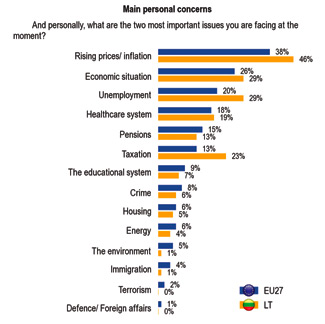

| Lithuania and India share opportunity |
LITHUANIA’S MINISTER of Foreign Affairs, Vygaudas Ušackas, together with Economy Minister Dainius Kreivys and a business delegation of 28 members arrived in Mumbai, India’s financial centre, recently led by Rajinder Kumar Chaudhary, Honorary Consul of India to Lithuania. The Ministers attended a business forum at the Confederation of Indian Industry. During the meeting, Minister Ušackas noted that the visit of almost 30 Lithuanian businessmen, the Minister of Economy and the Foreign Minister to India was the best proof of Lithuania’s interest to develop dynamic economic and political relations with India, the world’s largest democracy that has 1.1 billion people. Ušackas was glad about the first Indian investment projects in Lithuania and expressed hope that more investors from India would follow the example set by the polyethylene producer Orion Global Pet that is established in the Klaipėda Free Economic Zone. During the visit, Tadas Karosas, the head of Čili Holdings, signed a franchising agreement with head of the GIPL company Sandeep Grover. In accordance with this agreement, the Čili restaurant chain will expand into India. India’s pharmaceutical manufacturers took great interest in the distribution of medications on the Lithuanian market and the whole of the European Union market. This was discussed with representatives from the Lithuanian company Eluva. Lithuanian businessmen also visited a renewable energy factory of solar cells and discussed cooperation possibilities with its administration. The head of India’s diplomatic division welcomed the interest from Lithuanian businessmen in trade and investment possibilities that India offered. Ministers S.M.Krishna and V.Ušackas agreed to develop a dynamic partnership. In 2008, Lithuania-India trade amounted to €293 million. Fertilizers constitute a significant part of Lithuania’s exports. The Indian-Baltic Chamber of Commerce in Delhi is headed by Asta Kuckaitė. Anyone interested in the business possibilities in India, Asta can be contacted at ak@ibcc.lt On 4 December, Minister Ušackas also met with India’s Minister for New and Renewable Energy Farooq Abdullah and Minister of Commerce and Industry Anand Sharma.A Lithuanian Consulate, headed by Om Prakash Lohia was also opened in Mumbai. |
| Lithuanian Foreign Trade |
Statistics Lithuania reports that, based on non-final data obtained from customs declarations and Intrastat reporting data, exports in January–October 2009 amounted to LTL33 billion, while imports – LTL37.2 billion. The foreign trade deficit of Lithuania amounted to LTL4.2 billion, and was by 72.7% lower than in the same period in 2008. Data on trade with EU countries was adjusted after VAT returns’ data had been received. In January–October 2009, against January–October 2008, exports and imports decreased by 31 and 41.1%, mineral products excluded – by 27.2 and 41.2% respectively. Exports of goods of Lithuanian origin decreased by 31.9%, mineral products excluded – by 26.2%. An impact on the decline in exports was made by the decrease in exports of petroleum oils and oils obtained from bituminous minerals (by 42.2%), fertilizers (by 52.2%), vehicles other than railway or tramway rolling stock (by 44%), electrical machinery and equipment (by 42.2%). Imports declined due to decreased imports of crude petroleum (by 40.7%), vehicles other than railway or tramway rolling stock (by 70.3%), boilers, machinery and mechanical appliances (by 45.3%). In October 2009, against September, exports and imports increased by 1.3 and 0.7% respectively, mineral products excluded – by 6.1 and 1.3% respectively. Exports of goods of Lithuanian origin decreased by 1.9%; mineral products excluded, exports of goods of Lithuanian origin increased by 4.6%. In January–October 2009, the most important partners in exports were Russia (13%), Latvia (10.3%), Germany (9.5%), Poland (7.2%), in imports – Russia (30.6%), Germany (11.1%), Poland (10%) and Latvia (6.3%). In January–October 2009, the largest share in exports fell within mineral products (21.6%), machinery and mechanical appliances, electrical equipment (9.8%), products of the chemical or allied industries (9.3%), in imports – mineral products (29.7%), machinery and mechanical appliances, electrical equipment (12.6%), products of the chemical or allied industries (12.4%). |
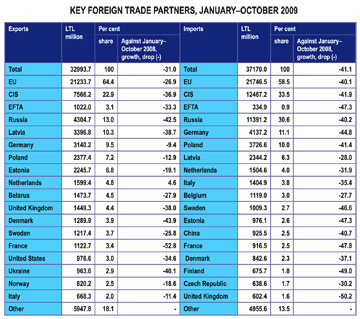
| Unemployment in Lithuania |
Statistics Lithuania informs that, according to the Labour Force Survey data, the number of unemployed in III quarter 2009 was 228,100, just 5000 more than in II quarter 2009, and that the growth in the unemployment had slowed. In III quarter 2009, the unemployment rate stood at 13.8%, which is 0.2% higher than in II quarter 2009. Over the year (III quarter 2009 against III quarter 2008), the unemployment rate grew 2.3 times. The most rapid growth has been in the youth (aged 15–24) unemployment rate. In III quarter 2009, 53,000 young people, or one in ten, were unemployed (a year ago it was 26,000). Although the number of young unemployed persons a year ago, as compared with III quarter 2009, was twice as low, the number of young unemployed persons with higher education qualifications remained almost unchanged (7400 and 7800 respectively). The male unemployment rate has been growing faster than the female rate. The male unemployment rate grew from 6% in III quarter 2008 to 17.3% in III quarter 2009, while the female – from 5.9% to 10.3%. In II quarter 2009, the male unemployment rate stood at 16.7%, the female one at 10.4%. A higher male unemployment rate was conditioned by a rapid decrease in the amount of work in industrial and construction enterprises. In III quarter 2009, there were 1,424,000 persons aged 15 and over working in the country; as compared with II quarter 2009, this figure remained almost unchanged (growing by 1900, or 0.1%), while over a year it dropped by 113,400, or 7.4%. Over III quarter 2009, the number of persons working in agriculture, forestry and fishing grew by 7100, trade – by 9000, professional, scientific and technical activities – by 6700. The number of persons working in other economic activities remained almost unchanged. The most marked decrease over the year was in the number of persons working in construction – from 167,000 to 117,000 (down 30%), accommodation and food service activities – from 43,000 to 36,000 (16%), manufacturing – from 262,000 to 223,000 (15%). In III quarter 2009, an increase was observed in the number of employees working not under an employment contract (fixed or non-term), but under a verbal agreement. According to the estimates of Statistics Lithuania, in III quarter 2009, the number of such workers was 27,000, which is 11,000 more than in II quarter 2009. The largest share of such workers was recorded in manufacturing and agriculture (8,000 in each), as well as in construction, trade and other sectors. In III quarter 2009, the employment rate stood at 60.4%; over the quarter, it grew by 0.1%, while a year ago it was higher by 4.6%. In III quarter 2009, the male employment rate stood at 59.6%, the female at 61.2%. Over a year, the male employment rate dropped by 7.9%, the female by 1.5% percentage points. Unemployment In The Baltic States According to the data of NSIs of the Baltic States, in III quarter 2009, the lowest unemployment rate was recorded in Lithuania (13.8%), the highest – in Latvia (18.4%); in Estonia, it stood at 14.6%. Over the quarter, the unemployment rate in Lithuania remained almost unchanged, while in Latvia and Estonia it grew by 1.7% and 1.1%. |
| DnB NORD Deliver |
In a well-attended seminar held at Reval Hotel recently, over 200 Vilnius business leaders gathered to hear the prognosis of DnB NORD on the research and forecasts for the Baltic rim countries. With presentations from Prof Rimantas Rudzkis, Chief Analyst, and Jekaterina Rojaka, Chief Economist, followed by a frank and open question and answer session, the DnB NORD specialists addressed the most pressing economic issues confronting Lithuania and its neighbours over the coming few years. Essentially DnB NORD’s Economic Research Group predicts that out of the six Baltic Rim countries, moderate economic growth will be seen in Poland, Finland and, possibly Estonia in 2010, while Denmark, Lithuania and Latvia will need more time to fully climb out of recession. Looking at each country individually: • Denmark: the expansive budget policy will help mitigate the negative effects of the crisis, however a high level of indebtedness among businesses and households in the country will cause one of the longest recessions in the European Union (EU). • Finland: the country faces one of the deepest recessions among the old EU members due to the sensitivity of its exports to the global economic crisis. Finland’s recovery will be gradual, and rather sluggish in 2010, impeded by a high unemployment rate. • Estonia: decisive action in an effort to adopt the euro in 2011 and a clear recession exit strategy will enable the country to take the leading position in the Baltic trio and outrival the other Baltic States in the competition for foreign direct investments. • Lithuania: political disagreements and floundering reforms in the public sector are undermining hopes of rapid economic recovery. The country will not be able to avoid a protracted depression without a targeted investment, small business stimulus package and restructuring of the public sector. The incumbent government has asserted its commitment to launch the necessary reforms next year, but it still lacks political support to do so. • Latvia: lack of political will and rapidly rising sovereign debt may result in the erosion of the public sector, loss of competitiveness and the country’s investment appeal. However, immediate structural reforms of public sector and further improvement of the business environment would help the country move forward. • Poland: the modest level of liabilities amongst both businesses and households, a large domestic market and flexible exchange rate helped the country resist the worst effects of the global economic crisis, and will help insulate Poland from economic problems in the immediate future. They could soon rival Estonia in terms of the average purchasing power. Nevertheless, growing debt of the government sector is a source of concern in the long-term. You can download the full edition of Baltic Rim Economies:Growth and Constrains 2010 from DnB NORD Bankas’ website: www.dnbnord.lt/publications |
| Lithuanian Tourism down 21.8% |
According to provisional data provided by Statistics Lithuania, in the first nine-month period of 2009, accommodation establishments had 21.8% less guests than in the same period of 2008. Over January–September 2009, accommodation establishments (hotels, guesthouses, motels, health resorts, etc.) had 1.16 million guests, of whom 53.6% were foreigners. Hotels and guesthouses accommodated 847,900, other establishments – 75,100, health resorts – 79,900 guests. Against the same period 2008, the number of guests in Druskininkai decreased by 13.9%, in Birtonas -10.3%, in Neringa -36.8%, in Palanga - 19.8%. Over the nine-month period of 2009 against the previous year, hotels and guesthouses accommodated 20.7% less guests; the number of foreigners fell 17.2%. The number of guests from EU countries decreased by 20%. Less guests arrived from the neighbouring countries such as Latvia (26.8%), Estonia (24.4%), Poland (16.2%), Russia (6.2%), as well as from Western Europe – Ireland (42.7%), United Kingdom (38.9%), Norway (31.1%), Italy (26.6%), Finland (24.9%), Denmark (21.6%), Sweden (13.6%), Germany (16.1%). The number of guests from Belarus increased by 23%, Czech Republic – 11.4%, Iceland – 1.3%. The majority of guests were from Poland – 94,900 (previous year 113,300), Germany – 87,400 (previously 104,300), Russia 52,400 (previously 55,900), Latvia – 43,300 (previously 59,100), Belarus – 21,300 (previously 17,400). The nine-month occupancy rate of hotel and guesthouse rooms was 36.2% (previously 47.9%). Over the nine-month period of 2009, Vilnius hotels and guesthouses accommodated 390,500 thousand guests, or 20.1% less than in the same period 2008. The number of foreigners was 325,900 or 18%. The nine-month occupancy rate of Vilnius hotel and guesthouse rooms was 46.5% (previously 58.2%). |
| Revised III quarter GDP estimate |
Statistics Lithuania, based on the latest available information for September and more comprehensive business and price statistics, has estimated GDP components for III quarter 2009 by production, expenditure and income approaches and revised the first GDP estimate. According to the revised data, in III quarter 2009, GDP current prices amounted to LTL23,954 million and, against the respective period in 2008, dropped by 14.2%, while against II quarter 2009 it grew by 13.1% (the changes have been estimated using a chain-linked volumes). (The previously published first GDP estimate for III quarter 2009 was LTL23,713 million and, against July–September 2008, dropped by 14.3%, while against the previous period in 2009 it grew by 13%). Over the nine months of 2009, GDP amounted to LTL68.71 billion, which is by 15.7% less than a year ago. In III quarter 2009, based on provisional data, negative results were observed for almost all business activities and non-market services. The largest drop in the value added was observed in construction (45%), industry and energy (15.1%), trade, transport and communication (15.7%) and financial intermediation, real estate and other business (12.4%). A slower decrease in the value added was observed in public administration and defence, education, health care and social work activities (1.2%). A growth in the value added was recorded only for agricultural enterprises (4.9%). Consumption expenditure in July–September 2009, against the respective period in 2008, decreased even more than in the first half of the year. Over III quarter 2009, household final consumption expenditure dropped by 19%, those of non-profit institutions – by 16%. General government final consumption expenditure was decreasing at a slower rate (by 1.5%). A further rapid decrease was observed in expenditure on capital formation: gross fixed capital formation against the previous year declined by 41.4%. Nevertheless, as compared with II quarter 2009, certain minor positive changes have been observed. A considerable reduction in consumer demand and the volume of production conditioned a decrease in both exports and imports of goods and services in III quarter 2009, against the same period in 2008, (by 17.4 and 31.3% respectively). As compared with the previous quarter of 2009, exports grew by 11.8, imports – by 3.3% |
| 39% of GDP was generated in Vilnius county |
Gross domestic product by county in 2008 Statistics Lithuania informs that, based on provisional data, gross domestic product (GDP) per capita in 2008 grew in all counties. The most considerable growth in nominal GDP per capita in 2008 was observed in Utena (by 19.2%) and Marijampolė (by 17.1%) counties, while nominal GDP per capita in the country grew by 13.4%. Just as in the previous year, in terms of GDP per capita as compared with the national average, Vilnius (154.3%) and Klaipėda (100.1%) counties were in the lead. However, nominal GDP per capita in Vilnius county grew by just 11.5, in Klaipėda county – by 10.7%, i.e. these counties demonstrated the slowest growth in nominal GDP per capita as compared to other counties. In five counties (those of Alytus, Marijampolė, Panevėžys, Šiauliai and Tauragė), GDP per capita is still below 80% of the national average (in 2007, there were six such counties). In Utena county, the indicator in question in 2008 exceeded the 80% threshold (with 82% of the national average). In 2008, the gap between Vilnius and other regions did not narrow: GDP per capita in Vilnius county exceeded the indicators of Alytus, Marijampolė, Panevėžys, Šiauliai and Tauragė counties two and more times.
|
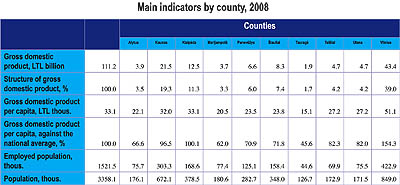
| Lithuanians Continue to Seek Greener Pastures |
According to Statistics Lithuania the number of Lithuanian citizens who emigrated from their homeland in the first 10 months of this year is 18,255. The number for the full year of 2008 was 17,015, so this year’s figure is already over 1000 more than all of last year, and further, according to records kept since Lithuania regained its independence, it is the highest number of people ever to offically leave in the one calendar year. Including undeclared migration last year, the number of people leaving Lithuania was 23,700, travelling mostly to Ireland, UK, Spain and the USA. In total, the number of people who have left Lithuania since independence now numbers more than half a million. |
| Business News |
Seimas Approves Cut in Corporation Tax for Small Businesses Vilnius, Nov 24 (ELTA) - Surprisingly, the Seimas approved the amendments proposed by MP Dainius Budrys to reduce income tax for small companies to 5%. The initial government proposal was to reduce income tax from 13 to 7.5%. The reduction of income tax to 5% will apply to those companies that employ up to 10 people, and whose fiscal year income does not exceed LTL500,000 (€145,089 euros). It is further proposed to reduce income tax from 20 to 15% for larger companies Vilnius among ten least expensive cities Stockholm, Dec 2 (ELTA) - The experts of the British company PriceRunner which compares the prices of goods and services this autumn have named Oslo, the capital of Norway, the most expensive city worldwide. Lithuania’s capital Vilnius entered the top ten of the least expensive world cities. The analysts announced their conclusions after comparing prices of the products under 26 different names, including milk, cigarettes, books, computers, BigMac hamburgers, in 33 world cities. “Prices in the capital of Norway are higher by 35 percent than the average of prices in other countries,” states PriceRunner. PriceRunner has ranked Oslo the most expensive city in the world for the third year in a row. Price Runner carried out the study on 17-21 October 2009. First signs of export growth - President Vilnius, Nov 24 (ELTA) - On Tuesday President Dalia Grybauskaitė congratulated businessmen at ‘Export Prizes 2009’ and emphasized that the continued efforts of people and businesses, patient work and ability to be flexible had already provided good results, as the first signs of growth of exports were observed. However, the head of state noted that she saw more possibilities of strengthening dialogue between the authorities and business. “I am glad to see the results of your successful activities in foreign markets. Exports are the basis of growth of our small open economy. By exporting products to foreign markets, you firstly export Lithuanian diligence, knowledge, and values of the nation. You are the business card of our country,” the president noted. Grybauskaitė also expressed her joy over the fact that there were women among business leaders. Their contribution to sustainable development of business was very important and noted by a number of organizations and experts worldwide. The president said that exports and its structure was a mirror of the country’s economic policies. The implementation of structural reforms and better business environment as well as the initiatives of business people should give favorable results. Grybauskaitė noted seeing more possibilities of strengthening the dialogue between authorities that had not been used. “It would be useful to consolidate your winnings in both domestic and foreign markets,” she said. European labour markets deeply hit by crisis, but more resilient than expected The current crisis is taking its toll on EU labour markets, reversing most of the employment growth achieved since 2000, according to the 2009 Employment in Europe Report published on 23 November 2009. Men, young people, the low-skilled and workers on temporary contracts have borne the brunt of the employment contraction. Employment in the EU has shrunk by over 4 million jobs since the start of the crisis, although the effect has been somewhat mitigated thanks to the use of shorter working hours and other schemes. But these short term measures, however important, are not in themselves sufficient to ensure a successful exit from the crisis. Employment policies must focus on preparing for the transition to a low-carbon economy. With this challenge in mind, the 21st annual edition of the Employment in Europe report takes a deeper look at two key issues for future EU labour market policy: movements to, from and between jobs and the implications of climate change for the job market. EU labour markets are more dynamic than often believed, but long-term unemployment remains a serious threat European labour markets have shown considerable dynamism in recent years, as every year, around 22% of European workers change jobs. Such dynamism is not just limited to countries usually seen as ‘flexible’, such as the UK or Denmark, but concerns all EU countries, although the figures range from 14% of workers in Greece and 16% in Sweden to over 25% in the UK, Finland, Spain and Denmark. This appears to be part of a more sustained rise, since the late 1990s, in transitions from inactivity and unemployment towards employment in the EU, suggesting a fundamental structural improvement in our labour markets. However, not all workers have benefited equally from this positive trend. Although the number of long-term unemployed has declined since the 1990s, this problem remains a serious challenge. In recent years, close to 45% of all unemployment spells lasted longer than a year in the EU, compared with only about 10% in the US. Tackling this issue has become even more urgent since the start of the crisis. Policies aimed at supporting workers’ transitions toward employment in line with the principles of flexicurity are key to lowering long-term unemployment and preserving employability. Lithuanian real estate prices down 35% over year Vilnius, Nov 25 (ELTA) - Over the past year, the prices of the country’s entire real estate, including land, buildings and their premises, went down almost LTL144 billion (€41.71 billion) or 35%. These are the first estimates of real estate mass valuation carried out by the Centre of Registers. The depreciation of the country’s assets was mostly determined by a drop of LTL58 billion (€16.8 billion) or 42% in the prices of land, and a decrease of almost LTL56 billion (€16.22 billion ) or 45% in the prices of units. Real estate in Lithuania presently totals around LTL268 billion (€77.634 billion). Reval Hotels promotes Juha Mähönen Reval Hotels, has appointed its Country Manager for Lithuania, Mr Juha Mähönen, in the position of Regional Director, Estonia & St. Petersburg. In this newly created position Mr Mähönen also takes responsibility as General Manager of Reval Hotel Group AS chain’s subsidiary based in Tallinn, Estonia, where they have three hotels, and the newly opened Reval Hotel Sonya in St Petersburg, Russia, will also report to him. Mr Mähönen will start in the new position on 18 January 2010. |
| “New” Ideas from Forgotten Economists |
The Opportunity of Cutting Edge sectors in the Lithuanian Economy During Times of Crisis
The ideas of 20th century economist and sociologist Joseph Schumpeter can be drawn upon in the case of Lithuanian to emphasize the importance of innovation on one hand, and the danger of stagnation on the other. Innovation can be a means by which to rise in the global economic hierarchy, while stagnation - a means to fall. Schumpeter suggested that innovation and entrepreneurship act as a sort of engine for economies to expand. National institutions such as the government and economy must create favorable conditions for the entrepreneur to be able to bring new commodities to the market. In such countries as Lithuania, still undergoing a post-Soviet transition, opportunities abound for new business ideas. Schumpeter popularized the term “creative destruction,” by which he meant that innovation by entrepreneurs has the ability to radically change stagnant industries or an entire economy. A current example is the inability of large American automobile industries to rapidly change products under today’s market conditions. The American auto industry is faced with short and long term dilemmas. In the short term, it has taken such measures as reducing costs by asking employees to take extended vacations. But in the long run, will it be able to adapt as quickly as new, smaller, and more innovative companies? The possibility that such massive industries, such as General Motors, which employs some 320,000 workers falling into bankruptcy is a very real concern, while little known start ups such as Tesla Motors offer compelling (and far more efficient) alternatives to buyers. Lithuania has certain real advantages compared to larger economies in terms of innovation. First, Lithuania’s industries are still in a relatively nascent stage. Twenty years after the collapse of the Soviet Union, its industries are specializing and adapting to a global marketplace faster than the industries of such “old Europe” countries as Germany. This is a case of the so-called “second place advantage”, where a newly opened economy can learn from the mistakes and consequently “out-innovate” them, since they have no new infrastructure to need to replace. One sector that Lithuania is specializing in quite successfully is biotechnology, where it is a regional leader. According to the Lithuanian Biotechnology Association, the biotech sector in Lithuania has been growing by about 22% yearly for the past five years. Two such companies, Fermentas and Sicor Biotech were sold in 2007 for more than €28 million (Innovations Report 2008). Another positive development of the biotechnology industry in Lithuania is related to immigration and the “brain drain” phenomenon. Seventeen advanced Lithuanian experts who had previously emigrated have decided to return to the Vilnius Institute of Biotechnology. Dr Daumantas Matulis from the Institute of Biotechnology has stated that: “The growing importance of life sciences and biotechnology in Lithuania is being recognized with ScanBalt Forum 2008 to take place in Vilnius. This is a chance to promote Lithuania as an attractive place to work, live and invest. We intend to further strengthen our position as a strong player within life sciences and biotechnology in the Baltic Sea Region” (Innovations Report 2008). The aforementioned example of car industries can be related to the economy of Lithuania. Such old Europe economies as Germany are juggernauts, compared to the nimble Lithuania. The country has a very highly educated population and competitive universities that produce bright graduates. Thus, all things equal, per capita, Lithuania needs fewer innovators to make potentially large changes in its much smaller economy, which unlike EU-15 countries, is still in a condition of flux. Another advantage for Lithuania in terms of innovation is the attractiveness in the previous regard to foreign direct investment. Although Lithuania may lack the capital of “old Europe,” it has a skilled and educated workforce, and low labor costs. This makes it an attractive place for foreign firms that want to also out-innovate the competition. Why build a factory in the traditionally more expensive EU-15, than in the less expensive business climate of such new member countries as Lithuania? The current economic crisis can in a sense be seen in a positive light for little Lithuania. While the economy is under stress, Lithuanian firms can continue to innovate. However, when the global economy does improve - which with time it will - it will take a far smaller “push” to restore Lithuania’s economy to a strong position, compared to much larger EU-15 countries. The IMF’s Robert Zoellick stated on 22 March 2009 that, weighed down by large, sluggish economies, the global economic recovery is expected in 2010, at which point major economies will break even. However, developing nation economies are expected to expand by up to 4.5% (World Bank 2008). Regionally, the European Commission states that biotechnology will be a very important part of Europe’s economy in the coming decades. Ernst and Young find that the Lithuanian biotechnology market is one of the largest in the region, with 99% of biotechnology products exported to 86 countries. In 2006, the biotechnology industry had sales in excess of €90 million. Among former Communist countries, Lithuania follows only Hungary in sales volume. The Lithuanian government would be wise to consider investing in up and coming sectors, and thus far seems to be doing so. For example, it has increased biotechnology research funding during the last five years (Innovations Report 2008). |
| Main Socio-Economic Indicators of Lithuania |
|
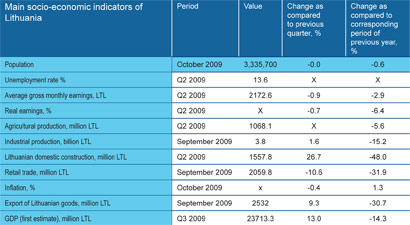
| Lithuania’s trade deficit LTL3.7 billion |
Statistics Lithuania reports that, based on non-final data obtained from customs declarations and Intrastat reporting data, exports in January–September 2009 amounted to LTL29.2 billion, and imports – LTL33 billion. The foreign trade deficit of Lithuania was LTL3.7 billion, 73.5% lower than in the same period last year. |
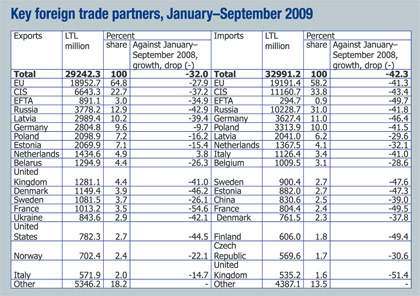
| Consumer Goods and Services Down 0.4% in September |
Statistics Lithuania announced that in October 2009, against September, prices for consumer goods and services went down by 0.4%. |

| Construction down 48% |
Based on provisional data provided by Statistics Lithuania, in Q3 2009, construction carried out on domestic work amounted to LTL1663 million at current prices, which is by 48% less than in II quarter 2008. The value of construction work carried out within Lithuania was LTL1621 million (97%), and outside Lithuania LTL42 million (3%). Highest rise in part-time workers in Estonia, Ireland and Lithuania |
| Lithuania has Highest EU GDP Growth |
GDP increased by 0.4% in the euro area (EA16) and by 0.2% in the EU27 during the third quarter of 2009, compared with the previous quarter, according to flash estimates published by Eurostat. In the second quarter of 2009, growth rates were -0.2% in the euro area and -0.3% in the EU27. |
| Seimas set to increase VAT to 21% |
Vilnius, July 21 (ELTA) - On Tuesday the Seimas approved the amendments to the value added tax raising the VAT tariff from 19% to 21%. Sixty-five MPs voted for, 40 parliamentarians against and 22 MPs abstained. |
| We should look for solutions ourselves and not expect help from banks - Kubilius |
Vilnius, July 16 (ELTA) - The Government is not satisfied with the incumbent banks’ activities and the fact that the loan bag has been closed, however, it does not have any influence instruments to change this situation. Acting Prime Minister Andrius Kubilius stated this at the Thursday Government hour at the Seimas. “The only thing which we can do is to strengthen trust in the Government’s activities on the international markets. If borrowing becomes cheaper on international markets, it will become cheaper in the country too,” Kubilius said. According to the acting prime minister, the Government is actively speaking with banks and trying to make pressure for borrowing to become cheaper, however, it cannot make any real influence. “We are talking, expressing our remarks. We do not hold big instruments, however, we see the situation and attract the attention of the governments of those countries where the banks are operating to it. I believe that by autumn we will have the result of these discussions and new proposals,” the acting prime minister explained. According to him, first of all the authority itself should seek solutions and not press banks. “That is why we are coming to you with reduced budget for the third time, because nobody will propose another variant,” Kubilius told MPs. |
| GDP to shrink less in H2 - Bank of Lithuania |
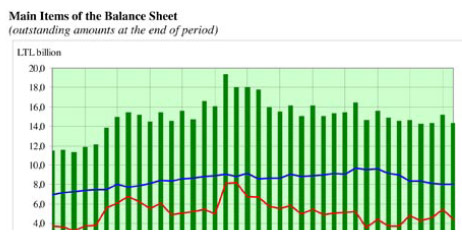 |
Vilnius, Aug 6 (ELTA) - The first gross domestic product estimate of the second quarter, announced by the Department of Statistics, revealed a very abrupt 22.4% drop in GDP. According to this data, the economic contraction did not slacken in the second quarter. However, this allows preempts substantially softer quarterly changes in the second half of 2009. The economic downturn in Lithuania, associated with intense changes in external and domestic demand, strengthened the uncertainty of economic development prospects substantially. Compared to the projections of May, changes in the real sector are expected to be more sizeable. However, taking into account the intense GDP drop in the first half of 2009, a considerable deceleration of the downturn is expected for the second half of the year, with GDP this year shrinking by 19.3%. The stabilisation scenario is supported by boosted sentiment in global markets. A recent rise in the stock and commodity markets, better than expected US GDP indicators for the second quarter, positive news in manufacturing and real estate market show stronger signs of a start to global recovery. Higher external demand would activate the Lithuanian tradable sector and be a significant factor of an overall economic recovery. The projected further 5.2% fall of Lithuania’s GDP in the next year is associated with worse domestic demand trends due to still declining wages and an increased unemployment rate. An alternative scenario envisaging a slower economic activity stabilisation compared to that in the baseline scenario should not be rejected. Key risk factors that may entail worse projections are persisting uncertainty in terms of a further economic development of foreign countries, a more profound decrease in private consumption and investments, and a higher unemployment rate. According to this scenario, GDP might shrink up to 2 percentage points more. If the assumption of a robust external demand recovery does not fulfill, a stronger downturn than that envisaged in the baseline scenario is possible. At the beginning of the year, given strong uncertainty of economic development prospects, investments into the means of production experienced a particularly intensive drop. A protracted recovery in global markets would contribute to a further decrease of these investments. Investments are also limited by unfavorable borrowing conditions, while a fallen share of profitable enterprises demonstrates fewer opportunities for enterprises to finance investments by their own funds. A less favorable development of the global economy would in turn entail a subsequent recovery in international financial markets and would allow planning of a stronger than currently projected curtailment in the flow of the loans to enterprises in Lithuania. A deeper contraction in domestic and external demand would also change the assessment of the foreign trade development. Imports and exports this year would drop more than envisaged in the baseline scenario. Next year changes of these indicators will be softer - the growth of exports would be encouraged by a subsequent start of the recovery of Lithuania’s trade partners, while the downturn of imports would be eased by an increasing imports of natural gas or electricity after the closure of the Ignalina Nuclear Power Plant. |
| Consumer sentiment up in June |
Vilnius, June 29 (ELTA) - In June, consumer sentiment improved compared to May and stood at minus 42, an increase of 6 points. |